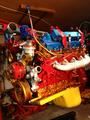
Engine removal pics

Tuned

Joined: Feb 2010
Posts: 280
Likes: 0
From: Castalian Springs tn
You already have one stand just need one more. Make motor mounts out of pipe and flat steel and you are in good shape. Sooner or later the motor would have come apart mostly sooner and it wouldn't have been pretty.

Lead Driver


Joined: Mar 2010
Posts: 5,505
Likes: 257
From: Woodbridge, Ontario, CA

It is ALWAYS a good practice to keep all the main parts organized in a manner in which you know where every part goes. I know that on the thousands of head gasket replacements I've done on these engines the last couple of years, I always re-install all valvetrain components back to their original locations. All the fasteners on the other hand, I just set them into a pile. After having numerous of these apart, I pretty much know where every fastener goes.

Logistics Pro
Joined: Mar 2007
Posts: 4,604
Likes: 4
From: Claremore, OK
I don't have a crossover number for the other part.
Lead Driver
Joined: Mar 2010
Posts: 5,505
Likes: 257
From: Woodbridge, Ontario, CA
Anthony, have you pulled your turbo apart? How is the condition of the y-pipe? How about the condition of all the rest of the other parts? Another suggestion about storing parts would be to go to town on buying various Rubbermaid containers. For example, take your eight injectors and leave it impregnated in a suitably sized container of new and clean engine oil. Ditto for new valve lifters. Just some suggestions. How about both the FICM and main engine harnesses? With THAT amount of mileage, and I can't imagine how hardened and brittle they must be by now.
Thread Starter
|
Postmaster
Joined: Jan 2008
Posts: 3,174
Likes: 10
From: Kansas City MO
I was worried about the y pipe. I will check the joints for leaks. I used ziplock bags. The totes would b nice. My inj are not submerged, but are soaked with new oil and sealed up. I'm planning on replacing the pistons, lifters, and the valve train. Not sure about what's gonna happen with the heads. I wrapped both wiring harnesses with reg electrical tape (15 rolls). They seem to be in good condition.
The new lifters should b soaking? Didn't think about that. I'm gonna have to reread your last 2 posts, I like getting tips like that.
The new lifters should b soaking? Didn't think about that. I'm gonna have to reread your last 2 posts, I like getting tips like that.
Thread Starter
|
Postmaster
Joined: Jan 2008
Posts: 3,174
Likes: 10
From: Kansas City MO
It is ALWAYS a good practice to keep all the main parts organized in a manner in which you know where every part goes. I know that on the thousands of head gasket replacements I've done on these engines the last couple of years, I always re-install all valvetrain components back to their original locations. All the fasteners on the other hand, I just set them into a pile. After having numerous of these apart, I pretty much know where every fastener goes.
FTE Stories
Ford Trucks for Ford Truck Enthusiasts

Top 10 Fords at 2026 Carlisle Ford Nationals
Joe Kucinski
3 Best / 3 Worst Parts of Modern Ford Ownership
Brett Foote
10 Amazing Upgrades That Solve Common Ford Truck Owner Headaches
Pouria Savadkouei
Every 2026 Ford Engine Explained
Brett Foote
10 Ugly Ford Trucks That We Still Kinda Love
Joe Kucinski
10 Things Every Truck Owner NEEDS (2026 Edition)
Michael S. Palmer
Rezvani's Latest Post-Apocalyptic Monster Is a Ford F-150 Raptor Underneath
Verdad Gallardo
Top 10 Most Expensive Ford Trucks Ever Sold on Bring a Trailer
Joe Kucinski
2027 Ford Super Duty Buyer's Guide (Every Model, Engine, & Package)
Brett Foote
Lead Driver
Joined: Mar 2010
Posts: 5,505
Likes: 257
From: Woodbridge, Ontario, CA
Yes, there is one tool (that I have sitting under my bench collecting dust as present) that aligns the cam and crank gears into time. But looking through the book procedure, tells me all it does is ensure the two dowels are both positively aligned which looks pretty straightforward if you ask me. But yeah, this is one VERY crucial step that I wouldn't want to mess up, so it would likely be a very good idea to have that tool handy when you need it.

Elder User
Joined: Apr 2012
Posts: 904
Likes: 1

at least as far as parts that are getting new bushings.
most of my rebuild info is with gas engines, but general
mechanical procedures and good practices carry over to
most things.....
switching main bearing caps on a gas motor is the kiss of death,
unless you are line boring the mains... that is just a for instance.
same with rod caps, etc.
crotchety old machinists tend to be very conservative about stuff.
i'd mark rods with where they came from, orientation, keep the
caps paired correctly, etc.... and i'd do that pretty much on everything
i took apart.
FWIW, i pulled apart a 4 stroke bike engine that had lube failure
at 7,000 rpm... i took it apart with a dead blow hammer, and
a body shop slide hammer, and it wasn't in as bad a shape as
the lifter video.....
i'd suggest with your luck you buy a lottery ticket, but it'd be a waste
of money....
who wins the lottery twice?
you are very fortunate.
Elder User
Joined: Apr 2012
Posts: 904
Likes: 1
Yes, there is one tool (that I have sitting under my bench collecting dust as present) that aligns the cam and crank gears into time. But looking through the book procedure, tells me all it does is ensure the two dowels are both positively aligned which looks pretty straightforward if you ask me. But yeah, this is one VERY crucial step that I wouldn't want to mess up, so it would likely be a very good idea to have that tool handy when you need it.
using a digital level... a good one will resolve to a tenth of a degree,
and i ended up putting dowel pins in the four press rollers, then laying
the level across them, and zeroing them relative to each other.... and
if you get them out of time, the photos on the sunday edition have one
color shifted different than the other three, or you can lock the press up
at speed, and destroy the frame, which is a seven figure repair.
anyway, if you have dowel pins you can index off of, you can time
shafts very well that way, in my experience.
Lead Driver
Joined: Mar 2010
Posts: 5,505
Likes: 257
From: Woodbridge, Ontario, CA
dunno if this would work, but i've timed 4 color printing presses
using a digital level... a good one will resolve to a tenth of a degree,
and i ended up putting dowel pins in the four press rollers, then laying
the level across them, and zeroing them relative to each other.... and
if you get them out of time, the photos on the sunday edition have one
color shifted different than the other three, or you can lock the press up
at speed, and destroy the frame, which is a seven figure repair.
anyway, if you have dowel pins you can index off of, you can time
shafts very well that way, in my experience.
using a digital level... a good one will resolve to a tenth of a degree,
and i ended up putting dowel pins in the four press rollers, then laying
the level across them, and zeroing them relative to each other.... and
if you get them out of time, the photos on the sunday edition have one
color shifted different than the other three, or you can lock the press up
at speed, and destroy the frame, which is a seven figure repair.
anyway, if you have dowel pins you can index off of, you can time
shafts very well that way, in my experience.