




Bye Bye Front Drums
Thread Starter
|
Lead Driver


Joined: Apr 2011
Posts: 6,399
Likes: 40
From: El Dorado, Arkansas
I started pulling the 28-spline axles and seals out of the 9-inch housing this morning.
There are various types of hammers designed to do very specific jobs. There's one type of hammer designed specifically for the removal of axle shafts, if the axle won't slide out by hand. That type of hammer is a slide hammer. --some people invert the brake drum and use it as a slide hammer. With the drum being drug across the wheel studs, that's a good way to flatten out the wheel stud threads. It's also a good way to permanently warp/distort the drum casting and, a ball-pein hammer will make flat spots along the edge of the wheel flange.
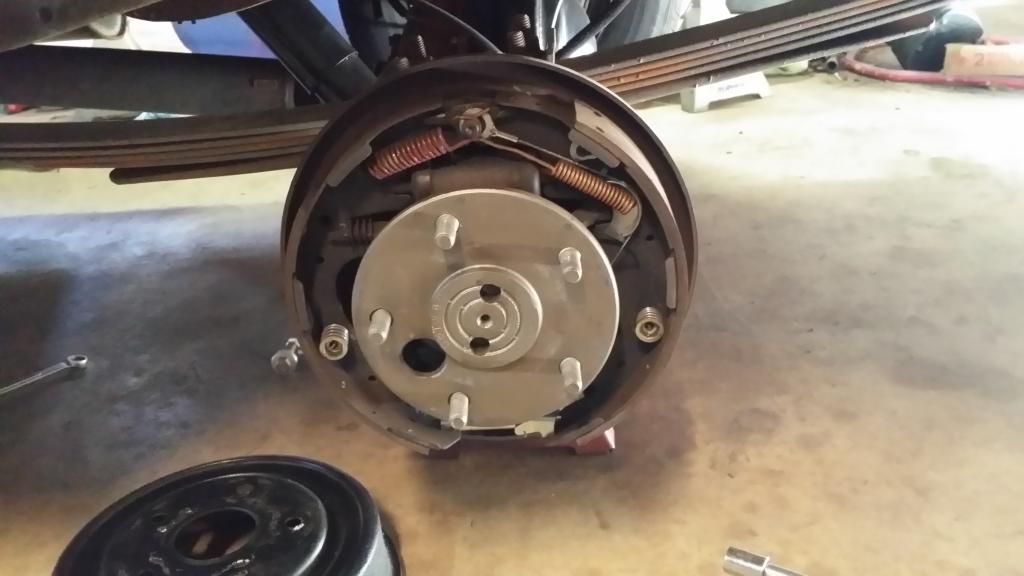


Axle seal ready to come out.

A change of attachments on the slide hammer and the axle seal can be pulled from the housing.

Axle seal popped out of the bore on the end of the axle tube.

Time to install the new axle seal with a larger I.D. to fit the larger O.D. of the journal on the 31-spline axle. I use my set of bearing race/seal drivers to install the axle seals. I also apply a thin layer of Permatex Ultra Black RTV around the out side of the seals metal shell, as added insurance against leaks, just prior to installing the seal. --the new axle seal for the 31-spline axle is a NAPA/SKF brand seal p/n 15960 (made in the USA).

New seal for the larger 31-spline axle installed.

....and a shop rag stuffed in the hole to keep dirt and dust out until the axle bearings get here and then the axles can be installed.

Comparison of skinnier 28-spline axle on the left compared to beefier 31-spline axle on the right.

That's one side down, one more to go then, time to swap out 3rd members.
There are various types of hammers designed to do very specific jobs. There's one type of hammer designed specifically for the removal of axle shafts, if the axle won't slide out by hand. That type of hammer is a slide hammer. --some people invert the brake drum and use it as a slide hammer. With the drum being drug across the wheel studs, that's a good way to flatten out the wheel stud threads. It's also a good way to permanently warp/distort the drum casting and, a ball-pein hammer will make flat spots along the edge of the wheel flange.


Axle seal ready to come out.

A change of attachments on the slide hammer and the axle seal can be pulled from the housing.

Axle seal popped out of the bore on the end of the axle tube.

Time to install the new axle seal with a larger I.D. to fit the larger O.D. of the journal on the 31-spline axle. I use my set of bearing race/seal drivers to install the axle seals. I also apply a thin layer of Permatex Ultra Black RTV around the out side of the seals metal shell, as added insurance against leaks, just prior to installing the seal. --the new axle seal for the 31-spline axle is a NAPA/SKF brand seal p/n 15960 (made in the USA).

New seal for the larger 31-spline axle installed.

....and a shop rag stuffed in the hole to keep dirt and dust out until the axle bearings get here and then the axles can be installed.

Comparison of skinnier 28-spline axle on the left compared to beefier 31-spline axle on the right.

That's one side down, one more to go then, time to swap out 3rd members.

Hotshot


Joined: Mar 2013
Posts: 14,255
Likes: 199
From: Phoenix, Az.
Before you go pressing the axle bearings on check those mount plates to fit your housing. Over the lifetime of the 9" (ers) there were quite a few mount plates and gaskets. Different inner hole,4 bolt pattern, and 3/8" or 1/2" bolt holes.
Hotshot
Joined: Mar 2013
Posts: 14,255
Likes: 199
From: Phoenix, Az.
3/8" copper washers were 373820-S. However parts store brake hose banjo bolt copper washers can be used.
Thread Starter
|
Lead Driver
Joined: Apr 2011
Posts: 6,399
Likes: 40
From: El Dorado, Arkansas

I tried to find a set of copper crush washers yesterday. O'Reilly's had some packs in the Help Section for caliper banjo bolts. It was like an 8 or 10 pack of washers but in pairs of varying sizes within the two packs they had. Not enough of the same size washers to do (10) studs and, I didn't want all different size O.D. and I.D. copper washers on the 3rd member.
The nuts are prevailing torque lock nuts. The only purpose of the copper washers is to crush down around the 3rd member-to-housing studs, when the nuts are torqued down, to help guard against gear oil leaks from around the studs. A little Permatex Ultra Black on the threads will accomplish the same thing, --if I can't find (10) copper washers of the same I.D. and O.D.
In reference to your question on my slide hammer; It's a 10-way set I bought through NAPA (NAPA label on it) back in 2003 or 2004 (p/n 3594). I THINK it's made by OTC (Owatonna Tool Company --the same people that make service department tools for Ford). It wasn't a cheap set --$331.00 best I remember but, I have used it a LOT and it's saved my butt plenty of times and been well worth the price tag. My set is more for mechanical use but, I'm sure you can get body working attachments for it.
My slide hammer and bearing race/seal driver sets.

Thread Starter
|
Lead Driver
Joined: Apr 2011
Posts: 6,399
Likes: 40
From: El Dorado, Arkansas

The 31-spline stamped steel axle retainers have the same configuration of (4) 1/2" holes and are on the same centers as the existing 28-spline stamped axle retainers. --They are both on the old style Ford large axle bearing housing flange pattern.
Thread Starter
|
Lead Driver
Joined: Apr 2011
Posts: 6,399
Likes: 40
From: El Dorado, Arkansas

FTE Stories
Ford Trucks for Ford Truck Enthusiasts

Top 6 Best Deals Available on New Fords & Lincolns Right Now
Brett Foote
This Hennessey Takes the Expedition Tremor's Off-Roading Capability to the Next Level
Verdad Gallardo
Top 10 Fords at 2026 Carlisle Ford Nationals
Joe Kucinski
3 Best / 3 Worst Parts of Modern Ford Ownership
Brett Foote
10 Amazing Upgrades That Solve Common Ford Truck Owner Headaches
Pouria Savadkouei
Every 2026 Ford Engine Explained
Brett Foote
10 Ugly Ford Trucks That We Still Kinda Love
Joe Kucinski
10 Things Every Truck Owner NEEDS (2026 Edition)
Michael S. Palmer
Rezvani's Latest Post-Apocalyptic Monster Is a Ford F-150 Raptor Underneath
Verdad Gallardo
Hotshot
Joined: Mar 2013
Posts: 14,255
Likes: 199
From: Phoenix, Az.
Oh, I know you're on top of your game Steve. Anybody can over look something. I just wanted to make sure before you go pressing the one time bearings and collars. I had your back.
Thread Starter
|
Lead Driver
Joined: Apr 2011
Posts: 6,399
Likes: 40
From: El Dorado, Arkansas
If you pressed a new set of axle bearings and the bearing retainer ring onto the axle, then, realized you forgot to install the stamped steel axle retainer FIRST and you had to press the bearing/bearing ring off to put the axle retainer on, you can go ahead and put that brand new bearing and bearing retainer ring right over in the trash can.
It doesn't matter if the bearing is brand new right out of the box, has never been used or, has zero hours of use on it. It's now cannon fodder.
The axle bearing and retaining ring are interference fit items. This means the act of pressing them onto the journal of the axle actually stretches the I.D. of the bearing and the ring. It will only be that tight once.
If the bearing/ring are removed and then re-installed on the axle, they will not have the same grip to the axle journal they did the first time because they were stretched the first time.
Putting a previously installed bearing on an axle runs a great risk of the bearing/ring losing its grip on the axle and the axle can come sliding out of the housing, while the vehicle is at speed.
--It's dangerous. Don't do it!
Also, axle bearings and retainer rings should not be pressed on together. Press the axle bearing on first, THEN, press the bearing retainer ring on.
Cargo Master
Joined: Nov 2005
Posts: 2,694
Likes: 45
From: La Ribera, Baja, Mexico
Oh how I love this site, good information, the truth, whole truth, and mostly, nothing but the truth.. so help me Henry. Great photos, good lighting, and helpful hints.. What else can a poor shade tree mechanic like me ask for??
Saludos amigos
Baja
Saludos amigos
Baja
Thread Starter
|
Lead Driver
Joined: Apr 2011
Posts: 6,399
Likes: 40
From: El Dorado, Arkansas
I started taking the C7AW single vertical rib 9-inch 3rd member loose so I can pull it out of the housing.
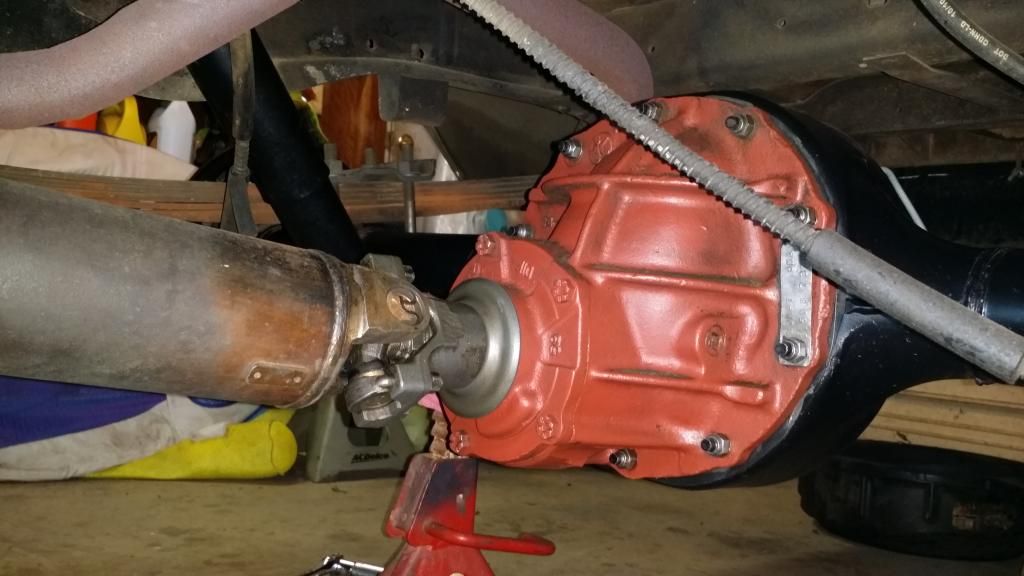
I broke it loose and the gear oil started coming out. It seems like it's been coming out of there for an hour now while I've been waiting.
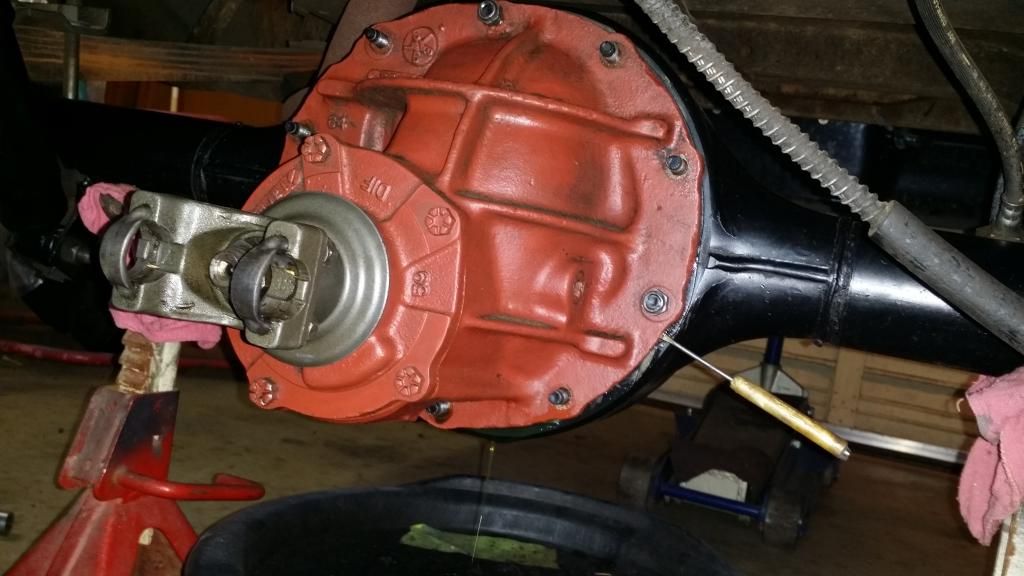
I was out here in the shop until 1:00 a.m. this morning cleaning up the N-case. I don't think I'm going to be that dedicated tonight waiting to pull this 3rd member. I'm just going to let it drip over night and attack it again in the morning.

I broke it loose and the gear oil started coming out. It seems like it's been coming out of there for an hour now while I've been waiting.

I was out here in the shop until 1:00 a.m. this morning cleaning up the N-case. I don't think I'm going to be that dedicated tonight waiting to pull this 3rd member. I'm just going to let it drip over night and attack it again in the morning.
Thread Starter
|
Lead Driver
Joined: Apr 2011
Posts: 6,399
Likes: 40
From: El Dorado, Arkansas
Way back when, I put an 8-inch rear end under it that had a Ford Equa-Lok 2-pinion differential and 3.00:1 gears.
Later on, I installed a '57 Ford station wagon 9-inch large axle bearing rear end under it.
Eventually, I replaced that with a '79 Lincoln Versailles 9-inch large axle bearing housing with factory rear disc brakes.
That got changed to an '80 model Mercury Monarch 9-inch small axle bearing drum brake rear end. I designed the adapter brackets to replace the rear drums and installed 11-5/8" ventilated '94-'04 SN95 Cobra rear disc rotors with Ford/Varga Cobra rear disc brake calipers.
This is what the '80 Monarch small axle bearing drum brake 9-inch rear end looked like, when I got it from the wrecking yard.

1980 Mercury Monarch 9-inch small axle bearing (formerly) drum brake rear end I converted to Cobra rear discs. --that's my OTHER factory (bare) N-case in the Monarch rear end housing. Not a Daytona version but, an N-case nonetheless.


Mock-up of the prototype adapter brackets, to check fitment of the Cobra rear disc brake components, on the remnant of a small bearing 9-inch axle tube from a '59 Fairlane.


