



Gas vs PSD

Postmaster
Joined: Apr 2008
Posts: 4,724
Likes: 4
From: Rogersville, TN
You will need tons of torque to the tire to move say a 20k lb load.
Lets not forget hp is just the torque*RPM/5252. So at low RPM's, when starting with a load, you need lots of torque to move that load. Torque twists the tires, HP makes it move faster.
Yes, with gearing you can put the engine at higher RPM's allowing it to create more HP and and allow the the gears transform that HP into torque at the tires, but once you are rolling and try to get more speed, you'll have problems.
Lets not forget hp is just the torque*RPM/5252. So at low RPM's, when starting with a load, you need lots of torque to move that load. Torque twists the tires, HP makes it move faster.
Yes, with gearing you can put the engine at higher RPM's allowing it to create more HP and and allow the the gears transform that HP into torque at the tires, but once you are rolling and try to get more speed, you'll have problems.
Let's also not forget that all a chassis(rear wheel) dyno does is take the 7,313 tq number from my 5.4 and factor in my gear ratio and wheel rpm to calculate how much hp it is making. Chassis dynos and rated hp do nothing but tell you how powerful your engine is, not how well it translates to the ground in a certain gear. 7,313 tq x 107 wheel rpm/5252=149 hp on the chassis dyno. If you run that on an engine dyno it would be 350 tq x 2500 engine rpm/5252= 166 hp. That 17 hp differential has nothing to do with the gearing, but is caused by friction loss in the moving parts between the crank and the wheels.
Not when you are able to turn almost twice the rpms and do it in a lower gear. Bill can run 70 mph with his v10 in 2nd gear while Kajtek is almost at the redline in OD at the same speed.
Senior User
Joined: Feb 2010
Posts: 236
Likes: 0
From: Whitewater, WI
Not really, even if you gear them. What if part of the job is to go down the highway at 75 mph? By the time you gear the rotary engine to move a load like that, you won't have enough RPM's left over to get it to that speed, even with a 9k redline. You will need tons of torque to the tire to move say a 20k lb load.
Lets not forget hp is just the torque*RPM/5252. So at low RPM's, when starting with a load, you need lots of torque to move that load. Torque twists the tires, HP makes it move faster. Yes, with gearing you can put the engine at higher RPM's allowing it to create more HP and and allow the the gears transform that HP into torque at the tires, but once you are rolling and try to get more speed, you'll have problems. hence the reason if that job involves moving down the highway, a torquesless engine will suffer from that extreme gearing it has on it. Unless of course you have a 5 million gear tranny and don't mind shifting through 50,000 gears for every mph. (On a side note my cousin just bought a tractor with 30 forward gears that tops out at 26 mph ) But having such a tranny is not practical, so taking this into a practical since, the torque is required to make the truck pull the load and maintain a practical gearing/tranny while towing large loads at start up and while at highway speeds, which covers probably 99% of the "jobs" you mentioned earlier.
True, this is a V10 versus PSD thread, but in truth that is what I'm comparing. The V10 has more hp and less torque than the PSD (at least from similar years). I'm just taking that to an extreme to show that torque is just as important as hp when when significant weight is being towed.
Lets not forget hp is just the torque*RPM/5252. So at low RPM's, when starting with a load, you need lots of torque to move that load. Torque twists the tires, HP makes it move faster. Yes, with gearing you can put the engine at higher RPM's allowing it to create more HP and and allow the the gears transform that HP into torque at the tires, but once you are rolling and try to get more speed, you'll have problems. hence the reason if that job involves moving down the highway, a torquesless engine will suffer from that extreme gearing it has on it. Unless of course you have a 5 million gear tranny and don't mind shifting through 50,000 gears for every mph. (On a side note my cousin just bought a tractor with 30 forward gears that tops out at 26 mph
) But having such a tranny is not practical, so taking this into a practical since, the torque is required to make the truck pull the load and maintain a practical gearing/tranny while towing large loads at start up and while at highway speeds, which covers probably 99% of the "jobs" you mentioned earlier.True, this is a V10 versus PSD thread, but in truth that is what I'm comparing. The V10 has more hp and less torque than the PSD (at least from similar years). I'm just taking that to an extreme to show that torque is just as important as hp when when significant weight is being towed.
The rep police got me otherwise I'd definetly give you a rep for that post. That is what I am talking about when I say that a psd is better tow rig than a V10. Good post


Posting Guru
Joined: Jun 2005
Posts: 1,803
Likes: 0
From: Amarillo, TX
Yes, you need torque to move the tires. But not engine torque. Crankshaft torque and dyno "rear wheel" hp and torque numbers are not worth the paper they are written on. For example, my 5.4 will show 149 hp and 315 tq at 2,500 rpm at the rear wheels on a chassis dyno. My 7.3 will show 203 hp and 355 tq at 3,000 rpm. That is crankshaft hp minus 10% loss with a manual. To save everyone the math, the actual rear wheel tq for my 5.4 in 1st is 7,313 and 4,281 for my 7.3 in 2nd(automatic 1st gear equivalent). So even though the 7.3 is making more crankshaft hp and tq AND will show more hp and tq on a rear wheel dyno, the 5.4 can actually pull almost twice the weight at that rpm in those gears. I would take my manual 5.4 over an automatic psd any day of the week when it comes to getting a heavy load like that moving. A manual psd would work best, but the simple fact is, good gearing can make up for lack of engine torque.
Let's also not forget that all a chassis(rear wheel) dyno does is take the 7,313 tq number from my 5.4 and factor in my gear ratio and wheel rpm to calculate how much hp it is making. Chassi dynos and rated hp do nothing but tell you how powerful your engine is, not how well it translates to the ground in a certain gear. 7,313 tq x 107 wheel rpm/5252=149 hp on the chassis dyno. If you run that on an engine dyno it would be 350 tq x 2500 engine rpm/5252= 166 hp. That 17 hp differential has nothing to do with the gearing, but is caused by friction loss in the moving parts between the crank and the wheels.
Not when you are able to turn almost twice the rpms and do it in a lower gear. Bill can run 70 mph with his v10 in 2nd gear while Kajtek is almost at the redline in OD at the same speed.
Let's also not forget that all a chassis(rear wheel) dyno does is take the 7,313 tq number from my 5.4 and factor in my gear ratio and wheel rpm to calculate how much hp it is making. Chassi dynos and rated hp do nothing but tell you how powerful your engine is, not how well it translates to the ground in a certain gear. 7,313 tq x 107 wheel rpm/5252=149 hp on the chassis dyno. If you run that on an engine dyno it would be 350 tq x 2500 engine rpm/5252= 166 hp. That 17 hp differential has nothing to do with the gearing, but is caused by friction loss in the moving parts between the crank and the wheels.
Not when you are able to turn almost twice the rpms and do it in a lower gear. Bill can run 70 mph with his v10 in 2nd gear while Kajtek is almost at the redline in OD at the same speed.
Huh? Are you saying "Give me a long enough lever and I can move the earth"
If you are trying to compare a 5.4 to a PSD? You are not even in the same area code. I have had a 5.4, V-10 and PSD's. The PSD will out tow all of them. But the V-10 is a very close second.
FTE Leadership Emeritus
Joined: Jul 2002
Posts: 42,561
Likes: 423
From: Long Island USA

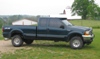
Well... maybe we can do a real test sometime. I drove the set on the picture above on Nevada desert keeping the engine close to redline for about 20 minutes when I was climbing the big mountain at 90F outside.
Not only the engine didn't overheat, but I was using AC at part of the time.
If there is a gas engine that can match that performance, I would like to see it.
Not only the engine didn't overheat, but I was using AC at part of the time.
If there is a gas engine that can match that performance, I would like to see it.

Now, year-for-year, I'd have to find a '99 V10 to do that test just to compare apples-to-apples. Then, I'd have to figure out how to get it to do 3000RPMs at 75MPH, gearing-wise, which would give me around a 5.22 rear gear with a .7 overdrive, or no overdrive with a 3.73. And, get that all in an F450 platform.
Now, my 2-valve PI-head V10 could do it. And it wouldn't overheat, nor blow-up before it got there.
What speed were you going?

--
Lots of F450/550's around here, loaded to the gills, just like your setup - without the rear-squat going on. They ain't pulling hills in Nevada, but they do have 100-200K+ miles on them, all doing it in 90 degree heat here on Long Island this week, and they ain't blowin' up neither
If you buy a V10-equipped F450, it's meant to do the same thing as the diesel-equipped F450. Without overheating, without blowing up because it's sitting at red-line for 20 minutes, yada yada yada.
Anyway...

Postmaster
Joined: Apr 2008
Posts: 4,724
Likes: 4
From: Rogersville, TN
Huh? Are you saying "Give me a long enough lever and I can move the earth"
If you are trying to compare a 5.4 to a PSD? You are not even in the same area code. I have had a 5.4, V-10 and PSD's. The PSD will out tow all of them. But the V-10 is a very close second.
If you are trying to compare a 5.4 to a PSD? You are not even in the same area code. I have had a 5.4, V-10 and PSD's. The PSD will out tow all of them. But the V-10 is a very close second.
Funny thing. Not only are the 5.4 and 7.3 I refer to in the same area code, but they are even closer than that. They are both sitting in my driveway side by side at the moment. Not only do I have the math to back it up, I can just hook the same trailer to both of them and tell you the same thing. In the same gear at the same rpm, you are correct. They are not even close. But at the same speed and both at peak hp the 5.4 will walk all over it because not only is it making more hp it has the gearing advantage too.
What were the set ups for your 5.4 and 7.3?
Edit-The thing that gets a lot of PSD guys(and I admit, it got me too) is that we only compare throttle response and what gear we climb a hill in. My 7.3 has more get up and go if I compare them in the same gear. My 7.3 can climb hills in 5th that my 5.4 needs 4th and sometimes 3rd. I was convinced that the 7.3 would pull the wheels out from under it. Funny thing happened when I went to make my videos though. When I looked at my speedo, my 7.3 was only doing half the speed of my 5.4 in the same gear. Once I compared how they pulled at the same speed with both at peak engine tq, the 5.4 pulled a lot better.
FTE Leadership Emeritus
Joined: Jul 2002
Posts: 42,561
Likes: 423
From: Long Island USA
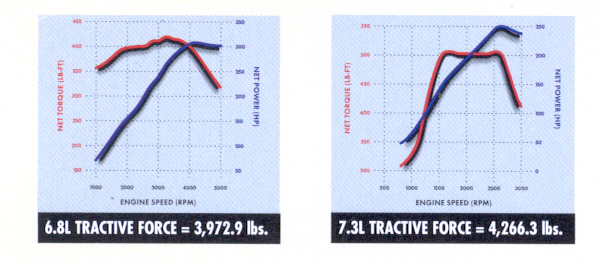
Oh, and don't forget through all this "torque" discussion, that my little ole 2-valve V10 puts out 80% of it's peak torque at just 1000RPMs. At the TC stall point, which is around 1500RPMs, it's over 88% of the peak torque of 425FT/lbs.
With a 4.30, compared to the standard 3.73 of a 7.3, the advantage is almost gone.
At 1500 RPMs, my V10 makes 375FT/lbs, the 7.3 makes 500. If you figure a 15% improvement in rear gearings, that 375 becomes 431. At the peak, my 425 becomes 488. Pretty darn close to the peak of 500 for the 7.3.
Add to that that I can hold a lower tranny gear longer, all parasitic losses are the same because it's a 4R100 on both, and it quickly becomes apparent (to those without rose-colored glasses) that there IS NOT MUCH OF A DIFFERENCE.
Now, we can go back over the entire hole loop again, or we can all agree, that THERE ISN'T MUCH DIFFERENCE between the 7.3 and the 2-valve V10.
The 6.0 and the 3-valve V10, about just as much difference - not enough to argue about.
Unmodded.
With a 4.30, compared to the standard 3.73 of a 7.3, the advantage is almost gone.
At 1500 RPMs, my V10 makes 375FT/lbs, the 7.3 makes 500. If you figure a 15% improvement in rear gearings, that 375 becomes 431. At the peak, my 425 becomes 488. Pretty darn close to the peak of 500 for the 7.3.
Add to that that I can hold a lower tranny gear longer, all parasitic losses are the same because it's a 4R100 on both, and it quickly becomes apparent (to those without rose-colored glasses) that there IS NOT MUCH OF A DIFFERENCE.
Now, we can go back over the entire hole loop again, or we can all agree, that THERE ISN'T MUCH DIFFERENCE between the 7.3 and the 2-valve V10.
The 6.0 and the 3-valve V10, about just as much difference - not enough to argue about.
Unmodded.
Postmaster
Joined: Apr 2008
Posts: 4,724
Likes: 4
From: Rogersville, TN
Add to that that I can hold a lower tranny gear longer, all parasitic losses are the same because it's a 4R100 on both, and it quickly becomes apparent (to those without rose-colored glasses) that there IS NOT MUCH OF A DIFFERENCE.
Now, we can go back over the entire hole loop again, or we can all agree, that THERE ISN'T MUCH DIFFERENCE between the 7.3 and the 2-valve V10.
Now, we can go back over the entire hole loop again, or we can all agree, that THERE ISN'T MUCH DIFFERENCE between the 7.3 and the 2-valve V10.
I am comparing two engines with different tranny gears AND different rear end gears. With my 5.72 1st and 4.10 gears my 5.4 will turn 256 wheel rpms in 1st gear(close to the same speed as the auto 7.3 with 3.73). Compare the tractive force of it in 1st to that automatic 7.3 in 1st and see how well they compare

Senior User
Joined: May 2004
Posts: 407
Likes: 0
From: Humble, Texas
Tried to rep you, but got pulled over by the "spread the wealth" cops, escorted back to the cruiser and handcuffed. Had to type the post with my nose. You ever try to type an exclamation point using only your nose?
FTE Stories
Ford Trucks for Ford Truck Enthusiasts

10 Ugly Ford Trucks That We Still Kinda Love
Joe Kucinski
10 Things Every Truck Owner NEEDS (2026 Edition)
Michael S. Palmer
Rezvani's Latest Post-Apocalyptic Monster Is a Ford F-150 Raptor Underneath
Verdad Gallardo
Top 10 Most Expensive Ford Trucks Ever Sold on Bring a Trailer
Joe Kucinski
2027 Ford Super Duty Buyer's Guide (Every Model, Engine, & Package)
Brett Foote
Top 10 Ford Truck Tragedies
Joe Kucinski
AEV FXL Super Duty - the Super Duty Raptor Ford Doesn't Make
Brett Foote
Lobo Vs Lobo: Proof the F-150 Lobo Should Be Even Lower!
Michael S. Palmer
Ford's 2001 Explorer Sportsman Concept Looks For a New Home
Verdad Gallardo
Elder User
Joined: May 2010
Posts: 650
Likes: 0
From: WV
Yes, you need torque to move the tires. But not engine torque. Crankshaft torque and dyno "rear wheel" hp and torque numbers are not worth the paper they are written on. For example, my 5.4 will show 149 hp and 315 tq at 2,500 rpm at the rear wheels on a chassis dyno. My 7.3 will show 203 hp and 355 tq at 3,000 rpm. That is crankshaft hp minus 10% loss with a manual. To save everyone the math, the actual rear wheel tq for my 5.4 in 1st is 7,313 and 4,281 for my 7.3 in 2nd(automatic 1st gear equivalent). So even though the 7.3 is making more crankshaft hp and tq AND will show more hp and tq on a rear wheel dyno, the 5.4 can actually pull almost twice the weight at that rpm in those gears. I would take my manual 5.4 over an automatic psd any day of the week when it comes to getting a heavy load like that moving. A manual psd would work best, but the simple fact is, good gearing can make up for lack of engine torque.
Let's also not forget that all a chassis(rear wheel) dyno does is take the 7,313 tq number from my 5.4 and factor in my gear ratio and wheel rpm to calculate how much hp it is making. Chassi dynos and rated hp do nothing but tell you how powerful your engine is, not how well it translates to the ground in a certain gear. 7,313 tq x 107 wheel rpm/5252=149 hp on the chassis dyno. If you run that on an engine dyno it would be 350 tq x 2500 engine rpm/5252= 166 hp. That 17 hp differential has nothing to do with the gearing, but is caused by friction loss in the moving parts between the crank and the wheels.
Not when you are able to turn almost twice the rpms and do it in a lower gear. Bill can run 70 mph with his v10 in 2nd gear while Kajtek is almost at the redline in OD at the same speed.
Let's also not forget that all a chassis(rear wheel) dyno does is take the 7,313 tq number from my 5.4 and factor in my gear ratio and wheel rpm to calculate how much hp it is making. Chassi dynos and rated hp do nothing but tell you how powerful your engine is, not how well it translates to the ground in a certain gear. 7,313 tq x 107 wheel rpm/5252=149 hp on the chassis dyno. If you run that on an engine dyno it would be 350 tq x 2500 engine rpm/5252= 166 hp. That 17 hp differential has nothing to do with the gearing, but is caused by friction loss in the moving parts between the crank and the wheels.
Not when you are able to turn almost twice the rpms and do it in a lower gear. Bill can run 70 mph with his v10 in 2nd gear while Kajtek is almost at the redline in OD at the same speed.
My post in summary was: An engine with no torque will need massive gearing and/or tranny to make it move a heavy load and this become problematic at high speeds because of that gearing.
We see this all the time. At 70 RPM my V10 is at 2500 rpm with a 4.30 while a newer 6.4 maybe only at 1800 with it's 3.55 rear end. Now if you take a torqueless engine like the rotary, you'll have to run some stupid rear end to be able to move the truck + a 15-20k lb load. Lets just say that since it has about 1/4 the torque of the V10, it would need 4 times bigger rear end, that means we'll be running 13.2 rear end to put the same amount of torque to the tires to get everything moving as my V10 would have (same trannies).
that's fine and all, but what about at 70 mph? While my V10 is at 2500 or so, the rotary will be at 4 times that, or 10,000 RPMs. Same thing when you compare the V10 to the PSD, the more aggressive gears in the gasser that help it get the starting power, are a disadvantage by keeping the RPM's high at highway speeds. I just metnioned the 7.3 PSD because they were similar in hp.
The major difference is that the V10 is practical and usable while the rotary engine is not.

Lead Driver


Joined: Jul 2007
Posts: 7,868
Likes: 9
From: Rhode Island
Actually there are "million gear" transmissions. CVTs and Hydrostatics. One of those would be ideal to demonstrate that HP is what allows you to pull big loads, maybe not easily, quietly, efficiently or reliably, but if two engines have the same HP, they can do the same work.
Postmaster
Joined: Apr 2008
Posts: 4,724
Likes: 4
From: Rogersville, TN
FINALLY!!! The right term. I was wondering if it would ever get mentioned. "Rear wheel torque" means about as much as flywheel horsepower. It's tractive force that actually does the moving. I know it's semantics, which is why I didn't say anything about it earlier.
Tried to rep you, but got pulled over by the "spread the wealth" cops, escorted back to the cruiser and handcuffed. Had to type the post with my nose. You ever try to type an exclamation point using only your nose?
Tried to rep you, but got pulled over by the "spread the wealth" cops, escorted back to the cruiser and handcuffed. Had to type the post with my nose. You ever try to type an exclamation point using only your nose?
Elder User
Joined: May 2010
Posts: 650
Likes: 0
From: WV

Edit: Josh beat me to it.
Elder User
Joined: May 2010
Posts: 650
Likes: 0
From: WV
Actually there are "million gear" transmissions. CVTs and Hydrostatics. One of those would be ideal to demonstrate that HP is what allows you to pull big loads, maybe not easily, quietly, efficiently or reliably, but if two engines have the same HP, they can do the same work.
Most of those still have an upper and lower range though, just it can go into "any" gear inbetween those ranges. Also I don't think those are very durable just yet, i.e. can't take the power put down by a truck engine. Won't be long though.
Senior User
Joined: May 2004
Posts: 407
Likes: 0
From: Humble, Texas
There is a reason why I haven't been saying tractive force though. Tractive force also takes into account ground and tire hardness. Using a steady acceleration, my 5.4 in 1st gear is going to have the same tractive force as it has rear wheel tq, so the term is interchangeable there. Where that becomes a problem is if I pop the clutch and floor it. The rear wheel tq will exceed the tractive force and I will just spin the tires.
I know what you're saying though. It's basically semantics and you'd need a heavy duty pocket protector and taped together black birth control glasses to really care either way. For the record, I don't care either way I was just wondering how long it would take for tractive force to be mentioned.
Lead Driver
Joined: Jul 2007
Posts: 7,868
Likes: 9
From: Rhode Island
There are CVTs that can take that kind of abuse, but you don't see them in the automotive environment because they usually take up a lot of space are are far too noisy
There are plenty of hydrostatic transmissions that are upto the task though. Hydrostatics have a near limitless "low gear" range. You could be bouncing off the rev limiter at 5500RPM and still be crawling at a quarter mile per hour.
There are plenty of hydrostatic transmissions that are upto the task though. Hydrostatics have a near limitless "low gear" range. You could be bouncing off the rev limiter at 5500RPM and still be crawling at a quarter mile per hour.