



Gas vs PSD
Post Fiend
Joined: Mar 2006
Posts: 7,841
Likes: 0
From: Vacaville, Ca

Bill, it is ok that you are 17. We were all your age once. Believe me that in 17 more years your views will not be the same as they are today. You might even find yourself driving a diesel and liking it more than a gasser.
Post Fiend
Joined: Mar 2006
Posts: 7,841
Likes: 0
From: Vacaville, Ca
In my opinion, the best pulling engine will be able to put the required amount of tractive force to the ground at the lowest rpm. It makes for an easier, less stressful pull so I can concentrate on Wilkow, Hannity, and Levin on the XM. In your example, that would be the 1,200 lb ft motor...and by a boat load. Others may have different preferences which is why this argument will never go away.

Fleet Mechanic


Joined: Feb 2007
Posts: 1,852
Likes: 39

Are you saying that torque is completely meaningless aft of the crankshaft? While I would agree that it is not the measure of work, it is transmitted throughout the entire drivetrain. Putting my mind back in physics class 20 years ago, the ONLY thing that moves any object is the force that is applied. In a truck, that force is torque. Without it, the truck just sits there and looks pretty, or in the case of a Chevy, it just sits there.
Now take the 571 hp engine, put it in a truck and attach a 15k trailer to it and see how well it tows. It has over 200 more hp than my 6.0 does so it should leave me in the dust. But it won't because in order to take advantage of it peak hp, it has to be spinning so fast that fixed gears will not be effective in getting the load moving and keeping it moving efficiently.
I would rep you if I could, for the stimulating civil conversation, but I have to spread it around first. So, I'll just say "thanks".
Fleet Mechanic
Joined: Feb 2007
Posts: 1,852
Likes: 39
Yes, and I thought he did quite well on Leno last night. I was expecting lots of boos from the audience, I was pleasantly surprised at how well he was received.
When he backed up to hit Gore a second time, it made my night.
When he backed up to hit Gore a second time, it made my night.
Super Moderator

Joined: Aug 2003
Posts: 25,479
Likes: 742
From: Isanti, MN
Seems like he beat me to it. Again.
Who says they can't build a driveline designed to operate an engine that high? I believe 15,000 RPMs pushes the limit of modern torque converters, but who says it has to go into the transmission that fast?
Why couldn't they, say, put a 3:1 reduction gearset at the crank before it enters the torque converter. Hook the torque converter to that output shaft, and voila: a 5,000 RPM engine, as far as the transmission is concerned.
An engine like this, with a light enough flywheels so it could rev freely, would pull much like a PSD would. Think about it, 190 HP at the equivilent of 1666 RPMs...that's Diesel territory there.
Would it last long? Maybe. Are you famililar with a rotary engine? I believe those spin to around 10,000 in the RX-8, but it would not be unreasonable given the design to make one that could spin faster. Power at speed could be accomplished with a turbo.
Efficiency, however, would be another matter. Take an inefficient rotary engine, rev it to 15,000 RPMs and strap a turbo on it...would likely mean a 5 MPG machine.
BUT it would out tow any PSD ever made!
Who says they can't build a driveline designed to operate an engine that high? I believe 15,000 RPMs pushes the limit of modern torque converters, but who says it has to go into the transmission that fast?
Why couldn't they, say, put a 3:1 reduction gearset at the crank before it enters the torque converter. Hook the torque converter to that output shaft, and voila: a 5,000 RPM engine, as far as the transmission is concerned.
An engine like this, with a light enough flywheels so it could rev freely, would pull much like a PSD would. Think about it, 190 HP at the equivilent of 1666 RPMs...that's Diesel territory there.
Would it last long? Maybe. Are you famililar with a rotary engine? I believe those spin to around 10,000 in the RX-8, but it would not be unreasonable given the design to make one that could spin faster. Power at speed could be accomplished with a turbo.
Efficiency, however, would be another matter. Take an inefficient rotary engine, rev it to 15,000 RPMs and strap a turbo on it...would likely mean a 5 MPG machine.
BUT it would out tow any PSD ever made!

"Mifflin Clay"
Joined: Jul 2005
Posts: 3,177
Likes: 4
From: Mifflin, PA
Anyone want to take a stab at how much a V10 (or even a 5.4) could tow if equipped with an 8 or 10 speed close ratio transmission?
There's a reason those over the road big rigs have 16 speed trannys.....
There's a reason those over the road big rigs have 16 speed trannys.....
Super Moderator
Joined: Aug 2003
Posts: 25,479
Likes: 742
From: Isanti, MN
Most common fleet trucks have either a 9-speed or a 10-speed transmission. These are probably the most common.
Some fleets, and many owner/operators use 13-speeds, or 18-speeds. Both are variants of a 9-speed. They include an extra gearset on the tailshaft of the transmission that allows you to split each gear. A 13-speed only can split the top 4 gears, while an 18-speed can split all 9.
With the 13-speed in my truck, my engine lives between 12-1400 RPMs...it never has to go outside that range unless I'm at an idle... You could stuff a V10 in a heavy truck and have it do very well, believe it or not. It would take some crazy gearing, as my work truck has 3.25 rears, but if you set it up so it would cruise at 60 MPH at 4,000 RPM in top gear, that engine would pull 80,000 lbs.
Keeping it cool would be tough. Even tougher would be making it last more than a few thousand miles with that kind of stress. But it could be done!
FTE Stories
Ford Trucks for Ford Truck Enthusiasts

Top 6 Best Deals Available on New Fords & Lincolns Right Now
Brett Foote
This Hennessey Takes the Expedition Tremor's Off-Roading Capability to the Next Level
Verdad Gallardo
Top 10 Fords at 2026 Carlisle Ford Nationals
Joe Kucinski
3 Best / 3 Worst Parts of Modern Ford Ownership
Brett Foote
10 Amazing Upgrades That Solve Common Ford Truck Owner Headaches
Pouria Savadkouei
Every 2026 Ford Engine Explained
Brett Foote
10 Ugly Ford Trucks That We Still Kinda Love
Joe Kucinski
10 Things Every Truck Owner NEEDS (2026 Edition)
Michael S. Palmer
Rezvani's Latest Post-Apocalyptic Monster Is a Ford F-150 Raptor Underneath
Verdad Gallardo
FTE Leadership Emeritus
Joined: Jul 2002
Posts: 42,561
Likes: 423
From: Long Island USA

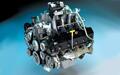
In this conversation, we are comparing a V10 and a PSD. Two entirely different motors.
The PSD has big rods and heavy pistons. It doesn't like high RPMs.
The V10 has much lighter pistons and rods and overhead cams which means a very light valve train. It likes high RPMs and was designed for it.

Senior User
Joined: May 2004
Posts: 407
Likes: 0
From: Humble, Texas
He doesn't come on until 10:00 pm. I am rarely driving around that late. Now if they'd swap Laura Ingraham and Mike Church, I'd be a King Dude listener!
There are probably a lot of forces that act on the drivetrain at any given time. The torque you are talking about does not just appear out of thin air, it is provided by gravity. I believe our friend Newton has a law concerning this that states that in order to move the truck, the engine would have to produce enough power to overcome the sum of all the forces that are acting on it. So lets just take this a little further....
Lets assume a heavy trailer on the truck and after exhaustive math, we determine that it will take 7,000 lb ft of axle torque to get it moving up the hill. Speed is irrelevant because the hill is short and once we get to the top, the amount of force required will significantly decrease. So we have a truck with a 6.4, 3.11 1st gear ratio and a 3.73 diff. At 650 lb ft of torque at the flywheel, this truck will produce 7,540 lb ft of axle torque and the truck and trailer start climbing the hill.
Now lets put a V10 in the truck. With the same drivetrain and 457 lb ft of torque, this truck produces 5,301 lb ft at the axle and the truck starts moving backward. So lets fix this problem by giving the V10 4.30 gears. Now it produces 6,111 lb ft, still moving it backward. If we keep giving it steeper gears, we have to go over 4.88 to get our 7,000 lb ft. Just in case you're interested, the 6.4 with 4.30 gears will produce 8,692 lb ft. in this scenario.
The V10, however, will pull harder at 70 mph than the 6.4 will due to hp differences. Sometimes torque is better and sometimes hp is better. By the way, my apologies for not repping you earlier. I should have.
Nobody says they can't. I thought I had in my prior post that it would take creative gearing to get it to work. I must have deleted that sentence. I would say that your solution is creative and it would probably work. In fact, you'd then have 600 lb ft going into the transmission. However, I wouldn't want to listen to the engine all day long.
Now there is a significant amount of torque on the entire driveline, up to the transmission's park pawl. Just a little less torque than it would take to get the truck moving back up the hill. The torque is there, and it is constant, but there is zero motion. Hence no work is being done, and zero power is being produced.
Lets assume a heavy trailer on the truck and after exhaustive math, we determine that it will take 7,000 lb ft of axle torque to get it moving up the hill. Speed is irrelevant because the hill is short and once we get to the top, the amount of force required will significantly decrease. So we have a truck with a 6.4, 3.11 1st gear ratio and a 3.73 diff. At 650 lb ft of torque at the flywheel, this truck will produce 7,540 lb ft of axle torque and the truck and trailer start climbing the hill.
Now lets put a V10 in the truck. With the same drivetrain and 457 lb ft of torque, this truck produces 5,301 lb ft at the axle and the truck starts moving backward. So lets fix this problem by giving the V10 4.30 gears. Now it produces 6,111 lb ft, still moving it backward. If we keep giving it steeper gears, we have to go over 4.88 to get our 7,000 lb ft. Just in case you're interested, the 6.4 with 4.30 gears will produce 8,692 lb ft. in this scenario.
The V10, however, will pull harder at 70 mph than the 6.4 will due to hp differences. Sometimes torque is better and sometimes hp is better. By the way, my apologies for not repping you earlier. I should have.
Who says they can't build a driveline designed to operate an engine that high? I believe 15,000 RPMs pushes the limit of modern torque converters, but who says it has to go into the transmission that fast?
Why couldn't they, say, put a 3:1 reduction gearset at the crank before it enters the torque converter. Hook the torque converter to that output shaft, and voila: a 5,000 RPM engine, as far as the transmission is concerned.
Why couldn't they, say, put a 3:1 reduction gearset at the crank before it enters the torque converter. Hook the torque converter to that output shaft, and voila: a 5,000 RPM engine, as far as the transmission is concerned.
Hotshot
Joined: Dec 2006
Posts: 14,069
Likes: 17
From: Melbourne, Ky
Hey Bill, at 17 you've got a lot more towing experience than a lot of us on here. I commend anyone that works. You sir are a sign of hope that unfortunately I have lost, looking at the kids/young adults of today. I won't go off topic any more than I already have. I'm proud of you for what you do, you work hard.


Thread Starter
|
Modular motor junkie
Joined: May 2009
Posts: 6,190
Likes: 8
From: Texas
Not at all. It will take time to type up, but I will try tonight.
"Mifflin Clay"
Joined: Jul 2005
Posts: 3,177
Likes: 4
From: Mifflin, PA
Lets assume a heavy trailer on the truck and after exhaustive math, we determine that it will take 7,000 lb ft of axle torque to get it moving up the hill. Speed is irrelevant because the hill is short and once we get to the top, the amount of force required will significantly decrease. So we have a truck with a 6.4, 3.11 1st gear ratio and a 3.73 diff. At 650 lb ft of torque at the flywheel, this truck will produce 7,540 lb ft of axle torque and the truck and trailer start climbing the hill.
Now lets put a V10 in the truck. With the same drivetrain and 457 lb ft of torque, this truck produces 5,301 lb ft at the axle and the truck starts moving backward. So lets fix this problem by giving the V10 4.30 gears. Now it produces 6,111 lb ft, still moving it backward. If we keep giving it steeper gears, we have to go over 4.88 to get our 7,000 lb ft. Just in case you're interested, the 6.4 with 4.30 gears will produce 8,692 lb ft. in this scenario.
The V10, however, will pull harder at 70 mph than the 6.4 will due to hp differences. Sometimes torque is better and sometimes hp is better. By the way, my apologies for not repping you earlier. I should have.

Posting Guru
Joined: Dec 2006
Posts: 2,498
Likes: 3
From: Windsor, Colorado
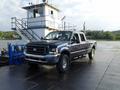
Here's one for ya Bill. Don't know how much it weighed, but when I let it down on my pickup I thought the hitch was going to hit the ground. Good think I have that heavy psd up front!
