



Gas vs PSD
Thread Starter
|
Modular motor junkie
Joined: May 2009
Posts: 6,190
Likes: 8
From: Texas
Besides, I am rev limited to 153 in OD with those gears, and that is more speed than I need. The governor is at 105 and I think I could hit that with 4.88s.

Fleet Mechanic


Joined: Feb 2007
Posts: 1,852
Likes: 39

High torque motors improve the quality of the towing experience, but torque alone is not a measure of ultimate capacity. Horsepower is.
In the example we're talking about, yes, the Cat motor is going to handle the load much much better overall. But, if it were possible to hold the V10 at its peak with the right gearing, it would move a heavier load. If that is not true, then the HP numbers posted are not true.
You will not find anywhere in this thread where I have said that high-torque motors are not better to tow with.

Fleet Mechanic
Joined: Jan 2006
Posts: 1,510
Likes: 7
From: Anchorage, AK
Because high torque motors tow better. That doesn't mean they necessarily tow MORE. To move a heavier load, or to move the same load faster, you need more horsepower.
You will not find anywhere in this thread where I have said that high-torque motors are not better to tow with.
You will not find anywhere in this thread where I have said that high-torque motors are not better to tow with.

FTE Legend

Joined: Aug 2004
Posts: 37,887
Likes: 20
From: North Central Rural Sask.
Again, why do semi truck engines have so much more torque then horsepower? According to what you just wrote, they should have 1000 horsepower and like 400 ft lbs of torque...
Yes a semi truck is larger so it needs more torque to get moving, but semis now a days have the same rear diff ratios as our pickups, and the amount of gears they have just gets the load going a little faster, yet they haul 50k plus, and drive the same roads we do while doing it.
So why does the torque in a semi double (sometimes triple) the amount of horsepower it has?
Post Fiend
Joined: Mar 2006
Posts: 7,841
Likes: 0
From: Vacaville, Ca

When I was drag racing small block fords in a 2000lb car I had a 4500 rpm stall converter to help get the car moving because although I had 400+ horsepower, I did not have enough torque down low to launch hard enough for a good ET. I found that torque is what got you moving and horsepower is what got you the mile per hour at the far end. Big block motors have an abundance of torque down low so they were only running 2500 rpm stall converters to launch.
So using the information that I learned from racing, it only makes sense that torque is very important when towing. Which is why in the test the 6.4 was quicker to the top of the hill. The V10 has more hp for the far end giving it the advantage of more mile per hour but it still lost the race. If it had a torque converter with more stall or lower gears say 4.88 or 5.14 it would have been quicker but then gas milage would suck and the transmission wouldn't last because of the heat from the converter.
So using the information that I learned from racing, it only makes sense that torque is very important when towing. Which is why in the test the 6.4 was quicker to the top of the hill. The V10 has more hp for the far end giving it the advantage of more mile per hour but it still lost the race. If it had a torque converter with more stall or lower gears say 4.88 or 5.14 it would have been quicker but then gas milage would suck and the transmission wouldn't last because of the heat from the converter.

Senior User
Joined: May 2004
Posts: 407
Likes: 0
From: Humble, Texas
Ill admit im not an expert on the subject, but Ive read up on it to the point where I get the basics of it. Where I get cloudy, is when I think of a 500 high horsepower civc engine installed in a superduty truck, and saying to myself yep, that would outpull a v10 or a 7.3.
I was under the impression that most of the discussion was about outpulling one another. I guess it depends on the definition of outpull.
Again, why do semi truck engines have so much more torque then horsepower? According to what you just wrote, they should have 1000 horsepower and like 400 ft lbs of torque...
Yes a semi truck is larger so it needs more torque to get moving, but semis now a days have the same rear diff ratios as our pickups, and the amount of gears they have just gets the load going a little faster, yet they haul 50k plus, and drive the same roads we do while doing it.
So why does the torque in a semi double (sometimes triple) the amount of horsepower it has?
I was under the impression that most of the discussion was about outpulling one another. I guess it depends on the definition of outpull.
Again, why do semi truck engines have so much more torque then horsepower? According to what you just wrote, they should have 1000 horsepower and like 400 ft lbs of torque...
Yes a semi truck is larger so it needs more torque to get moving, but semis now a days have the same rear diff ratios as our pickups, and the amount of gears they have just gets the load going a little faster, yet they haul 50k plus, and drive the same roads we do while doing it.
So why does the torque in a semi double (sometimes triple) the amount of horsepower it has?
Now think what horsepower means. Back in the day, engine designers were looking to sell their engines not to put in automobiles but to put in machines for manufacturing, farming or other industry. To convince the businesses to buy their machines, they had to determine how many horses their engine could replace. So some dude, who I can't remember the name of, made a determination of how much work could be performed by each horse. Whatever he determined got reduced down to the force required to lift 33,000 pounds in one minute, or 550 pounds per second. This adds a time requirement. So in other words, it is a measure of how fast work can be performed.
So in very simple terms, torque is how much force is being produced and horsepower is how fast it's being produced. So now lets go get a strong horse and name him Krewat and go get a weak one and name him Bill. Bill doesn't have a lot of strength but he is full of fast twitch muscle fibers so he can access power quickly. Krewat is very strong but is less than motivated. Both Bill and Krewat need to lift pallets, through a simple pulley, to a height of 5 feet. Bill needs to lift 275 pounds and Krewat needs to lift 550 pounds. Bill can take off and lift the 275 pounds to 5 feet in only 2 seconds. It takes Krewat 5 seconds to lift the 550 pounds. Krewat lifted at a rate of 550 pounds per second, or produced 1 horsepower. Bill, on the other hand, lifted at a rate 687 pounds per second, or produced 1.25 horsepower.
So one day, Bill gets Krewats load and Krewat gets Bills load. Krewat lifts Bills load in 2.5 seconds, still one horsepower. Bill strains and strains but just doesn't have the strength to lift the 550 pounds. So he is producing zero horsepower with that load. So rather than switching the horses, the worker replaces Bills pulley with one that has a 2:1 ratio. Now Bill can lift the load in a shade over 2 seconds due to the resistance of the extra pulley. Now he is producing a shade under 1.25 horsepower. We call this "drivetrain loss".
So at the end of the story, Bill had to retire early because of muscle soreness from too many pulled muscles and injuries sustained when the 2:1 pulley failed due to its more complicated design. Krewat, on the other hand, lasted much longer because his strength allowed him to enjoy less stressful working conditions, although he whined a lot and was considered high maintenance.

Lead Driver

Joined: Jul 2007
Posts: 7,868
Likes: 9
From: Rhode Island
Ill admit im not an expert on the subject, but Ive read up on it to the point where I get the basics of it. Where I get cloudy, is when I think of a 500 high horsepower civc engine installed in a superduty truck, and saying to myself yep, that would outpull a v10 or a 7.3.
I was under the impression that most of the discussion was about outpulling one another. I guess it depends on the definition of outpull.
Again, why do semi truck engines have so much more torque then horsepower? According to what you just wrote, they should have 1000 horsepower and like 400 ft lbs of torque...
Yes a semi truck is larger so it needs more torque to get moving, but semis now a days have the same rear diff ratios as our pickups, and the amount of gears they have just gets the load going a little faster, yet they haul 50k plus, and drive the same roads we do while doing it.
So why does the torque in a semi double (sometimes triple) the amount of horsepower it has?
I was under the impression that most of the discussion was about outpulling one another. I guess it depends on the definition of outpull.
Again, why do semi truck engines have so much more torque then horsepower? According to what you just wrote, they should have 1000 horsepower and like 400 ft lbs of torque...
Yes a semi truck is larger so it needs more torque to get moving, but semis now a days have the same rear diff ratios as our pickups, and the amount of gears they have just gets the load going a little faster, yet they haul 50k plus, and drive the same roads we do while doing it.
So why does the torque in a semi double (sometimes triple) the amount of horsepower it has?
We have an imaginary semi engine, it makes 350 HP @ 2000 RPM, thats 919 lb-ft of torque. Now take the V10, say 360HP @ 4700 RPM, that is 407 lb-ft of torque. Now put a 2:35:1 gear reduction on the V10 (or roughly double the rear gears), its still making that same 360HP, but now at the same RPM as that semi engine(but the motor is still screaming away at 4700 RPM), the gear reduced V10 is now putting out the equivalent of 945 lb-ft of torque. So yes, it will outpull that semi engine, will it last long doing it ? No, will it be efficient? no.
FTE Stories
Ford Trucks for Ford Truck Enthusiasts

Top 10 Most Expensive Ford Trucks Ever Sold on Bring a Trailer
Joe Kucinski
2027 Ford Super Duty Buyer's Guide (Every Model, Engine, & Package)
Brett Foote
Top 10 Ford Truck Tragedies
Joe Kucinski
AEV FXL Super Duty - the Super Duty Raptor Ford Doesn't Make
Brett Foote
Lobo Vs Lobo: Proof the F-150 Lobo Should Be Even Lower!
Michael S. Palmer
Ford's 2001 Explorer Sportsman Concept Looks For a New Home
Verdad Gallardo
10 Best Ford Truck Engines We Miss the Most!
Joe Kucinski
2026 Shelby F-150 Off-Road: Better Than a Raptor R?
Brett Foote
2027 Super Duty Carhartt Package First Look: 12 Things You NEED to Know!
Michael S. Palmer
Smokin
Joined: Jun 2006
Posts: 8,849
Likes: 0
So now lets go get a strong horse and name him Krewat and go get a weak one and name him Bill. Bill doesn't have a lot of strength but he is full of fast twitch muscle fibers so he can access power quickly.
So at the end of the story, Bill had to retire early because of muscle soreness from too many pulled muscles and injuries sustained when the 2:1 pulley failed due to its more complicated design. Krewat, on the other hand, lasted much longer because his strength allowed him to enjoy less stressful working conditions, although he whined a lot and was considered high maintenance.
So at the end of the story, Bill had to retire early because of muscle soreness from too many pulled muscles and injuries sustained when the 2:1 pulley failed due to its more complicated design. Krewat, on the other hand, lasted much longer because his strength allowed him to enjoy less stressful working conditions, although he whined a lot and was considered high maintenance.

I like story time.
I still don't see how Krewat is considered a "whiner"? Is it because he needed more expensive oats?

 Looks to be gaining speed, Must be all the torque....& HP...

Postmaster
Joined: Apr 2008
Posts: 4,724
Likes: 4
From: Rogersville, TN
well, made, not makes. i think they stopped making it in 06 or 07, but i could be wrong. i wouldnt own a chevy if you gave it to me for free, but they have put out a few really good products, and the 8.1 was one of them.

Posting Guru
Joined: Aug 2009
Posts: 2,165
Likes: 0
From: Union Lake MI
I think because it is out of the box ready to go, Quiet & Reliable.
The long stroke, BTW here is another one with a long stroke. Little more than triple.

It also has pretty large crank Bearings too:


Guess it need a pretty long stroke to produce more torque.

Here are some pretty big holes to fill...With these


Then give her a little boost.

Pretty nice Snail Shell

Guess you need some torque to spin this, Or is it Horse Power? I am not sure, any scientists here?
Me too now rpm = torque = HP ? Here is a little mat for ya.
On the torque vs. HP ...
<table cellpadding="0" cellspacing="0"><tbody><tr><td>The cylinder bore is just under 38" and the stroke is just over 98". Each cylinder displaces 111,143 cubic inches (1820 liters) and produces 7780 horsepower. Total displacement comes out to 1,556,002 cubic inches (25,480 liters) for the fourteen cylinder version.
Some facts on the 14 cylinder version:
<table class="card" cellpadding="0" cellspacing="0"> <tbody><tr> <th>Total engine weight</th> <td width="20">
</td><td>2300 tons (The crankshaft alone weighs 300 tons.)</td></tr> <tr><th>Length</th> <td width="20">
</td><td>89 feet</td></tr> <tr><th>Height</th> <td width="20">
</td><td>44 feet</td></tr> <tr><th>Maximum power</th> <td width="20">
</td><td>108,920 hp at 102 rpm </td></tr> <tr><th>Maximum torque</th> <td width="20">
</td><td>5,608,312 lb/ft at 102rpm </td></tr> </tbody></table> </td><td width="10">
</td><td align="center" valign="top">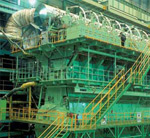
Video » </td></tr></tbody></table>
Fuel consumption at maximum power is 0.278 lbs per hp per hour (Brake Specific Fuel Consumption). Fuel consumption at maximum economy is 0.260 lbs/hp/hour. At maximum economy the engine exceeds 50% thermal efficiency. That is, more than 50% of the energy in the fuel in converted to motion.
For comparison, most automotive and small aircraft engines have BSFC figures in the 0.40-0.60 lbs/hp/hr range and 25-30% thermal efficiency range.
Even at its most efficient power setting, the big 14 consumes 1,660 gallons of heavy fuel oil per hour.
A cross section of the RTA96C
<table cellpadding="0" cellspacing="0"><tbody><tr><td valign="top">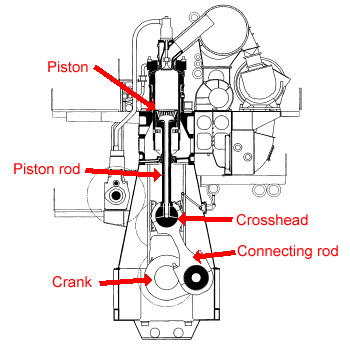 </td><td width="10">
</td> <td valign="top"> The internals of this engine are a bit different than most automotive engines. The top of the connecting rod is not attached directly to the piston. The top of the connecting rod attaches to a "crosshead" which rides in guide channels. A long piston rod then connects the crosshead to the piston. I assume this is done so the the sideways forces produced by the connecting rod are absorbed by the crosshead and not by the piston. Those sideways forces are what makes the cylinders in an auto engine get oval-shaped over time.
</td></tr></tbody></table>

Story time is over for now. Looks like rpm has no bearing..
It is not what ya drive it is how ya drive it, V10 with a little boost will work for me.
Ill admit im not an expert on the subject, but Ive read up on it to the point where I get the basics of it. Where I get cloudy, is when I think of a 500 high horsepower civc engine installed in a superduty truck, and saying to myself yep, that would outpull a v10 or a 7.3.
I was under the impression that most of the discussion was about outpulling one another. I guess it depends on the definition of outpull.
Again, why do semi truck engines have so much more torque then horsepower? According to what you just wrote, they should have 1000 horsepower and like 400 ft lbs of torque...
Yes a semi truck is larger so it needs more torque to get moving, but semis now a days have the same rear diff ratios as our pickups, and the amount of gears they have just gets the load going a little faster, yet they haul 50k plus, and drive the same roads we do while doing it.
So why does the torque in a semi double (sometimes triple) the amount of horsepower it has?
I was under the impression that most of the discussion was about outpulling one another. I guess it depends on the definition of outpull.
Again, why do semi truck engines have so much more torque then horsepower? According to what you just wrote, they should have 1000 horsepower and like 400 ft lbs of torque...
Yes a semi truck is larger so it needs more torque to get moving, but semis now a days have the same rear diff ratios as our pickups, and the amount of gears they have just gets the load going a little faster, yet they haul 50k plus, and drive the same roads we do while doing it.
So why does the torque in a semi double (sometimes triple) the amount of horsepower it has?
It also has pretty large crank Bearings too:
Guess it need a pretty long stroke to produce more torque.
Here are some pretty big holes to fill...With these
Then give her a little boost.
Pretty nice Snail Shell
Guess you need some torque to spin this, Or is it Horse Power?
I am not sure, any scientists here?Me too now rpm = torque = HP ? Here is a little mat for ya.
On the torque vs. HP ...
<table cellpadding="0" cellspacing="0"><tbody><tr><td>The cylinder bore is just under 38" and the stroke is just over 98". Each cylinder displaces 111,143 cubic inches (1820 liters) and produces 7780 horsepower. Total displacement comes out to 1,556,002 cubic inches (25,480 liters) for the fourteen cylinder version.
Some facts on the 14 cylinder version:
<table class="card" cellpadding="0" cellspacing="0"> <tbody><tr> <th>Total engine weight</th> <td width="20">
</td><td>2300 tons (The crankshaft alone weighs 300 tons.)</td></tr> <tr><th>Length</th> <td width="20">
</td><td>89 feet</td></tr> <tr><th>Height</th> <td width="20">
</td><td>44 feet</td></tr> <tr><th>Maximum power</th> <td width="20">
</td><td>108,920 hp at 102 rpm </td></tr> <tr><th>Maximum torque</th> <td width="20">
</td><td>5,608,312 lb/ft at 102rpm </td></tr> </tbody></table> </td><td width="10">
</td><td align="center" valign="top">
Video » </td></tr></tbody></table>
Fuel consumption at maximum power is 0.278 lbs per hp per hour (Brake Specific Fuel Consumption). Fuel consumption at maximum economy is 0.260 lbs/hp/hour. At maximum economy the engine exceeds 50% thermal efficiency. That is, more than 50% of the energy in the fuel in converted to motion.
For comparison, most automotive and small aircraft engines have BSFC figures in the 0.40-0.60 lbs/hp/hr range and 25-30% thermal efficiency range.
Even at its most efficient power setting, the big 14 consumes 1,660 gallons of heavy fuel oil per hour.
A cross section of the RTA96C
<table cellpadding="0" cellspacing="0"><tbody><tr><td valign="top">
</td><td width="10"> </td> <td valign="top"> The internals of this engine are a bit different than most automotive engines. The top of the connecting rod is not attached directly to the piston. The top of the connecting rod attaches to a "crosshead" which rides in guide channels. A long piston rod then connects the crosshead to the piston. I assume this is done so the the sideways forces produced by the connecting rod are absorbed by the crosshead and not by the piston. Those sideways forces are what makes the cylinders in an auto engine get oval-shaped over time.
</td></tr></tbody></table>
Story time is over for now. Looks like rpm has no bearing..
It is not what ya drive it is how ya drive it, V10 with a little boost will work for me.
Super Moderator
Joined: Aug 2003
Posts: 25,479
Likes: 742
From: Isanti, MN
Look at the equation for HP: HP = (Torque x RPM)/5252
There is NO possible way you can EVER have more HP than Torque until you go over 5252 RPM. Therefore, an engine that can't achieve 5252 RPMs can't EVER make more horsepower than torque.
So when you have a heavy duty diesel engine with a max redline of 2400 RPMs, it's ALWAYS going to have more torque than horsepower. The only way you can make a reasonable amount of horsepower at, say, 1400 RPMs is to have LOTS of torque. Which is why the 1,800 ft-lbs.
Which is why I can say that a Toyota Tundra 5.7L engine pulling at peak HP is pulling harder than a Schneider tractor-trailer can.
Yes, that 500 HP civic motor would, too. For the 30 seconds or so before it blew up. Of course it'd never make a good truck motor, but that souped up 1.8L engine can and will pull harder than my 15L diesel. Just not for very long, and not very efficiently. Larger displacement engines can handle more power for longer. That's the benefit you get from it.
As I was driving across Illinois this morning I was thinking about a cool project I could do if I ever had the money. Take a V10 and build it for forced induction. Set it up so that it made ~400 HP from 3,000 RPMs and up, and install it in a heavy duty tractor. Would take some funky gearing, but set it up so at 3,500 RPMs you were cruising at 60 MPH in top gear. My blown V10 would be doing the exact same job as a heavy duty diesel, but with less than half the torque. I'd expect a life expectancy on this motor to be less than 10,000 miles, even with the best parts you could buy. BUT...it WOULD do it!
Postmaster
Joined: Apr 2008
Posts: 4,724
Likes: 4
From: Rogersville, TN
thats a nice engine, but the v10 will still outpull it. it only turns 102 rpm, which means its going to have to have some insane amount of gearing to achieve any kind of speed at all. it may pull 20 million pounds like its not even there, but that doesnt matter. the v10 can turn 6k rpm, and with the proper gearing, it will be able to pull the same load faster.
Thread Starter
|
Modular motor junkie
Joined: May 2009
Posts: 6,190
Likes: 8
From: Texas
but we are taking about horses, right?