When you click on links to various merchants on this site and make a purchase, this can result in this site earning a commission. Affiliate programs and affiliations include, but are not limited to, the eBay Partner Network.
Oops. I thought you were installing dual factory pumps. Wonder how the amp draw compares?
I would be tempted to use the factory wiring for the main pump, then tie into it as a signal wire for the secondary pump’s relay.
Wish I could remember how SSJ did his setup but haven’t had a chance to go searching (I struggle with FTE searches). Seems like he used a pressure switch to kick in the second pump. Something like 60 psi on, but I can’t remember how he turned it off. Maybe it just used a timer since he was only expecting to need it during WOT runs.
If your secondary pump is running all the time, will there be enough return line volume to accommodate double the flow at idle? The pumps will constantly push the fuel but it will not be needed at the fuel bowl so the FPR will send it back to the tank.
Or did I miss it and you’re regulating at the pumps?
I think part of your initial build is listed in the “what did you do today” thread.
Is the main goal to add redundancy in case of pump failure? If so, maybe put the second on a key on toggle switch for full control?
Here's a thread where SSJ hints at how he does dual pumps. Plumbed in parallel, with the ISSPRO fuel pressure gauge triggering the second pump when needed.
Oops. I thought you were installing dual factory pumps. Wonder how the amp draw compares?
I am using the factory pumps. Noob used an 044 for his in tank.
Originally Posted by RacinJasonWV
I would be tempted to use the factory wiring for the main pump, then tie into it as a signal wire for the secondary pump’s relay.
Too late, I’m committed to running power wires off of relays located under the hood. Factory wire will be the signal only.
Originally Posted by RacinJasonWV
Wish I could remember how SSJ did his setup but haven’t had a chance to go searching (I struggle with FTE searches). Seems like he used a pressure switch to kick in the second pump. Something like 60 psi on, but I can’t remember how he turned it off. Maybe it just used a timer since he was only expecting to need it during WOT runs.
If your secondary pump is running all the time, will there be enough return line volume to accommodate double the flow at idle? The pumps will constantly push the fuel but it will not be needed at the fuel bowl so the FPR will send it back to the tank.
Both pumps running full time so hopefully it won’t overwhelm the return line. The feed line from 2 micron post filter to fuel bowl remains the same size. I’m not sure how this will affect volume delivery.
Originally Posted by RacinJasonWV
Or did I miss it and you’re regulating at the pumps?
Nope, stock FPR with RiffRaff black spring rated at 68Lbs.
Originally Posted by RacinJasonWV
I think part of your initial build is listed in the “what did you do today” thread.
Not in depth. Just some pictures of what I am up to.
Originally Posted by RacinJasonWV
Is the “main goal” to add redundancy in case of pump failure? If so, maybe put the second on a key on toggle switch for full control?
It’s complicated. After that tank full of rust and chasing my tail around a faulty BNIB Ford FPR I swapped out to a more restrictive pre filter. 20micron from the 50. I see fp drop 8-10Lbs under heavy demand (which for me is probably 35-40% of the time it’s running) I don’t like that. Dual pumps will have a better ability to draw through the 20micron, as well as push through the 2 micron.
Plus redundancy of having 2 pumps.
Plus it feeds my PMS and gives me something to do over the winter months.
Blah Blah Blah…
Last edited by Y2KW57; Dec 27, 2025 at 02:58 PM.
Reason: Separated quoted post from reply that was previously nested within quoted post, to reduce (my) confusion
Here's a thread where SSJ hints at how he does dual pumps. Plumbed in parallel, with the ISSPRO fuel pressure gauge triggering the second pump when needed.
Thanks! Wow that post was almost 6 years ago… and my forgetter got most of it right. Very surprised!
Originally Posted by F350towing
It’s complicated. After that tank full of rust and chasing my tail around a faulty BNIB Ford FPR I swapped out to a more restrictive pre filter. 20micron from the 50. I see fp drop 8-10Lbs under heavy demand (which for me is probably 35-40% of the time it’s running) I don’t like that. Dual pumps will have a better ability to draw through the 20micron, as well as push through the 2 micron.
Plus redundancy of having 2 pumps.
Plus it feeds my PMS and gives me something to do over the winter months.
Gotcha. Most important part changed to red!
I satisfied my wintertime PMS by connecting the battery tender for a week. I’ll put it back on next month.
A couple of thoughts before they fly the coop.
If the return line does cause issues, you could add a regulator at the parallel pumps and send some back from there. Maybe it could be set to something slightly higher than the bowl FPR. But it’s a moot point because it’ll be fine as is.
If the finer prefilter continues to cause pressure drop issues, you could run two of the 20 micron versions in parallel which should bring it back up to a 40 micron flow equivalent.
Post 8 by callforfire was what first got me thinking about going down this PMS path. He is running a regulated return so no help to me for info about a stock fuel bowl.
Next I recently saw this picture on Facebook and again the PMS was strongly influenced. The red circles are by me asking the OP about the AN fittings.
Got the sump installed today. Did a 2 hour leak test while I started getting the wiring roughed in, fuel lines cut to length, and some shop cleanup.
I decided to drill at the lowest part of the tank. Makes sense right. There is this spot that has a recessed circle perfectly sized for the sump. During the dry-fit it was amazing like it was made to go there.
Don’t do it. Once the hole was cut the outside shoulder of the sump was hitting against the bevel of the recess and I couldn’t get it to seal because the O-ring wouldn’t compress.
“It was at that moment he knew he’d effed up”
Hour and a half of using various abrasive methods while laying on my back and 3 tests later I finally got it to seal by knocking the shoulder down on the tank. I suppose I could have done some of the filing on the sump housing.
Lesson learned for anyone in the future. Just go into the flat part of the tank either fore or aft of the low point.
What is the motivation for drawing fuel from a sump mounted outside of the lowest part of the tank?
the OEM draw straw is plastic and it crumbles and leaves you w/o fuel when the tank still has 10-12 gallons of fuel left in it.
also the screens tend to stop up badly, requiring you drop the tank, clean or replace them.
I chose to eliminate that problem with a Sump, using a Wix 24006 PreFilter between the sump and fuel pump. I left the OEM Return Line as is, no issues in two years.
My Excursion is a Pavement Princess, wet grass and mud is the worst it will ever see.
I don't believe in using a normal vehicle to do Rock Crawling.
No Return Line port in this Adapter, on purpose.
If you look close, there is a stainless bolt next to the center attachment screw.
that can be used to drain Water or gasoline if someone doses your diesel tank
the Wix 24006 holds almost a quart of water though, change it once in a blue moon.
What is the motivation for drawing fuel from a sump mounted outside of the lowest part of the tank?
The sump pretty much eliminates the need for a lift pump. On my setup I am not lifting the fuel from the bottom of the tank to the top of the tank through a small pipe. When the fuel pump starts drawing, on my fuel system it's a very short trip to the pump. Add a inline ball valve to your sump in case you break snap a fuel line at the sump so you can stop the bleeding if needed, or if you need to service the fuel filters or lines.
Another plus is you get to pick fuel line diameter! I went with a AN10 line to feed my fuel system and a AN-6 as a return. I have a Fuel Lab pump and it is set to it's lower power setting and it will push around 70 psi. I have mine regulated down to 62 psi while the rest is returned back to the tank. It's the only pump in the system, simplicity at best.
A sump has it's draw back too, so it's not like sliced white bread either. It hangs lower than the stock tank would by a 2 or 3 inches. Although I've never ran into any issues like this with mine with over 100,000 plus miles.
What is the motivation for drawing fuel from a sump mounted outside of the lowest part of the tank?
After the 2024 rusty fuel debacle I have decided to completely overbuild my fuel system.
The reasoning behind the sump is 3 fold.
1- since I’m running dual pumps I was concerned a single 5/16” line wouldn’t be able to feed them. The sump gives me the ability to run dual 1/2” lines from the tank to the pre-filter.
2- using a sump system ensures that I’m drawing from the bottom of the tank which will help eliminate biomass.
3- gravity feed, no o-rings, no quick connects, no chance of drawing air into the system.
Now maybe, just maybe, I’m being a bit paranoid,
but after spending as much time as I did doing a system cleanup,
after deciding to fuel up at the wrong station,
and buying a faulty (Directly from Ford) FPR rebuild kit,
The only thing I ever want to have to worry about in the future is a dirty filter, and be knowing that clean fuel hits my fuel bowl.
you and I have the same paranoia,
but the 1st reason I got the sump, was the huge amount of stories on Facebook of guys running out of fuel with 1/4 tank on the gauge.
Wish my son and I had thought about that ball valve, of course, we can still add it.
I get the 1/4 turn valve with the "nylon" looking seat.
never had one fail.
2- using a sump system ensures that I’m drawing from the bottom of the tank which will help eliminate biomass.
So on a cold start, or after a period of time when the truck hasn't moved, allowing time for the heavier water, foreign particle contamination, corrosion conglomeration, microbes and bacteria, slime, and sludge to settle to the bottom of the tank, drawing from the bottommost point of the tank is what will help eliminate biomass?
By always drawing the most contaminated material first, and then immediately filtering it?
Is this sort of like dusting the furniture everyday? Rather than waiting until the layer of dust is so thick on the table top that the wood grain isn't visible any longer?
The factory fuel pickup in my diesel fuel tank is elevated a bit above the bottom of the tank, and the return fuel is reintroduced to the tank near the area where the inlet fuel is drawn in, which Ford claims helps to warm up the suctioned fuel so as to help prevent the fuel from gelling in the line between the tank and the pump.
Earlier, I think I asked you about gelling before, but you pointed out that BC isn't as cold as Saskatchewan, which has the kind of cold that I think of when I think of Canada.
After noticing the increased popularity of forum folks putting an aftermarket sump in the bottommost exterior of the tank, I've become curious what the motivation was, and I appreciate everyone's input and help.
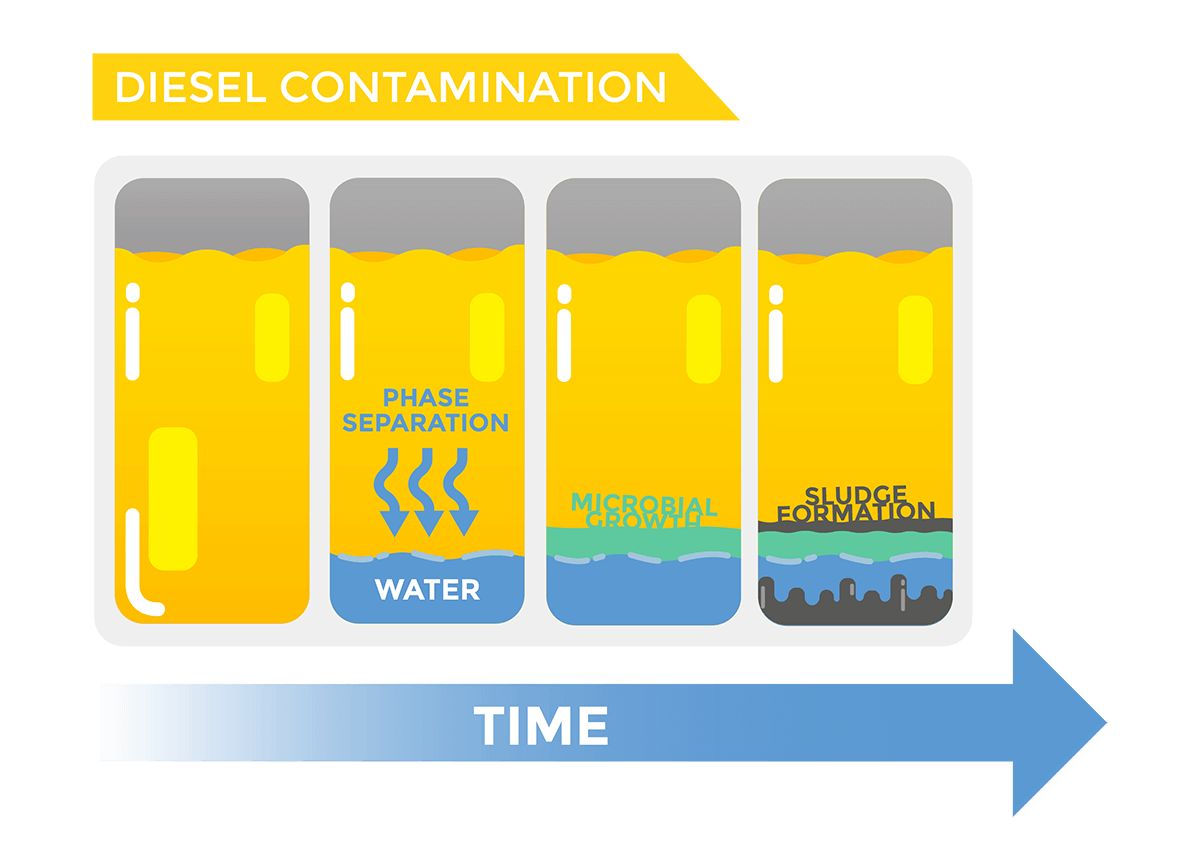
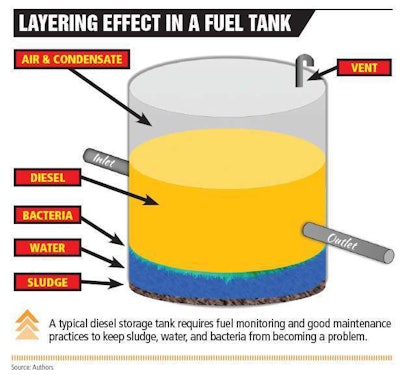
The following photos and illustrations of contaminated diesel fuel stratification are interesting. The locales of biomass, bacteria and microbes appear to fall into two zones.
- The upper zone is above the water at the bottom of the tank, where the living, blooming bacteria thrive on the nutrients in the diesel layer above, while being sustained by the water layer beneath.
- The lower zone is where the dead bacteria and heavier contaminate mass sank through the water to the bottom, forming the sludge.
Does "eliminating biomass" in the lower layer of dead contaminant artifacts, along with the unwanted medium that supports it (water) should be interpreted literally... mean pumping it out from the bottom of the tank at every cold start, under the presumption that the additional filters will separate the good fuel from the bad stuff before reaching the fuel bowl?
Is the operating idea that if the heavier water is continually pumped out, there will be less moisture at the bottom of the tank to support microbial growth in the upper water to fuel interface?
Is the operating idea that if the heavier water is continually pumped out, there will be less moisture at the bottom of the tank to support microbial growth in the upper water to fuel interface?
This is my thought process.
I figure that while in operating season and the tank is constantly circulating fresh fuel this shouldn’t be a problem.
It’s when it goes into hibernation for 5 months that this biomass can occur. If just before storage I go fill the tank and there are any contaminants those will get filtered out and with the tank being full there is less room for condensation to occur, again helping to reduce this risk.
I’m also diligent about starting the truck on a regular basis to keep things lubricated and circulated so if any contaminants drop out they won’t have time to fester.
Again that is the thought process.
I think the biggest key to this is knowing the station I’m fueling at and not fuelling at a station that is being fuelled.
By siphoning it off at the bottom of the tank,
the "Biomass" will never, ever, have a chance to form in the first place.
Biomass requires water and dirty solids, like hay field dust, yes, that got me with our tractor, when I had to refuel it with the wind blowing in the wrong direction.
that tractor quit about 30 minutes after I filled the tank, the fuel filter had to be changed twice.
BUT, once that filter was clean again, it started right up like it is supposed to.
This Hennessey Takes the Expedition Tremor's Off-Roading Capability to the Next Level
Slideshow: The VelociRaptor Expedition gains a lift, upgraded suspension, Brembo brakes, and trail-ready equipment while retaining the stock 440-horsepower EcoBoost V6.
Rezvani's Latest Post-Apocalyptic Monster Is a Ford F-150 Raptor Underneath
Slideshow: Called the Fortress, the 850-horsepower pickup combines Raptor underpinnings with military-inspired features, survival equipment, and a starting price of $285,000.