


Cummins swap/frame question

FTE Legend


Joined: Jul 2010
Posts: 32,875
Likes: 48
From: Northeast, OK
The GLK has no instrumentation whatsoever on the turbos. And, since they are computer-controlled there's little way to bring them in and then back out as the 'puter will bring them back in should conditions require them.
Lead Driver

Joined: Feb 2013
Posts: 5,006
Likes: 72
From: Roseville, MN
By the way, you don't need to bother with calibrating the speedo right away either. Just figure out how much it's off and you can guess your real speed pretty well from looking at the uncalibrated speedo. If you decide to keep the 2.75s you can calibrate it later, and if not you won't have wasted that effort.

Thread Starter
|
Post Fiend
Joined: Dec 2007
Posts: 8,521
Likes: 16
From: Lost
you don't need to bother with calibrating the speedo right away either. Just figure out how much it's off and you can guess your real speed pretty well from looking at the uncalibrated speedo. If you decide to keep the 2.75s you can calibrate it later, and if not you won't have wasted that effort.
Thread Starter
|
Post Fiend
Joined: Dec 2007
Posts: 8,521
Likes: 16
From: Lost
The plot thickens on the "free" flywheel/clutch. The 6 speed uses a spacer on the starter. I assume this means the starter ring gear on the flywheel is closer to the back of the engine. This spacer can be bought from a few sources, so it's not too big of a deal, if it's needed....
The wierd thing is, the flywheel is drilled for either the 12.25" or 13" clutch. This is common for the 5 speed flywheels, but since all 6 speeds used the 13" clutch, and the flywheel is claimed to be unique, it seems odd that this one is dual drilled.
Not sure how to pinpoint whether this is a "true" 6 speed flywheel, which would require the spacer, or a dual drilled 5 speed flywheel.
The cost of the spacer, added to the larger input shaft kit, brings the cost of using this "free" clutch/flywheel within a few dollars of buying a new "stock" 5 speed clutch/flywheel.
Yes, I still *should* replace the input shaft. But, I have a good used stock input shaft sitting on my toolbox......
The wierd thing is, the flywheel is drilled for either the 12.25" or 13" clutch. This is common for the 5 speed flywheels, but since all 6 speeds used the 13" clutch, and the flywheel is claimed to be unique, it seems odd that this one is dual drilled.
Not sure how to pinpoint whether this is a "true" 6 speed flywheel, which would require the spacer, or a dual drilled 5 speed flywheel.
The cost of the spacer, added to the larger input shaft kit, brings the cost of using this "free" clutch/flywheel within a few dollars of buying a new "stock" 5 speed clutch/flywheel.
Yes, I still *should* replace the input shaft. But, I have a good used stock input shaft sitting on my toolbox......
Thread Starter
|
Post Fiend
Joined: Dec 2007
Posts: 8,521
Likes: 16
From: Lost
Want to talk about strong, they make dual and triple disc 13" clutch setups for these. THAT would be overkill..........
Cost on those starts in the $1200 range, and goes up quickly. I am not even going to consider that route.......
FTE Legend
Joined: Jul 2010
Posts: 32,875
Likes: 48
From: Northeast, OK
There is a balance between strong and rapid engagement. Larger clutches and those with multiple disks have more surface area. Too much surface area and there is little to no slip when engaging. So starting from a stop is a problem.
Thread Starter
|
Post Fiend
Joined: Dec 2007
Posts: 8,521
Likes: 16
From: Lost
Finally got in touch with the guy that the boss figured would have the engine mounting plate/adapter I need, and he says he has an extra one. Supposed to bring it by the shop next time he comes this way. Very reasonable price too. About 1/4th of the usual asking price.......
This will allow me to test fit the flywheel, and see if it needs that spacer or not. I am leaning towards foregoing the 13" clutch, since the bigger input shaft kit is nearly the same cost as a new clutch in stock size.
If the spacer is needed, it's cost is also the same as the difference in price between the clutch kit alone, and one that includes a new flywheel.
I have a good stock input shaft I can swap in. I think I'll try to keep my clutch costs down, so I can get it together quicker. There's still other stuff I'll have to buy along the way......
The current flywheel is drilled for either size clutch, so it will be used if the spacer isn't needed.
FTE Stories
Ford Trucks for Ford Truck Enthusiasts

10 Fords to Drive Before You Die
Joe Kucinski
3 Best / Worst Features Of The 2025+ Ford Expedition
Brett Foote
10 Ways Ford is LOSING to the Competition
Joe Kucinski
Top 6 Best Deals Available on New Fords & Lincolns Right Now
Brett Foote
This Hennessey Takes the Expedition Tremor's Off-Roading Capability to the Next Level
Verdad Gallardo
Top 10 Fords at 2026 Carlisle Ford Nationals
Joe Kucinski
3 Best / 3 Worst Parts of Modern Ford Ownership
Brett Foote
10 Amazing Upgrades That Solve Common Ford Truck Owner Headaches
Pouria Savadkouei
Every 2026 Ford Engine Explained
Brett Foote
Thread Starter
|
Post Fiend
Joined: Dec 2007
Posts: 8,521
Likes: 16
From: Lost
That doesn't mean I'm going to toss all that stuff. There could be a time when I actually need to put it to use.....
Thread Starter
|
Post Fiend
Joined: Dec 2007
Posts: 8,521
Likes: 16
From: Lost
Made a little progress today. Went to the shop to do this:


I popped the balancer and front cover off to deal with the KDP (killer dowel pin). The KDP had worked it's way out about 1/4". Not as bad as some, but still not good.
I punched it back into place, then set about making a retainer plate to keep it from ever coming out unexpectedly. (sorry, no pics of that. I forgot I have this fancy new phone that can do that kinda thing, until I was ready to come home)
Put the retainer in place, and used red locktite on the bolt that holds it in. Pretty sure it's not gonna escape.......
Put the front cover and balancer back on, even though they may need to come back off, for a new front crank seal.
Then I set about cleaning the injector bores. They were NASTY. Someone has had the injectors out of this engine before, and didn't use the copper sealing washers under them. The injectors were already pulled out when I got the engine, but they were included. Likely going to just buy new 40HP injectors, since they cost right at the same as having the current injectors rebuilt, and they have a better spray pattern than the original "large tip" ones that fit my engine. The better spray pattern came along at the same time as the tip was reduced from 9mm to 7mm. They make copper sleeves with the sealing washer integrated for just such applications.
Gratuitous pic of the trans, partly torn apart. You can see the 13" clutch and flywheel in the background.

A close up view of the air intake tube. The top row of lettering will be removed.......

And, a straighter shot at the front.

I popped the balancer and front cover off to deal with the KDP (killer dowel pin). The KDP had worked it's way out about 1/4".
Not as bad as some, but still not good.I punched it back into place, then set about making a retainer plate to keep it from ever coming out unexpectedly. (sorry, no pics of that. I forgot I have this fancy new phone that can do that kinda thing, until I was ready to come home)
Put the retainer in place, and used red locktite on the bolt that holds it in. Pretty sure it's not gonna escape.......
Put the front cover and balancer back on, even though they may need to come back off, for a new front crank seal.
Then I set about cleaning the injector bores. They were NASTY. Someone has had the injectors out of this engine before, and didn't use the copper sealing washers under them. The injectors were already pulled out when I got the engine, but they were included. Likely going to just buy new 40HP injectors, since they cost right at the same as having the current injectors rebuilt, and they have a better spray pattern than the original "large tip" ones that fit my engine. The better spray pattern came along at the same time as the tip was reduced from 9mm to 7mm. They make copper sleeves with the sealing washer integrated for just such applications.
Gratuitous pic of the trans, partly torn apart. You can see the 13" clutch and flywheel in the background.
A close up view of the air intake tube. The top row of lettering will be removed.......
And, a straighter shot at the front.
Thread Starter
|
Post Fiend
Joined: Dec 2007
Posts: 8,521
Likes: 16
From: Lost
Before anyone asks, yes the oil filler tube is leaning over. I didn't tighten it down all the way, since it has to come back off to install the injection pump.
No, I didn't clean the outside of the front cover. I will be power washing the entire engine once I have all the holes filled with their proper items. The injectors and injection pump aren't in it, and that leaves 6 holes leading directly into the cyls, and a big one that will let water into the crankcase.
No, I didn't clean the outside of the front cover. I will be power washing the entire engine once I have all the holes filled with their proper items. The injectors and injection pump aren't in it, and that leaves 6 holes leading directly into the cyls, and a big one that will let water into the crankcase.


Thread Starter
|
Post Fiend
Joined: Dec 2007
Posts: 8,521
Likes: 16
From: Lost
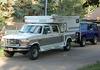
I should have got a pic of it when I had it hanging in the air. I swung one arm of that big lift around, and picked it up. In order to get it come out of the back of the truck, I had to deflate the rear tires, and drive out from under it. Figured that was easier than trying to use the forklift to pick up the pallet it was on, even though that was how it got loaded into the truck.
FTE Legend
Joined: Jul 2010
Posts: 32,875
Likes: 48
From: Northeast, OK
Yes, progress is good. And, I like the ingenuity of deflating the tires to get out from under it. 
As for the air inlet's lettering, is the tube flat-sided or rounded? It looks rounded but if flat we could mill the letters off.
And, I just sent you a PM that might should'a been posted here. And, I can do that if you want as we might want more input than just the two of us.
As for the air inlet's lettering, is the tube flat-sided or rounded? It looks rounded but if flat we could mill the letters off.
And, I just sent you a PM that might should'a been posted here. And, I can do that if you want as we might want more input than just the two of us.