When you click on links to various merchants on this site and make a purchase, this can result in this site earning a commission. Affiliate programs and affiliations include, but are not limited to, the eBay Partner Network.
My dad used to have an 87 F150 with an EFI 302. That poor 302 could get that truck rolling, but that's about it. Put a trailer on the back of it, especially a trailer loaded with a 1980 F100, and that truck would struggle!
However, it dawned on me today that I'm running straight antifreeze - no water. I thought I'd bought the pre-mixed stuff, but it isn't and there isn't a drop of water in it. Would that cause it to run warm on an 80˚ day? I can drain about half of it out and put water in, but I'm wondering if I should go with the aluminum radiator that I had in Dad's truck while doing that.
Yes, no water would cause a rise in the temperature. Optimally is a 60/40 split (60% anti-freeze and 40% water). I do a back flush on my truck at least once every two or three years. I have a good way to do it if you are interested. Let me know if you want it.
Dave - I knew that pure antifreeze has less heat transfer ability than a 60/40 split. But, I was really wondering if anyone thought I was running close enough to the limit of the cooling system that it would cause it to run essentially two letters warmer on the gauge when pulling the trailer. But, then again, I'm not sure the gauge isn't having ICVR problems. Oh well, I know I need to drain some antifreeze out and replace it with water, so will do and see how much that helps. Thanks.
Today I finally had time to check out why Rusty was idling so poorly. It had gotten so bad that I had to put it in Neutral and give it some gas to keep it running at a stop. So I pulled the top to the E'brock to see what kind of junk was in there, even though I run two filters in the fuel line. Sure enough, the driver's side had a piece of something in the bowl, as shown in the picture. It is ~ 3/8" long and was right by the main jet, so my theory was that it was covering the jet and causing problems. However, after putting it all back together nothing had changed. I still had the idle stop screw turned in at least a turn from where it had been before I moved the engine to Rusty, and the idle was still awful. And, the exhaust stank.
OK, time for a little tuning, so I put the vacuum gauge on and found something like 13" of vacuum. At that point I wondered if the timing had gotten bumped, but it is still sitting on 16˚ BTDC. Then I played with the idle mix screws and everything got better the further I screwed them out - until they fell out of the carb, at which point the engine died. And even just before they fell out the vacuum was only 14", so there was some problem in the idle circuit.
With the screws out I pulled all of the vacuum lines off and put 100 PSI air to each fitting and idle screw hole. (Try that with your Holley! ) I put the idle screws in, preset to 2 1/2 turns, connected all the vacuum lines, and started it. Wow! It was like the fast idle was stuck on high! I took over a turn off the idle stop screw and it was still running at over 1000 RPM and 20" of vacuum. Got the idle down to 600, turned the idle mix screws IN, and the best vacuum turned out to be 17 - 18", right where it was before I moved the engine from Dad's truck to Rusty. Problem solved.
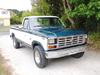
Looks like it is time to resurrect this thread since I'm doing quite a bit of work to Rusty. Why? Because he's about to be used for several things, including a trip to pick up Dad's engine from the machine shop, a trip or two to see Dad, and then in November a 200 mile round trip towing a trailer to pick up a 50 Chevy pickup.
So, what's been done? Here are a few things:
AFR gauge: I installed my new AEM Wideband AFR gauge, which not only records AFR but also RPM and manifold vacuum.
Tuned carb: Using the AFR meter I determined that the carb wasn't right, so rebuilt it. Then I found that once right it was too rich at cruise as well as WOT, so changed the jets as well as rods to dial it in.
Transfer case: The NP208 was leaking from the region of the shift detent, and I initially thought a gasket was leaking. But, after cleaning that area I determined that the case was cracked. So I swapped the t-case out for the one that I had rebuilt.
Tires & wheels: I really don't like the whine of the heavy-lugged tires that were on Rusty, so swapped them with the lighter tires on aluminum wheels that are destined for Dad's truck. That quietened things down so much that I then could hear many rattles that had previously been masked.
Passenger's door: One of the worst areas for rattles was the passenger's door. So I pulled it apart and found the storage bin wasn't screwed on well, the lock linkage wasn't attached and rattling, and the window run was so hard and broken that it allowed the window to rattle and wind to come in. So I replaced the window run with a new one, attached the lock linkage, and cleaned up the nasty storage bin and screwed it down. Now when you close the door it is so tight there's no rattle.
Ok, that's what has been done. Today I pulled the door panel off the driver's door and had what I thought was a brilliant idea - why not sand blast the UV-damaged mealy plastic off and get down to good plastic? So, that's what I did and it looked so good that I wanted to paint it. Unfortunately, all I could find was a Chevy color - Desert Sand. Oh well, so I painted it. Yuk! It is just wrong for Rusty. So, I think I'll order the correct SEM paint and do it right.
Here's a shot of the panel after I painted it. Unfortunately I don't have a shot showing what it should be, but this just isn't right. And, there are nubs sticking up in many places. So, I guess it is time to get the right paint, sand it down, and paint it again.
I got the driver's door re-done today, inc new window run, a new weather seal using a plastic bag, the arm rest and storage compartment cleaned, and the door panel installed. But, that gave me a really good (bad?) look at the Chevy Desert Sand beside Ford's tan. YUK! The Desert Sand has a green look to it when compared to the original color and looks sick.
But, I do have two cans of what I think is the right SEM paint on its way so maybe next week, just before the GTG, I can get the panels painted. In any event, the doors shut sooooo much better with the windows not rattling due to the brick-hard runs - and the runs were only about 2/3's there as many pieces had broken off. I'm sure that driving it will be that much better as well - as soon as the temp goes down enough to drive with the windows closed.
Anyway, here's the driver's door showing the contrast in colors. And, yes this pic makes the door panel look quite different than the previous pic did, but trust me - this is much closer to what it really looks like.
Got the "new" later model coolant/washer fluid reservoir installed today. Here's what it takes.
The early model has a tab on the bottom that goes into a bracket that screws to the fender. But the later model has a pin - in a different location. If you are smart you get the bracket along with the reservoir. But, if you are like me follow along.
Here's a marked-up shot of the bracket showing where I drilled a 5/16" hole to take the pin, which lets the later model reservoir bolt right into the earlier trucks.
And here's what it looks like mounted:
The only other thing is that the outlet for the washer fluid is a larger diameter on the newer reservoir than the earlier ones. But my hose had a step-down about 3" from the reservoir and when I took that off the hose was long enough to fit right on the barb. And, now the windshield washer works and I'm not worried about the coolant hose not reaching the bottom.
Jim - As the attachment shows the early ones, like I replaced, came in 80 - 84's while the later ones were 85 & 86 - both styles with gas engines. And then in 87 they changed again.
As said earlier, you really should get the bracket when you get the 85/86 reservoir. Here's the illustration from the parts catalog showing the generic part # is 17651:
And here's the text entry from the catalog. Unfortunately it omits either the 80/84 single battery usage or the 85/86 bracket so I can't find the true part #. In other words, you'd better get it at the salvage or you'll have to modify yours as you can't order it w/o the #.
Got the SEM paint in today and I just had to try a spot. Here's the spot, circled in red, and the paint is a very good match for the storage compartment.
And, here's the paint. Turns out SEM's Palomino is a good match for Ford's Code U interior color called Fawn.
Actually, the way I read LMC's catalog that's an even later style, the 87-96 one, and is probably the one Jim mentioned that he has with the reservoirs swapped. So I don't know that it will work - but don't know that it won't either.
Here's the catalog entry again, with the early one in yellow and the later 85-86 version in green. The 87-96 is probably a few lines down. I'll do a search for a new 85-86 reservoir.
EDIT: Rear Counter says none are available at any Ford dealers. Google did give me hits at other locations, but all I saw were for a different #, frequently -B, which is for the diesel. Maybe just what you need, Paul/RW.
Is the diesel the single tank model pictured on that page?
Obviously a larger overflow tank, and mounted out of the way of a second battery tray on the drivers side.
Rezvani's Latest Post-Apocalyptic Monster Is a Ford F-150 Raptor Underneath
Slideshow: Called the Fortress, the 850-horsepower pickup combines Raptor underpinnings with military-inspired features, survival equipment, and a starting price of $285,000.







 At that point I wondered if the timing had gotten bumped, but it is still sitting on 16˚ BTDC. Then I played with the idle mix screws and everything got better the further I screwed them out - until they fell out of the carb, at which point the engine died. And even just before they fell out the vacuum was only 14", so there was some problem in the idle circuit.
 ) I put the idle screws in, preset to 2 1/2 turns, connected all the vacuum lines, and started it. Wow! It was like the fast idle was stuck on high! I took over a turn off the idle stop screw and it was still running at over 1000 RPM and 20" of vacuum. Got the idle down to 600, turned the idle mix screws IN, and the best vacuum turned out to be 17 - 18", right where it was before I moved the engine from Dad's truck to Rusty. Problem solved.