


Engine Rebuild Part 2

Lead Driver


Joined: Dec 2000
Posts: 6,293
Likes: 47
From: South central, Minnesota
Is your set the hex nuts or the 12 point? I'm going 12-point on mine. I think the 12-point nuts will give a little more clearance.
Lead Driver


Joined: Mar 2008
Posts: 7,182
Likes: 380
From: Near Los Angeles
I'm sorry, maybe I wasn't clear. The cliff v.cover is taller than the oem cover. So there are no problems with the rocker arms or the ARP rocker studs hitting. However, one of the ARP studs that secures the head to the block, does hit on the mounting lip (where the bolts go to hold the v.cover to the head) of the Clifford v.cover. Only one hits. I simply removed a bit of aluminum from the underside of the lip where it used to hit. Now it does not affect the seal.
Thread Starter
|
Moderator
Joined: Dec 2007
Posts: 7,987
Likes: 104
From: Boise, Idaho

No worries, that makes sense. I thought it was just a height thing.
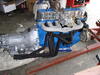
So, stopped by again this morning to drop off the spacer ring for the cam so that he could get the cam dialed in.
The crank was laid in and turned nice and smooth, so no need to worry about the bearing tolerances. It turned great.


So, stopped by again this morning to drop off the spacer ring for the cam so that he could get the cam dialed in.
The crank was laid in and turned nice and smooth, so no need to worry about the bearing tolerances. It turned great.
Lead Driver
Joined: Mar 2008
Posts: 7,182
Likes: 380
From: Near Los Angeles
I'm curious about the roll pin beside #7 and #5 main caps in the first photo. What is their purpose? They are not present on my block/engine. Are they to help position?
Oh, and it all looks great.
Oh, and it all looks great.
Thread Starter
|
Moderator
Joined: Dec 2007
Posts: 7,987
Likes: 104
From: Boise, Idaho
Originally Posted by F-250 restorer
I'm curious about the roll pin beside #7 and #5 main caps in the first photo. What is their purpose? They are not present on my block/engine. Are they to help position?
Oh, and it all looks great.
Oh, and it all looks great.
FTF, do you know what those are for?
FTE Stories
Ford Trucks for Ford Truck Enthusiasts

Top 10 Most Expensive Ford Trucks Ever Sold on Bring a Trailer
Joe Kucinski
2027 Ford Super Duty Buyer's Guide (Every Model, Engine, & Package)
Brett Foote
Top 10 Ford Truck Tragedies
Joe Kucinski
AEV FXL Super Duty - the Super Duty Raptor Ford Doesn't Make
Brett Foote
Lobo Vs Lobo: Proof the F-150 Lobo Should Be Even Lower!
Michael S. Palmer
Ford's 2001 Explorer Sportsman Concept Looks For a New Home
Verdad Gallardo
10 Best Ford Truck Engines We Miss the Most!
Joe Kucinski
2026 Shelby F-150 Off-Road: Better Than a Raptor R?
Brett Foote
2027 Super Duty Carhartt Package First Look: 12 Things You NEED to Know!
Michael S. Palmer
Lead Driver
Joined: Mar 2008
Posts: 7,182
Likes: 380
From: Near Los Angeles
Is that something Ford did only on certain years? I have a '75 and they are absent.
Tuned
Joined: May 2009
Posts: 300
Likes: 5
From: Apex, NC
Looking great AB, it seems you are at about the same stage of reassembly that I am with mine. Could you do me a favor? After the crank gear is installed, could you measure the distance between the back of the gear and the face of the block? I have mine installed and I'm not certain that mine is set completely back far enough. It would seem that the gear is meant to "bottom out" on the radius fillet on the crank, but I have no what of knowing if I'm back that far or not.
I heated the gear and it did slip on farther than when cold, but in no way "dropped right on" as is claimed by many. I had to use the balancer and the snout bolt to get it to go on as far as it did. Extremely difficult and I finally stopped when I hit 140 ft lbs on my torque wrench, but it seems like it should go back further?
I have about 1.84 mm behind my gear.
I heated the gear and it did slip on farther than when cold, but in no way "dropped right on" as is claimed by many. I had to use the balancer and the snout bolt to get it to go on as far as it did. Extremely difficult and I finally stopped when I hit 140 ft lbs on my torque wrench, but it seems like it should go back further?
I have about 1.84 mm behind my gear.

Freshman User

Joined: Feb 2015
Posts: 36
Likes: 0
Hey AB man looks like you are doing a nice rebuild. I have read through a ton of threads on here and all over the innerweb trying to decide which way to go with my rebuild. I have a '72-240,81-300,85-300 engine. I was looking at doing something similar to what you are doing. Man does it get confusing when everybody starts talking numbers. I enjoy all the input from you and everybody else. I wish I had a local shop like you got there. I was thinking of boring the 300 block and using my 240 head. I am still up in the air one whether upsize the valves. I will keep reading your post and listening to everybody's input.
Fleet Mechanic
Joined: Nov 2002
Posts: 1,643
Likes: 69
Looking great AB, it seems you are at about the same stage of reassembly that I am with mine. Could you do me a favor? After the crank gear is installed, could you measure the distance between the back of the gear and the face of the block? I have mine installed and I'm not certain that mine is set completely back far enough. It would seem that the gear is meant to "bottom out" on the radius fillet on the crank, but I have no what of knowing if I'm back that far or not.
I heated the gear and it did slip on farther than when cold, but in no way "dropped right on" as is claimed by many. I had to use the balancer and the snout bolt to get it to go on as far as it did. Extremely difficult and I finally stopped when I hit 140 ft lbs on my torque wrench, but it seems like it should go back further?
I have about 1.84 mm behind my gear.
I heated the gear and it did slip on farther than when cold, but in no way "dropped right on" as is claimed by many. I had to use the balancer and the snout bolt to get it to go on as far as it did. Extremely difficult and I finally stopped when I hit 140 ft lbs on my torque wrench, but it seems like it should go back further?
I have about 1.84 mm behind my gear.
There should be a chamferred spacer ring, sometimes referred to as the "wedding band", that slips over the cam (chamfer facing rearwards) that is a few thou thicker than the thrust retainer plate. This sets the fore/aft movement of the cam around .002 - .006". It is not unheard of for an assembler to leave out that critical wedding band.
Thread Starter
|
Moderator
Joined: Dec 2007
Posts: 7,987
Likes: 104
From: Boise, Idaho

But yeah, the guy's a pro. I'm really thankful to have stumbled upon him as he really knows his stuff, which is especially helpful when I'm not doing a stock build and am picking and mixing parts.