




Engine Rebuild Part 2

Thread Starter
|
Moderator


Joined: Dec 2007
Posts: 7,987
Likes: 104
From: Boise, Idaho

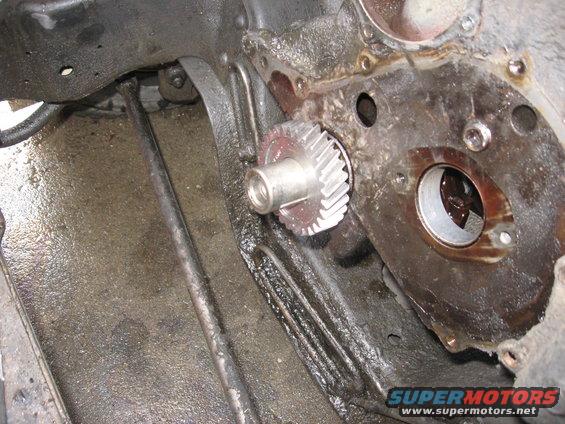
Looking great AB, it seems you are at about the same stage of reassembly that I am with mine. Could you do me a favor? After the crank gear is installed, could you measure the distance between the back of the gear and the face of the block? I have mine installed and I'm not certain that mine is set completely back far enough. It would seem that the gear is meant to "bottom out" on the radius fillet on the crank, but I have no what of knowing if I'm back that far or not.
I heated the gear and it did slip on farther than when cold, but in no way "dropped right on" as is claimed by many. I had to use the balancer and the snout bolt to get it to go on as far as it did. Extremely difficult and I finally stopped when I hit 140 ft lbs on my torque wrench, but it seems like it should go back further?
I have about 1.84 mm behind my gear.
I heated the gear and it did slip on farther than when cold, but in no way "dropped right on" as is claimed by many. I had to use the balancer and the snout bolt to get it to go on as far as it did. Extremely difficult and I finally stopped when I hit 140 ft lbs on my torque wrench, but it seems like it should go back further?
I have about 1.84 mm behind my gear.
Originally Posted by The Frenchtown Flyer
There should be a chamferred spacer ring, sometimes referred to as the "wedding band", that slips over the cam (chamfer facing rearwards) that is a few thou thicker than the thrust retainer plate. This sets the fore/aft movement of the cam around .002 - .006". It is not unheard of for an assembler to leave out that critical wedding band.
If anyone ever needs it, you can get it here:
Engine finishing kit Ford 240 /300 4.9 liter #fkf-4
However, that's not the same for the crank gear. If I remember right, you just press the crank gear on as far as it'll go.
When I put one on previously, I got a steel pipe that had a larger inner diameter than the end of the crank and just tapped it on the rest of the way. It worked well.

Thread Starter
|
Moderator
Joined: Dec 2007
Posts: 7,987
Likes: 104
From: Boise, Idaho
Hey AB man looks like you are doing a nice rebuild. I have read through a ton of threads on here and all over the innerweb trying to decide which way to go with my rebuild. I have a '72-240,81-300,85-300 engine. I was looking at doing something similar to what you are doing. Man does it get confusing when everybody starts talking numbers. I enjoy all the input from you and everybody else. I wish I had a local shop like you got there. I was thinking of boring the 300 block and using my 240 head. I am still up in the air one whether upsize the valves. I will keep reading your post and listening to everybody's input.
The 300 block with the 240 head sounds like a great combo. I was thinking of doing that but it ended up being more cost effective for me to simply up the compression by getting the proper connecting rods to use higher compression 351w pistons. They both accomplish roughly the same thing (although I think the 240 head may have another perk or two in the chambers, but I can't remember).
As far as upping the size on the valves, that depends on what else you want to do with the engine. For starters, bigger valves aren't going to do much for you if you don't open up the head to accommodate for them. Otherwise, you have the same sized runners that simply open up at the end to make room for a bigger valve. On that note, my full on porting job for this was not cheap, and was roughly a little over $100 a cylinder. So, it depends on where you want to put your money. You could always do it yourself, though.
Anything to help the head breath is always beneficial on this engine.

Fleet Mechanic
Joined: Nov 2002
Posts: 1,643
Likes: 69
Whoops - my bad - I thought you were talking cam gear. the crank gear has a chamfer on the bore so the gear can be pressed flush up against the crank journal. It sounds like the gear may be on backwards. Can you see a chamfer on the front of the gear bore? If so turn it around. Also, inspect the crank to see that the fillet radius on the front crank journal did not get galled up. The fillet radius is there on the #1 journal to reduce the stress riser that could lead to premature crank snout failure. If it gets galled up its effect is diminished. Especially critical on poly-vee drive systems.

Freshman User

Joined: Feb 2015
Posts: 36
Likes: 0
Thanks AB. I noticed the pistons in the older block had pistons that looked like those silv-o-lite pistons (1170-030) they had the small dish. I was thinking maybe using the h519p30 speed pro's. Using 240 head and upsizing the valves to the 1.9 int and 1.6 exh. The porting and polishing I have done before. I just finished a 4.0 jeepster and it took me more like 20 hours to do mine. I read this entire thread and didn't you use the 240 rod?
Thread Starter
|
Moderator
Joined: Dec 2007
Posts: 7,987
Likes: 104
From: Boise, Idaho
Thanks AB. I noticed the pistons in the older block had pistons that looked like those silv-o-lite pistons (1170-030) they had the small dish. I was thinking maybe using the h519p30 speed pro's. Using 240 head and upsizing the valves to the 1.9 int and 1.6 exh. The porting and polishing I have done before. I just finished a 4.0 jeepster and it took me more like 20 hours to do mine. I read this entire thread and didn't you use the 240 rod?
As for the rods, I used 300 rods (the 240s would be the wrong length). From 1965 - 1968, they used a 0.912" wrist pin, which is the same as the 351v8. After '68, they went to the 0.975", which is what the FE engine family uses.
You can use 390v8 pistons, but they start at a 4.05" bore and I had already bored my block and I didn't want to pay to have it bored out more. Plus, I didn't want to bore my block out any more than I had to.
Sounds good on the port and polish, that'll be awesome. If you do, post some pics!
Thread Starter
|
Moderator
Joined: Dec 2007
Posts: 7,987
Likes: 104
From: Boise, Idaho
A bit of an update.
My builder was in the Christmas spirit last week after he degreed the cam, so he just went ahead and installed all the rings pistons, crank, bearing caps, the whole deal on his own time. So the block is done.
He'll have the valves done this week, and then I have about another $150 to pay on it, and it's....
DONE

I should be able to pick it up this weekend or next weekend.
The cam is degreed. It called for 106°, but the closest he could get it was 107°, which he said would be unnoticleable. He also said that most cam degree specifications factor in a small amount of slop for timing chains/belts, which would put a 106° cam around 107° anyway, and that since our engines are gear driven, there's no slop and it'd be right around the same place. Makes sense I suppose.
Heh, the last thing he taunted me with was a shop he works with does an on-stand engine break-in/dyno tune. They spend a couple days over the weekend breaking in the cam, seating the rings, and fine tuning the carb.
But it's about $600 for the procedure...
My builder was in the Christmas spirit last week after he degreed the cam, so he just went ahead and installed all the rings pistons, crank, bearing caps, the whole deal on his own time. So the block is done.
He'll have the valves done this week, and then I have about another $150 to pay on it, and it's....
DONE
I should be able to pick it up this weekend or next weekend.
The cam is degreed. It called for 106°, but the closest he could get it was 107°, which he said would be unnoticleable. He also said that most cam degree specifications factor in a small amount of slop for timing chains/belts, which would put a 106° cam around 107° anyway, and that since our engines are gear driven, there's no slop and it'd be right around the same place. Makes sense I suppose.
Heh, the last thing he taunted me with was a shop he works with does an on-stand engine break-in/dyno tune. They spend a couple days over the weekend breaking in the cam, seating the rings, and fine tuning the carb.
But it's about $600 for the procedure...
Lead Driver
Joined: Mar 2008
Posts: 7,182
Likes: 380
From: Near Los Angeles
I'll bet that was a nice surprise. Good for you, AB. What an exciting time.
Iirc, your cam is ground with a 110* LSA, right? and the builder was advancing it to 106*? but b/c of variables, etc., it ended up at 107. Is that right? As he said, I'm sure you won't notice.
I have a hundred questions, but you won't be able to answer until you drive it, so I'll wait to ask.
Iirc, your cam is ground with a 110* LSA, right? and the builder was advancing it to 106*? but b/c of variables, etc., it ended up at 107. Is that right? As he said, I'm sure you won't notice.
I have a hundred questions, but you won't be able to answer until you drive it, so I'll wait to ask.
FTE Stories
Ford Trucks for Ford Truck Enthusiasts

Top 10 Most Expensive Ford Trucks Ever Sold on Bring a Trailer
Joe Kucinski
2027 Ford Super Duty Buyer's Guide (Every Model, Engine, & Package)
Brett Foote
Top 10 Ford Truck Tragedies
Joe Kucinski
AEV FXL Super Duty - the Super Duty Raptor Ford Doesn't Make
Brett Foote
Lobo Vs Lobo: Proof the F-150 Lobo Should Be Even Lower!
Michael S. Palmer
Ford's 2001 Explorer Sportsman Concept Looks For a New Home
Verdad Gallardo
10 Best Ford Truck Engines We Miss the Most!
Joe Kucinski
2026 Shelby F-150 Off-Road: Better Than a Raptor R?
Brett Foote
2027 Super Duty Carhartt Package First Look: 12 Things You NEED to Know!
Michael S. Palmer
Thread Starter
|
Moderator
Joined: Dec 2007
Posts: 7,987
Likes: 104
From: Boise, Idaho
It was a very nice surprise.
And yeah, 110° lobe center with a 4° advance. I didn't ask directly why he couldn't get it right on the 106 but I imagine it had something to do with the availability of cam keys, new deck height, etc. So, it ended up at 107°.
No worries, I have a lot of questions myself. Looking forward to getting it in and fired up.
Still a number of things to do once I get it home though. Assembly, paint, etc.
And yeah, 110° lobe center with a 4° advance. I didn't ask directly why he couldn't get it right on the 106 but I imagine it had something to do with the availability of cam keys, new deck height, etc. So, it ended up at 107°.
No worries, I have a lot of questions myself.
Looking forward to getting it in and fired up.Still a number of things to do once I get it home though. Assembly, paint, etc.
Lead Driver
Joined: Mar 2008
Posts: 7,182
Likes: 380
From: Near Los Angeles
Hey AB, I'm curious about your chamber size, and your final static c.r. When I run the numbers I come up with 9.26 static c.r., with a 73cc chamber. I must have missed something. I got zero deck, .039 gasket thickness, and 4.180 gasket bore diameter, 19 cc piston dish, 4.030 cylinder bore? Where did miscalculate?
Thread Starter
|
Moderator
Joined: Dec 2007
Posts: 7,987
Likes: 104
From: Boise, Idaho
Heya K,
I didn't zero deck the block. I left it at 0.005" so there's just a touch of meat on it in case I ever need to rebuild it in the future.
That still leaves it a tad higher than I was thinking, but I think I'll be alright due to the cam I'm using. It leaves the dynamic compression ratio in a safe range for regular gas.
It's still about 9.2:1 from what I'm figuring.
But, if I really need to, I can use the thicker .048" head gasket which will set it right around 9.05:1.
Now, the only thing that keeps throwing me when discussing the CR with my builder is that the program he uses has an extra variable that I've never seen anywhere else, and that's the Outer Diameter of the piston. Like the beveled edge and the small amount of space between the piston and the cylinder wall. It generally adds about 1.25ccs to the overall volume, which is good for about 0.1 CR difference.
However, like I said, I've never seen this factored in anywhere else or with any other resource.
I didn't zero deck the block. I left it at 0.005" so there's just a touch of meat on it in case I ever need to rebuild it in the future.
That still leaves it a tad higher than I was thinking, but I think I'll be alright due to the cam I'm using. It leaves the dynamic compression ratio in a safe range for regular gas.
It's still about 9.2:1 from what I'm figuring.
But, if I really need to, I can use the thicker .048" head gasket which will set it right around 9.05:1.
Now, the only thing that keeps throwing me when discussing the CR with my builder is that the program he uses has an extra variable that I've never seen anywhere else, and that's the Outer Diameter of the piston. Like the beveled edge and the small amount of space between the piston and the cylinder wall. It generally adds about 1.25ccs to the overall volume, which is good for about 0.1 CR difference.
However, like I said, I've never seen this factored in anywhere else or with any other resource.

Thread Starter
|
Moderator
Joined: Dec 2007
Posts: 7,987
Likes: 104
From: Boise, Idaho
Hey dd, Welcome to the forums!
I saw you mention it in another post, but where in northern Idaho are you?
I thought maybe 76522 was the zip, but that's Texas.
I used to have two 300 powered Broncos, and only have one now, but with the 13" of snow we got over the last two days, I wish I had the other one back!
I saw you mention it in another post, but where in northern Idaho are you?
I thought maybe 76522 was the zip, but that's Texas.
I used to have two 300 powered Broncos, and only have one now, but with the 13" of snow we got over the last two days, I wish I had the other one back!
Lead Driver
Joined: Mar 2008
Posts: 7,182
Likes: 380
From: Near Los Angeles
I saw that in another online calculator I was looking at, but of course I can't find it now. I do remember that I didn't know how to get the info it required.