



Tomahawk's Highboy Thread
Thread Starter
|
Postmaster
Joined: Jul 2009
Posts: 4,094
Likes: 5
From: Central Illinois
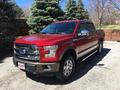
Good question Steve. The truck is a collection of parts....think psycho Billy Cadillac. I'm not 100% sure about any of this but......the front clip is from a '70. The cab is a '68, because it had a 3 hole gas tank and because of the seat belt shoulder harness location. The bed is '68, it had side reflectors but I had to drill holes for the rear reflectors and I didn't find any bondo bumps or signs the the holes were welded shut, but then again it could be a '67 that someone added side reflectors to. The engine or at least the block may have come from an industrial application as indicated by ribs on the outside of the casting. The front axle is from a '73-'75 crew cab. The frame, rear axle, instrument cluster and tranny were from dents, the bench seat is out of an '89 F_50, the radiator is made in China and to top it all off.........it's titled as a '71 F350.
*the sound of Steve passing out and falling on the floor*
*the sound of Steve passing out and falling on the floor*
Thread Starter
|
Postmaster
Joined: Jul 2009
Posts: 4,094
Likes: 5
From: Central Illinois
When I decided to convert my closed knuckle Dana 60 from drums to discs I was told by people who know a lot more about these truck than I do told me it was a bad idea. They were so right. It cost me way more time and money than just looking for an open knuckle Dana 44 or 60 with disc brakes. I would never do it again. The kit I got was $535 from Blackbirds Custom Trucks, but the guy no longer sells on-line. He does local business only now, he's located in Spokane, WA.

Posting Guru
Joined: Apr 2006
Posts: 1,477
Likes: 7
From: NAMPA, ID.
LEDs have a much lower current draw than an incandescent bulb. Without an added load (resistance) on the circuit and on the blinker relay, it will make the reed switch open and close at a much faster rate. This is known a 'hyper flashing' where the blinkers will flash at a very rapid rate.
The part I have a problem with is the claim that leds will make flashing faster, with the lower amperage draw it should make them flash slower, if at all.
The part I have a problem with is the claim that leds will make flashing faster, with the lower amperage draw it should make them flash slower, if at all.
Thread Starter
|
Postmaster
Joined: Jul 2009
Posts: 4,094
Likes: 5
From: Central Illinois
More current gives you more heat and the hotter your resistance wire or plate gets the slower it cools. Less heat or current the shorter the heating and cooling cycles are (powering one lamp instead of two). The LED does not provide enough heat (current) to close the flasher contact and stop the heating.
Lead Driver


Joined: Apr 2011
Posts: 6,399
Likes: 40
From: El Dorado, Arkansas
There's nothing wrong with having a collection of parts (body or mechanical) to further the cause of keeping one more of these trucks functional and still operating on the road.
The body and trim on my truck is all '69 Ranger but, I have numerous mechanical parts that aren't stock to my truck or even from a '67-'72 model F-series truck. Some of its parts are from the Dentsides, some from the Bullnose trucks, some from the '92-'96 model trucks, some from a '70 Thunderbird --it even has parts on it from an '89 Saleen Mustang, and in the future will have a 4R70W transmission from a '98 Mustang as well as the possibility of a 5.0L EFI H.O. engine from a '90 Mustang GT.
I think your truck (regardless of its compilation of parts) looks fantastic. I was just wondering why some things on it differ from what would have been the stock configuration of a '70 model Ranger. I didn't know the back story. Now It all makes sense.
The body and trim on my truck is all '69 Ranger but, I have numerous mechanical parts that aren't stock to my truck or even from a '67-'72 model F-series truck. Some of its parts are from the Dentsides, some from the Bullnose trucks, some from the '92-'96 model trucks, some from a '70 Thunderbird --it even has parts on it from an '89 Saleen Mustang, and in the future will have a 4R70W transmission from a '98 Mustang as well as the possibility of a 5.0L EFI H.O. engine from a '90 Mustang GT.
I think your truck (regardless of its compilation of parts) looks fantastic. I was just wondering why some things on it differ from what would have been the stock configuration of a '70 model Ranger. I didn't know the back story. Now It all makes sense.
FTE Stories
Ford Trucks for Ford Truck Enthusiasts

Top 10 Fords at 2026 Carlisle Ford Nationals
Joe Kucinski
3 Best / 3 Worst Parts of Modern Ford Ownership
Brett Foote
10 Amazing Upgrades That Solve Common Ford Truck Owner Headaches
Pouria Savadkouei
Every 2026 Ford Engine Explained
Brett Foote
10 Ugly Ford Trucks That We Still Kinda Love
Joe Kucinski
10 Things Every Truck Owner NEEDS (2026 Edition)
Michael S. Palmer
Rezvani's Latest Post-Apocalyptic Monster Is a Ford F-150 Raptor Underneath
Verdad Gallardo
Top 10 Most Expensive Ford Trucks Ever Sold on Bring a Trailer
Joe Kucinski
2027 Ford Super Duty Buyer's Guide (Every Model, Engine, & Package)
Brett Foote
Cargo Master
Joined: Nov 2005
Posts: 2,694
Likes: 45
From: La Ribera, Baja, Mexico
Thanks for the disc brake conversion numbers. Mine is a '68 Big Ball 44HD front axle, and now I have the numbers, is it really worth the kit price and the effort to switch it over..???
I do like your adjustable drag link though, as when I did the PS conversion, I ended up jus tsleeving and welding up a solid drag link. As it is, I am able to turn tighter to the left, than to the right... not by much, but a noticeable amount in tight spots.
Baja
I do like your adjustable drag link though, as when I did the PS conversion, I ended up jus tsleeving and welding up a solid drag link. As it is, I am able to turn tighter to the left, than to the right... not by much, but a noticeable amount in tight spots.
Baja
Lead Driver
Joined: Apr 2011
Posts: 6,399
Likes: 40
From: El Dorado, Arkansas
LEDs on a circuit with a conventional flasher relay (designed for higher current draw incandescent light bulbs) will hyper flash because the relay senses the low current draw of the LED as being a bulb that's burned out.
Lower resistance equals a lower current draw on the relay, which equals lower heating of the reed switch inside the flasher relay, which equals faster cyclical cooling times on the reed switch in the relay, which equals the reed switch opening and closing at a faster rate, which equals the blinkers blinking faster than normal, which is pretty much the same basic thing Gavin explained.
There's only two ways to keep LEDs from hyper flashing; wire in blast resistors into the wires feeding the bulbs or, (and more sensible to do), simply plug a flasher relay into the connector that's LED compatible.
Lower resistance equals a lower current draw on the relay, which equals lower heating of the reed switch inside the flasher relay, which equals faster cyclical cooling times on the reed switch in the relay, which equals the reed switch opening and closing at a faster rate, which equals the blinkers blinking faster than normal, which is pretty much the same basic thing Gavin explained.
There's only two ways to keep LEDs from hyper flashing; wire in blast resistors into the wires feeding the bulbs or, (and more sensible to do), simply plug a flasher relay into the connector that's LED compatible.
Super Moderator


Joined: Dec 2005
Posts: 208,498
Likes: 410
From: Omaha/Elkhorn, NE

Good question Steve. The truck is a collection of parts....think psycho Billy Cadillac. I'm not 100% sure about any of this but......the front clip is from a '70. The cab is a '68, because it had a 3 hole gas tank and because of the seat belt shoulder harness location. The bed is '68, it had side reflectors but I had to drill holes for the rear reflectors and I didn't find any bondo bumps or signs the the holes were welded shut, but then again it could be a '67 that someone added side reflectors to. The engine or at least the block may have come from an industrial application as indicated by ribs on the outside of the casting. The front axle is from a '73-'75 crew cab. The frame, rear axle, instrument cluster and tranny were from dents, the bench seat is out of an '89 F_50, the radiator is made in China and to top it all off.........it's titled as a '71 F350.
*the sound of Steve passing out and falling on the floor*
*the sound of Steve passing out and falling on the floor*

Hotshot


Joined: Mar 2013
Posts: 14,255
Likes: 199
From: Phoenix, Az.
 Case in point is my 1994 Cougar. With a 1993 Thunderbird Super Coupe front end, T-Bird Super Coupe wheels, 97 Cougar back spoiler with 3rd brake lamp, Blue 97 Cougar interior with 94'S 3rd brake lamp deleted from the package tray, Tokiko lowering suspension that mimicks the Super Coupe, aftermarket high flow cat Y pipe for the factory 4.6L, Flowmaster cat back exhaust, etc,etc. I couldn't find the correct color of blue to paint the factory tan dash. And since I don't like tan interiors I wanted the blue. So I painted the dash gray. And used the door trim panels and the console to blend the gray to the blue. I don't have any pics of this stuff though.
__________________
Hotshot
Joined: Mar 2013
Posts: 14,255
Likes: 199
From: Phoenix, Az.
 . You are right, now. I built this car prolly 8 or 9 years ago. Way before Jeff Dunham did that skit and I found this Forum.
 I call him ThunderCat. He's been a darn good car but off the road now. 196,xxx miles and too much wore out pretty much at the same time. The 4.6L still purrs like a kitten but doesn't have the power it used to. I should part him out and sell that IRS for someone's Bump, Dent, or Chebbie. I saved him from the crusher once those 8 or 9 years ago. I just haven't had the heart to tear him apart.
But from now on it IS JEFF-FA-FA- FYING.


Cargo Master
Joined: Nov 2005
Posts: 2,694
Likes: 45
From: La Ribera, Baja, Mexico
Lucky for most of us, each vehicle comes with a little Jeff-FA-FA-Fying in its soul. I like to think of it as Personal-a-fying, with Jefftrending. I know that I have had to replace parts on my '68 from PNP's and sometimes I am not able to determine what actual year the truck was, that I was picking parts off. I am sure that the short block and head are from different years. The doors came from a very clean '70, after mine rusted out on the bottoms. Parts are Parts, as a not so famous old time mechanic once said to me, and that "Grease is cheaper than parts", he added. I am just thankful, that my Highboy has enough room underneath, for me to roll around with a grease gun, and hit all those zerk fittings. Luckily, I stumbled onto a parts house going out of biz, and they sold me a case of old U joints, with zerks, (remember those?), at $3.00 each. I still have half a dozen spares.
Maybe we ought to have to average the years of all the parts, and register our trucks that way... ??
Baja
Maybe we ought to have to average the years of all the parts, and register our trucks that way... ??
Baja