When you click on links to various merchants on this site and make a purchase, this can result in this site earning a commission. Affiliate programs and affiliations include, but are not limited to, the eBay Partner Network.
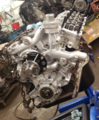
Another nice weekend with miscellaneous projects on Clifford. This week, oil change to include the new drain plug, ABS light investigation, and swapping out the old clutch line with a new fabbed one. Pulled the draing plug to change the oil and it took vice grips to get it out. The old one (original to the Cummins) was basically rounded off from whoever had this motor in the first place. I had purchased one for a dodge cummins only to find out that the threads were different (too large a diameter) when I built the motor. So, I put the original in at the time. I finally got around to looking at Quickserve (Cummins website) and found the proper size and thread pitch. Ordered one up from Amazon. It's a Mishimoto plug with a neodymium magnet on the end and it's aluminium with a metal washer (not copper). Easy enough to swap out and no more leaks and it should serve me well unless I decide to over torque it at some point. New filter in place and I dump 4 gallon of oil in. I had ordered the oil off of Amazon as well a few weeks back as it was the cheapest place to get it, even with shipping. 4 Gallon. My motor holds 12 quarts. And in my infinite wisdom, I dumped all 4 gallon in (16 quarts). I didn't have to go anywhere Saturday, so when I was all done, I fired it up to check for leaks and then shut it down. I decided to go see my folks on Sunday, so I checked my oil level to make sure, and it was way over full. Took me a good 20 minutes to realize what I'd done. Drained the extra gallon out from the plug in the side of the pan into a funnel for use another time. Man did I feel stupid!!!
Anyway...after all that, I decided to tackle the leaky clutch line I've had in there since the build. the brake fluid is eating away al my pretty paint that no one can see on the trans and starter. So, I removed the slave and master and line from the truck, and tore it down. The replacement is fairly easy, you just remove the roll pins (and cotter pins in my case) from the line ends. I built one out of SS braided line with a teflon coating inside the plastic line and some AN fittings. Easy enough, though I'd never used that type of fitting before. The one challenge was that the new fittings for the master and slave were a touch too large to fit into the holes. So, I filed them down carefully until they just fit. Then, put the rubber washers back in and reinstalled the roll pins and cotter pins. From there, I cut the SS line by tightening a zip tie around it and cutting it off with a 4" grinder, installed the AN fittings and then put it all back together. I bled it out by attaching the reservoir to a shelf in my garage and pushing the slave in until all the bubbles stopped. From there, I installed in the truck and had zero pedal. So, I pulled the slave out of the trans and had my better half watch for bubbles. Eventually, they all stopped. I still don't have a great pedal, and I'm not sure what's going on with it. It may have air in the master still. One other thing that seems very odd is that when I was bleeding it by hand, I kept getting a black cloud of junk in the reservoir that was coming from somewhere inside the system. I dumped and refilled several times, and most of it went away, but it's till kind of there. Hopefully (and I don't know how I would), I didn't mess something up when tearing it all apart. Time will tell I suppose.
Last thing I did was swap out the check valve and washers on my fuel filter housing as those were seeping a little bit. Not a lot, but enough to bother me. I had originally used copper brake line washers and the old check valve, but a while back I found a new check valve that came with new washers. Very easily installed.
On to the pics!! Old and new Mishimoto plugs New check valve and sealing washers. I ended up not replacing the large ones just yet. Old check valve and washers Old janky clutch line
More pictures...... Old line diameter New line diameter Had to file that end down All filed down and ready for install Fitting installed with roll pin and cotter pin Zip tie keeps the SS line from fraying New line with ends installed
Hope everyone is during well during this lockdown! and staying healthy!
I tackled reverse lights this weekend, for a couple of reasons. First and foremost, I can't back my boat in the driveway without them because they kill the surge brakes on the trailer and my driveway is up hill just a bit. Other than that, my reverse sensors will randomly go off and well, I can't see at night backing up!
So, I ordered the pigtail for the G56 a while back that comes with the wires and the plug for the transmission. It's essentially an on/off switch that connects the wires when the transmission is placed in reverse. Simple enough. So, I pulled the switch out of the trans, and checked it with a meter to make sure it was functional (continuity test), and it was. Then I built the pigtail as it comes needing assembled, and tested again. All good. From there, I knew that there was one wire coming out of the PCM (yellow and light grey stripe). It comes out of the C1381b connector and goes to the reverse light relay. It's supposed to get a signal from the transmission telling it to energize the relay, turning on the lights. What I didn't notice right away on the wiring diagram that would have helped me out a great deal was that the other end in the picture is a GROUND symbol. More on that later, and you can probably guess what happened.
So, ran the wires temporarily under the truck, hooked one end of the trans switch to the reverse relay wire and the other to the positive terminal on the battery. Put the trans in reverse, and lights! Woo!! I didn't want to wire it directly to the battery, so I pulled the one remaining wire that's 12V switched power I have wrapped up near the battery and connected it, turned the key to the RUN position, reverse, no lights!! UGH!!! Tested on the battery, worked fine. So then, I went to the lamp portion of the wiring manual and it shows ground as well. I hooked the other end to the negative battery terminal, turned the key on, placed in reverse, and lights! Along with that, I had backup sensors working as there was a car right behind the X.
I guess the takeaway is: Pay attention to the wiring diagram. They didn't make them for their health.
Finished out the wiring underneath with some covering and routing, solder connectors all around, and now I have backup lights and reverse sensors!
I still have a ton of work to do and I see crap I want to fix every time I'm under the truck. Next nice day will be the 4WD shifter linkage and I really need to clean up some additional wiring around the battery section as there's a bit of a mess right there. Once we get some really nice weekends, I'll be tackling the rockers and some rust. I've been watching some folks around here doing some of that work and watching a few youtube series and I have a list in the old Amazon wishlist that's ready to go for supplies. I've had full length outer rockers in the garage for a while and I need to cut up some of my remaining sheet metal and practice up on welding. I figure I'll rebuild any part of the inners that I need to along the way of the outers. Hopefully that'll give me enough confidence and skill to tackle the door bottoms when the time comes. On to the pics!! Wire diagram of the reverse lamps. you can see that they ground. Genuine Mopar pigtail. I didn't have shrink tubing big enough, but this works and I taped it good too. Here's my wire mess I need to deal with. You can see the shrink wrapped wire tapped into the PCM reverse relay actuator wire. I didn't have smaller wire loom, so I used a larger piece and tied in the new clutch line while I was at it.
My rockers need to be replaced Iand I've been doing a lot of looking lately. believe the rear door rockers are different between the super duty platform and the excursion so I think the rears will be too short.
My rockers need to be replaced Iand I've been doing a lot of looking lately. believe the rear door rockers are different between the super duty platform and the excursion so I think the rears will be too short.
Potentially...I'll see if I can dig them out and hold them up well enough to get a picture to see how they fit.
Everything available for the crew SD should be the same, except the rear dogleg or C pillar bottom corner. Nobody makes those. Also, someone made the inner steel rocker panels for the EX. Can be found on gar-Bay.
Couldn't get a picture, but the front length of the above mentioned rocker is perfect, but the back is about an inch shorter than factory. I can certainly make it work, but it's not an exact fit. the bottom flange runs the entire length of the panel, and the front edge is longer than required. Overall, it'll work just fine, but it's not perfect.
Over the past two days I've managed to get my AC recharged...somehow. I'm new to the AC stuff but I read and read on this forum and a few other places to try and get an idea as to how I should go about it. I replaced a few orings out of an abundance of caution and then pulled a vacuum on it for about an hour. Hooked up a can of PAG and put that in and 134 as well. I could only get a little bit in the system and my AC pump was not cycling on and off. So, I was only able to get in so much. Yesterday at the office I jumped the AC relay, pump came on, and I was able to get some dye and more 134 in. Drove it home with the pump running and it like to froze me out. Got home, hooked it up again, and got the remainder of the 68 ounces in.
My pump still won't cycle by itself, so I'll have to do a bit more diagnosing to see why that is. The Cummins conversion has something to do with it, and I know for a fact that I have to have a tach signal (which I do). Dodge pump on the motor. We're headed to FL today for a week trip, so I wired a switch in and I'll cycle it on and off as required for the trip for now. Eventually, I'd like it to work on it's own. Pressures were all over the place and to be honest I'm not sure I'm doing it correctly in the first place. More research is needed for sure. Anyone have a good step by step write-up or source for this stuff? I thought about taking it in for AC service, but all they'll likely do is pump it down and refill to proper levels. At this point, I'm thinking I have the proper amount in, or at least very close.
Low pressure switch is likely defective. That would suck because you'd have to pull it down again to replace I don't recall, but are you using a swaphelper for the tach, or the notched plate at the crank?
Low Pressure switch is most suspect unfortunately...as long as you have proper pressure when the compressor is engaged for a bit.
I do have the swaphelper tach, but it doesn’t read correctly. I have one more ground I need to make sure is correct, and then it’s down to adjusting the gap on the sensor.
Just made the run from Ohio to FL using the switch to run the compressor. It is at a minimum as pain in the neck having to switch on and off every few minutes. Needs fixed ASAP for sure. At this point, I’ll have a shop pull it down and it’ll get opened up and get all new pressure switches and orifices and whatever else. Anyone have a good parts diagram or a source for all the components? I did already replace the drier as I had the system open for several months. Thanks!
Over the past two days I've managed to get my AC recharged...somehow. I'm new to the AC stuff but I read and read on this forum and a few other places to try and get an idea as to how I should go about it. I replaced a few orings out of an abundance of caution and then pulled a vacuum on it for about an hour. Hooked up a can of PAG and put that in and 134 as well. I could only get a little bit in the system and my AC pump was not cycling on and off. So, I was only able to get in so much. Yesterday at the office I jumped the AC relay, pump came on, and I was able to get some dye and more 134 in. Drove it home with the pump running and it like to froze me out. Got home, hooked it up again, and got the remainder of the 68 ounces in.
My pump still won't cycle by itself, so I'll have to do a bit more diagnosing to see why that is. The Cummins conversion has something to do with it, and I know for a fact that I have to have a tach signal (which I do). Dodge pump on the motor. We're headed to FL today for a week trip, so I wired a switch in and I'll cycle it on and off as required for the trip for now. Eventually, I'd like it to work on it's own. Pressures were all over the place and to be honest I'm not sure I'm doing it correctly in the first place. More research is needed for sure. Anyone have a good step by step write-up or source for this stuff? I thought about taking it in for AC service, but all they'll likely do is pump it down and refill to proper levels. At this point, I'm thinking I have the proper amount in, or at least very close.
Often the suction pressure in the accumulator doesn't drop low enough on a healthy system at idle to trip the pressure switch. The accumulators appear to be the same part number for all years. The OE low pressure switch is listed as the same one for all years too but showing discontinued. I know from just re doing my system that the pressure switch subs over to a new part requiring a different pigtail plug. With that said, the male thread fitting on the accumulator body contains a schrader core which gets depressed when the pressure switch is screwed in all the way. So in theory you should be able to remove the low press switch with no freon loss. Being that you are a 2003, you have the automatic temp controls? If so you'll have an In Car Temp Sensor, and possibly an evap coil sensor and maybe those need the interface to the Cummins PCM.
There are a few neat temp control devices avail you can experiment with which may allow you to disregard tach tie in, and use the low pressure switch wires to cycle the system based on your suction pipe temps exiting the front evaporator.
This Hennessey Takes the Expedition Tremor's Off-Roading Capability to the Next Level
Slideshow: The VelociRaptor Expedition gains a lift, upgraded suspension, Brembo brakes, and trail-ready equipment while retaining the stock 440-horsepower EcoBoost V6.
Rezvani's Latest Post-Apocalyptic Monster Is a Ford F-150 Raptor Underneath
Slideshow: Called the Fortress, the 850-horsepower pickup combines Raptor underpinnings with military-inspired features, survival equipment, and a starting price of $285,000.








 Drained the extra gallon out from the plug in the side of the pan into a funnel for use another time. Man did I feel stupid!!!




 Got home, hooked it up again, and got the remainder of the 68 ounces in.
 I don't recall, but are you using a swaphelper for the tach, or the notched plate at the crank?