When you click on links to various merchants on this site and make a purchase, this can result in this site earning a commission. Affiliate programs and affiliations include, but are not limited to, the eBay Partner Network.
12 point NAS flange bolts on the intake, and they couldn't manage to get the ring terminal under one of them?
I'm not sure WHY you'd need tricky fasteners in that application.
It's not like they are under a lot of tension or in a restricted well where you would need to use a reduced head 12 point thin wall socket.
I'm glad it's you peeling the onions.
Sometimes they make me want to cry.
Well, I'm done with Rusty as a guy is coming to get him on Saturday. So, I'm troubleshooting Big Blue's reluctance to start. It was a very firm "ain't gonna happen" so I had visions of finding "it".
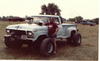
Put the test light on the red/light blue wire at the solenoid and got nothing. Then I looked at the Start & Ignition schematic on the 1986 EVTM and see a C-121 that the wire goes through before going to the clutch switch. And, looking at the 1985 EVTM in hardcopy I see the same thing. But, looking at the 1985 wiring schematics themselves I find the same connector is called C-306. Anyway, it is as shown on Page 14 here, and is right below the brake booster, as shown below.
And, sure enough, by moving the connector to get the pic everything now worked. So, I pulled the connector apart and checked both ways. One side does go to the solenoid, but the other side doesn't get power in Start, so something has changed again - apparently while pulling the connectors apart. Looks like I'm onto something.
Gotta quit for today, but tomorrow I hope to find that pesky thing!
In the automotive technician world, that is what is called the wiggle test.
12 point NAS flange bolts on the intake, and they couldn't manage to get the ring terminal under one of them?
I'm not sure WHY you'd need tricky fasteners in that application.
It's not like they are under a lot of tension or in a restricted well where you would need to use a reduced head 12 point thin wall socket.
I'm glad it's you peeling the onions.
Sometimes they make me want to cry.
My new engine has them on the intake, just not the 12 point, that is what ARP fasteners sells.
Gary, on the back of the intake, it looks like the guy who worked on it used RTV (I hope, because if that is the end gasket, that is the problem). If you want to do a quick check, use the blower feature on your shop vac, it will put enough pressure to locate a leak, you will be able to feel it. BTW, I do hope it has the proper "turkey roaster" intake gasket under there.
My new engine has them on the intake, just not the 12 point, that is what ARP fasteners sells.
I'm just saying, there's SO many other things on this truck to spend money on WHY would you spend $ on 130ksi aircraft (or ARP) bolts and then use a crimp connector for the pump circuit or a cut up ring terminal for a starter connection???
My truck got treated to a $40 Ebay BoltLocker set of stainless.
(that's EVERY bolt on both intake and exhaust manifolds, oil pan, valve covers, and all the front dress)
Moose - Yeah, I may have to wiggle it more. Dunno. But I'm carrying a little red jumper that does quick work of starting the truck. And I'm not going to fix the clutch switch until I'm confident the problem is long gone.
Bill - Good idea on the shop vac. Just pressurize the sump and look for the leaks. I'll do that. Thanks. And, I'm pretty sure that is RTV. It feels like it.
Jim - Vernon spared no expense. None. He researched everything and chose the best of the best. He just couldn't find people willing to do a good work, so you get things like high-end bolts and crimp connectors. High-end parts and poor quality of installation.
I'm truly sorry it didn't work out for him, but because of that I wound up with a truck with such excellent potential. I just need to peel the onion and enjoy onion rings.
Gary,
I'm quite aware of how Vern researched and documented all of the quality components that went into Big Blue.
I don't think he cut any corners or spared any expense trying to get the very best F250 he could.
I'm also sure he didn't intentionally hire some methhead cracker to do the work.
But it seems the proof is in the pudding.
I feel bad for him not having the truck of his dreams to enjoy.
Bill - Even standing over them doesn't work if you really don't know what they should be doing. John, my body/paint man had to redo a bunch of what Marshall did, and I watched Marshall do several of the things John re-worked.
Jim - I feel badly for him as well. But the fuel pump issue alone would have caused him great problems to rectify what someone hacked up. It isn't safe and caused the crankcase to fill up with gas, so needs fixed. But, it is going to take me many days to get it resolved, and I have a fair understanding of what it is supposed to be. And the intermittent starting problem may send me 'round the bend.
He didn't tell me what he paid to have the engine built, but he did share that the estimate to have the horrific oil leaks fixed at another shop was $1500 to $2000. I don't know the final bill on that, but they found the rear main had been installed incorrectly and the valve covers had no gaskets. So, I'm guessing they pulled the engine to get to the rear main, and that means they earned the money.
To have to have another shop fix someone's work had to have been terribly frustrating. So, he made the decision to part with the truck, and he told me later that both he and his wife were happy it was gone. In fact, he said that reading this thread was much better than trying to get things done himself. So, Vern, I hope you are reading this. We are peeling that onion layer after layer. But I know there's a core of gold below all those layers.
I will be willing to bet the front tank is a later tank, you might look and see if they threw away the heat shield that is supposed to be on it. It causes the tank to rust at the top of the inside edge seam and is frequently discarded. I threw mine away, but my tank is 35" further away from the exhaust than a standard cab.
Bill - I'll check when I can get to it, but I'm reasonably sure the front tank is a later one since the filler takes the newer screw-in cap. And, since something is wrong with the filler neck as it is next to impossible to fill it.
However, I'm not sure I understand about the heat shield - does it cause the rust or is it the absence of the shield that causes the rust?
As I expected, but needed to make sure. Thanks. Would be good to coat a new tank with something to prevent that.
As I sit here finishing my second cup of coffee I'm thinking about why they hacked the fuel pump wiring - and I don't understand. They bypassed the oil pressure switch, probably because it was bad or, more likely, because there was no port for it when they installed the aftermarket gauges. That would have meant the fuel pump relay would come in and the fuel pump would run any time the key is in Run or Start.
But they also bypassed the fuel pump relay, and they did that by running a wire from the fuse box, through a stand-alone fuse, to the inertia switch and from there to the pump. Man, that was a lot of work when the inertia switch is already connected to the pump. Just hit it with switched power.
So, my guess is that the relay is bad. Given that, while I await the red/yellow wire from Amazon I can in fix the hack on the inertia switch and replace the fuel pump relay - either with the one from Bill or with the new one from Vern. I'll still have the pump on in Run, but I can check that everything else but the oil pressure switch is working. Then, when the wiring comes in, finish it up.
If I under stand it why not put the full right wiring in place and just jump out the oil switch? This way when you get the switch installed you just pull out the jumper and plug it into the switch.
This way you also know if the wiring works or not.
Dave ----
Yes, that's exactly what I'm saying. However, one thing I forgot is if they hacked both sides of the inertia switch wiring then I have to fix the wiring from the fuel pump relay to the pump. And that's when another other harness Bill sent me comes in. Should be plug-and-play.
This Hennessey Takes the Expedition Tremor's Off-Roading Capability to the Next Level
Slideshow: The VelociRaptor Expedition gains a lift, upgraded suspension, Brembo brakes, and trail-ready equipment while retaining the stock 440-horsepower EcoBoost V6.
Rezvani's Latest Post-Apocalyptic Monster Is a Ford F-150 Raptor Underneath
Slideshow: Called the Fortress, the 850-horsepower pickup combines Raptor underpinnings with military-inspired features, survival equipment, and a starting price of $285,000.




 So, I pulled the connector apart and checked both ways. One side does go to the solenoid, but the other side doesn't get power in Start, so something has changed again - apparently while pulling the connectors apart. Looks like I'm onto something.