


Engine Rebuild Part 2
Thread Starter
|
Moderator


Joined: Dec 2007
Posts: 7,987
Likes: 104
From: Boise, Idaho


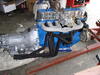
Well, the engine is out and it's finally getting closer to the time to drag the '81 away. I've stripped it pretty bare and there's not a lot left of it.
Soon, I should start the process of pulling the 302 out of my new Bronco and dropping my 300 in its place. Haven't driven it since about March, so I'm getting antsy.
I was sure to grab the frame perches out of my '81 while I was in there as well.
The 302 is fuel injected, so I'm actually planning on keeping it that way. I'm not going to go with the full MPFI setup for a 300, but I am looking to switch to a Holley Sniper. I've been advised on several fronts to go with the 2bbl version, since "barrels" don't really matter on EFI, and it's rated to 580cfm/350HP, which is plenty for my needs.
The Bronco is already plumbed for a high pressure fuel system and all of that, so a lot of the hard work is already done for me.
One question for you guys. Do any of you know of a good way to identify the source of an oil leak when an engine is out? Despite all fresh new gaskets on this engine, it leaked really bad. I don't know where I went wrong.
And, of course, it was dripping down the back of the engine, which means that it could either be the valve cover, oil pan, lifter cover, or rear main. You know, nice and nailed down...

Elder User
Joined: Apr 2012
Posts: 544
Likes: 6
From: Kalispell, MT
wipe it down good (not using much, if any cleaner) then dust it with baking soda or flour. thru reverse capillary action, you'll see the wet spot reveal themselves. similar to a dye penetrant testing used in NDT techniques. a quick google will show you some cool stuff.

Lead Driver
Joined: Jul 2009
Posts: 6,477
Likes: 19
From: Sheffield, AL
wipe it down good (not using much, if any cleaner) then dust it with baking soda or flour. thru reverse capillary action, you'll see the wet spot reveal themselves. similar to a dye penetrant testing used in NDT techniques. a quick google will show you some cool stuff.

Thread Starter
|
Moderator
Joined: Dec 2007
Posts: 7,987
Likes: 104
From: Boise, Idaho
I think I tracked down why my engine was leaking.
Not sure why, but several of the bolt holes on the silicone gasket were torn.
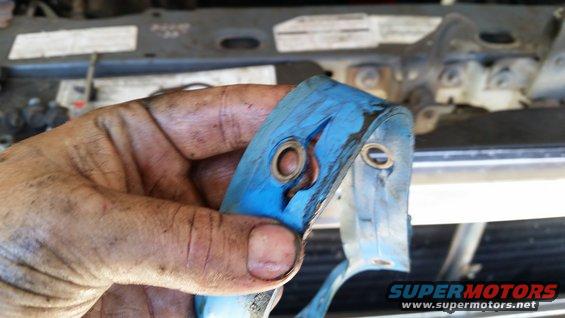
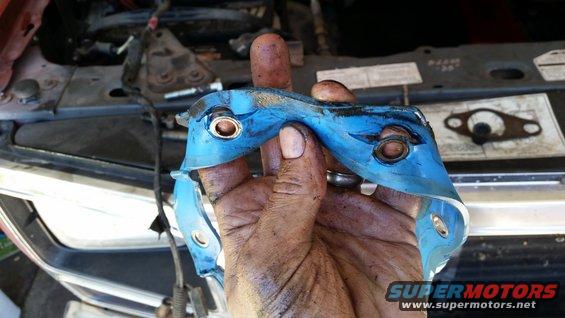
This is frustrating for several reasons. I was gifted a set of these for the oil pan, which should have made for some very evenly dispersed pressure.

The oil pan was also brand new, so it was extremely flat. And I was extremely meticulous about torquing it properly to spec, even torquing in stages.
It split and tore and leaked almost immediately.
I'll try another one, and maybe shoot for a few ft/lbs less than I did before, but it's still annoying.
Not sure why, but several of the bolt holes on the silicone gasket were torn.
This is frustrating for several reasons. I was gifted a set of these for the oil pan, which should have made for some very evenly dispersed pressure.
The oil pan was also brand new, so it was extremely flat. And I was extremely meticulous about torquing it properly to spec, even torquing in stages.
It split and tore and leaked almost immediately.
I'll try another one, and maybe shoot for a few ft/lbs less than I did before, but it's still annoying.
Thread Starter
|
Moderator
Joined: Dec 2007
Posts: 7,987
Likes: 104
From: Boise, Idaho
I've read and been told that using sealant on a silicone gasket is a BIG no no.
The reason they use silicone is that it can move and distort as time goes on, filling gaps, and sealing by being able to slip along the surfaces.
If you use sealant, it sticks it in place and completely negates its biggest advantage.
The reason they use silicone is that it can move and distort as time goes on, filling gaps, and sealing by being able to slip along the surfaces.
If you use sealant, it sticks it in place and completely negates its biggest advantage.
Posting Guru
Joined: Jun 2012
Posts: 1,061
Likes: 9
From: Mims, FL
I've heard some of same things; not sure what the answer is. I know you did your best to do everything right. Probably best to do it over same way and hope for the best unless someone can come up with a better idea.
FTE Stories
Ford Trucks for Ford Truck Enthusiasts

Top 10 Most Expensive Ford Trucks Ever Sold on Bring a Trailer
Joe Kucinski
2027 Ford Super Duty Buyer's Guide (Every Model, Engine, & Package)
Brett Foote
Top 10 Ford Truck Tragedies
Joe Kucinski
AEV FXL Super Duty - the Super Duty Raptor Ford Doesn't Make
Brett Foote
Lobo Vs Lobo: Proof the F-150 Lobo Should Be Even Lower!
Michael S. Palmer
Ford's 2001 Explorer Sportsman Concept Looks For a New Home
Verdad Gallardo
10 Best Ford Truck Engines We Miss the Most!
Joe Kucinski
2026 Shelby F-150 Off-Road: Better Than a Raptor R?
Brett Foote
2027 Super Duty Carhartt Package First Look: 12 Things You NEED to Know!
Michael S. Palmer
Thread Starter
|
Moderator
Joined: Dec 2007
Posts: 7,987
Likes: 104
From: Boise, Idaho
Yeah, that's kinda what I'm thinking. Not my favorite solution, but it might have to do.
I've used two of these gaskets before with good results, so maybe I just got a bad one.
I've used two of these gaskets before with good results, so maybe I just got a bad one.
Lead Driver
Joined: Mar 2008
Posts: 7,182
Likes: 380
From: Near Los Angeles
Didn't all the splits occur at the bolt holes? That would seem to imply too much torque, too tight?
On my neoprene v.cover gasket I use weather strip adhesive on one side and allow it to dry. I will most likely, after I research it, do the same with the one piece pan gasket. But that depends on what I find after research, since I haven't used that type of gasket before. I also like to use a 1/4" inch drive ratchet for covers like that so I can really get a feeling for the tightness (is that a word?) of the bolt/nut.
On my neoprene v.cover gasket I use weather strip adhesive on one side and allow it to dry. I will most likely, after I research it, do the same with the one piece pan gasket. But that depends on what I find after research, since I haven't used that type of gasket before. I also like to use a 1/4" inch drive ratchet for covers like that so I can really get a feeling for the tightness (is that a word?) of the bolt/nut.
Thread Starter
|
Moderator
Joined: Dec 2007
Posts: 7,987
Likes: 104
From: Boise, Idaho
Yeah, that's what it looks like. I know the torque on the oil pan is not all that much, about 16 - 22 ft/lbs or something, and I have a nice, click-type torque wrench.
Who knows, maybe I was reading it wrong and had it one rotation too far, which would set it for 28 ft/lbs when I meant to have it pointing at 18.
Who knows, maybe I was reading it wrong and had it one rotation too far, which would set it for 28 ft/lbs when I meant to have it pointing at 18.

More Turbo


Joined: Nov 2015
Posts: 710
Likes: 111
I had that problem when I tried to use the one piece gasket on an early year oil pan that is dimpled slightly around the bolt holes to hold the cork gasket in place.
The late model oil pan is flat around the bolt holes.
The late model oil pan is flat around the bolt holes.
Thread Starter
|
Moderator
Joined: Dec 2007
Posts: 7,987
Likes: 104
From: Boise, Idaho
The aftermarket oil pans I've purchased don't come with the raised ridges, even if you get a year correct pan.
So, it was perfectly flat and ready for a 1 piece silicone gasket.
So, it was perfectly flat and ready for a 1 piece silicone gasket.