


Dad's Engine

Senior User
Joined: Nov 2013
Posts: 328
Likes: 0
From: Los Angeles
I have nothing to add technically but I think it's awesome this guy Tim is not trying to sell you world.
Restraint is an admiral quality. It is used far to often.
From what you've described it seems like someone I'd like to do business with.
Restraint is an admiral quality. It is used far to often.
From what you've described it seems like someone I'd like to do business with.

Posting Guru
Joined: Jan 2014
Posts: 1,083
Likes: 0
From: Where the Army sends me
I agree. I consider this a great recommendation.

Thread Starter
|
FTE Legend


Joined: Jul 2010
Posts: 32,875
Likes: 48
From: Northeast, OK
Bruno - I feel your pain and remember, all too well, the angst you had when you bought those heads. So I appreciate your advice and will take it to heart. Truth be told, that's the gut feel I had, but felt like I should check this deal out to see what could be done. Sometimes you get lucky - like a pretty complete 400 for $40.
CC & RL250 - I agree. Tim is the real deal. He isn't high pressure at all. For instance, I sent his spreadsheet back with the high volume oil pump selected. But when he sent it back with answers to my questions he'd put it back to the standard pump and said "I strongly do not suggest the high volume pump." Similarly, I asked about the two different timing sets and he suggested the smaller one as the bigger one is for high lift cams with lots of spring tension on the valves.
All - I really like the idea of the Aussie heads, albeit from Tim unless the "local" guy practically gives them to me since that might make is a worthwhile gamble. They fit with the theme of "It's from Ford although maybe not from this decade much less year, or even from this country or put together like that." The man in black's Fordillac!
As for pistons, that's the limitation on the 400. I'm pretty well stuck with the pistons Tim has. And all three of the heads we are talking about, Eddy/TFS, & Aussie, have ~60 cc combustion chambers. And, if I'm going to go with a closed-chamber head I'm going to zero-deck the pistons, so it takes a special piston to get back down to 9.5:1. Fortunately Tim has them and swears by them.
CC & RL250 - I agree. Tim is the real deal. He isn't high pressure at all. For instance, I sent his spreadsheet back with the high volume oil pump selected. But when he sent it back with answers to my questions he'd put it back to the standard pump and said "I strongly do not suggest the high volume pump." Similarly, I asked about the two different timing sets and he suggested the smaller one as the bigger one is for high lift cams with lots of spring tension on the valves.
All - I really like the idea of the Aussie heads, albeit from Tim unless the "local" guy practically gives them to me since that might make is a worthwhile gamble. They fit with the theme of "It's from Ford although maybe not from this decade much less year, or even from this country or put together like that." The man in black's Fordillac!
As for pistons, that's the limitation on the 400. I'm pretty well stuck with the pistons Tim has. And all three of the heads we are talking about, Eddy/TFS, & Aussie, have ~60 cc combustion chambers. And, if I'm going to go with a closed-chamber head I'm going to zero-deck the pistons, so it takes a special piston to get back down to 9.5:1. Fortunately Tim has them and swears by them.

pedant
Joined: Jan 2008
Posts: 23,576
Likes: 39
From: EXTREME southwest CT

If you are going with the iron 302 heads I would say get them from Tim.
There won't be any surprises.
He will know exactly how much the exhaust ports can be improved and have a cam ground to take advantage of that.
Re: the pistons.
How do your bores clean up?
What oversizes are available?
I went to his site and it seems the 335 page is under construction.
There won't be any surprises.
He will know exactly how much the exhaust ports can be improved and have a cam ground to take advantage of that.
Re: the pistons.
How do your bores clean up?
What oversizes are available?
I went to his site and it seems the 335 page is under construction.

Postmaster
Joined: Nov 2009
Posts: 4,575
Likes: 5
From: Broken Arrow , OK
Yes bore size is important. I wonder what over size pistons Tim is saying will get to 9.5:1 with Aussie heads? The bigger the bore the higher the CR. So will .030 over still be at 9.5? If the block will clean up at .020 that's as far as I would go. However, most machinists want to take a virgin .030 over if it has many miles on it.
You need to find out what the dish in the pistons are and play with the CR calculator.
Gary, with a 3.5" stroke like the W has I was playing heck to keep the CR right. Even with .030 over 12 cc dish pistons at 0 deck height and a 64 CC combustion chamber I am probably closer to 9.6-9.7.
You need to find out what the dish in the pistons are and play with the CR calculator.
Gary, with a 3.5" stroke like the W has I was playing heck to keep the CR right. Even with .030 over 12 cc dish pistons at 0 deck height and a 64 CC combustion chamber I am probably closer to 9.6-9.7.
Thread Starter
|
FTE Legend
Joined: Jul 2010
Posts: 32,875
Likes: 48
From: Northeast, OK
Jim - Good idea! I hadn't thought of Tim knowing the difference in exhaust port restrictions and tailoring the cam to account for it. Good idea. I know in talking to people at Comp that they do adjust the cam based on the issues with the engine. For instance, they said that most Chevys suffer from small intake ports so they adjust for that. Similarly, Fords suffer from restrictive exhaust ports.
And that helps explain why Tim doesn't go with off-the-shelf cams. He's frequently working with people who aren't using stock components so the cam's parameters need to be adjusted to accommodate that. But, it sounds like you are suggesting that I port the Aussie heads, probably with Tim's guidance, and that he dial the cam in for the expected results. Right?
As for the bores, I haven't pulled the pistons out of Dad's block, but the bores look good. The engine has ~140k on it so there's obviously some wear, but they look new compared to the block I picked up last week. The machinist said I should hold off buying the pistons until he bores and hones the block, but I did check and Tim has them in 20, 30, and 50 over.
And, you are right about Tim's site. He's migrating to a new one and many things are gone, links go to 404, etc. the link to the pistons I posted a bit ago worked when I posted it and didn't a few minutes later. Hopefully the new site will be fully functional soon.
And that helps explain why Tim doesn't go with off-the-shelf cams. He's frequently working with people who aren't using stock components so the cam's parameters need to be adjusted to accommodate that. But, it sounds like you are suggesting that I port the Aussie heads, probably with Tim's guidance, and that he dial the cam in for the expected results. Right?
As for the bores, I haven't pulled the pistons out of Dad's block, but the bores look good. The engine has ~140k on it so there's obviously some wear, but they look new compared to the block I picked up last week. The machinist said I should hold off buying the pistons until he bores and hones the block, but I did check and Tim has them in 20, 30, and 50 over.
And, you are right about Tim's site. He's migrating to a new one and many things are gone, links go to 404, etc. the link to the pistons I posted a bit ago worked when I posted it and didn't a few minutes later. Hopefully the new site will be fully functional soon.
Thread Starter
|
FTE Legend
Joined: Jul 2010
Posts: 32,875
Likes: 48
From: Northeast, OK
Yes bore size is important. I wonder what over size pistons Tim is saying will get to 9.5:1 with Aussie heads? The bigger the bore the higher the CR. So will .030 over still be at 9.5? If the block will clean up at .020 that's as far as I would go. However, most machinists want to take a virgin .030 over if it has many miles on it.
You need to find out what the dish in the pistons are and play with the CR calculator.
Gary, with a 3.5" stroke like the W has I was playing heck to keep the CR right. Even with .030 over 12 cc dish pistons at 0 deck height and a 64 CC combustion chamber I am probably closer to 9.6-9.7.
You need to find out what the dish in the pistons are and play with the CR calculator.
Gary, with a 3.5" stroke like the W has I was playing heck to keep the CR right. Even with .030 over 12 cc dish pistons at 0 deck height and a 64 CC combustion chamber I am probably closer to 9.6-9.7.
Wow! That sounds good - 10.5:1. Shades of the 60's. Put that in the plus column for the aluminum heads.

FTE Stories
Ford Trucks for Ford Truck Enthusiasts

10 Things Every Truck Owner NEEDS (2026 Edition)
Michael S. Palmer
Rezvani's Latest Post-Apocalyptic Monster Is a Ford F-150 Raptor Underneath
Verdad Gallardo
Top 10 Most Expensive Ford Trucks Ever Sold on Bring a Trailer
Joe Kucinski
2027 Ford Super Duty Buyer's Guide (Every Model, Engine, & Package)
Brett Foote
Top 10 Ford Truck Tragedies
Joe Kucinski
AEV FXL Super Duty - the Super Duty Raptor Ford Doesn't Make
Brett Foote
Lobo Vs Lobo: Proof the F-150 Lobo Should Be Even Lower!
Michael S. Palmer
Ford's 2001 Explorer Sportsman Concept Looks For a New Home
Verdad Gallardo
10 Best Ford Truck Engines We Miss the Most!
Joe Kucinski
Postmaster
Joined: Nov 2009
Posts: 4,575
Likes: 5
From: Broken Arrow , OK
I cant find KB pistons for the 400 on Summit or Jegs. So I cant find the specs for them. I will try go directly to their site and see if they have a catalog.
On edit: I cant even find who manufactures them.
On edit: I cant even find who manufactures them.

Moderator


Joined: Nov 2007
Posts: 22,415
Likes: 92
From: Denver Metro Area, CO

My understanding is that these are custom-made Keith Black pistons, TMI has them made in batches of like 1,000 at a time (or maybe it's 100, I forget) so he gets a price break. Regardless, they're not off-the-shelf pistons so you're not gonna find much info out there....
I'm getting custom-made pistons for my brother's 3.0L Taurus SHO, they're costing me ~$1,000.
I'm getting custom-made pistons for my brother's 3.0L Taurus SHO, they're costing me ~$1,000.
pedant
Joined: Jan 2008
Posts: 23,576
Likes: 39
From: EXTREME southwest CT
Jim - Good idea! I hadn't thought of Tim knowing the difference in exhaust port restrictions and tailoring the cam to account for it. Fords suffer from restrictive exhaust ports.
it sounds like you are suggesting that I port the Aussie heads, probably with Tim's guidance, and that he dial the cam in for the expected results. Right?
it sounds like you are suggesting that I port the Aussie heads, probably with Tim's guidance, and that he dial the cam in for the expected results. Right?
I'm saying, if you are going with these heads (and get them from him) he would know just how they flow and be able to have a cam ground with that in mind.
As far as DIY porting (working the short side and raising the floor)
1)It's never easy to weld inside an iron port. Some people build up braze.
2)I wouldn't grind much without having a sectioned head in front of me or the sort of templates Scott at ReinCarnation does for the 385 series engines.
But then, you would have to provide all those numbers to Tim so he could order you the right cam.
IMHO stick with the stock Aussie heads.
If you want more than these can provide go right to the Trick Flow's that have better ports out of the box.
Thread Starter
|
FTE Legend
Joined: Jul 2010
Posts: 32,875
Likes: 48
From: Northeast, OK
We've been talking about what is called "static compression ratio". But what really counts is dynamic compression ratio. Here's what Wallace Racing has to say about that:
One thing I find interesting in this is that rod length changes the DCR. I'd never thought about how the rod length changes where the piston is in the cylinder for a given point in the revolution of the crank. But a longer rod means the piston dwells longer around TDC and BDC and then moves more rapidly between. However, where a piston is when the valves open/close has a lot to do with dynamic compression ratio. I'm going play with that calculator a bit.
And that takes me back to what I said earlier about comparing engines. As it turns out, comparing just bore, stroke, and cam timing isn't nearly all of the picture. You also have to consider the length of the rod. And for comparison purposes, a 351W's rod is 5.956", a 351C's rod is 5.78", and a 351M/400's is slightly bigger at 6.58". And that makes me think about the Cam Quest runs I did using a 351C as the base and giving it a 4" stroke to make it a 400. Yes, I got results, but they probably only apply to a stroked 351C given the .8" shorter stock rod, which might be even shorter in a stroker kit. And to think the guy at Comp agreed that was a good approach! On top of that, their cams are universal across the 335 Series engines, regardless of stroke. I think I'm really starting to see why Tim says we shouldn't use an off-the-shelf cam, but should tailor one to the specifics of the engine.
Jim - Ok, got you. And that's basically where I was as I don't know what to do on an Aussie head and, obviously, don't have one to section as I did the Windsor. Further, there's not much on the web about porting them. So I'm coming down to getting everything from Tim and just need to decide which heads to go with.
Of the variables, the most important is cam timing which has a dramatic effect on your "dynamic" as opposed to your static compression ratio. The more "overlap" your cam has, the lower your "actual" as opposed to your static compression ratio will be. This is one area you can easily change.
Another consideration is rod length and it's effect on the engine's output. Changing the rod length will affect the piston location in the bore relative to cam timing everywhere except at TDC and BDC thus changing the dynamics of the engine.
They have a dynamic compression ratio calculator at that site and I'm going to play with it a bit. However, Tim said he would be happy to run the numbers when I get close to dial in the cam, so I'm certainly going to take him up on that offer.Another consideration is rod length and it's effect on the engine's output. Changing the rod length will affect the piston location in the bore relative to cam timing everywhere except at TDC and BDC thus changing the dynamics of the engine.
One thing I find interesting in this is that rod length changes the DCR. I'd never thought about how the rod length changes where the piston is in the cylinder for a given point in the revolution of the crank. But a longer rod means the piston dwells longer around TDC and BDC and then moves more rapidly between. However, where a piston is when the valves open/close has a lot to do with dynamic compression ratio. I'm going play with that calculator a bit.
And that takes me back to what I said earlier about comparing engines. As it turns out, comparing just bore, stroke, and cam timing isn't nearly all of the picture. You also have to consider the length of the rod. And for comparison purposes, a 351W's rod is 5.956", a 351C's rod is 5.78", and a 351M/400's is slightly bigger at 6.58". And that makes me think about the Cam Quest runs I did using a 351C as the base and giving it a 4" stroke to make it a 400. Yes, I got results, but they probably only apply to a stroked 351C given the .8" shorter stock rod, which might be even shorter in a stroker kit. And to think the guy at Comp agreed that was a good approach! On top of that, their cams are universal across the 335 Series engines, regardless of stroke. I think I'm really starting to see why Tim says we shouldn't use an off-the-shelf cam, but should tailor one to the specifics of the engine.
Jim - Ok, got you. And that's basically where I was as I don't know what to do on an Aussie head and, obviously, don't have one to section as I did the Windsor. Further, there's not much on the web about porting them. So I'm coming down to getting everything from Tim and just need to decide which heads to go with.
pedant
Joined: Jan 2008
Posts: 23,576
Likes: 39
From: EXTREME southwest CT
Those rods are almost as long as my 460, and at 4.00" the stroke is even longer!
Yes, The rod/stroke ratio obviously affects where the piston is in the bore in relation to crankshaft position.
But more often you hear about its affect on torque.
I know it increases both dwell and piston acceleration mid stroke.
At first I didn't think it mattered very much.
I guess this is best represented as a wave on a scale.
Like this:
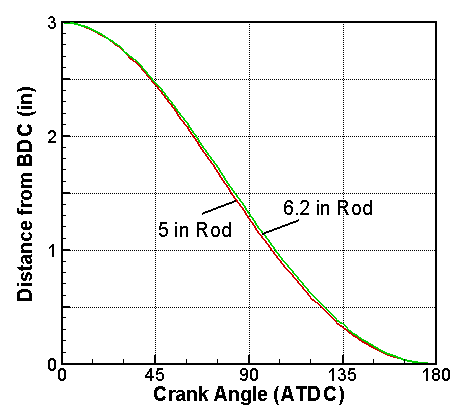
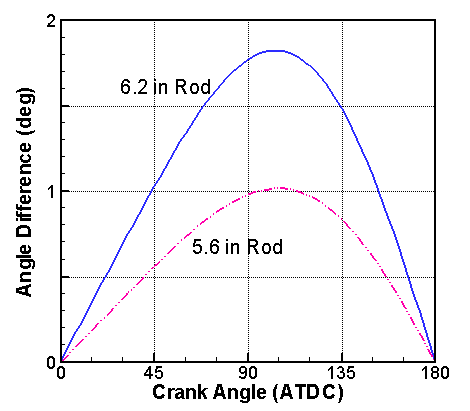
Rod Length and Cam Timing
So, in the above example it looks like it could amount to 1.7 crank degrees (or 0.8 cam degree) right around 115° of crankshaft angle.
How many valve events occur there?
I guess it would be best to superimpose the cam profile on top of a chart like this one.
I'm interested in what you find about just how much it does change the relation to valve timing of the various cams for your 400.
Yes, The rod/stroke ratio obviously affects where the piston is in the bore in relation to crankshaft position.
But more often you hear about its affect on torque.
I know it increases both dwell and piston acceleration mid stroke.
At first I didn't think it mattered very much.
I guess this is best represented as a wave on a scale.
Like this:
Rod Length and Cam Timing
So, in the above example it looks like it could amount to 1.7 crank degrees (or 0.8 cam degree) right around 115° of crankshaft angle.
How many valve events occur there?
I guess it would be best to superimpose the cam profile on top of a chart like this one.
I'm interested in what you find about just how much it does change the relation to valve timing of the various cams for your 400.
Thread Starter
|
FTE Legend
Joined: Jul 2010
Posts: 32,875
Likes: 48
From: Northeast, OK
Jim - Yes, the 400's stroke was the longest of all of Ford's V8's, although I discovered the other day that it was only .020" longer than that of the 300 six. That engine is 4.00 x 3.98.
The dynamic compression ratio calculator at Wallace Racing shows the following:
And this site says:
The dynamic compression ratio calculator at Wallace Racing shows the following:
- Ford 400 w/Comp 260HR
- Inlet Valve Close ABDC: 56 degrees
- Static Compression Ratio: 9.5:1
- Dynamic Compression Ratio: 7.92
- Dynamic Cranking Pressure: 156.91
- Ford 400 w/Comp 270HR
- Inlet Valve Close ABDC: 61 degrees
- Static Compression Ratio: 9.5:1
- Dynamic Compression Ratio: 7.62
- Dynamic Cranking Pressure: 149.22
And this site says:
Why it matters: A 355 engine with a 9:1 static CR using a 252 cam (110 LSA, 106 ICL) has an intake closing point of 52º ABDC and produces a running CR (DCR) of 7.93. The same 9:1 355 engine with a 292 cam (having an intake closing point of 72º ABDC) has a DCR of 6.87, over a full ratio lower. It appears that most gas engines make the best power with a DCR between 7.5 and 8.5 on 91 or better octane. The larger cam's DCR falls outside this range. It would have markedly less torque at lower RPM primarily due to low cylinder pressures, and a substantial amount of reversion back into the intake track. Higher RPM power would be down also since the engine would not be able to fully utilize the extra A/F mixture provided by the ramming effect of the late intake closing. To bring the 292 cam's DCR up to the 7.5 to 8.5:1 desirable for a street engine, the static CR needs to be raised to around 10:1 to 11.25:1. Race engines, using high octane race gas, can tolerate higher DCR's with 8.8:1 to 9:1 a good DCR to shoot for. The static CR needed to reach 9:1 DCR, for the 292 cam mentioned above, is around 12:1.
This lowering of the compression ratio, due to the late closing of the intake valve, is the primary reason cam manufactures specify a higher static compression ratio for their larger cams: to get the running or dynamic CR into the proper range.
Hopefully I'll get to chat with Tim on this soon as we are getting close to making a decision on all the parts. So I think he'll be happy to run the DCR #'s on his computer, play with cam profiles, and then suggest one for me. I'm anxious to see what he recommends. In fact, I'm going to see what he recommends on the heads, meaning Aussie or TFS. I want to get all of the recommendations in and then make a decision. Then I can commit, but it'll be an iterative process as the machinist has to grind the crank and bore/hone the block to figure out what bearings, pistons, and rings I need. then Tim can ship all of it. And with the pistons the machine shop can mock it up, measure the corners, and deck the block. Also, they can put in Tim's cam bearings. Then it all comes to my shop for a bit of engine building! This lowering of the compression ratio, due to the late closing of the intake valve, is the primary reason cam manufactures specify a higher static compression ratio for their larger cams: to get the running or dynamic CR into the proper range.