




The engine that failed

More Turbo


Joined: Nov 2015
Posts: 715
Likes: 112
First check to see if the carb throttle is full open when the gas pedal is depressed to the floor.
Then Please put the Q-jet back on.
The 465 cfm Holley with vacuum secondaries will not produce a good 300 six engine response.
Also adjust the timing so the total timing with all the mechanical advance in is at least 34 to 36 degrees with the vacuum advance disconnected.
The initial timing needs to be more than 12 degrees.
Then Please put the Q-jet back on.
The 465 cfm Holley with vacuum secondaries will not produce a good 300 six engine response.
Also adjust the timing so the total timing with all the mechanical advance in is at least 34 to 36 degrees with the vacuum advance disconnected.
The initial timing needs to be more than 12 degrees.

Moderator


Joined: Dec 2007
Posts: 7,987
Likes: 104
From: Boise, Idaho

You could always do the old trick of delaying the secondaries a bit. This is something that automakers actually did back in the day. Even though you should never really feel the secondaries come in (ideally, it should be a very smooth transition) the delay in their opening would produce a surge in power that people really liked, so they did it on purpose to make the car "feel" more powerful even though it was slightly less.
pmuller, out of curiosity, why wouldn't the Holley 465 work on his engine? Too small? Some particular design characteristic about this carb?
pmuller, out of curiosity, why wouldn't the Holley 465 work on his engine? Too small? Some particular design characteristic about this carb?
Thread Starter
|
Lead Driver
Joined: Mar 2008
Posts: 7,190
Likes: 384
From: Near Los Angeles
The 465 Holley was initially put on small v8's in the late 1950's. I'll be running the Quadrajet and the Summit 600, although not simultaneously, ha ha. I wanted to run an 800 cfm QJ, but I checked and I only have a 750. The diff. is only on the primary side; the 800 having a slightly larger diameter throat (venturi). For some reason GM put the 800 on several small v6's like a 231 ci. I checked and I have the air bleed restrictions needed to properly (I hope) calibrate it to my engine. Hopefully, having a carb with under 200 cfm on the primary side will help with the low end sluggishness I'm experiencing.
Regarding the Summit 600: This carb, and the tech behind it and its annular boosters, was created by Ford as an Autolite 4100. Holley bought the rights from Ford and produced the Holley 4010. It bombed b/c it didn't look like a Holley. Twenty years pass. Holley adds Holley floats, jets, secondary diapham, float level adjustment and windows, adjustable air bleeds, and is now making them for Summit, using the same annular fuel discharge. I did some research and found that the 500 cfm and the 600 cfm have the same venturi. The only difference is that the 500 has a smaller i.d. booster, which allows less air flow. That means that the 500 cfm is NOT going to produce better throttle response on smaller engines. Ford made a 4100 with smaller venturi (the 4100's stamped 1.08, a 485 cfm model) for engines with less displacement. But Summit/Holley has tried to capture a larger market by taking the 600 cfm and dialing it down while spending the least money possible.
Pmuller: I have 16* mechanical advance. The shop that did my distributor had it on a Sun machine and said to run 16* initial, giving 32* total.
Regarding the Summit 600: This carb, and the tech behind it and its annular boosters, was created by Ford as an Autolite 4100. Holley bought the rights from Ford and produced the Holley 4010. It bombed b/c it didn't look like a Holley. Twenty years pass. Holley adds Holley floats, jets, secondary diapham, float level adjustment and windows, adjustable air bleeds, and is now making them for Summit, using the same annular fuel discharge. I did some research and found that the 500 cfm and the 600 cfm have the same venturi. The only difference is that the 500 has a smaller i.d. booster, which allows less air flow. That means that the 500 cfm is NOT going to produce better throttle response on smaller engines. Ford made a 4100 with smaller venturi (the 4100's stamped 1.08, a 485 cfm model) for engines with less displacement. But Summit/Holley has tried to capture a larger market by taking the 600 cfm and dialing it down while spending the least money possible.
Pmuller: I have 16* mechanical advance. The shop that did my distributor had it on a Sun machine and said to run 16* initial, giving 32* total.
More Turbo
Joined: Nov 2015
Posts: 715
Likes: 112
I started a thread so we can collect a broad spectrum of carbs being used along with engine response.
https://fordsix.com/viewtopic.php?f=2&t=80035
F-250 restorer
I will be interested in the results of your carburetor swaps.
Thanks for taking the time to post your findings.
Moderator
Joined: Dec 2007
Posts: 7,987
Likes: 104
From: Boise, Idaho
The secondaries wouldn't affect driving at the lower RPMs he's having issues with though, would they? That seems to be in the 1000 - 2000 RPM range, which should be all on the primaries.
Even then, the secondary opening rate can be affected by springs, as well as an aftermarket plate to allow for other jets (as opposed to the metering plate). I had those on my 465.
Even then, the secondary opening rate can be affected by springs, as well as an aftermarket plate to allow for other jets (as opposed to the metering plate). I had those on my 465.
Thread Starter
|
Lead Driver
Joined: Mar 2008
Posts: 7,190
Likes: 384
From: Near Los Angeles
I wanted to re-check the mechanical advance. I thought I would use the oe timing index or pointer, with the t. mark on tdc, and transpose the 16* mark onto the balancer, and simply measure and add two more of the 16* measurements around the circumference. Is there a better way?
Also, using an allen wrench inside the v.advance canister through the hose attachment changes the amount of v.advance. Which way is which?
Also, using an allen wrench inside the v.advance canister through the hose attachment changes the amount of v.advance. Which way is which?
FTE Stories
Ford Trucks for Ford Truck Enthusiasts

3 Best / 3 Worst Parts of Modern Ford Ownership
Brett Foote
10 Amazing Upgrades That Solve Common Ford Truck Owner Headaches
Pouria Savadkouei
Every 2026 Ford Engine Explained
Brett Foote
10 Ugly Ford Trucks That We Still Kinda Love
Joe Kucinski
10 Things Every Truck Owner NEEDS (2026 Edition)
Michael S. Palmer
Rezvani's Latest Post-Apocalyptic Monster Is a Ford F-150 Raptor Underneath
Verdad Gallardo
Top 10 Most Expensive Ford Trucks Ever Sold on Bring a Trailer
Joe Kucinski
2027 Ford Super Duty Buyer's Guide (Every Model, Engine, & Package)
Brett Foote
Top 10 Ford Truck Tragedies
Joe Kucinski
Senior User
Joined: Mar 2017
Posts: 395
Likes: 1
From: Everton MO
I wanted to re-check the mechanical advance. I thought I would use the oe timing index or pointer, with the t. mark on tdc, and transpose the 16* mark onto the balancer, and simply measure and add two more of the 16* measurements around the circumference. Is there a better way?
Also, using an allen wrench inside the v.advance canister through the hose attachment changes the amount of v.advance. Which way is which?
Also, using an allen wrench inside the v.advance canister through the hose attachment changes the amount of v.advance. Which way is which?
I should have read back into your thread but... did you replace the dist? if you didnt there is a good chance the mechanical adv is stuck or not operating correctly. if you did replace it then all you should have to do is find your base timing.
Moderator
Joined: Dec 2007
Posts: 7,987
Likes: 104
From: Boise, Idaho
When I added timing marks to my balancer, I lined up the timing mark with the 10° mark on my timing cover. Then made a mark on the balancer on the 0° line. Rotated the balancer until the mark was at the 10° again. Made a mark at the 0° line, etc.
Continued until I had timing marks up to 60°.
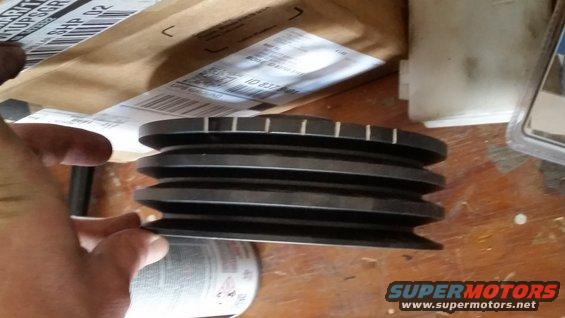
To check mechanical, put a timing light on it and then slowly rev the engine. If you do it with the screw on the carb and raise the RPMs incrementally, you can write them down and record your timing curve.
Then, get a handheld vacuum pump, put a hose on the vacuum advance canister, and slowly add vacuum. For each 1hg of vacuum, record how much the timing jumps.
This'll also help with adjusting the canister for the advance timing to come in earlier or later.
Continued until I had timing marks up to 60°.
To check mechanical, put a timing light on it and then slowly rev the engine. If you do it with the screw on the carb and raise the RPMs incrementally, you can write them down and record your timing curve.
Then, get a handheld vacuum pump, put a hose on the vacuum advance canister, and slowly add vacuum. For each 1hg of vacuum, record how much the timing jumps.
This'll also help with adjusting the canister for the advance timing to come in earlier or later.
Thread Starter
|
Lead Driver
Joined: Mar 2008
Posts: 7,190
Likes: 384
From: Near Los Angeles
Thanks, AB. That's a good method. I believe I have several msd timing mark tapes. If I have one for my balancer size, maybe I can tape that on to get the marks. Since the balancer is on now, I'll use the easier system.
Thread Starter
|
Lead Driver
Joined: Mar 2008
Posts: 7,190
Likes: 384
From: Near Los Angeles
Sorry, I should have been more specific. I meant using the tape as a means of revealing where to mark the balancer. You are correct. Our balancers are too narrow to apply the tape.
More Turbo
Joined: Nov 2015
Posts: 715
Likes: 112
You can still see the longer 10 degree lines and you can put dots at the important locations.
Thread Starter
|
Lead Driver
Joined: Mar 2008
Posts: 7,190
Likes: 384
From: Near Los Angeles
Funny, I got a new timing light today--one that is compatible with a multi-spark ignition. I had pretty much timed it by vacuum and ear, and hit the mark almost right on! I had it at 16* btdc, and the engine loves it. It smoothes out and runs fine, long, steady pulls in each gear. I didn't ck the advance due to an injury, but will get to it.