



CCV Mod, Done!!

Cargo Master
Joined: Jan 2009
Posts: 2,800
Likes: 31
From: OKC, OK
I thought about that afterwards. So much pressure would cause it pour into the crank case instead of vent out. You would need a good check valve. The way Chris did it seems like the way to go!

Hi!
Joined: Sep 2007
Posts: 1,268
Likes: 0
From: Central NJ

Anyone have numbers or know what size they are? I cant really take mine off and drive to Napa...

Posting Guru
Joined: Dec 2003
Posts: 2,392
Likes: 0
From: NW Arkansas

Lead Driver

Joined: Jan 2007
Posts: 6,708
Likes: 5
From: Kiowa CO

1.25" ID
1.5" OD is the size
1/8" width

Post Fiend
Joined: Feb 2007
Posts: 14,541
Likes: 2
From: Dallas-Ft. Worth
Yup -- that's them. Mine were shot when I did my CCV -- they looked just like the pics above. I found a pair at Discount Autoparts. No problems since.

Postmaster
Joined: Jun 2006
Posts: 2,647
Likes: 0
From: Fulltime RVer

If someone wanted could they get real fancy and drill a hole in the exhaust and weld on a small piece of pipe. Just thought that might help with the smell. Would that hurt anything? Probably unecessary, but the mice in my head are always running faster and faster giving me ideas.
If you plumb a CCV hose into the exhaust without a check valve this is what I think happens....
Before you start the engine the pressure in the crankcase and the pressure in the tailpipe where the CCV hose is connected are both 0" H20 gauge. Then when you start the engine and let it idle there's only about 0.2" H20 gauge pressure in the crankcase due to the small amount of blow by gases past the rings at idle and about 10" to 30" H20 gauge pressure in the tailpipe where the CCV hose is connected.
This 10" to 30" H20 gauge pressure difference initially forces corrosive exhaust gases from the tailpipe back up the CCV hose and into the crankcase which subjects all the oil seals to the higher pressure in the tailpipe and contaminates the oil as well.
Then when you place the engine under load the higher amount of blow by gases will increase the crankcase pressure to a high enough value (about 30" H20 gauge or more) to force the blow by gases along with the backed up exhaust gases and some of the crankcase oil out into the tailpipe.
Then each time you let off the throttle the pressure in the crankcase due to the blow gases is reduced to a low enough level to once again allow some exhaust gases to back up into the crankcase and containment the oil some more, and this process is repeated each time you get on and off the throttle until you shut the engine off at which point I would expect to see plenty of oil in the tailpipe where the where the CCV hose is connected!
I instrumented my old F350 with a cockpit gauge that read from 0" to 10" H20 so I could measure the crankcase pressure to keep tabs on the CCV hose and on the engine's blow by in general especially when towing long steep grades at WOT. For a properly designed CCV mod that vents the CCV hose to the open atmosphere the amount of blow by from a healthy engine shouldn't cause more than a 4" H20 crankcase pressure when towing up a hill at WOT.
The following is just a sample of what's been posted on this subject...
CCV into exhaust.
https://www.ford-trucks.com/forums/7...o-exhaust.html
Don't do it!! I did and now I don't. I argued with Eugene repeatedly about this. (Damn engineers think they know everything LOL) I used a check valve and a venturi tube, did everything right. I have been fighting a valve cover oil leak for almost a year, resealed twice, new gasket, proper torque, locktight, you name it I tried it. Finally I diconnected the CCV mod from the exhuast and the leak stopped. Just save yourself the hassle. Don't install the Mod into the exhaust. Barney
Gene proved that it *does* happen by measuring *POSITIVE* CC pressure at the oil cap on several trucks. It's not a theory, it's been proven. I was going to do it as well, but not after seeing that discussion. IIRC, it *can* work with a gasser because the exhaust pulses are undisturbed as they traverse the exhaust pipe. After pushing through a turbo, they're no longer distinct pulses -- just high pressure flow that wants to push back up the "venturi" that really isn't.
https://www.ford-trucks.com/forums/7...o-exhaust.html
A number of us have tried it, including me, but have since removed it. I put a pressure gauge on the tube that I had running into the exhaust, like you described it with the bung in the direction of the flow, and it actually was not providing a suction, but giving pressure. If hooked up to the CCV, this would pressurize your crankcase, which is a bad thing. The general concensus is to stay with a free flowing tube that just vents to the atmosphere.
If you put a pressure gauge on your oil cap & measure a lot of pressure with it hooked up, and not as much with it vented, I'd consider that "seeing for yourself". I didn't have to -- I took the good word of Gene and several of the others that had theirs measured. Extra pressure in your CC is a bad, BAD thing...
See post#30 (and others) here... https://www.ford-trucks.com/forums/6...-smokin-2.html , for an explanation why it DOESN'T work post turbo on a diesel, but DOES work on a high RPM gasser, if the bung is placed at just the correct location in a tuned manifold collector where it sees the negative pressure pulses in the exhaust flow. Even then, a check valve is required to stop the positive pressure pulses from blowing back up into the crankcase.
Bottom line is that crankcase pressure measurements show increased crankcase pressure when the CCV is vented to the tailpipe post turbo!
Bottom line is that crankcase pressure measurements show increased crankcase pressure when the CCV is vented to the tailpipe post turbo!
https://www.ford-trucks.com/forums/6...-pressure.html
After all the speculation and debate on here about running the CCV into the exhaust and whether it's a good idea or not, I decided to test it for myself. I used a gauge setup that Gene sent me (thanks Gene), which he put together to test CCV pressures.
The bottom line is this: My CCV is no longer routed into my exhaust and it will stay that way.
Before I even start testing testing CCV pressures, I decided to see what, if any, pressure the exhaust routed hose might produce. So I unhooked the exhaust routed hose from the valve cover doghouse (temporarily routed my CCV down the side of the engine) and hooked the gauge to that hose, right where it would normally go to the doghouse. So, the gauge is now reading the direct pressure the exhaust routed hose would be exerting on the crankcase.
My findings showed that the exhaust routed hose would exert on average 10-15 inches of H2O, but I also noted readings as high as 20-25 inches of water. The gauge was pretty bouncy, but I could get a pretty decent idea of what was going on. There bouncing needle showed me that there are definate pulsations in the exhaust though. The needle would occasionally bounce to a slight vaccum for just a fraction of a second, then jump right back up to pressure. On average, there was pressure coming from the hose.
I haven't yet started to test CCV pressures of venting straight down versus to the back of the truck yet. I'm going to play around with locations of the end of the hose when routed toward the back of the truck before I start that testing, with an attempt to see if I can find an area of low pressure somewhere under the truck that might actually create a slight vaccum at the end of the hose. I'll keep you all posted.
The bottom line is this: My CCV is no longer routed into my exhaust and it will stay that way.
Before I even start testing testing CCV pressures, I decided to see what, if any, pressure the exhaust routed hose might produce. So I unhooked the exhaust routed hose from the valve cover doghouse (temporarily routed my CCV down the side of the engine) and hooked the gauge to that hose, right where it would normally go to the doghouse. So, the gauge is now reading the direct pressure the exhaust routed hose would be exerting on the crankcase.
My findings showed that the exhaust routed hose would exert on average 10-15 inches of H2O, but I also noted readings as high as 20-25 inches of water. The gauge was pretty bouncy, but I could get a pretty decent idea of what was going on. There bouncing needle showed me that there are definate pulsations in the exhaust though. The needle would occasionally bounce to a slight vaccum for just a fraction of a second, then jump right back up to pressure. On average, there was pressure coming from the hose.
I haven't yet started to test CCV pressures of venting straight down versus to the back of the truck yet. I'm going to play around with locations of the end of the hose when routed toward the back of the truck before I start that testing, with an attempt to see if I can find an area of low pressure somewhere under the truck that might actually create a slight vaccum at the end of the hose. I'll keep you all posted.
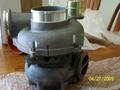
...I've got pics of how mine is routed...the tube into the ehaust is at a 45* angle and has the properly angled tip on it as well. It's one of the crank case evac kits from Jegs actually. IIRC, after all the debate of the best way to route it so it might create a vaccum, mine is setup exactly like that...
Thread Starter
|
Post Fiend
Joined: Feb 2008
Posts: 10,977
Likes: 5
From: Lancaster, Pa.
FTE Stories
Ford Trucks for Ford Truck Enthusiasts

Top 10 Fords at 2026 Carlisle Ford Nationals
Joe Kucinski
3 Best / 3 Worst Parts of Modern Ford Ownership
Brett Foote
10 Amazing Upgrades That Solve Common Ford Truck Owner Headaches
Pouria Savadkouei
Every 2026 Ford Engine Explained
Brett Foote
10 Ugly Ford Trucks That We Still Kinda Love
Joe Kucinski
10 Things Every Truck Owner NEEDS (2026 Edition)
Michael S. Palmer
Rezvani's Latest Post-Apocalyptic Monster Is a Ford F-150 Raptor Underneath
Verdad Gallardo
Top 10 Most Expensive Ford Trucks Ever Sold on Bring a Trailer
Joe Kucinski
2027 Ford Super Duty Buyer's Guide (Every Model, Engine, & Package)
Brett Foote
Hotshot


Joined: Jul 2003
Posts: 12,177
Likes: 40
From: Newport, WA
I bought my dog house O-rings at the local hardware store super cheap. Not trying to take business away from guzzle, but if you are in a pinch and need them ASAP they are available at any good hardware store- mine were in the plumbing section somewhere.
Lead Driver
Joined: Jan 2007
Posts: 6,708
Likes: 5
From: Kiowa CO
I hear ya. I totally forgot about those o-rings until I got everything apart. Being impatient like I am, instead of ordering them from guzzle, I hit the local Home Depot five minutes away and continued on with the mod. If anyone is deciding to do the CCV mod, just plan ahead and assume that yours are shot.
Cargo Master
Joined: Jan 2009
Posts: 2,800
Likes: 31
From: OKC, OK
Wow good to see all the response to the CCV exhaust question. After thinking about it for a little bit I realized it was a bad idea. However, it is nice to know the science behind it. Thanks guys!!
Postmaster
Joined: Jun 2006
Posts: 2,647
Likes: 0
From: Fulltime RVer
Ernest knows all too well that I haven't always agreed with him in the past, but in this case, I do agree that the CCV in the exhaust doesn't work. Every person that has tested the way he is suggesting has always ended up with additional pressure in the crankcase when the CCV is routed into the exhaust. I've heard of racers who have done this for decades on gas engines never getting this to work on diesel applications. For some reason, the venturi effect can't be re-created on diesels, at least not in this form.
Both the Bernoulli effect and the Venturi effect have been cited as reasons why hooking a CCV hose to a special fitting in the tailpipe will cause a lower than atmospheric pressure in the crankcase. At first glance this seems like a reasonable assumption because the Bernoulli effect states that... "as the speed of a moving fluid increases the pressure within the fluid decreases and the fluid can be either a liquid or a gas"!
Well the exhaust gas flows through the tailpipe at a considerable speed so the Bernoulli effect says the pressure within the exhaust gas is lower than if wasn't moving at all and that as the exhaust gas speed increases the pressure within the exhaust gas gets even lower, but the key here is how much lower and lower than what reference? In order to vent the crankcase the pressure within the exhaust gas has to be lower than atmospheric pressure!
I'll try to explain the Bernoulli effect and the Venturi effect in terms of the air flowing through a stock CCV tube and into the turbo inlet, and in terms of the exhaust gas flowing through a tailpipe and out into the atmosphere. Even though these are similar situations they're different enough that venting the crankcase to a stock CCV tube causes a lower than atmospheric pressure in the crankcase whereas venting the crankcase into the tailpipe causes a higher than atmospheric pressure in the crankcase.
When a 70 F room temperature mass of air is stationary all of the air molecules are in random thermal motion with a random velocity of Vr=920 mph and the air molecules exert a static pressure of Ps=14.7 psi by bouncing off of everything they come into contact with. This Ps=14.7 psi is due to their Vr=920 mph random velocity.
Now if this mass of air is flowing with a directed velocity of Vd=60 mph then all the molecules are moving along a given direction at Vd=60 mph and they exert a dynamic impact pressure Pd on any object they encounter. If you put your hand out the window at 60 mph with the palm facing forward perpendicular to the air flow your hand feels a dynamic impact pressure of Pd =0.0627 psi=1.735" H20!
That probably seems like a surprisingly low pressure for 60 mph but if your hand measures 5"x7" there's a {(5)(7)(0.0627)}=2.2 lb force pushing it backwards and if your arm is 3 feet long that's a 6.6 lb-ft TQ trying to rotate your shoulder!
The point of this is that stationary air only exerts a static pressure Ps whereas moving air exerts both a dynamic impact pressure Pd and a static pressure Ps and the increase in Pd comes at the expense of a decrease in Ps! In addition to their directed velocity Vd the molecules in moving air are also buzzing around in a random way with a random velocity Vr that's just slightly lower than the previous Vr=920 mph when the air was stationary.
This slight lowering of the random velocity Vr in moving air is necessary to maintain the total Kinetic ENERGY KE=1/2mVr^2+1/2mVd^2 in the moving air mass at the same valve as the KE=1/2mVr^2 in the stationary air mass. This slightly lower Vr causes a slightly lower Ps which is the Physics explanation of the Bernoulli effect that the static pressure within a mass of moving air is lower than the static pressure in a mass of stationary air containing the same total Kinetic ENERGY.
Bernoulli's Principle says that the total pressure Pt in an air mass which is due to its total Kinetic ENERGY is given by Pt=Ps+Pd and that as the air moves faster the Pd gets higher the and Ps gets lower so as to maintain the Pt constant.
You can estimate Pd from... Pd={(Vd/Vr)^2}{Ps}={(60/920)^2}{14.7}=0.06252=1.730" H20, and the exact equation for Pd is... Pd={(AD)(MPH^2)}/{155.62} Inches H20 where AD is the Air Density lb/ft^3. At 70 F and 14.7 psi the AD=0.075 lb/ft^3 so the Pd at 60 mph is Pd={(AD)(MPH^2)}/{155.62}={(0.075)(60^2)}/{155.62}=1.735" H20=0.0627 psi. For stationary air Pt=Ps=14.7 psi and this is the same Pt for the moving air so the new Ps=Pt-Pd=14.7-0.0627=14.6373 psi, and the difference in the static pressure within the moving air relative to the static pressure within the stationary air is Pd=0.0627 psi=1.735" H20.
In order to get a better feel for the relatively low pressures we're dealing with here consider that the pressure inside a 9” latex balloon is approximately 30" H20 higher than atmospheric pressure and that the typical human can exhale a maximum pressure that's about 40" H20 higher than atmospheric pressure!
The pic below is a model for the stock CCV tube. The static pressure within the mass of stationary air outside the air filter is P3=14.7 psi. Assume a tube diameter D1=4" with an air flow of 460 cfm which works out to a V1=60 mph. Now P1 is the static pressure within the mass of moving air and as before P3-P1=Pd=0.0627 psi=1.735" H20, and this lowering of the static pressure in the moving air by 1.735" H20 is the Bernoulli effect!
Downstream the tube narrows from a diameter D1 to D2 so that the cross sectional area reduces from A1 to A2 which increases the flow velocity to V2={(A1/A2)}{V1} and since the Pd~(V2/V1)^2 this means that P2~(A1/A2)^2 so P2 is given by P2={(A1/A2)^2}{P1}. Since (A1/A2)=(D1/D2)^2 the P2={(D1/D2)^4}{P1}.
If D2=3.5" then P2={(D1/D2)^4}{P1}={(4.0/3.5)^4}{1.735}=2.96" H20. Having P1 less than P3 and P2 less than P3 are both examples of the Bernoulli effect, and having P2 less than P1 is an example of the Venturi effect. According to Racor hooking a CCV hose to P2 and getting a 3" H20 "vacuum" would be just right for venting a crankcase, but as we'll see life isn't quite that simple!

The pic below is of my stock CCV tube and notice that the narrowed down Venturi section in it has a scoop that's pointing back into the incoming air flow! The reason for the scoop is to cancel the Inches H20 restriction of the air filter versus cfm flow. If you just hooked a CCV hose to P2 you'd be getting a 3" H20 pressure drop due to the Bernoulli effect plus up to an 18" H20 pressure drop due to the restriction of the air filter and a 21" H20 "vacuum" is way too much to safely apply to a crankcase.
I took measurements of my stock CCV while towing and it does a very good job of regulating the negative pressure applied to the crankcase to between -2" H20 and -7" H20 maximum at WOT full load. If it wasn't for blowing my turbo boot twice I'd never have considered doing a CCV mod to begin with!

Look at the first pic again and imagine that it's now a tailpipe with the turbo end vented to the P3=14.7 psi atmosphere pressure and exhaust gas being forced to flow into the air filter end under a pressure that's about 30" H20 higher than P3. Now the few inches of H20 pressure reduction within the exhaust gas due to the Bernoulli effect is relative to the exhaust inlet pressure which is 30" H20 above 14.7 psi so you wind up applying a 25" H20 or so pressure to the crankcase.
Here's how I think the device below works in a gasser that's set up with header pipes which are combined into a collector pipe.
6002 - Mr. Gasket Crankcase Evacuation System
Mr. Gasket :: Instruction Sheets
Click on 6002 to see a copy of the installation instructions...
http://www.mr-gasket.com/pdf/6002.pdf
Note the step #5 in the installation instructions above regarding the placement of the angled tube in the collector as is shown below. Those directions are very explicit concerning where the angled tube must be placed and how far it should extend into the collector pipe for various diameter collectors. Evidently someone's done some measurements and determined that the tube needs to be inserted about 40% of the collector radius. These directions also say to install a one-way check valve in each angled tube!
I think each of the header pipes is like a shotgun barrel and that each exhaust stroke is like a shotgun blast into the collector, and each blast produces a very intense pressure pulse that's of short duration and each pressure pulse is followed by a trailing low pressure tail that's of considerably longer duration and below atmospheric pressure. The angled tube is positioned to intercept these negative pressure tails and the check valve is to insure that the high pressure pulses don't enter the crankcase.
In a diesel with a turbo the exhaust manifold smoothes out the individual exhaust pulses so that they all run together and become an even flow at a more constant pressure. Then compared to the gasser the residual spent exhaust following the turbo essentially trickles down the tailpipe to where people install their CCV angled tubes.

Last edited by ernesteugene; Feb 10, 2009 at 02:53 AM. Reason: typo

Thread
Thread Starter
Forum
Replies
Last Post
cadunkle
Pre-Power Stroke Diesel (7.3L IDI & 6.9L)
4
Apr 25, 2017 11:00 PM
Skinsfan6
1999 - 2003 7.3L Power Stroke Diesel
8
Apr 26, 2011 08:48 PM
Riffraff Diesel
Vendor Specials, Discounts, Product Announcements & Group Buys
46
Mar 27, 2009 04:50 AM
