


The engine that failed
Thread Starter
|
Lead Driver


Joined: Mar 2008
Posts: 7,190
Likes: 384
From: Near Los Angeles
Most of the material to be removed to bring the chamber out to the bore circle line is near the top and as you taper the side towards the valves it just becomes a matter if smoothing out the rough surface.
I used a cone shaped burr for that part of the job and switched to tapered rolls on a mandrel to finish and to do the chamber floor.
Much safer working near a completed valve job with sanding rolls.
I used a cone shaped burr for that part of the job and switched to tapered rolls on a mandrel to finish and to do the chamber floor.
Much safer working near a completed valve job with sanding rolls.

More Turbo


Joined: Nov 2015
Posts: 715
Likes: 112
You are correct.
Here is a better view of the chamber.
https://www.dropbox.com/s/9dpif5xrxo...01520.JPG?dl=0
I did use a cone shaped burr to work that area.
My chamber shown here is 77cc but was 80 before the shop took a .025" cut off of it without asking me.
Here is a better view of the chamber.
https://www.dropbox.com/s/9dpif5xrxo...01520.JPG?dl=0
I did use a cone shaped burr to work that area.
My chamber shown here is 77cc but was 80 before the shop took a .025" cut off of it without asking me.
Thread Starter
|
Lead Driver
Joined: Mar 2008
Posts: 7,190
Likes: 384
From: Near Los Angeles
I did an initial cc of the chambers, and came up with 70cc. I thought it would measure around 76cc. Isn't that the standard cc for a non efi chamber? Granted, it has most likely been milled down a few times in the 40 years of its life. Actually, I am quite pleased with that measurement. 70cc, with .020 quench, a 19cc dish in the piston, and the .0353 thickness of the gasket, should bring my c.r. to 9.25:1. Once I polished the chambers, this head is going back together. I'm glad pmuller said to hold off on the milling of the block! Whew! I was counting on the chamber volume being 76cc, and was going to mill the block to 0 quench. Oops. Thanks, pmuller. You saved me again there. Today I go into super porting beast mode.
Important tip: Remember, before pulling the valve out through the head, once the spring is off, you have to take a file and remove any burr around the tip of the valve, and around the groove where the keepers sit. Or, you'll ruin your valve guide and your engine will start to burn oil.
*A note for who ever cares: The Craftsman valve compressor is crap. It was brand new, and lasted for two valves. **Note two: The rheostat they sell at the China inc. store, aka Harbor Freight, is also crapola. You need two of them hooked together, at $20 each, to slow an electric die grinder enough to do porting work. Instead, go to the second hand store and get a couple of their electric fans with speed control, and wire the controller into a chord, and run your device through that. That will be $5.00 for the tip.
Important tip: Remember, before pulling the valve out through the head, once the spring is off, you have to take a file and remove any burr around the tip of the valve, and around the groove where the keepers sit. Or, you'll ruin your valve guide and your engine will start to burn oil.
*A note for who ever cares: The Craftsman valve compressor is crap. It was brand new, and lasted for two valves. **Note two: The rheostat they sell at the China inc. store, aka Harbor Freight, is also crapola. You need two of them hooked together, at $20 each, to slow an electric die grinder enough to do porting work. Instead, go to the second hand store and get a couple of their electric fans with speed control, and wire the controller into a chord, and run your device through that. That will be $5.00 for the tip.

Lead Driver

Joined: Dec 2000
Posts: 6,298
Likes: 47
From: South central, Minnesota
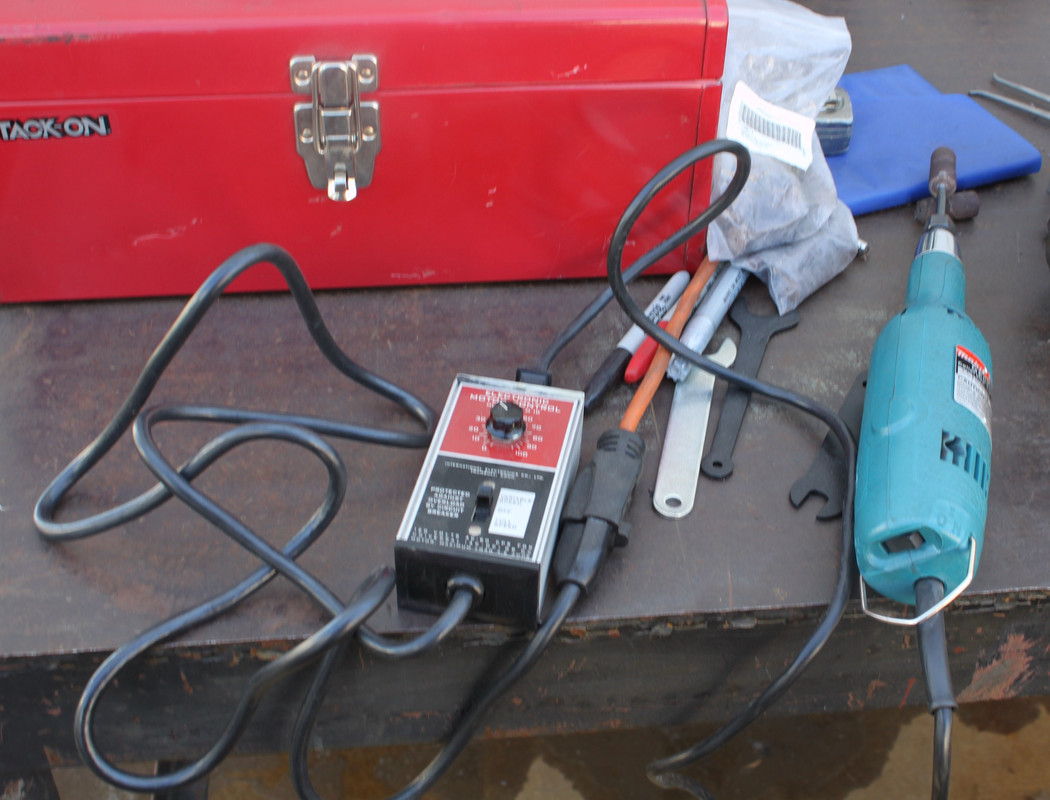
*A note for who ever cares: The Craftsman valve compressor is crap. It was brand new, and lasted for two valves. **Note two: The rheostat they sell at the China inc. store, aka Harbor Freight, is also crapola. You need two of them hooked together, at $20 each, to slow an electric die grinder enough to do porting work. Instead, go to the second hand store and get a couple of their electric fans with speed control, and wire the controller into a chord, and run your device through that. That will be $5.00 for the tip.
Here's the ones I bought.
Thread Starter
|
Lead Driver
Joined: Mar 2008
Posts: 7,190
Likes: 384
From: Near Los Angeles
Thanks Fordman. I'm using a cordless drill and a elec die grinder with a rotary stone. I hit the runners with the stone, and then come back and clean it up with the abrasive roll on the drill. Except for the exhaust runners. Those I hit first with the abrasive roller and clean out the soot, then the stone, and the roll. This is a lot of work, ha ha, like you didn't know. Here is an image of a partially done runner. The bits for digging/reshaping scare me. I'm just not skilled or confident enough to feel good about using them. No biggie.

What worried me was that with the exh valves, there was so much carbon that once the springs were removed I could not move the valve. I had to tap it out with a rubber mallet. Also, after 40k miles, there was loads of crap on the back of the intake valves. How do I remove that...maybe a wire wheel of brass bristles?

Since Finding that my chambers are only 69cc, and now seeing how small the exh runners are, I'm thinking that a cam with longer duration exh could be beneficial. Any thoughts?
What worried me was that with the exh valves, there was so much carbon that once the springs were removed I could not move the valve. I had to tap it out with a rubber mallet. Also, after 40k miles, there was loads of crap on the back of the intake valves. How do I remove that...maybe a wire wheel of brass bristles?
Since Finding that my chambers are only 69cc, and now seeing how small the exh runners are, I'm thinking that a cam with longer duration exh could be beneficial. Any thoughts?
Lead Driver
Joined: Dec 2000
Posts: 6,298
Likes: 47
From: South central, Minnesota
Thanks Fordman. I'm using a cordless drill and a elec die grinder with a rotary stone. I hit the runners with the stone, and then come back and clean it up with the abrasive roll on the drill. Except for the exhaust runners. Those I hit first with the abrasive roller and clean out the soot, then the stone, and the roll. This is a lot of work, ha ha, like you didn't know. Here is an image of a partially done runner. The bits for digging/reshaping scare me. I'm just not skilled or confident enough to feel good about using them. No biggie.
What worried me was that with the exh valves, there was so much carbon that once the springs were removed I could not move the valve. I had to tap it out with a rubber mallet. Also, after 40k miles, there was loads of crap on the back of the intake valves. How do I remove that...maybe a wire wheel of brass bristles?
What worried me was that with the exh valves, there was so much carbon that once the springs were removed I could not move the valve. I had to tap it out with a rubber mallet. Also, after 40k miles, there was loads of crap on the back of the intake valves. How do I remove that...maybe a wire wheel of brass bristles?
Now just imagine that plus the additional time with buffs and polishing compounds on the chambers and exhaust ports. I start with either carbide burs or 80 grit abrasive rolls. I also use stones. Then on the combustion chambers and exhaust ports I also use 180, 240, 320 grit abrasive rolls. Then move on to the polishing compounds. You can do it all with stones and abrasive rolls. The carbide burs just cut quicker. Once you get use to using them they sure speed up things. If you ever want to try them, a junk head is a good way to get use to using them. Just pick up a cheap head you don't care about and go to town on it. I really enjoy porting stuff. I just kind of get in a rhythm and zone everything else out.
On the valves a bench grinder with a wire wheel will clean them up the fastest. If you aren't in a big hurry I soak them in a tray of ATF. Just filled enough to cover the carboned areas. The ATF also works great for cleaning carbon off pistons too! Just let them soak for a day or two and they clean up much easier.
Thread Starter
|
Lead Driver
Joined: Mar 2008
Posts: 7,190
Likes: 384
From: Near Los Angeles
What about cleaning the valve seats? There is gunk, dabs of goo on them. I thought I'd use lacquer thinner or paint thinner, or some such chemical, to wipe them clean.
Fordman, I admire you for taking the time to finely sand and then polish the chambers and exhaust ports. I might do it if I were set up better, but I'm roughing it with a battery powered drill-driver and a garage with so much parts and junk that I can barely turn around in there any more, and I'm constantly worried that the neighbors will complain about the noise. But my hat is off to you. That is going the extra mile. What is the benefit? Can you feel the diff?
Should I replace the valve seals and keepers?
Fordman, I admire you for taking the time to finely sand and then polish the chambers and exhaust ports. I might do it if I were set up better, but I'm roughing it with a battery powered drill-driver and a garage with so much parts and junk that I can barely turn around in there any more, and I'm constantly worried that the neighbors will complain about the noise. But my hat is off to you. That is going the extra mile. What is the benefit? Can you feel the diff?
Should I replace the valve seals and keepers?
Lead Driver
Joined: Dec 2000
Posts: 6,298
Likes: 47
From: South central, Minnesota
Thinner works, I've also used diesel, simple green works for smaller parts that you can soak in it I use whatever I've got that's handle that will cut it.
Believe me there is nothing special about my set up. The fanciest thing is the Makita die grinder. I do all the work with an extension cord, a work bench sitting on the end of my house in my driveway while sitting on a stack of tires. I'm sure the neighbors love it!
 But they are use to me doing crazy stuff. I've cut up mutiple vehicles in my driveway in the past. How many neighbors have you seen take a sawzall to a car/truck( many times ) and cut it into 3 foot pieces. Couldn't really tell you the flow/power difference. It always feels better to me. But if it's actually better or just some placebo effect, I couldn't say. The main reason I do it is to slow down carbon deposits. I also like to add a oil separator/catch can set up into the PCV systems to also help that. Building a flow bench is on my project to do list. Then I'd be able to tell if there is an actual difference in flow or not. I'm sure PMuller can tell you exactly how much of a benefit or detriment there is to a full polished chamber and port over a rougher cut. He's got much more experience and flow bench time.
I replace the seals every time I have a head apart. They are cheap and it's apart what better time to do it. When I don't change stuff like that it usually bites me in the rear! The keepers/locks etc. I reuse on stock engines. If I'm upgrading springs, cam etc. I replace them. They are cheaper then replacing/rebuilding the engine from a dropped valve.
.
Believe me there is nothing special about my set up. The fanciest thing is the Makita die grinder. I do all the work with an extension cord, a work bench sitting on the end of my house in my driveway while sitting on a stack of tires.
I'm sure the neighbors love it! But they are use to me doing crazy stuff. I've cut up mutiple vehicles in my driveway in the past. How many neighbors have you seen take a sawzall to a car/truck( many times ) and cut it into 3 foot pieces. Couldn't really tell you the flow/power difference. It always feels better to me. But if it's actually better or just some placebo effect, I couldn't say. The main reason I do it is to slow down carbon deposits. I also like to add a oil separator/catch can set up into the PCV systems to also help that. Building a flow bench is on my project to do list. Then I'd be able to tell if there is an actual difference in flow or not. I'm sure PMuller can tell you exactly how much of a benefit or detriment there is to a full polished chamber and port over a rougher cut. He's got much more experience and flow bench time.I replace the seals every time I have a head apart. They are cheap and it's apart what better time to do it. When I don't change stuff like that it usually bites me in the rear! The keepers/locks etc. I reuse on stock engines. If I'm upgrading springs, cam etc. I replace them. They are cheaper then replacing/rebuilding the engine from a dropped valve.
.
FTE Stories
Ford Trucks for Ford Truck Enthusiasts

3 Best / 3 Worst Parts of Modern Ford Ownership
Brett Foote
10 Amazing Upgrades That Solve Common Ford Truck Owner Headaches
Pouria Savadkouei
Every 2026 Ford Engine Explained
Brett Foote
10 Ugly Ford Trucks That We Still Kinda Love
Joe Kucinski
10 Things Every Truck Owner NEEDS (2026 Edition)
Michael S. Palmer
Rezvani's Latest Post-Apocalyptic Monster Is a Ford F-150 Raptor Underneath
Verdad Gallardo
Top 10 Most Expensive Ford Trucks Ever Sold on Bring a Trailer
Joe Kucinski
2027 Ford Super Duty Buyer's Guide (Every Model, Engine, & Package)
Brett Foote
Top 10 Ford Truck Tragedies
Joe Kucinski
Thread Starter
|
Lead Driver
Joined: Mar 2008
Posts: 7,190
Likes: 384
From: Near Los Angeles
Dang it. Wrote a long reply and lost it. Funny about the neighbors and cutting up cars.
What I thought was gunk on the v.seats is actually pits. The exh. seats are the worse. The sealing area of the valves is pitted as well. Is this normal?

I'm dreading having to have new exh seats installed, and I don't think lapping would solve the pitting problem on the intakes. So ... what should I do? I'm a bit irritated that this could happen after 40k miles. Is this normal?
What I thought was gunk on the v.seats is actually pits. The exh. seats are the worse. The sealing area of the valves is pitted as well. Is this normal?
I'm dreading having to have new exh seats installed, and I don't think lapping would solve the pitting problem on the intakes. So ... what should I do? I'm a bit irritated that this could happen after 40k miles. Is this normal?
Lead Driver
Joined: Dec 2000
Posts: 6,298
Likes: 47
From: South central, Minnesota
What I would do is to lap the valves and see how it comes out. If the pitting remains after lapping then take the head & valves to a machine shop and have them reground. You really shouldn't need the seats replaced unless they are sunk. And if you are having them reground there are a bunch of options you can have done there to as far as angles and number of angles, etc. But I would start with lapping and that will give you an idea of what you are working with..
Thread Starter
|
Lead Driver
Joined: Mar 2008
Posts: 7,190
Likes: 384
From: Near Los Angeles
I'll try to lap the valves and determine the outcome.
I have one issue that is hindering the build. When I decided on the cam, I took it for granted that I would have a 76cc c.chamber. That is the volume of a stock carb'ed chamber. To my surprise, I found I had 69-70cc chambers. With my cam (adv. duration=280, @.050, lift .480" with a lsa of 108*, advanced 4*, I come up with a dynamic Compression ratio of 7.36. That is quite close to the 7.50 threshold of pinging with low grade gas. Yes, I could run mid-grade fuel, but I'm cheap. Even if I used my Isky 256* cam in the engine, it puts the dcr over 7.50. A bit more duration solves the problem, or I could back off the advance down to 2*.
I guess that if this is my biggest problem, then the build is going well.
Merry Christmas, to one and all!!
I have one issue that is hindering the build. When I decided on the cam, I took it for granted that I would have a 76cc c.chamber. That is the volume of a stock carb'ed chamber. To my surprise, I found I had 69-70cc chambers. With my cam (adv. duration=280, @.050, lift .480" with a lsa of 108*, advanced 4*, I come up with a dynamic Compression ratio of 7.36. That is quite close to the 7.50 threshold of pinging with low grade gas. Yes, I could run mid-grade fuel, but I'm cheap. Even if I used my Isky 256* cam in the engine, it puts the dcr over 7.50. A bit more duration solves the problem, or I could back off the advance down to 2*.
I guess that if this is my biggest problem, then the build is going well.
Merry Christmas, to one and all!!

Tuned
Joined: May 2013
Posts: 396
Likes: 5
From: Ottawa, Canada
I would not lap those. Looks like quite a bit of pitting. Been there done that. Didn't get more than a year out of it and I was back to square one pulling the head with awful compression. Get a valve job done. They may not need to install new seats and may just do the valve job on the old ones.
The cost of the valve job vs the cost of doing it again likely isn't worth it. Also if the milage is quite high on the valves I'd consider replacing them. That would prob tighten up some valve guide wear as well.
Checking to see if they are leaking is easy. I flip the head upside down on wood blocks with valves, spark plugs and springs assembled. Fill the chamber with water. Blow compressed air into the port and if bubbles come up around the valve its time for valve work.
I'm no engine machinist but after the fiasco I had with lapping old valves.... That's my 2¢.
The cost of the valve job vs the cost of doing it again likely isn't worth it. Also if the milage is quite high on the valves I'd consider replacing them. That would prob tighten up some valve guide wear as well.
Checking to see if they are leaking is easy. I flip the head upside down on wood blocks with valves, spark plugs and springs assembled. Fill the chamber with water. Blow compressed air into the port and if bubbles come up around the valve its time for valve work.
I'm no engine machinist but after the fiasco I had with lapping old valves.... That's my 2¢.
Thread Starter
|
Lead Driver
Joined: Mar 2008
Posts: 7,190
Likes: 384
From: Near Los Angeles
I found a machine shop to grind the valves and the seats for $130. The hardened seats were good and did not need to be replaced.
I'm going to buzz about 1/8th of an inch off the back wall of the chamber; the wall opposite from the s.plug wall. I'm hoping to gain 2cc volume. Getting chambers, or finding that I had chambers of 70cc and not the 76cc chambers that I thought I had, has thrown my cam selection back to the planning department. Although I love hearing an engine lope at idle, I'm now thinking of mpg and power, and having to sacrifice the beloved lope. Howard's Cams makes one with 267*adv., int & exh, with .480 lift and 110 lsa. I think it has 47* overlap, compared to 60* which my first choice, along with lope, had.
It's funny that the choice can be so difficult.
Head will be together tomorrow. Then I'll jump to welding up the frame and building the engine.
I'm going to buzz about 1/8th of an inch off the back wall of the chamber; the wall opposite from the s.plug wall. I'm hoping to gain 2cc volume. Getting chambers, or finding that I had chambers of 70cc and not the 76cc chambers that I thought I had, has thrown my cam selection back to the planning department. Although I love hearing an engine lope at idle, I'm now thinking of mpg and power, and having to sacrifice the beloved lope. Howard's Cams makes one with 267*adv., int & exh, with .480 lift and 110 lsa. I think it has 47* overlap, compared to 60* which my first choice, along with lope, had.
It's funny that the choice can be so difficult.
Head will be together tomorrow. Then I'll jump to welding up the frame and building the engine.
More Turbo
Joined: Nov 2015
Posts: 715
Likes: 112
Since you are trying to get more chamber volume, just go straight accross by increasing the wall angle.
If you take material from the bottom (Chamber ceiling) you weaken the chamber as you get close to the water jacket.
What size valves are in the head?
The Custom cam you have gives you power and reasonable fuel mileage.
I have a cam with 288/288, 232/232 on a 112 LSA getting 18 mpg at 70 mph and 15 around town with a 650 cfm 4 barrel carb.
If you change to a cam with less than 280 degrees adv duration you will certainly have detonation problems.
Keep the cam you have and advance it 2 degrees instead of 4.
If you take material from the bottom (Chamber ceiling) you weaken the chamber as you get close to the water jacket.
What size valves are in the head?
The Custom cam you have gives you power and reasonable fuel mileage.
I have a cam with 288/288, 232/232 on a 112 LSA getting 18 mpg at 70 mph and 15 around town with a 650 cfm 4 barrel carb.
If you change to a cam with less than 280 degrees adv duration you will certainly have detonation problems.
Keep the cam you have and advance it 2 degrees instead of 4.
Thread Starter
|
Lead Driver
Joined: Mar 2008
Posts: 7,190
Likes: 384
From: Near Los Angeles
Since you are trying to get more chamber volume, just go straight accross by increasing the wall angle.
If you take material from the bottom (Chamber ceiling) you weaken the chamber as you get close to the water jacket.
What size valves are in the head?
The Custom cam you have gives you power and reasonable fuel mileage.
I have a cam with 288/288, 232/232 on a 112 LSA getting 18 mpg at 70 mph and 15 around town with a 650 cfm 4 barrel carb.
If you change to a cam with less than 280 degrees adv duration you will certainly have detonation problems.
Keep the cam you have and advance it 2 degrees instead of 4.
If you take material from the bottom (Chamber ceiling) you weaken the chamber as you get close to the water jacket.
What size valves are in the head?
The Custom cam you have gives you power and reasonable fuel mileage.
I have a cam with 288/288, 232/232 on a 112 LSA getting 18 mpg at 70 mph and 15 around town with a 650 cfm 4 barrel carb.
If you change to a cam with less than 280 degrees adv duration you will certainly have detonation problems.
Keep the cam you have and advance it 2 degrees instead of 4.
Thanks for jumping in, pmuller.