


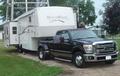


V10 Gearing

Guest
Joined: Nov 2004
Posts: 7,988
Likes: 55
From: north west new jersey
art
it's just the gears sets.carriers and housings are the same.
you do not want to lift a 10.5 carrier alone , take my word at that! as i did it on 3 trucks so that means many times in and out to shim those bad boys in place. and i'll bet you know whats hurting now big time! both sides.plus my back is still ooocccchhhhing
it's just the gears sets.carriers and housings are the same.
you do not want to lift a 10.5 carrier alone , take my word at that! as i did it on 3 trucks so that means many times in and out to shim those bad boys in place. and i'll bet you know whats hurting now big time! both sides.plus my back is still ooocccchhhhing

Thread Starter
|
Laughing Gas
Joined: Jun 2005
Posts: 939
Likes: 1
Hey, lots of good posts here, however im still at a loss as to what the advantage of one versus the other is (gearing), I never got into gearing when buying my previous trucks. Just took what was available.
So whats the advantages of 3.73,4.10,4.30.
Im guessing at this point at least this..
3.73 more low end torque, better for towing, worse gas mileage.
4.10 best of both worlds
4.30 no low end torque, worse for towing and best for gas mileage
The posts for "get the .... gears" is good as it helps to know what everybody recommends. But i was also looking for a little of "Why one would want to pick one over the other and what are its pros and cons"?
Thanks
So whats the advantages of 3.73,4.10,4.30.
Im guessing at this point at least this..
3.73 more low end torque, better for towing, worse gas mileage.
4.10 best of both worlds
4.30 no low end torque, worse for towing and best for gas mileage
The posts for "get the .... gears" is good as it helps to know what everybody recommends. But i was also looking for a little of "Why one would want to pick one over the other and what are its pros and cons"?
Thanks

Elder User
Joined: Jun 2005
Posts: 645
Likes: 2
Im guessing at this point at least this..
3.73 more low end torque, better for towing, worse gas mileage.
4.10 best of both worlds
4.30 no low end torque, worse for towing and best for gas mileage
3.73 more low end torque, better for towing, worse gas mileage.
4.10 best of both worlds
4.30 no low end torque, worse for towing and best for gas mileage
3.73: Less low end torque, lower hwy RPM's, worst choice for towing
4.10: $50 cheaper than the 4.30's
4.30: Highest low end torque, best choice for towing, gas milage not that much worse, if any than the 3.73's. 4.30's puts the engine closer to the center of the torque curve especially if you are thinking about oversize tires. My fuel economy is practically the same even though my current truck is a crew and my last was a supercab. For something as heavy as a SuperDuty the 3.73 maybe makes sense in a two wheel drive "daily driver" but I wouldn't get it anywhere else, especially in a 4x4. The 4x4 has more weight and more aerodynamic drag and benefits from the higher gears.
Last edited by dmp437; Dec 6, 2005 at 08:06 AM.

Posting Guru
Joined: Dec 2004
Posts: 1,713
Likes: 16

SDTruckman, You have it exactly opposite.
Think of it like this, when your drive shaft turns 3.73 times to turn your rear wheel 1 complete revolution , you have 3.73 to 1 gears.
When your drive shaft turns 4.3 times to turn your rear wheel 1 complete revolution then you have 4.30 to 1 gears or 4.30:1
This is in high gear which is direct drive or 1:1 ratio.
This shows you the higher the number of the rear end, the lower gearing you have.
The difference in gas mileage btween the 4.10s and 4.30s, is very little in an unloaded truck. Towing heavy the 4.30s are probably a little better.
Also the 4.10s give you a legal GCWR ( gross combined weight rating ) of 21000 LB.
The 4.30 give you a GCWR of 23000 LB, same as a diesel.
My truck and Fiver should be around 20000 at the most, but I wish I would have gotten the 4.30s to give me that extra 2000 pounds of legal tow weight. I am very happy with my truck's performance now.
These GVWR are for the 05 and 06 models, Before that 20000 was tops even for the mighty PSD.
Think of it like this, when your drive shaft turns 3.73 times to turn your rear wheel 1 complete revolution , you have 3.73 to 1 gears.
When your drive shaft turns 4.3 times to turn your rear wheel 1 complete revolution then you have 4.30 to 1 gears or 4.30:1
This is in high gear which is direct drive or 1:1 ratio.
This shows you the higher the number of the rear end, the lower gearing you have.
The difference in gas mileage btween the 4.10s and 4.30s, is very little in an unloaded truck. Towing heavy the 4.30s are probably a little better.
Also the 4.10s give you a legal GCWR ( gross combined weight rating ) of 21000 LB.
The 4.30 give you a GCWR of 23000 LB, same as a diesel.
My truck and Fiver should be around 20000 at the most, but I wish I would have gotten the 4.30s to give me that extra 2000 pounds of legal tow weight. I am very happy with my truck's performance now.
These GVWR are for the 05 and 06 models, Before that 20000 was tops even for the mighty PSD.
Last edited by Wrenchtraveller; Dec 6, 2005 at 08:16 AM.

Elder User
Joined: Mar 2005
Posts: 735
Likes: 1
From: SW Iowa
SD man
I think the consenous of opinion seems to be get the 4.30LS final drive ratio gearing and your Super Duty will run like a "striped a-ss ape".
If you get the 3.73 finals, which seems to be what most all the dealer's around here stock for '06 F-250 and F-350 SD automatics, both 5.4 gas and 6.0 diesel (I haven't found any dealer stock '06 V-10's yet), you will almost be happy, but will always wonder "what if", especially if you tie into a big load.
If you get the 3.73 finals, which seems to be what most all the dealer's around here stock for '06 F-250 and F-350 SD automatics, both 5.4 gas and 6.0 diesel (I haven't found any dealer stock '06 V-10's yet), you will almost be happy, but will always wonder "what if", especially if you tie into a big load.

FTE Leadership Emeritus


Joined: Jul 2002
Posts: 42,562
Likes: 423
From: Long Island USA

Let's say a 3.73 rear gear puts down "X" amount of torque to the ground at any given tranny gear.
A 4.10 puts down 5% more torque to the ground than the 3.73, and a 4.30 puts down 15% more torque than a 3.73
Conversely, the engine runs 15% higher RPMs with the 4.30's than the 3.73's at the same road speed.
Gearing is probably the most cost-effective way to get 15% more torque from your motor applied to the ground ... 15% is more than a Superchips tuner on 87 octane, I'd think.
A 4.10 puts down 5% more torque to the ground than the 3.73, and a 4.30 puts down 15% more torque than a 3.73
Conversely, the engine runs 15% higher RPMs with the 4.30's than the 3.73's at the same road speed.
Gearing is probably the most cost-effective way to get 15% more torque from your motor applied to the ground ... 15% is more than a Superchips tuner on 87 octane, I'd think.
Thread Starter
|
Laughing Gas
Joined: Jun 2005
Posts: 939
Likes: 1
Ok thats a little clearer now.
4.30 more grunt, but worse MPG
4.10 middle of the road
3.73 less grunt, but better MPG
what exactly would be the difference in the MPG City/Highway
4.30 more grunt, but worse MPG
4.10 middle of the road
3.73 less grunt, but better MPG
what exactly would be the difference in the MPG City/Highway
FTE Stories
Ford Trucks for Ford Truck Enthusiasts

Top 6 Best Deals Available on New Fords & Lincolns Right Now
Brett Foote
This Hennessey Takes the Expedition Tremor's Off-Roading Capability to the Next Level
Verdad Gallardo
Top 10 Fords at 2026 Carlisle Ford Nationals
Joe Kucinski
3 Best / 3 Worst Parts of Modern Ford Ownership
Brett Foote
10 Amazing Upgrades That Solve Common Ford Truck Owner Headaches
Pouria Savadkouei
Every 2026 Ford Engine Explained
Brett Foote
10 Ugly Ford Trucks That We Still Kinda Love
Joe Kucinski
10 Things Every Truck Owner NEEDS (2026 Edition)
Michael S. Palmer
Rezvani's Latest Post-Apocalyptic Monster Is a Ford F-150 Raptor Underneath
Verdad Gallardo
Junior User
Joined: Feb 2005
Posts: 54
Likes: 0
I recall reading a couple years ago, I think it was is Trailer LIfe Magazine, where they tested tow vehicles with different rear end ratios. The conclusions they came up with were that between most gear ratios there was never more than 1.5 mpg difference with most differences being less 1 mpg. And in city driving there was no difference. So to buy gearing for significant better mpg is a mistake. It won't happen. Driving habits, weights, tire pressures, and wind resistance have way more bearing on mpg.


Moderator

Joined: May 2005
Posts: 8,237
Likes: 1,248
From: San Antonio, TX
You'll most likely get WORSE mpg in the city with 3.73s. It takes more grunt to get that big ring gear moving. Combine that with stop and go driving and it gets worse. Add a trailer or heavy load......mpg will be dismal.
Elder User
Joined: Mar 2005
Posts: 735
Likes: 1
From: SW Iowa
??????
Now I am confused. I agree it takes more grunt to start and keep up to speed a 3.73 vs a 4.30 final drive, but isn't the ring gear bigger in the 4.30 than the 3.73? More teeth? Thus giving it a greater mechanical advantage over the smaller gear 3.73?
Where is the capt. when you need him?
I like what Kewat said... a 4.30 final drive delivers 15% more torque to the wheels than a 3.73, and that is a lot of grunt when you are talking the hundreds of foot lbs that V-10 puts out.!
Where is the capt. when you need him?
I like what Kewat said... a 4.30 final drive delivers 15% more torque to the wheels than a 3.73, and that is a lot of grunt when you are talking the hundreds of foot lbs that V-10 puts out.!

New User
Joined: Dec 2005
Posts: 18
Likes: 0
im gonna jump in here and try to steal some knowledge. it seems to be unanimous that the 4:30 is the best in this truck. i cant find a gear calculator, so i will ask. what gearing would you run in a v10 running 38 inch tires???? some have said all the way down into the low 5's???
