When you click on links to various merchants on this site and make a purchase, this can result in this site earning a commission. Affiliate programs and affiliations include, but are not limited to, the eBay Partner Network.
After debate inside my head, I ditched the center section idea I was going to use and instead made a more traditional transmission mount. Nothing fancy. It will mount to the boxed frame rails with through bolts. I will weld in crush tubes for the bolts. Obstacles are exhaust and running board bracket.
First I made a few raw drawings just to get an idea of how it was going to look. The obstacles will pretty much dictate how it needs to be made. Once I had a general plan I made a permanent drawing just like I did for my exhaust.
I started by making the frame mounting plates. I used 1/4" plate. One pair of bolt heads will be behind the running board bracket. I tacked them together and cleaned them up on the grinding disc. I also drilled 1/8" pilot holes for the mounting bolts.
I used them as a template and clamped them to the frame. Once I drilled out 1/8" pilot holes in the frame I opened them up to 3/4". I opened up the holes in the plate to 1/2". Then I made up some crush tubes. I used 3/4" DOM tubing with a wall thickness of 1/8". That leaves the inside hole 1/2. I'll be using ARP 1/2" bolts to attach.
I set the crush tubes in the frame leaving a little shallow on each side. That leaves a nice open corner to weld. They clean up nice and easy.
Then I brurned them in.
And cleaned them up. I used a grinding wheel and flap disc, then ran a 1/2" drill bit through the hole. You can see how one pair of holes is right between the running board attachments.
Now that the mounting plates are in I cut up some steel from the measurements I figured in the drawing. I used 3" × 1 1/2" rectangular with a 3/16" wall thickness. It's some beefy stuff.
Then set them on the drawing to see how I did.
The center piece holds the trans mount so I punched some 7/16" holes through both sides on my drill press. Then enlarged the bottom holes to accept the washers and to be able to get a socket to the bolt head.
I welded on the first pair of angle pieces and mounted it to the transmission.
Then I did some final trimming on the last parts until it was a perfect fit. One important thing is that all this stuff will be painted so I need to account for that or it won't fit after paint. When I installed the frame plates I sandwiched a few pieces of construction paper between the frame and plates to account for paint thickness.
Now that everything fits real nice I tacked it in place and pulled it out to fully weld.
Then mounted it in the truck.
And test fit with the exhaust.
This is how the bolt heads sit behind the running board brackets.
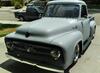
Gotta say, it feels pretty darn good finishing that. Now I can roll the truck around as I please. Another thing checked off the list .
I know you've already drilled through your chassis, but I followed a tutorial similar to this tutorial to create threaded inserts for my gas tank when I moved it to the rear:
I know you've already drilled through your chassis, but I followed a tutorial similar to this tutorial to create threaded inserts for my gas tank when I moved it to the rear:
I contacted a local fabricator - they built them for me. I had searched sites like grainger and while they had similar, no one had what that video did. Rivet nuts seemed like they would work, but I wanted to copy the video a bit more closely (I did a slightly smaller size but wanted the same principle).
I have a few small things I want to work on next, emergency brake cables and such. The next major project is going to be the steering column/pedals/electric PS. So the next major decision is going to be getting the seating position sorted.
I went up in the attic and drug out a pair of Corbeau TRS buckets that have been stored for at least 4 years. I bought them for my jeep build but they were tough getting in and out of on a lifted Jeep because of the high thigh bolsters on the seats and the small door opening with a high sill. Only had them in there for a few months. They might be a nice fit in the truck though. I pulled off the garbage bags they were stored in and they are perfect. So.... Hmmm... The age old question. Bench or buckets.... Got some thinking to do.
I have a few small things I want to work on next, emergency brake cables and such. The next major project is going to be the steering column/pedals/electric PS. So the next major decision is going to be getting the seating position sorted.
I went up in the attic and drug out a pair of Corbeau TRS buckets that have been stored for at least 4 years. I bought them for my jeep build but they were tough getting in and out of on a lifted Jeep because of the high thigh bolsters on the seats and the small door opening with a high sill. Only had them in there for a few months. They might be a nice fit in the truck though. I pulled off the garbage bags they were stored in and they are perfect. So.... Hmmm... The age old question. Bench or buckets.... Got some thinking to do.
Are the buckets comfortable? I was going to go with that style but went with Corbeau sport seats instead for more comfortable. That bench seat looks nice also
Nick,
An answer to your age old question of buckets or bench. For me with my smaller cab 48 F1, the answer is bench. The extra space afforded by the bench is welcome for my wife and I as we have "spread out" a little as we have aged.
My choice is the frame from Glide Engineering. I've seen their product and it is excellent. Here is a link for the 48-52 seat frame. FORD PU 1948-1952
^^Thanks Phil. I'm leaning bench. I'm also looking at TMI Products. They have some nice bench's too.
So I finished up the emergency brake set up. There are several ways I could run the cables. I choose to run them through the frame. It just seemed the best way and made the cables nice and neat without hard bends. I wanted to drill through the frame at an angle, which is difficult if not impossible with a drill bit. So I made an adapter pate for my notcher.
Then I clamped it to the frame with some vice grips. The arbor of the notcher is 15/16". So as long as I use a larger bit than the arbor I can drill all the way through something until I run out of arbor. I used a 1" bit.
Then I bored out the hole. On top of the frame are the plugs I drilled out. It makes a nice accurate hole.
I slid a piece of 1" DOM tubing through the hole, marked the excess and cut off. Then I fitted it up until it was just shallow of the frame rails. Just like all the other through frame fittings I've made. Then welded both sides. Because the e-brake cable runs through these tubes I took extra time to clean them up and polish the edges. I used various attachments for my Dremel.
I'm using an E-Stopp electric parking brake. Before I boxed the frame I planned most of this out and welded nuts behind the boxing plates. Future Nick thanks past Nick. Made it easy. Just bolted it on. I did make a few bracket for the cable and plug welded them to the frame.
Then I busted out the brake line tools. On my last project I bought a vice mounted flaring tool from Eastwood. It's a great tool, perfect flare every time. Worth every penny. For brake line I am using NiCopp which doesn't rust or corrode and is much easier to work with than SS. I'm using a stainless spiral wrap for protection from debris (and me during the build ).
I made up the lines for the axle. To secure the lines to the axle I modified some clamps into P-Clamps. The hole left will be plug welded to the axle.
I used hard line from caliper to caliper. Then I made a bracket for the T-fitting. It mounts to the axle with the threaded vent tube.
Here is a pic of the lines mounted to the axle with my home made clips.
I welded on the tab for the flex hose from the axle to the frame.
Then a few pics of the finished and secured e-brake cables. I'm pleased with the outcome.
One note on rear disc brakes as Ive learned the hard way in the past. My calipers are solid mounted to the axle. There are no slides. The caliper has 4 pistons, two on each side and doesn't need to slide to actuate. If the caliper is mounted on slides, flexible hose should be used.
Also, I can run solid mounted calipers because I'm using a full floating rear end. The axles only are there to turn the wheels. They support no weight. There is no endplay of the axle. On axles with c-clips where there is endplay the calipers must be mounted on slides regardless. Otherwise the small amount of axle endplay will actually push the caliper pistons back into the bores a little bit when you go around a corner. Then you will have to pump the brakes to set the pads back against the rotor. Not cool.
If anyone isn't familiar with the E-Stopp parking brake system I took a short 16 second video. It works nice.
Rezvani's Latest Post-Apocalyptic Monster Is a Ford F-150 Raptor Underneath
Slideshow: Called the Fortress, the 850-horsepower pickup combines Raptor underpinnings with military-inspired features, survival equipment, and a starting price of $285,000.








 .
.