



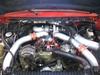


hydrolocked

Thread Starter
|
Fleet Owner


Joined: Aug 2004
Posts: 20,419
Likes: 197
From: AZ

Just a update on the coolingmist. The pump for sure doesn't have a check valve, water flows right threw it. My system did not have a check valve installed. The solenoid let water thru when not energized, it went bad. Turning the controller off the way I described above is the way you do it. I tested the components several times. The solenoid when energized will flow as hard as the pump pumps. When off it drips water. When I installed it, I bought it as a kit and installed it as I was directed to. Worked fine for a couple of years until the solenoid screwed up. I will investigate it further until I figure out if there should be a check valve in addition to the solenoid. I will leave it installed with a shut off valve and when I tacked some real mountain grades I will manually turn it on and off. Its a very good way to keep EGT's down on hard pulls but there has to be a better system to prevent this from happening again.
Thread Starter
|
Fleet Owner
Joined: Aug 2004
Posts: 20,419
Likes: 197
From: AZ
When I mentioned to coolingmist that my motor was hydrolocked they stopped talking to me, go figure!
Hotshot


Joined: Dec 2005
Posts: 14,377
Likes: 609
From: evansville in
Wth...to me.its ALL about customer service.obviously the system is not new.oh well.lets talk and figure out what needs to be done to fix the problem! That should be their concern so no one has it happen in the future.lousy on their part!
Cargo Master
Joined: Nov 2010
Posts: 2,797
Likes: 10
I have been following your thread since day one considering I had the time to install my kit from coolingmist just a few weeks ago. I opted for the solenoid over the check valve as an upgrade. Are you suggesting throwing a check valve down stream from the solenoid? Why not two for safety? I sure as hell never want to have a hydrolocked motor over this setup and am trying to figure out what else I can do to prevent this from ever happening.
I'll keep following but let usknow what they say as well as your result for a fix.
Thanks again!
I'll keep following but let usknow what they say as well as your result for a fix.
Thanks again!
FTE Stories
Ford Trucks for Ford Truck Enthusiasts

Top 10 Fords at 2026 Carlisle Ford Nationals
Joe Kucinski
3 Best / 3 Worst Parts of Modern Ford Ownership
Brett Foote
10 Amazing Upgrades That Solve Common Ford Truck Owner Headaches
Pouria Savadkouei
Every 2026 Ford Engine Explained
Brett Foote
10 Ugly Ford Trucks That We Still Kinda Love
Joe Kucinski
10 Things Every Truck Owner NEEDS (2026 Edition)
Michael S. Palmer
Rezvani's Latest Post-Apocalyptic Monster Is a Ford F-150 Raptor Underneath
Verdad Gallardo
Top 10 Most Expensive Ford Trucks Ever Sold on Bring a Trailer
Joe Kucinski
2027 Ford Super Duty Buyer's Guide (Every Model, Engine, & Package)
Brett Foote

Hotshot

Joined: Jun 2007
Posts: 10,008
Likes: 7
From: Austin, TX
It sounds like he has one already and the valve is leaking past. All that is needed is to replace the valve, but if the valve is going to fail like that, something may be needed as back up. Be nice if the water nozzles had pop off valves so they wouldn't spray water unless pressure reaches like 50psi or something.

Post Fiend
Joined: Dec 2010
Posts: 10,121
Likes: 3
From: Orrville, Ohio
The only real solutions I can would be:
1- Install 2 solenoid valves and check them often to be sure they're functioning
2- Install the tank low in the vehicle (on a frame rail under the bed or something, perhaps) so that the truck would have to be at a severe angle to allow the water to siphon into the intake on top of the engine, then never park at that extreme an angle. Also, remember that the farther the tank is from the engine, the less the angle has to be in order for it to be at the same height as the nozzle (which would allow it to siphon water). Ideally (and I know this likely isn't possible because of space constraints) the reservoir would be mounted low in the vehicle at the front end. That way the truck would have to be darn near on end before the reservoir would be higher than the intake and nozzles at the top of the engine.
That's my $.02 anyway.
Thread Starter
|
Fleet Owner
Joined: Aug 2004
Posts: 20,419
Likes: 197
From: AZ
On my last email to coolingmist I asked if they had a simple manual shut off valve. This is his reply, just like you said Nate:
I don’t have any shut off switch, however if you want you can order a 2nd solenoid, put it in line with the other. If one fails the other will be fine.
I also opted for the solenoid Nossliw, which failed. I don't see why I couldn't find just a regular manual shut off, I'm going to look for one. I would like to find a place up front for my seven gallon tank but don't know where I would put it. Any less size tank and I would be filling it all the time. I fill this one enough. When we stop in a rest area I have three or four gallons in the bed to dump in. A pop off valve would be a good idea Travis.
I don’t have any shut off switch, however if you want you can order a 2nd solenoid, put it in line with the other. If one fails the other will be fine.
I also opted for the solenoid Nossliw, which failed. I don't see why I couldn't find just a regular manual shut off, I'm going to look for one. I would like to find a place up front for my seven gallon tank but don't know where I would put it. Any less size tank and I would be filling it all the time. I fill this one enough. When we stop in a rest area I have three or four gallons in the bed to dump in. A pop off valve would be a good idea Travis.
Cargo Master
Joined: Nov 2010
Posts: 2,797
Likes: 10
Would anything along these lines work for you? Ball or gate doesn't matter but fab up you own line connector and it seems pretty fail proof. Putting two solenoids in doesn't really eliminate the problem... One could fail and you would never know, untill the other one did....
Manual shutoff in my opinion is the best way to go about it... in that case the operator is responsible.
McMaster-Carr
McMaster-Carr
Check valves...http://www.mcmaster.com/#standard-check-valves/=jxpq4v
Manual shutoff in my opinion is the best way to go about it... in that case the operator is responsible.
McMaster-Carr
McMaster-Carr
Check valves...http://www.mcmaster.com/#standard-check-valves/=jxpq4v
Post Fiend
Joined: Dec 2010
Posts: 10,121
Likes: 3
From: Orrville, Ohio
The ideal would be to get a pop off valve with a low PSI pop off. A check valve only keeps the fluid from flowing the wrong way (back up the pipe) and I think he said the system already has one in it didn't he? That would be, in essence to keep the boost pressure from pushing back up through the lines when the system isn't pumping water into the nozzle. A pop off valve would keep the water from flowing through it (toward the nozzle) until the pressure was sufficient to push the valve open. The issue is that if it was hard water that more or less limed up the solenoid valve (Glenn said the nozzles were limed shut) the same thing could happen to a pop off valve. The only fool proof ways to prevent this from happening are either to install a manual valve (because you would know if it is shut or not) or to relocate the reservoir to a low point on the truck as was described above. Any other "automatic" type of device in the system is going to be susceptible to lime buildup and getting stuck open the same as the solenoid would. There just isn't an easy, automatic and fool proof solution. The most easy and fool proof solution is the manual valve that Glenn is talking about.
Thread Starter
|
Fleet Owner
Joined: Aug 2004
Posts: 20,419
Likes: 197
From: AZ
When I first installed the system I was having lime up problems and clogged screens on the nozzles. Then I just started using the filtered water out of my camper and or filling it out of the hose at camp sites with my water hose that has the filters installed in. That greatly reduced my clogged screen problems.
Now, what I'm thinking is, when ordering the unit I got the solenoid over the check valve because it was suppose to be better. The very last day of travel, about three hundred miles, out of curiosity looked at the tank of water and it was full. The only other time I've ever seen this is when the nozzle was clogged up or limed up. I backed the camper in and pulled away leaving the pickup facing down the driveway. Being gone for six months requires a lot of things to be done, unpacking, turning the water on etc. etc. The injection not using any water was the least of my worries. About three days later I wanted to use the pickup and discovered hydrolock. Now obviously, the nozzle was not clogged or limed up, it allowed water to flow by into the motor. Pulling the water line off the motor side of the solenoid and getting a drip, drip told me that the nozzle failed in a partially open position. Also, this is the reason the tank was full when I got home. The solenoid was stuck and not allowing full flow, just a drip. Great links noseliw, even after I finally order a new solenoid and nozzle I will install a manual shut off. When I know I will be needing the injection I will open it but I will keep it closed at all other times. Its a very useful tool but obviously can't be trusted.
Now, what I'm thinking is, when ordering the unit I got the solenoid over the check valve because it was suppose to be better. The very last day of travel, about three hundred miles, out of curiosity looked at the tank of water and it was full. The only other time I've ever seen this is when the nozzle was clogged up or limed up. I backed the camper in and pulled away leaving the pickup facing down the driveway. Being gone for six months requires a lot of things to be done, unpacking, turning the water on etc. etc. The injection not using any water was the least of my worries. About three days later I wanted to use the pickup and discovered hydrolock. Now obviously, the nozzle was not clogged or limed up, it allowed water to flow by into the motor. Pulling the water line off the motor side of the solenoid and getting a drip, drip told me that the nozzle failed in a partially open position. Also, this is the reason the tank was full when I got home. The solenoid was stuck and not allowing full flow, just a drip. Great links noseliw, even after I finally order a new solenoid and nozzle I will install a manual shut off. When I know I will be needing the injection I will open it but I will keep it closed at all other times. Its a very useful tool but obviously can't be trusted.