


for those with an intercooler...


Elder User
Joined: Feb 2012
Posts: 888
Likes: 2
Can an intecooler be too large?
It's a question that comes up pretty often this one...and there are plenty of misconceptions from "experts"!
Basically, the answer is yes it can be too big, BUT there are many things that should be taken into consideration, and in reality being too large is never an issue....
From a power point of view, it is a case of the bigger the better as cooler, denser and more oxygen rich air means a more efficient and powerful engine. A 100% efficient intercooler will bring the intake charge (turbo outlet) down to ambient temperature, and although we cannot expect to achieve this, we aim to reduce the temperatures as much as possible.
It is technically possible to calculate the ideal size of intercooler for a vehicle, but the amount of information required is immense. Some of this information is impossible to know 100% as each application is different, and are the many driving scenarios that the vehicle will endure.
Calculating technically ideal intercooler dimensions will generally produce a size that is too big to fit into the car anyway, so as a rule we design intercoolers that make as much use of the space as possible without being too difficult for people to install.
The turbo can make the intake charge air extremely hot as by its nature it is driven by the exhaust and also any form of compressor creates heat. We have seen air at well over 180 degrees exiting a turbo and an efficient intercooler or charge cooler can reduce this to around 20 - 25 degrees.
One of the main concerns people have is of turbo "lag" with a large intercooler. When you consider that some vehicle manufacturers produce cars with more than one intercooler, and we also manufacture intercooler systems using two or even three intercoolers plus pipework for certain applications, even then there is no noticeable lag. Once air is compressed at one end of the system it is, for all intents and purposes instantly compressed at the other.
More important factors should be considered such as the design and construction of the intercooler and this is why we have ended up at the design and method of construction we use. This is why some of our intercoolers may have the same external dimensions but give great power gains through improved flow, heat transfer and even weight can be a factor.
It's a question that comes up pretty often this one...and there are plenty of misconceptions from "experts"!
Basically, the answer is yes it can be too big, BUT there are many things that should be taken into consideration, and in reality being too large is never an issue....
From a power point of view, it is a case of the bigger the better as cooler, denser and more oxygen rich air means a more efficient and powerful engine. A 100% efficient intercooler will bring the intake charge (turbo outlet) down to ambient temperature, and although we cannot expect to achieve this, we aim to reduce the temperatures as much as possible.
It is technically possible to calculate the ideal size of intercooler for a vehicle, but the amount of information required is immense. Some of this information is impossible to know 100% as each application is different, and are the many driving scenarios that the vehicle will endure.
Calculating technically ideal intercooler dimensions will generally produce a size that is too big to fit into the car anyway, so as a rule we design intercoolers that make as much use of the space as possible without being too difficult for people to install.
The turbo can make the intake charge air extremely hot as by its nature it is driven by the exhaust and also any form of compressor creates heat. We have seen air at well over 180 degrees exiting a turbo and an efficient intercooler or charge cooler can reduce this to around 20 - 25 degrees.
One of the main concerns people have is of turbo "lag" with a large intercooler. When you consider that some vehicle manufacturers produce cars with more than one intercooler, and we also manufacture intercooler systems using two or even three intercoolers plus pipework for certain applications, even then there is no noticeable lag. Once air is compressed at one end of the system it is, for all intents and purposes instantly compressed at the other.
More important factors should be considered such as the design and construction of the intercooler and this is why we have ended up at the design and method of construction we use. This is why some of our intercoolers may have the same external dimensions but give great power gains through improved flow, heat transfer and even weight can be a factor.


New User
Joined: Jan 2015
Posts: 1
Likes: 0
An old topic, but ran across it during a search. It amazes me how much misinformation is out there regarding turbos. intercoolers, etc. as NMB2 mentioned above. I have a background with turbos that mostly involves cars, but I am also familiar with truck applications. There are some differences between the two, but for the most part some of the differences mentioned here like piston material do NOT make a difference to how boost is made or delivered to the engine.
A 350 chevy engine that is boosted would likely use a very similar amount of air to that of a 444 ci diesel BECAUSE even though the cubic inch displacement of the 350 is smaller the powerband in that engine likely goes as high as 6000-6500 or so rpm (yes, potentially higher but just looking at a mild example), while the diesel will only be pulling to around 4000 rpm. Air flow in lbs/min is how turbo capacities are measured, and you actually may have a much larger turbo on the gas engine even though it is smaller because it is going to rev higher.
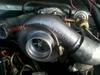
As an example, the turbo on my 73 Trans Am is an 88mm Garrett GT-4788. It feeds a 462 ci Pontiac that makes peak torque at 4800 rpm, and peak hp at 5500 rpm (1228 hp @ 15 psi). I can tell you that it makes the stock turbo on an IDI look like a peanut as far as size.
*On another note, boost as measured in pounds per square inch (psi) is ONLY a measure of restriction of air flow. The turbo is trying to move air forward and only so much can squeeze into the cylinders through the intake. When I upgraded to better flowing heads, my boost numbers dropped but the car made more power than it had at the higher numbers of boost previously. Of course I adjusted the wastegate tighter then to bring up the boost higher again and make even more power.
Regarding intercoolers, once again NMB2 was correct. You really can't easily "oversize" an intercooler. Air compresses more than water obviously, and we can pump lots of air into a tank (think a firefighters self contained breathing apparatus (SCBA) which has a lot of air shoved into a tank at lets say 2500 psi. But at the 15-60 psi range, which is where we are talking for turbos it really doesn't compress much, and it doesn't really matter how BIG the intercooler is. If you take a 40 ft long pipe, seal it at one end and apply pressure at the other end the pipe pressurizes EQUALLY throughout its entire length.
There are people running TRUNK mounted turbos on cars. Think about the length of the hot and cold runs there! And they work, as long as there are no air leaks in the system. There may be disadvantages to this setup but I won't discuss that, because almost every turbo setup in a car or truck that is not a race vehicle involves some compromises somewhere.
Granted, it will take more volume of air on a 40 ft pipe than a 2 ft pipe, but on an intercooler run of several feet of pipe in a truck, and the largest intercooler you could possibly fit, it would be VERY hard at 15 psi (the max for IDI engines) to lose enough from the stock turbos output capacity to drop the boost pressure as much as some here have mentioned. At 15 psi air does not compress much at all, and is really not far off from how much liquids compress at that pressure in volume.
Take a 50 ft hose full of water (make sure it is already full) with a nozzle on the end. Have someone on the nozzle, and someone prepared to open the valve on the supply. Have a 3rd person yell, "Go!" and have the person on the supply open the valve and the person on the nozzle immediately open it, and its pretty much instantaneous......water will shoot from the nozzle with zero delay.
Oh, and those ebay intercoolers are JUST as capable of flowing plenty of air for these IDI engines; just as much as Ford made ones IF you choose one big enough. Maybe don't choose one that was sized for a Honda Civic? The small ones tend to have small passages for airflow, and THAT is where proper sizing for an intercooler really plays a part, not in being too big.
The issue people DO have is losing boost through loose fittings on hot and cold sides. Also, there can be restriction in hot or cold sides of a turbo piping, and of course there IS friction...the longer the run of pipe the more friction there is (YES, even with air flowing), the more turns it makes and the tighter the turns same thing.
Ideally one should put a boost gauge before and after an intercooler, and there shouldn't be a drop greater than 1 psi between inlet and outlet.
A 350 chevy engine that is boosted would likely use a very similar amount of air to that of a 444 ci diesel BECAUSE even though the cubic inch displacement of the 350 is smaller the powerband in that engine likely goes as high as 6000-6500 or so rpm (yes, potentially higher but just looking at a mild example), while the diesel will only be pulling to around 4000 rpm. Air flow in lbs/min is how turbo capacities are measured, and you actually may have a much larger turbo on the gas engine even though it is smaller because it is going to rev higher.
As an example, the turbo on my 73 Trans Am is an 88mm Garrett GT-4788. It feeds a 462 ci Pontiac that makes peak torque at 4800 rpm, and peak hp at 5500 rpm (1228 hp @ 15 psi). I can tell you that it makes the stock turbo on an IDI look like a peanut as far as size.
*On another note, boost as measured in pounds per square inch (psi) is ONLY a measure of restriction of air flow. The turbo is trying to move air forward and only so much can squeeze into the cylinders through the intake. When I upgraded to better flowing heads, my boost numbers dropped but the car made more power than it had at the higher numbers of boost previously. Of course I adjusted the wastegate tighter then to bring up the boost higher again and make even more power.
Regarding intercoolers, once again NMB2 was correct. You really can't easily "oversize" an intercooler. Air compresses more than water obviously, and we can pump lots of air into a tank (think a firefighters self contained breathing apparatus (SCBA) which has a lot of air shoved into a tank at lets say 2500 psi. But at the 15-60 psi range, which is where we are talking for turbos it really doesn't compress much, and it doesn't really matter how BIG the intercooler is. If you take a 40 ft long pipe, seal it at one end and apply pressure at the other end the pipe pressurizes EQUALLY throughout its entire length.
There are people running TRUNK mounted turbos on cars. Think about the length of the hot and cold runs there! And they work, as long as there are no air leaks in the system. There may be disadvantages to this setup but I won't discuss that, because almost every turbo setup in a car or truck that is not a race vehicle involves some compromises somewhere.
Granted, it will take more volume of air on a 40 ft pipe than a 2 ft pipe, but on an intercooler run of several feet of pipe in a truck, and the largest intercooler you could possibly fit, it would be VERY hard at 15 psi (the max for IDI engines) to lose enough from the stock turbos output capacity to drop the boost pressure as much as some here have mentioned. At 15 psi air does not compress much at all, and is really not far off from how much liquids compress at that pressure in volume.
Take a 50 ft hose full of water (make sure it is already full) with a nozzle on the end. Have someone on the nozzle, and someone prepared to open the valve on the supply. Have a 3rd person yell, "Go!" and have the person on the supply open the valve and the person on the nozzle immediately open it, and its pretty much instantaneous......water will shoot from the nozzle with zero delay.
Oh, and those ebay intercoolers are JUST as capable of flowing plenty of air for these IDI engines; just as much as Ford made ones IF you choose one big enough. Maybe don't choose one that was sized for a Honda Civic? The small ones tend to have small passages for airflow, and THAT is where proper sizing for an intercooler really plays a part, not in being too big.
The issue people DO have is losing boost through loose fittings on hot and cold sides. Also, there can be restriction in hot or cold sides of a turbo piping, and of course there IS friction...the longer the run of pipe the more friction there is (YES, even with air flowing), the more turns it makes and the tighter the turns same thing.
Ideally one should put a boost gauge before and after an intercooler, and there shouldn't be a drop greater than 1 psi between inlet and outlet.

Thread
Thread Starter
Forum
Replies
Last Post
1994F2507.3L
1994.5 - 1997 7.3L Power Stroke Diesel
91
Aug 20, 2015 10:43 AM
101mm, 408, 73, 73l, aftercooler, boost, cfm, gain, gains, hypermax, idi, intercooler, mpg, oreocreaming, turbo






