



38R limits
Thread Starter
|
Posting Guru
Joined: Oct 2006
Posts: 1,078
Likes: 2
From: New London, Mo
38R limits
OK so today i did some research and found out that i have a 38R still havent had a chance to pull that valve covers and figure out what i have for injectors. What are my limits with a 38R? When i turn my chip all the way up and step on the sweet spot is between 20-30psi of boost but after that it just rolls black smoke. I have done the 6637 mod, am i not getting enough air for the high boost? I can peg the gauge on 40psi but i feel more power between 20-30 psi. Is something wrong? or do i need to do something else with my intake?

Post Fiend
Joined: Feb 2006
Posts: 11,892
Likes: 2
From: Middle Tennessee
What tunes do you have and from who? Here is an efficiency map with some calculations I made a while back:

Obviously Gene is on to something with the HP loss post he has posted. My calculations came directly from the Garrett site formula using 7.3 liters of displacement and a few assumptions such as sea level etc.
I make right about 400HP and I can assure you I am not showing 56lbs of boost. The 38R has made quite a bit more HP than what I do, but again, as posted, you will be hard pressed to push it much past 40PSI of boost so I do not know how to reconcile my calculations except to say that I have not seen one make more than 500HP. That does match up.
As mentioned I can make about 38PSI of boost matting it. What you do not see is that I have a larger housing which skews the plotted graph because my drive pressure is lower.
Obviously Gene is on to something with the HP loss post he has posted. My calculations came directly from the Garrett site formula using 7.3 liters of displacement and a few assumptions such as sea level etc.
I make right about 400HP and I can assure you I am not showing 56lbs of boost. The 38R has made quite a bit more HP than what I do, but again, as posted, you will be hard pressed to push it much past 40PSI of boost so I do not know how to reconcile my calculations except to say that I have not seen one make more than 500HP. That does match up.
As mentioned I can make about 38PSI of boost matting it. What you do not see is that I have a larger housing which skews the plotted graph because my drive pressure is lower.
Thread Starter
|
Posting Guru
Joined: Oct 2006
Posts: 1,078
Likes: 2
From: New London, Mo
i have a ts performance chip and i have no idea what tunes are on it. i need to send it off and get it re burnt but im in laramie wyoming and i dont think i could live without it. if i shut the chip off my truck does not run wortha crap bieng at 7200 feet elevation my turbo does not spool up quick like it did at home. im also trying to put if off as i want to get a dp- tuner.

Junior User
Joined: Jun 2010
Posts: 92
Likes: 0
Just throwin this out there... but maybe you need a boost fooler for the MAP sensor. I've heard that somewhere around 25-30psi if the MAP sensor sees that pressure it will start to de-fuel the motor... causing a loss of power.
So the reason why you feel better performance around that range is because the truck hasn't started to de-fuel.
But hey, I'm still new at this so again, I'm just thinking out loud.
So the reason why you feel better performance around that range is because the truck hasn't started to de-fuel.
But hey, I'm still new at this so again, I'm just thinking out loud.

Post Fiend


Joined: Jun 2006
Posts: 9,714
Likes: 2
From: White Mnt's,New Hampshire
Trending Topics
Thread Starter
|
Posting Guru
Joined: Oct 2006
Posts: 1,078
Likes: 2
From: New London, Mo
The guy i bought it off said it has custom tunes but i honestly do not know like i said i am hoping i can get a dp-tuner here soon
FTE Stories
Ford Trucks for Ford Truck Enthusiasts

AEV FXL Super Duty - the Super Duty Raptor Ford Doesn't Make
Brett Foote
Lobo Vs Lobo: Proof the F-150 Lobo Should Be Even Lower!
Michael S. Palmer
Ford's 2001 Explorer Sportsman Concept Looks For a New Home
Verdad Gallardo
10 Best Ford Truck Engines We Miss the Most!
Joe Kucinski
2026 Shelby F-150 Off-Road: Better Than a Raptor R?
Brett Foote
2027 Super Duty Carhartt Package First Look: 12 Things You NEED to Know!
Michael S. Palmer
10 Most Surprising 2026 Ford Truck Features!
Joe Kucinski
Top 10 Ford Trucks Coming to Mecum Indy 2026
Brett Foote
5 Best / 5 Worst Ford Truck Wheels of All Time
Joe Kucinski
Post Fiend
Joined: Jun 2004
Posts: 9,293
Likes: 10
From: Parker, CO
Basically, you'll need to find out from the previous owner what was put in. Or at least get his name and what shop he bought the injectors from, and see if the shop can pull up an old bill of sale.
Postmaster
Joined: Jun 2006
Posts: 2,647
Likes: 0
From: Fulltime RVer

...OK so today i did some research and found out that i have a 38R. ...What are my limits with a 38R? When i turn my chip all the way up and step on the sweet spot is between 20-30psi of boost but after that it just rolls black smoke. I have done the 6637 mod, am i not getting enough air for the high boost? I can peg the gauge on 40psi but i feel more power between 20-30 psi. Is something wrong? or do i need to do something else with my intake?...
Trying to run too high of a BP with any turbo involves considerations similar to the ones I discussed in post #11 here for using Mod1 to increase the BP on a stock setup and that mod resulted in more BP but less FWHP... 113 things to know about a stock 7.3L PSD @ WOT!!! - Ford Truck Enthusiasts Forums ...!
The BP achieved for a given CPR depends on the AAP, AFPD, and ICPD ...and reducing the AFPD by installing a lower restriction AF is a helpful mod in general ...but doing the 6637 mod was a step backwards because it increases the AFIAT which means more turbine drive HP is needed to run the compressor and more turbine drive HP requires a higher EBP/EGT!
However the basic issue at hand is your 7200 ft operating altitude where as can be seen below the AAP is only about 11.15 psia compared to 14.69 psia at sea level!

This means at your 7200 ft altitude the MAF values on the standard map below are reduced by the factor (11.15/13.95)=0.80 which means that everything else being the same your airflow at sea level would be 25% more than it is at your 7200 ft operating altitude! As everyone knows there's no substitute for larger CID and the same is true for operating at lower altitudes!

The RPM lines & BP values shown on the map above are for a stock AF & IC and for operating at 300 ft which is the reference AAP=13.95 psia shown on the map.
For a stock truck @ 300 ft a BP=17 psig requires a CPR=2.34 and a FWHP=250 @ 2600 rpm requires a VFF=13.3 gph and a EGT=1001*F.
To maintain the same BP=17 psig at a 7200 ft operating altitude requires a CPR=2.77 (which would give a BP=22 psig at 300 ft) and for the same VFF=13.3 gph the FWHP=246 @ 2600 rpm and the EGT=1123*F.
At a 7200 ft operating altitude it requires a 0.2 gph increase in VFF to recover to a FWHP=250 @ 2600 rpm and with BP=17 psig & VFF=13.5 gph the EGT=1136*F.
For the same assumptions in posts #52 & #55 here... 500 HP + injector and turbo help - Page 4 - Ford Truck Enthusiasts Forums ...which included a "cold-air intake" with a 65*F ambient temp, improved efficiency IC, etc... at a 7200 ft altitude the GTP38R will produce a BP=24 psig at a CPR=3.39 ...and with a VFF=25.7 gph @ 2800 rpm the FWHP=514.5 and the DRHP=438.5 and the EGT=1250*F!
Since some might comment that my computer model for predicting the above numbers is wrong I'll give the following quotes from my MIT textbook...

In the above (P2/P1)=CPR and T1=(AFIAT*F+460) and Cp is the heat capacity of air and J=1 for English units where Pca is given in hp ...so as you can see for everything else being the same the hp required to power the compressor is proportional to (AFIAT+460) and any open element under the hood AF increases the AFIAT!

In the above F=(1/AFR) and Te=(EGT*F+460) and Yt=TPR which depends on EBP ...so as you can see for everything else being the same a higher EBP/EGT is needed for the turbine to generate the higher drive hp required to power the compressor due to the hotter intake air from an open element under the hood AF!
Thread Starter
|
Posting Guru
Joined: Oct 2006
Posts: 1,078
Likes: 2
From: New London, Mo
At your "7200 ft operating altitude" the "optimum operating BP" for your GTP38R is 23-24 psig because depending on the exact values of AFPD & ICPD this BP at 7200 ft requires a CPR=3.40 which is at the efficiency limit of a GTP38R! As I discussed regarding a GTP38R vs dyno HP in posts #52 & #55 here... 500 HP + injector and turbo help - Page 4 - Ford Truck Enthusiasts Forums ...if you exceed a CPR of 3.4 (which at 300 ft gives a BP=32 psig) the compressor efficiency falls rapidly which increases the required turbine drive hp and that increases the PHPL and the CSHPL which reduces the FWHP!
Trying to run too high of a BP with any turbo involves considerations similar to the ones I discussed in post #11 here for using Mod1 to increase the BP on a stock setup and that mod resulted in more BP but less FWHP... 113 things to know about a stock 7.3L PSD @ WOT!!! - Ford Truck Enthusiasts Forums ...!
The BP achieved for a given CPR depends on the AAP, AFPD, and ICPD ...and reducing the AFPD by installing a lower restriction AF is a helpful mod in general ...but doing the 6637 mod was a step backwards because it increases the AFIAT which means more turbine drive HP is needed to run the compressor and more turbine drive HP requires a higher EBP/EGT!
However the basic issue at hand is your 7200 ft operating altitude where as can be seen below the AAP is only about 11.15 psia compared to 14.69 psia at sea level!
This means at your 7200 ft altitude the MAF values on the standard map below are reduced by the factor (11.15/13.95)=0.80 which means that everything else being the same your airflow at sea level would be 25% more than it is at your 7200 ft operating altitude! As everyone knows there's no substitute for larger CID and the same is true for operating at lower altitudes!
The RPM lines & BP values shown on the map above are for a stock AF & IC and for operating at 300 ft which is the reference AAP=13.95 psia shown on the map.
For a stock truck @ 300 ft a BP=17 psig requires a CPR=2.34 and a FWHP=250 @ 2600 rpm requires a VFF=13.3 gph and a EGT=1001*F.
To maintain the same BP=17 psig at a 7200 ft operating altitude requires a CPR=2.77 (which would give a BP=22 psig at 300 ft) and for the same VFF=13.3 gph the FWHP=246 @ 2600 rpm and the EGT=1123*F.
At a 7200 ft operating altitude it requires a 0.2 gph increase in VFF to recover to a FWHP=250 @ 2600 rpm and with BP=17 psig & VFF=13.5 gph the EGT=1136*F.
For the same assumptions in posts #52 & #55 here... 500 HP + injector and turbo help - Page 4 - Ford Truck Enthusiasts Forums ...which included a "cold-air intake" with a 65*F ambient temp, improved efficiency IC, etc... at a 7200 ft altitude the GTP38R will produce a BP=24 psig at a CPR=3.39 ...and with a VFF=25.7 gph @ 2800 rpm the FWHP=514.5 and the DRHP=438.5 and the EGT=1250*F!
Since some might comment that my computer model for predicting the above numbers is wrong I'll give the following quotes from my MIT textbook...
In the above (P2/P1)=CPR and T1=(AFIAT*F+460) and Cp is the heat capacity of air and J=1 for English units where Pca is given in hp ...so as you can see for everything else being the same the hp required to power the compressor is proportional to (AFIAT+460) and any open element under the hood AF increases the AFIAT!
In the above F=(1/AFR) and Te=(EGT*F+460) and Yt=TPR which depends on EBP ...so as you can see for everything else being the same a higher EBP/EGT is needed for the turbine to generate the higher drive hp required to power the compressor due to the hotter intake air from an open element under the hood AF!
Trying to run too high of a BP with any turbo involves considerations similar to the ones I discussed in post #11 here for using Mod1 to increase the BP on a stock setup and that mod resulted in more BP but less FWHP... 113 things to know about a stock 7.3L PSD @ WOT!!! - Ford Truck Enthusiasts Forums ...!
The BP achieved for a given CPR depends on the AAP, AFPD, and ICPD ...and reducing the AFPD by installing a lower restriction AF is a helpful mod in general ...but doing the 6637 mod was a step backwards because it increases the AFIAT which means more turbine drive HP is needed to run the compressor and more turbine drive HP requires a higher EBP/EGT!
However the basic issue at hand is your 7200 ft operating altitude where as can be seen below the AAP is only about 11.15 psia compared to 14.69 psia at sea level!
This means at your 7200 ft altitude the MAF values on the standard map below are reduced by the factor (11.15/13.95)=0.80 which means that everything else being the same your airflow at sea level would be 25% more than it is at your 7200 ft operating altitude! As everyone knows there's no substitute for larger CID and the same is true for operating at lower altitudes!
The RPM lines & BP values shown on the map above are for a stock AF & IC and for operating at 300 ft which is the reference AAP=13.95 psia shown on the map.
For a stock truck @ 300 ft a BP=17 psig requires a CPR=2.34 and a FWHP=250 @ 2600 rpm requires a VFF=13.3 gph and a EGT=1001*F.
To maintain the same BP=17 psig at a 7200 ft operating altitude requires a CPR=2.77 (which would give a BP=22 psig at 300 ft) and for the same VFF=13.3 gph the FWHP=246 @ 2600 rpm and the EGT=1123*F.
At a 7200 ft operating altitude it requires a 0.2 gph increase in VFF to recover to a FWHP=250 @ 2600 rpm and with BP=17 psig & VFF=13.5 gph the EGT=1136*F.
For the same assumptions in posts #52 & #55 here... 500 HP + injector and turbo help - Page 4 - Ford Truck Enthusiasts Forums ...which included a "cold-air intake" with a 65*F ambient temp, improved efficiency IC, etc... at a 7200 ft altitude the GTP38R will produce a BP=24 psig at a CPR=3.39 ...and with a VFF=25.7 gph @ 2800 rpm the FWHP=514.5 and the DRHP=438.5 and the EGT=1250*F!
Since some might comment that my computer model for predicting the above numbers is wrong I'll give the following quotes from my MIT textbook...
In the above (P2/P1)=CPR and T1=(AFIAT*F+460) and Cp is the heat capacity of air and J=1 for English units where Pca is given in hp ...so as you can see for everything else being the same the hp required to power the compressor is proportional to (AFIAT+460) and any open element under the hood AF increases the AFIAT!
In the above F=(1/AFR) and Te=(EGT*F+460) and Yt=TPR which depends on EBP ...so as you can see for everything else being the same a higher EBP/EGT is needed for the turbine to generate the higher drive hp required to power the compressor due to the hotter intake air from an open element under the hood AF!
Thank you for posting this il will try to figure out what it means. Im not very good with math figures and stuff. I will see if i can contact to po and see what it has for tunes and injectors.

Postmaster
Joined: Jan 2009
Posts: 2,544
Likes: 4
From: Suffolk, VA
I got a question for you guys, Eugene, Tenn, etc; to piggy back on this. What say you about the efficiency of the stock turbo with a 1.0 housing? Eugene says that removing the red line preventing the wastegate from opening at 7ish psi and running it at 25 psi is inefficient. So if a 1.0 A/R housing is added and a high flow outlet to reduce some of that drive pressure, then how does that 25psi look now?
Post Fiend
Joined: Jun 2004
Posts: 9,293
Likes: 10
From: Parker, CO
I got a question for you guys, Eugene, Tenn, etc; to piggy back on this. What say you about the efficiency of the stock turbo with a 1.0 housing? Eugene says that removing the red line preventing the wastegate from opening at 7ish psi and running it at 25 psi is inefficient. So if a 1.0 A/R housing is added and a high flow outlet to reduce some of that drive pressure, then how does that 25psi look now?
Postmaster
Joined: Jun 2006
Posts: 2,647
Likes: 0
From: Fulltime RVer
...I got a question for you guys, Eugene, Tenn, etc; to piggy back on this. What say you about the efficiency of the stock turbo with a 1.0 housing? Eugene says that removing the red line preventing the wastegate from opening at 7ish psi and running it at 25 psi is inefficient. So if a 1.0 A/R housing is added and a high flow outlet to reduce some of that drive pressure, then how does that 25psi look now?...
EBP={(AAP+PTPD)[{1-[(CSHP)/{(EGT+459.67)(1/158.7)(1+1/AFR)(MAF)(TTE)}]}^-3.8911] -(AAP)} psig
...which gives EBP=Exhaust Back Pressure, psig, pre-turbine as a function of the CSHP=Compressor Shaft HP that's required to generate a given BP because as you can see some of the parameters in this equation such as CSHP, EGT, AFR, and MAF are interdependent so you've got to define a specific operating point for the compressor, the turbine, and the engine in order to calculate a value of EBP and this is why I developed my new computer model!
If you want a simpleminded generic textbook graph answer to your question about the effect on EBP for a given BP due to changing from the stock 0.84 A/R exhaust housing to a 1.0 A/R housing you can study this graph which covers exhaust housings from 0.70 A/R to 1.40 A/R but at best this graph is a crude approximation and it doesn't apply to wastegated housings which can independently control the EBP to maintain a desired BP... http://ernesteugene.com/PSD/AR.jpg ... http://ernesteugene.com/PSD/AR2.jpg ... http://ernesteugene.com/PSD/AR3.jpg .
If anyone can find a map for a stock GTP38 which includes the "efficiency island contours" similar to the ones shown on the map below for a GTP38R please post a link to it! If you compare the GTP38R map below to the map I already gave above for a stock GTP38 my estimate is that on a GTP38 map the peak ridge of the efficiency island will run along the blue 2700 RPM line that's shown on the GTP38 map which means the peak ridge of the efficiency island on a GTP38 map is a little more to the left and closer to the surge line compared to the efficiency island shown on the GTP38R map.

If you look along the center contour of the peak ridge of the efficiency island on the GTP38R map above you see that the midpoint occurs at about the operating point... CPR=1.95 & MAF=42 lbm/min ...and moving left to the blue 2700 RPM line you see that this corresponds to the operating point... CPR=1.95 & MAF=35.6 lbm/min ...on a stock GTP38 map.
At a 300-ft altitude with a stock setup a CPR=1.95 corresponds to a BP=12 psig and that means at a 300-ft altitude the operating point... BP=12 psig & MAF=35.6 lbm/min ...represents the most efficient use of the turbo compressor and I estimate a TCE=72% at CPR=1.95, BP=12 psig and a TCE=70% at CPR=2.34, BP=17 psig and a TCE=68% at CPR=2.73, BP=22 psig and these TCE vs CPR, BP values are used in the analysis shown in the chart later on.
At a 300 ft operating altitude the AAP=14.54 psia and the difference between the ambient 14.54 psia and the 13.95 psia reference pressure at the compressor inlet which is shown on the maps is 0.59 psi and this is approximately the AFPD for a stock AF in the airflow range from BP=12 psig to BP=22 psig.
The operating point for the turbine is defined by a curve of TTE=Turbo Turbine Efficiency vs TPR=Turbine Pressure Ratio but I've had no luck in finding a turbine map for either a GTP38 or a GTP38R. I've looked at some generic textbook curves such as the one below which also included this text... http://ernesteugene.com/PSD/TPR_Text.jpg ...and the part in the text about the turbine being too small is exactly what happens when you "inappropriately" inhibit the wastegate from doing its job of relieving the excess EBP!
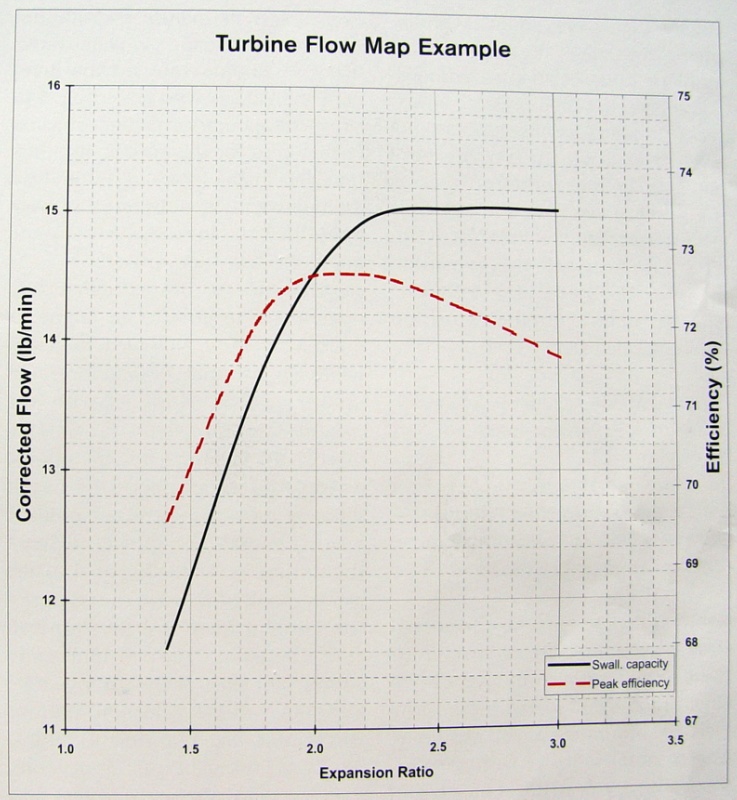
For the following analysis I used a TTE=70% for TPR in the range of TPR=2.0 to TPR=2.2 and a TTE=68% for TPR=2.5 and higher and for TPR=1.8 and lower. Hopefully the chart below is self explanatory and it shows that if the VFF is held constant at a little higher than for a stock tune then the most FWHP and the highest FWTE occurs with a BP=12 psig and if the VFF is adjusted to give a EGT=1150*F at each BP then the highest FWTE occurs at a BP=17 psig and the most FWHP occurs for a BP=22 psig!

The only reason why a stock ECM programs the wastegate to maintain a BP=17 psig instead of the more efficient BP=12 psig is to cool the combustion in order to meet NOx emissions! If you add enough additional fuel to increase the EGT to 1150*F both the FWHP and the FWTE increase and that's because both the turbine and the diesel it's attached to are heat engines and in a future post I'll discuss the mechanics of how a turbine converts "heat energy" into TSHP!
For now look in the row that gives the CSHP required and note that for BP=17 psig the turbine must produce 50 HP at it's output shaft! Assuming an 80% conversion efficiency from shaft HP into electrical power this would correspond to the output from a 30 kW wind turbine and if you Google one of those and see what the diameter of its blades are and then compare that diameter to a turbine wheel diameter you start to appreciate the power of heat energy!
Aeolos Wind Turbine Company ? 30kw Wind Turbine ? Wind Energy Generators ? Aeolos 30kw Wind Turbine

Thread
Thread Starter
Forum
Replies
Last Post
exbxtoy
1999 - 2003 7.3L Power Stroke Diesel
66
Sep 22, 2020 10:35 PM
Ezalycasaid
1994.5 - 1997 7.3L Power Stroke Diesel
557
Jul 27, 2019 07:01 AM
SkySkiJason
1999 - 2003 7.3L Power Stroke Diesel
53
Apr 12, 2012 06:27 AM
