




Formula 1

pedant
Joined: Jan 2008
Posts: 23,576
Likes: 40
From: EXTREME southwest CT

'They' are creating downforce to hold the wheels on the ground.
'They' have a lot of $$$, computer simulation and wind tunnel time making sure it is optimized.
I'm not sure what the flex rules are now, but in the past control surfaces would load to a point and then spill. (because, 'no active aerodynamics')
Merc innovated air bleeds within the chassis.
The front wings have a lot less elements this year.
'They' have a lot of $$$, computer simulation and wind tunnel time making sure it is optimized.
I'm not sure what the flex rules are now, but in the past control surfaces would load to a point and then spill. (because, 'no active aerodynamics')
Merc innovated air bleeds within the chassis.
The front wings have a lot less elements this year.

FTE Leadership Emeritus


Joined: Jan 2003
Posts: 161,999
Likes: 75
From: 3rd Rock

Dove tailing what Jim said..this is the most technically advanced hybrid in the world
Future vision: Engineers discuss 2014 changes 15 Aug 2013
The 2014 season will bring with it some of the biggest changes to Formula One racing’s technical regulations for quite some time. Not only is the sport adopting new 1.6-litre turbocharged V6 engines, there are also tweaks to the rules concerning aerodynamics and a far greater emphasis on energy recovery systems. We spoke to two technical directors - Toro Rosso’s James Key and Caterham’s Mark Smith - about the new regulations and what effect they’ll have on the design of next year’s cars, but first, here is a summary of the main changes:
Engine - it’s out with 2.4-litre normally-aspirated V8 engines and in with 1.6-litre V6 turbo engines, revving to a maximum of 15,000rpm. The current engines produce more than 750bhp, whilst the 2014 units will produce around 600bhp with additional power coming from Energy Recovery Systems (see below).
Gearbox - gearboxes are to have eight forward ratios - rather than the current seven - which each team must nominate ahead of the season.
Energy Recovery Systems (ERS) - in 2014, a larger proportion of each car’s power will come from ERS which, together with the engine, make up the powertrain or power unit. As well as generating energy under braking, ERS units will also generate power using waste heat from the engine’s turbocharger. Unlike the current KERS - which give drivers an extra 80bhp for six seconds per lap - the 2014 ERS will give drivers around 160bhp for 33 seconds per lap. To compensate for the extra power being generated under braking by ERS, teams will be allowed to use an electronic rear brake control system.
Fuel - to promote fuel efficiency, fuel will be limited to 100kg per race. At the moment fuel is unlimited, but teams typically use around 160kg per race.
Minimum weight - to compensate for the increased weight of the 2014 powertrain, minimum weight has been increased from the current 642kg to 690kg.
Exhaust - unlike today where two exhaust tailpipes are used, the 2014 regulations mandate the use of a single tailpipe which must be angled upwards to prevent the exhaust flow being used for aerodynamic effect. Additionally, bodywork is not allowed to be placed behind the tailpipe.
Nose height - for safety reasons the height of noses will be reduced in 2014. The maximum height is currently 550mm, whereas next year it’s 185mm.
Front wing - front wings will be a little narrower next year with the width reduced from 1800mm to 1650mm.
Rear wing - the rear wing will also look a little different in 2014 compared to this year’s models. The lower beam wing is being outlawed and the main flap will be slightly shallower in profile.
The 2014 season will bring with it some of the biggest changes to Formula One racing’s technical regulations for quite some time. Not only is the sport adopting new 1.6-litre turbocharged V6 engines, there are also tweaks to the rules concerning aerodynamics and a far greater emphasis on energy recovery systems. We spoke to two technical directors - Toro Rosso’s James Key and Caterham’s Mark Smith - about the new regulations and what effect they’ll have on the design of next year’s cars, but first, here is a summary of the main changes:
Engine - it’s out with 2.4-litre normally-aspirated V8 engines and in with 1.6-litre V6 turbo engines, revving to a maximum of 15,000rpm. The current engines produce more than 750bhp, whilst the 2014 units will produce around 600bhp with additional power coming from Energy Recovery Systems (see below).
Gearbox - gearboxes are to have eight forward ratios - rather than the current seven - which each team must nominate ahead of the season.
Energy Recovery Systems (ERS) - in 2014, a larger proportion of each car’s power will come from ERS which, together with the engine, make up the powertrain or power unit. As well as generating energy under braking, ERS units will also generate power using waste heat from the engine’s turbocharger. Unlike the current KERS - which give drivers an extra 80bhp for six seconds per lap - the 2014 ERS will give drivers around 160bhp for 33 seconds per lap. To compensate for the extra power being generated under braking by ERS, teams will be allowed to use an electronic rear brake control system.
Fuel - to promote fuel efficiency, fuel will be limited to 100kg per race. At the moment fuel is unlimited, but teams typically use around 160kg per race.
Minimum weight - to compensate for the increased weight of the 2014 powertrain, minimum weight has been increased from the current 642kg to 690kg.
Exhaust - unlike today where two exhaust tailpipes are used, the 2014 regulations mandate the use of a single tailpipe which must be angled upwards to prevent the exhaust flow being used for aerodynamic effect. Additionally, bodywork is not allowed to be placed behind the tailpipe.
Nose height - for safety reasons the height of noses will be reduced in 2014. The maximum height is currently 550mm, whereas next year it’s 185mm.
Front wing - front wings will be a little narrower next year with the width reduced from 1800mm to 1650mm.
Rear wing - the rear wing will also look a little different in 2014 compared to this year’s models. The lower beam wing is being outlawed and the main flap will be slightly shallower in profile.
FTE Leadership Emeritus
Joined: Jan 2003
Posts: 161,999
Likes: 75
From: 3rd Rock
VERY good article
How Formula One's Amazing New Hybrid Turbo Engine Works
.....and then the best
http://www.wired.com/autopia/2014/01...guide-f1-2014/
How Formula One's Amazing New Hybrid Turbo Engine Works
.....and then the best
http://www.wired.com/autopia/2014/01...guide-f1-2014/
pedant
Joined: Jan 2008
Posts: 23,576
Likes: 40
From: EXTREME southwest CT
Too bad Wired featured the Renault that RB is having so many problems with this year...
Or are they just sandbagging?
15k rpm limits are a farce.
This is F1, piston speed should be the limiting factor.
22,000 anyone?
Or are they just sandbagging?
15k rpm limits are a farce.
This is F1, piston speed should be the limiting factor.
22,000 anyone?

Fleet Owner
Joined: Sep 2005
Posts: 28,609
Likes: 18
From: Lake Tahoe, Nevada
Wolfie, I know everything has changed as of this year. But you ARE right about the drag created by the aerodynamic "aids." Or so I have read.... at 200kph, if an F1 driver lifts completely, he will experience around 3.5 G of drag. Any street car could not achieve that rapid a stop slamming both feet on the brakes.
Fleet Owner
Joined: Sep 2005
Posts: 28,609
Likes: 18
From: Lake Tahoe, Nevada
I agree Jim. I think that is sacred ground where rule makers should be ruled out!!!
If a team can build an engine that will stay together, get those angels out of the way, no limit on rpm.
If a team can build an engine that will stay together, get those angels out of the way, no limit on rpm.
pedant
Joined: Jan 2008
Posts: 23,576
Likes: 40
From: EXTREME southwest CT
There's already a fuel limit on the race.
RPM's will be limited by the ability to finish.
Let those puppies stretch their legs.
RPM's will be limited by the ability to finish.
Let those puppies stretch their legs.
FTE Stories
Ford Trucks for Ford Truck Enthusiasts

Top 10 Fords at 2026 Carlisle Ford Nationals
Joe Kucinski
3 Best / 3 Worst Parts of Modern Ford Ownership
Brett Foote
10 Amazing Upgrades That Solve Common Ford Truck Owner Headaches
Pouria Savadkouei
Every 2026 Ford Engine Explained
Brett Foote
10 Ugly Ford Trucks That We Still Kinda Love
Joe Kucinski
10 Things Every Truck Owner NEEDS (2026 Edition)
Michael S. Palmer
Rezvani's Latest Post-Apocalyptic Monster Is a Ford F-150 Raptor Underneath
Verdad Gallardo
Top 10 Most Expensive Ford Trucks Ever Sold on Bring a Trailer
Joe Kucinski
2027 Ford Super Duty Buyer's Guide (Every Model, Engine, & Package)
Brett Foote
FTE Leadership Emeritus
Joined: Jan 2003
Posts: 161,999
Likes: 75
From: 3rd Rock
100 liters = 26.4172051 US gallons
Damn little fuel for that much HP and that long of a race...1.5 hours not a fuel stop...it really is very impressive
Damn little fuel for that much HP and that long of a race...1.5 hours not a fuel stop...it really is very impressive
Last edited by IB Tim; Mar 6, 2014 at 08:53 PM.
pedant
Joined: Jan 2008
Posts: 23,576
Likes: 40
From: EXTREME southwest CT
A liter is one kilo only if pure water @4*C.
Or the fuel has a SG of 1.
Gasoline is somewhere under .75
http://www.engineeringtoolbox.com/sp...ids-d_336.html
Or the fuel has a SG of 1.
Gasoline is somewhere under .75
http://www.engineeringtoolbox.com/sp...ids-d_336.html

FTE Leadership Emeritus


Joined: May 2004
Posts: 18,787
Likes: 30
From: Melbourne, Aus
They seem to be playing with the front spoilers a great deal - and in ways that may not be immediately apparrent.
The more stuff they have out front - the more resistance they must have.
That much CRAP out in the front just doesn't seem very efficient to me - what the hell are they trying to accomplish?
IF THEY ARE ATTEMPTING TO STICK IT TO THE ROAD BETTER, IT MUST MEAN THEY HAVE A RATHER DRAMATIC AMOUNT OF ENERGY TO JUST THROW AWAY...
I seriously wonder what all of that costs in terms of the top speed end of the business?
And yet - the stange shapes of the many spoiler components must have been designed to smooth out the flow over the suspension parts.
It still looks very bizarre
The more stuff they have out front - the more resistance they must have.
That much CRAP out in the front just doesn't seem very efficient to me - what the hell are they trying to accomplish?
IF THEY ARE ATTEMPTING TO STICK IT TO THE ROAD BETTER, IT MUST MEAN THEY HAVE A RATHER DRAMATIC AMOUNT OF ENERGY TO JUST THROW AWAY...
I seriously wonder what all of that costs in terms of the top speed end of the business?
And yet - the stange shapes of the many spoiler components must have been designed to smooth out the flow over the suspension parts.
It still looks very bizarre
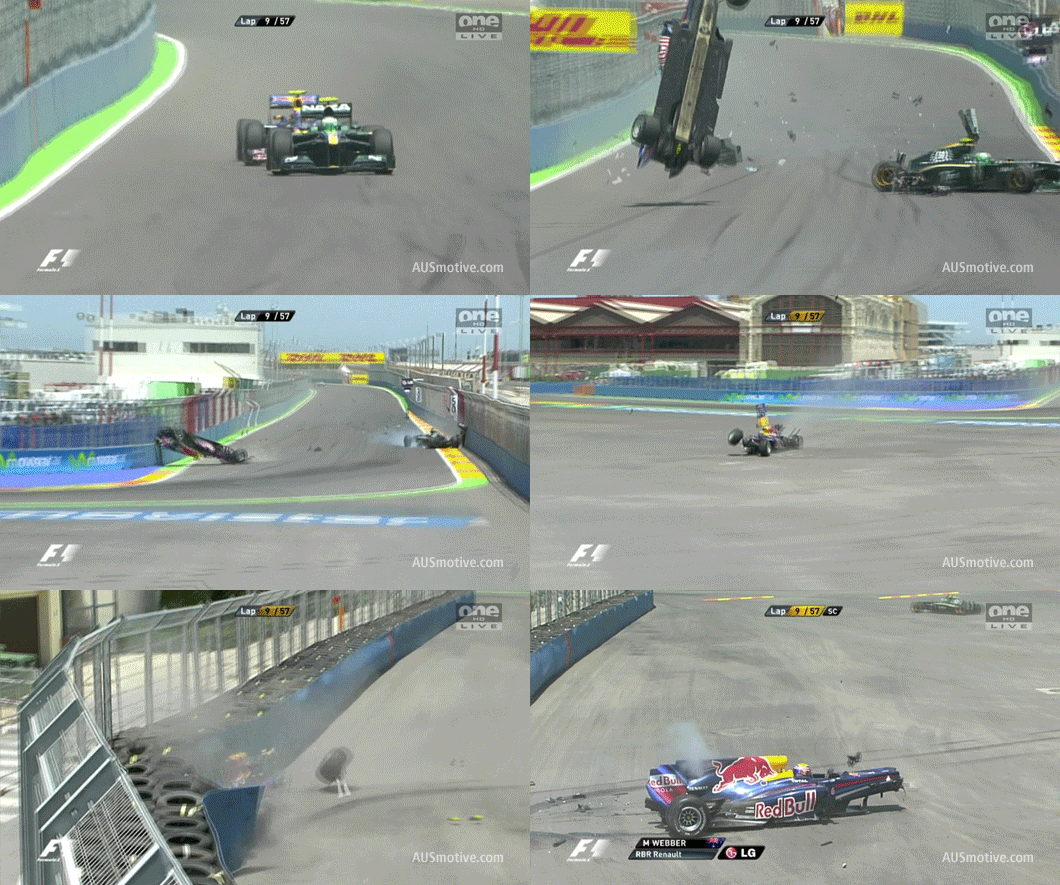
(the idea is to keep the nose low enough, so the car doesn't run up over the rear tires)
That said, for fuel conservation I heard most teams will be upshifting at 12-13k this year during the race.
Its pretty much 36 gallons.
FTE Leadership Emeritus
Joined: Jan 2003
Posts: 161,999
Likes: 75
From: 3rd Rock
Adrian am I off on 100 liters equals 26 us gallons or is that imperial gallons ...or fuel will be limited to 100kg per race. and that is where I got it wrong
I am off on my Kg to litter conversion..maybe that is why I got off on the wrong math "path"
So it is 36 gallons
I am off on my Kg to litter conversion..maybe that is why I got off on the wrong math "path"
So it is 36 gallons
Last edited by IB Tim; Mar 7, 2014 at 06:30 AM.
pedant
Joined: Jan 2008
Posts: 23,576
Likes: 40
From: EXTREME southwest CT
Is there a 'spec' fuel now?
Does everyone draw from the same drum?
I thought fuels were submitted before the race and a sample drawn at race end to make sure they jibed.
Teams were allowed to 'run what they brung' as long as their formula fit within the rules laid down by FIA.
Does everyone draw from the same drum?
I thought fuels were submitted before the race and a sample drawn at race end to make sure they jibed.
Teams were allowed to 'run what they brung' as long as their formula fit within the rules laid down by FIA.
FTE Leadership Emeritus
Joined: May 2004
Posts: 18,787
Likes: 30
From: Melbourne, Aus
Is there a 'spec' fuel now?
Does everyone draw from the same drum?
I thought fuels were submitted before the race and a sample drawn at race end to make sure they jibed.
Teams were allowed to 'run what they brung' as long as their formula fit within the rules laid down by FIA.
Does everyone draw from the same drum?
I thought fuels were submitted before the race and a sample drawn at race end to make sure they jibed.
Teams were allowed to 'run what they brung' as long as their formula fit within the rules laid down by FIA.
Essentially it has to have less than 102 RON (this would be about 97 octane on American pumps), and it can't contain anything in it that isn't in a normal fuel that you can buy at the pumps (although the composition might be different).
At the end of qualifying/race each car has to have 1 Litre/quart left in the tank so the officials can do random audits to confirm the fuel they are using meets these standards. This is why in recent years a number of cars have not driven back to the pits at the end of the race/qualifying as the teams were running as little fuel as possible and got so close to the final quart, that they just parked the car on the side of track as soon as they crossed the line. This was a grey area in the regs - this year, the car must make it back to the pits under its own power and still have the litre/quart left in the tank.