When you click on links to various merchants on this site and make a purchase, this can result in this site earning a commission. Affiliate programs and affiliations include, but are not limited to, the eBay Partner Network.
I don't dislike the 10 amp, just don't think I need it.
If it were only being plugged in occasionally for relatively short periods, I'd lean towards the higher amperage as well. It will be plugged in a lot of the time when the truck is not being used. Longer periods where a 2 amp trickle charge would have plenty of time to top off both batteries. The main advantage to going 5 amp for me is having the repair mode that the 2 amp doesn't have.
I wouldn't be against stepping up to the GEN5, but I can't tell the difference between it and the Genius 5 aside from attachment style. The former is permanent mount and the latter is more portable. The GEN5 has fixed leads and mounts directly to the vehicle. The Genius 5 has detachable leads and a separate mounting bracket. I prefer retaining the option to easily use it elsewhere if needed.
Also FWIW the only NOCO that can't select battery type is the Genius2D, but I've already ruled that one out.
@John in OkieLand that's for the suggestion. I have used that brand before, but of current offerings, I think I prefer the NoCo.
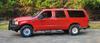
@josht , I have a NOCO Genius Gen1 Mini 4A on the truck and it works great. I opted for this model over something bigger because when the truck goes into "storage" in the back, it is usually there for 3+ weeks to 4 months. Below is a picture of the model I have and where I mounted it taken from this post.
for my other vehicles and they are 750mA. This includes our 3 other vehicles (which also have AGM batteries) and the riding mower. Although, the riding mower is not plugged in because I installed a lithium battery in it that is a good 12 years old now from when I had a motorcycle.
I find each of these tenders and batteries fit our use and expectations quite well. Maybe it is a blessing in disguise that I am cursed by the FLA Gods... I have not replaced an AGM battery in over 3 years since installing the latest one. We have not been let down by the no start or no crank tell tale signs of yet another failed FLA battery. We travel a lot and I do NOT want to be out in WY someplace and the vehicle no start... I also grew very tired of removing a battery and taking it to the place it was warrantied through.
I wish you the best of luck with your FLA choice and hope you get many years of faithful and strong service out of them.
Given enough time, why wouldn't a small charger bring a pair of batteries up to full charge? It might take a week, but it's still charging the whole time.
Given enough time, why wouldn't a small charger bring a pair of batteries up to full charge? It might take a week, but it's still charging the whole time.
This is exactly the reason I selected the 4A for the truck and 750ma for the other vehicles.
"Select a charger size capable of producing the appropriate amperage for the capacity of the battery." (Enersys, manufacturer of Odyssey, Northstar, X2/Power, and Hawker military AGM batteries)
The capacity of a battery is identified by amp hour ratings. Battery "amp hour" ratings can be expressed in a couple of different ways... "10 hour" and "20 hour", so it is important to not just look at the "amp hour" rating of any given battery when looking to size a charger. One must also pay attention as to which metric that "amp hour" rating is measured at, whether "10 hour" or "20 hour."
For the thin plate pure lead AGM batteries that Enersys manufactures, they recommend the following amperage for battery chargers:
- minimum of 40% amperage of the 10 hr amp hour capacity rating of the battery.
- minimum of 25% amperage of the 20 hr amp hour capacity rating of the battery.
The 20 hr amp hour rating for the Odyssey Group 65 batteries I bought a few years ago is 74ah.
25% of 74 is 18.5 amps, so a charger capable of producing 19 amps of charging current would meet the Enersys recommendation.
Charging algorithm (voltage, time, temperature) is another factor to consider with smart chargers. Because of this, Enersys used to test chargers from third party manufacturers. (They might still do this testing). Enersys publishes a list of chargers that passed their testing among the technical references available on their website.
I had a NOCO Genius charger that I wanted to use with my first set of Enersys made batteries (the original Sears DieHard Platinum AGMs from 15 years ago). I called Enersys when I did not see any NOCO chargers on their list, to ask if they had tested any of the NOCO Genius chargers. Enersys said that they had indeed tested them, but did not have them on their list of approved chargers because they did not recommend them, due to NOCO's charging algorithm they found in testing.
This was during the period of time when Enersys was not selling chargers under their own brand, so there did not seem to be any motivation on the part of Enersys to dissuade buyers from other charger brands in favor of their own, as they were not offering any chargers at that time. And, they did recommend other brands of chargers who had no affiliation with Enersys. So I selected one of those other brands on the approved list, and selected a size greater than 18.5 amps.
Just to be kind of pedantic about all this, I think it's worth differentiating between "charging" a battery, and "maintaining" a battery. Even a very small battery maintainer (or smart charger) should be fine for keeping large batteries topped off during storage.
The guidelines above are pretty helpful to think about for charging from a moderate or deeply discharged state.
I highly recommend everyone buy a 12V Car Battery Tester, 100-2000 CCA Load Tester, you can get them for $25 on amazon. It will tell you the current status of your battery, I always unhook mine and do CCA test but you can also do a starting test. They work on regular flooded, AGM flat plate, AGM spiral, or gel batteries.
Good thing about it is you can see your State of Health and State of Charge of your battery in %.
I use it to benchmark % before and after I throw my batteries on the DC welder for some desulfation.
Just to be kind of pedantic about all this, I think it's worth differentiating between "charging" a battery, and "maintaining" a battery. Even a very small battery maintainer (or smart charger) should be fine for keeping large batteries topped off during storage.
The guidelines above are pretty helpful to think about for charging from a moderate or deeply discharged state.
I highly recommend everyone buy a 12V Car Battery Tester, 100-2000 CCA Load Tester, you can get them for $25 on amazon. It will tell you the current status of your battery, I always unhook mine and do CCA test but you can also do a starting test. They work on regular flooded, AGM flat plate, AGM spiral, or gel batteries.
Good thing about it is you can see your State of Health and State of Charge of your battery in %.
I use it to benchmark % before and after I throw my batteries on the DC welder for some desulfation.
I have ZERO confidence in those tiny little gadgets, look at the wires and the clamps, at 100 Amps, they will melt, not to begin to think of a 1,000 amp load.
the worst mistake I made when I left my old job, was to let the Load Tester go, it was a 3 inch wide piece of Brass, with a MilliVolt meter across it, as a "shunt volt meter", calibrated in Amps.
that is the ONLY kind that can measure Actual Draw down.
I will go with my Clamp ON, ammeter and catch the Peak Inrush current of the starter motor.
I already know, that it hits over 800 amps.
here is one instance on the Old depleted batteries, at 512 amps.
then after the new batteries were installed, I checked it again, because it was Obvious that the Starter was spinning almost twice as fast.
a 2 amp Battery Tender,
will KEEP two diesel 850CCA batteries topped off, provided they are at full charge when it is plugged in.
If the batteries are at 12.3 or below, they will NEVER, EVER, bring them up to Full Charge and Top them OFF.
Been there, and dun that crap, it just won't work.
I "tender" agree.
Electrons need to move for charging to take place. To move, they need to be motivated, by force.
If there is not enough voltage difference between the battery's state of charge and the small charger's float voltage, electrons won't be motivated to move.
Let's say we both have Load Range G tires, which take 110 PSI cold when aired up to full capacity. Our stock wheels are rated to 115 psi cold. I'll bet neither one of us ever air up to 110, but let's pretend for the sake of argument that we do.
Let's also say that you have got a nice 7.5 HP 120 gallon 30 cfm air compressor that has a cut in switch at 140 psi and a cut out at 175 psi, while I have a dinky 3/4 HP 5 gallon 1 cfm air compressor that has a cut in switch at 80 psi and a cut out at 120 psi. Currently, our tires are at 95 psi, and we want to bring them up to 110.
While your compressor will have no difficulty at all counteracting the 95 psi of force already present in your tires with your ample supply of air at minimum force of 140 psi, my compressor will be immediately out forced, unless I pull the safety valve to release pressure in my tiny tank to 80 psi so that the pressure switch will cut in, then I have to wait until my compressor reaches 120 psi. Then, my compressor will have more force than my tire, so that air (electrons) will move toward the tire.
Except that air movement is very short lived in my situation. I hook up the air chuck and I only hear the air "moving" for a couple of seconds, if even that, and then all goes quiet. No more air movement. For the brief second that the air in my compressor was more forceful than the air in my tire, I only had 5 gallons of volume, and the volume in my tire is a near match. I need more force (voltage) and more volume (current, or amps) to bring my tire up to 110 psi.
To bring a 12 volt battery to a minimum of 12.65 volts to be considered fully charged at rest, a force differential is required. The voltage from the source has to be higher than the voltage from the sucker, so that the difference is accumulated by the sucker. (These analogies need not be taken literally or seriously... they are just thought exercises). For a 2 volt battery cell, a 2.4 volt force is needed to move electrons in the desired direction (from air compressor tank to tire, rather than the other way around!).
A tiny 2 amp float charger operating at 13.6 volts is a little under 2.27 volts per cell, not 2.40 volts per cell. As such, it can maintain the state of charge of a battery, but it cannot bring a "pair of batteries" (which is an even bigger battery, think tractor tire) "up to full charge," no matter how many weeks the float charger is connected.
Just to be kind of pedantic about all this, I think it's worth differentiating between "charging" a battery, and "maintaining" a battery.
Originally Posted by Sous
Another key point to the discussion at hand...
Exactly!
Lot of good information up there about charging and thanks for posting it. I have a charger capable of fully charging the batteries, individually if not combined, if that is needed. I am not looking for an onboard charger, I am looking to have a (mostly) dedicated tender/maintainer for this truck. Something to help prolong the life of good batteries when sitting for extended periods.
I do not need the truck, but it was a deal I could not pass up. I intend to need the truck eventually, and it would take a while lot to get me to part with it. I have other trucks that are more appropriate to my current truck duties, as such the F-250 goes weeks without being used. That changes somewhat during hunting season, which is honestly the reason I'm finally getting around to replacing the batteries that should have been changed probably 2 months ago. It's getting new batteries, the tender is intended to help maintain and prolong life of them during periods of low use.
If we always stuck to the guidelines/mandates manufacturers and our elected officials deemed were in our "best interests", this forum would be nothing but no start and which oil to use threads.
Rezvani's Latest Post-Apocalyptic Monster Is a Ford F-150 Raptor Underneath
Slideshow: Called the Fortress, the 850-horsepower pickup combines Raptor underpinnings with military-inspired features, survival equipment, and a starting price of $285,000.