When you click on links to various merchants on this site and make a purchase, this can result in this site earning a commission. Affiliate programs and affiliations include, but are not limited to, the eBay Partner Network.
Here is a real world example, my 6.2 is rated to pull a 15600 lb trailer and that's what I pull but I'm over the CGVW because when loaded the last time weighed I was at 24400. When pulling a grade in manual mode the truck pulls the hardest between 3200 and 4500 rpm and if you look at the torque curve for the motor that's at the flattest part of the torque curve at the rear wheels, after 4500 there is a fall off in power that you can feel in the seat of your pants, that's also where the torque starts to fall off. Of you look at the peak HP it continues to climb until max rpm but in real life HARD pulling it makes very little difference just more noise. Because of my 4.30 gears and the 6 speed transmission in manual mode I'm able to keep it in the torque sweet spot 3200 to 4500 rpm when needed and I'm sure with a 10 speed ot would even be better.
I'm a old fart that has been using trucks hard for years and without a bunch of calculations can tell you that more HP gets you up there faster but it's torque and gears that keeps you there when pulling hard. When I used to build my own motors for my trucks both work and RVing the biggest difference maker was a cam ground for max torque not HP also known back then as RV cams along with a RV stall converter in front of a built C6 with 4.10 gears, not a fast truck but a hard pulling one and that's what I wanted. And no I don't run around at 4500 rpm pulling my trailer and very rarely get over 3500 rpm going through the gears under normal road conditions and because of the 2 overdrives and 4.30 gears I can cruise at 65 mph at around 2000 rpm and you can't even hear the motor running.
That is exactly the same experience I just had. I just got back from a 2-week vacation out to CO over the Rockies; brother and I went out west with his toy hauler and our motorcycles. He now has a 2019 F250 4x4 CCLB with 6.2L and 4.30 gears. Nice rig. (For referecne, his previous truck was a 2005 F350 with 6.8L v-10. ) His toy-hauler weighed in just a hair under 10,000 lbs (actually like 9860 I think the ticket said) with our motorcycles loaded in the back; verified at the CAT scales in KS on the way out. His truck weighed in around 7840 lbs as I recall.
The new 6.2L engine is a boon if you keep it between 3800 and 4300 rpm; that's the fat part of the torque band just above the peak TQ rpm. You can rev the engine past 5000 rpm, and it does make good "power", but it actually has less torque. As so as the rpm falls towards torque peak, the "pull" actually gets better. However, if you let the rpm fall below 3500 rpm, you're kind of doomed and may need to downshift. I had to teach him how to use the M mode and the drive mode gear lockout selector. Once he got the hang of it, he loved it. The key is to shift PRIOR to the expected force resistance increase. If you see a hill coming, don't wait until you loose a few mph, and then let it auto-downshift, and then it looses a few more mph, and downshifts again. Then suddenly it's in 3rd gear wailing at 5500rpm trying to make up the speed. The better approach is to downshift one or even two gears PRIOR to the hill, get the rpm up above 3800 rpm so that you can try to maintain the torque and speed. Even if you have to shift it and it hits 4800 rpms, and the load increases, it will actually fall in rpm down to the "best" part of the band at 3850 (the official TQ peak rpm as claimed by Ford).
The older 6.8L engine actually has 25 more ft-lb of torque, but it's much lower in the rpm band, and has a more "narrow" powerband profile. Hence, while it can essentially pull the same load, it does it much slower.
All engines will pull the most load (force requirement) at peak torque. They will move the load faster at peak HP, IF AND ONLY IF THERE IS ENOUGH TORQUE TO SUSTAIN THE FORCE TO OVERCOME THE RESISTANCE LOAD.
The key is to shift PRIOR to the expected force resistance increase. If you see a hill coming, don't wait until you loose a few mph, and then let it auto-downshift, and then it looses a few more mph, and downshifts again. Then suddenly it's in 3rd gear wailing at 5500rpm trying to make up the speed. The better approach is to downshift one or even two gears PRIOR to the hill, get the rpm up above 3800 rpm so that you can try to maintain the torque and speed. Even if you have to shift it and it hits 4800 rpms, and the load increases, it will actually fall in rpm down to the "best" part of the band at 3850 (the official TQ peak rpm as claimed by Ford).
That's the secret to driving it in the mountains . Now if you are on flater ground just lock out gears when approaching a grade and let it gain some rpm then go back to normal when you crest the grade, I even do that with the cruise control set. I think it's actually fun to drive.
For comparison yesterday we had our 2017 F350 6.2L on the dyno lots of drive train loss for sure. We will have more data and info soon when we match up this 6.2L VS. our new 2020 7.3L truck(s) soon to arrive! This should be fun and very informative as its real world.
The key is to shift PRIOR to the expected force resistance increase. If you see a hill coming, don't wait until you loose a few mph,
Denny
Actually, this is not how you drive in the mountains. Sometimes downshifting too soon, puts the engine's rpms above the power band. It's better to wait til just before the engine hits the bottom of the rpm's pulling band then downshift. Then when it does, it's back in the sweet spot. I've driven truck in mountains for 42 years and I never downshift before a grade starts.
Actually, this is not how you drive in the mountains. Sometimes downshifting too soon, puts the engine's rpms above the power band. It's better to wait til just before the engine hits the bottom of the rpm's pulling band then downshift. Then when it does, it's back in the sweet spot. I've driven truck in mountains for 42 years and I never downshift before a grade starts.
I've driven my 6.2 in a lot of mountain grades and I've found that if I downshift early and keep the rpms up but not to max it works better, remember the 6.2 isn't a diesel and it has its own little odd things mostly because of the drive by wire.
I've driven my 6.2 in a lot of mountain grades and I've found that if I downshift early and keep the rpms up but not to max it works better, remember the 6.2 isn't a diesel and it has its own little odd things mostly because of the drive by wire
Denny
Doesn't matter, what the engine is. You're wasting fuel and losing momentum by downshifting before a grade. Better to put your foot into it first, then let the grade pull the speed down, then downshift just before it starts to lug. And if you're letting the cruise control do this, that's even worse. All diesels are drive by wire now and have been for a LONG time. I've only run into one grade where it was mandatory to downshift first and only because it was impossible to do so once on the grade. That grade is on UT Hwy 12 between Escalante and Boulder UT. Something like a 20% pull eastbound.
Doesn't matter, what the engine is. You're wasting fuel and losing momentum by downshifting before a grade. Better to put your foot into it first, then let the grade pull the speed down, then downshift just before it starts to lug. And if you're letting the cruise control do this, that's even worse. All diesels are drive by wire now and have been for a LONG time. I've only run into one grade where it was mandatory to downshift first and only because it was impossible to do so once on the grade. That grade is on UT Hwy 12 between Escalante and Boulder UT. Something like a 20% pull eastbound.
Do it anyway you want but the way I drive it works best for my setup, I've tried many different ways of doing it .
For comparison yesterday we had our 2017 F350 6.2L on the dyno lots of drive train loss for sure. We will have more data and info soon when we match up this 6.2L VS. our new 2020 7.3L truck(s) soon to arrive! This should be fun and very informative as its real world.
That is such a beautiful truck. Why is there so much loss? Other vehicles lose around 20%. These trucks always seem to dunk around 30-40% lower than rated numbers.
That is such a beautiful truck. Why is there so much loss? Other vehicles lose around 20%. These trucks always seem to dunk around 30-40% lower than rated numbers.
There is also a lot of loss at the tire/roller relationship; there's tire slip to account for that is much less in a true tire-to-asphalt contact patch. Plus, if you are actually towing something, the pin-load (5ver/GN) or hitch load (conventional) add weight to the rear end that increases grip. That advantage is also not present on a dyno test. So between the roller material not having as good a CoF (coefficient of friction) and less weight to increase that CoF, there's loss on a dyno that does not exist in the real world.
However, it's very hard to determine how much is lost via the dyno set-up; so many variable to try to account for.
Doesn't matter, what the engine is. You're wasting fuel and losing momentum by downshifting before a grade. Better to put your foot into it first, then let the grade pull the speed down, then downshift just before it starts to lug. And if you're letting the cruise control do this, that's even worse. All diesels are drive by wire now and have been for a LONG time. I've only run into one grade where it was mandatory to downshift first and only because it was impossible to do so once on the grade. That grade is on UT Hwy 12 between Escalante and Boulder UT. Something like a 20% pull eastbound.
The point in downshifting before the grade is so the hill doesn't pull your speed down enough to downshift. You downshift at the bottom as to maintain a constant speed from the bottom to the top.
I'm with "rvpuller" on this one. It works great for me!
Rezvani's Latest Post-Apocalyptic Monster Is a Ford F-150 Raptor Underneath
Slideshow: Called the Fortress, the 850-horsepower pickup combines Raptor underpinnings with military-inspired features, survival equipment, and a starting price of $285,000.


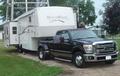


 . Now if you are on flater ground just lock out gears when approaching a grade and let it gain some rpm then go back to normal when you crest the grade, I even do that with the cruise control set. I think it's actually fun to drive.







