Numbers Are Out!

Super Moderator


Joined: Apr 2004
Posts: 34,535
Likes: 2,836

F450 and up, this is from the above link, surprised no one has mentioned it:
"A dyno-certified version of the 7.3-liter V8 producing 350 horsepower at 3,900 rpm and 468 lb.-ft. of torque at 3,900 rpm will be standard on F-450 chassis cab, F-550, the new F-600, F-650 and F-750 Medium Duty trucks, and F-53 and F-59 stripped chassis models. The upgraded E-Series will also feature the 7.3-liter V8. An optional calibration intended to help customers reduce their fuel consumption will also be offered; more information will be made available at a later date..."
"A dyno-certified version of the 7.3-liter V8 producing 350 horsepower at 3,900 rpm and 468 lb.-ft. of torque at 3,900 rpm will be standard on F-450 chassis cab, F-550, the new F-600, F-650 and F-750 Medium Duty trucks, and F-53 and F-59 stripped chassis models. The upgraded E-Series will also feature the 7.3-liter V8. An optional calibration intended to help customers reduce their fuel consumption will also be offered; more information will be made available at a later date..."

Super Moderator


Joined: Dec 2011
Posts: 13,360
Likes: 6,148
"A dyno-certified version of the 7.3-liter V8 producing 350 horsepower at 3,900 rpm and 468 lb.-ft. of torque at 3,900 rpm will be standard on F-450 chassis cab, F-550, the new F-600, F-650 and F-750 Medium Duty trucks, and F-53 and F-59 stripped chassis models. The upgraded E-Series will also feature the 7.3-liter V8. An optional calibration intended to help customers reduce their fuel consumption will also be offered; more information will be made available at a later date..."
What is most notable about this lower rating is that the E-350 cutaway is in the same cutaway body front, and as such has the same front area, the same underhood packaging constraints, and the same physical ability/inability to reject heat as the E-450, which has the higher HP/TQ dyno cert rating. So this leads me to wonder if the power rating deduct may have something to do with cost savings on some emissions equipment (catalyst material, evap can size, etc) since the GVWR/GCWR capacities on the lighter duty Class 3 rated E-Series did not warrant the need for rating the 7.3L at full power, as opposed to the Class 4 rated E-Series, upon which the larger (but not Super) Class C RVs are based.
My breakdown below shows the HP/TQ numbers for all of Ford's dyno cert applications. I inserted Ford's competition chassis cert numbers for the pickup crowd, but didn't bother with dyno cert numbers from competitors on the incomplete vehicle line up, because Ford no longer has any real competition on gas powered front engine Class A RV and Parcel Delivery van stripped chassis platform with the demise of Workhorse chassis. IH/GM's 4500/5500/6500 is all L5D currently, and who orders a RAM 4500/5500 without a Cummins? So gas up in a new
 .
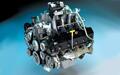
.All NEW 7.3L GASOLINE V8 Big Block Engine
7.3L Peak Horsepower and Torque Specifications Comparison by Model
~
- Super Duty Pickups (Complete Vehicle Chassis Certified)
- 430 Horsepower @ 5,500 RPM
- 475 lb.ft. Torque @ 4,000 RPM
- Alternative Comparison Ford 6.2L Gas V8 (Chassis Certified)
- 385 Horsepower @ 5,750 RPM
- 430 lb.ft. Torque @ 3,800 RPM
- Competitive Comparison GM 6.6L Gas V8 (Chassis Certified)
- 401 Horsepower @ 5,200 RPM
- 464 lb.ft. Torque @ 4,000 RPM
- Competitive Comparison FCA 6.4L Hemi V8 (Chassis Certified)
- 410 Horsepower @ 5,600 RPM
- 429 lb.ft. Torque @ 4,000 RPM
- Super Duty Chassis Cabs (Engine Dynamometer Certified)
- 350 Horsepower @ 3,900 RPM
- 468 lb.ft. Torque @ 3,900 RPM
- Super Duty Medium Duty (Engine Dynamometer Certified)
- 350 Horsepower @ 3,900 RPM
- 468 lb.ft. Torque @ 3,900 RPM
- Super Duty Stripped Chassis (Engine Dynamometer Certified)
- 350 Horsepower @ 3,900 RPM
- 468 lb.ft. Torque @ 3,900 RPM
- E-Series Cutaway Class IV (Engine Dynamometer Certified)
- 350 Horsepower @ 3,900 RPM
- 468 lb.ft. Torque @ 3,900 RPM
- E-Series Cutaway Class III (Engine Dynamometer Certified)
- 300 Horsepower @ 3,750 RPM
- 425 lb.ft. Torque @ 3,250 RPM
7.3L Gas Engine Build Features & Facts
~
- Design Origination
- Clean sheet designed as a low cost, low rpm, high torque, high reliability, fleet friendly, mechanically simplistic gasoline power plant
- Specifically designed for work trucks: cutaways, pickups, cab chassis, & stripped chassis E-350 through F-750
- Universal application in Class 2 through 7 trucks intended to reduce fleet maintenance burden keeping up with different engines
- A commonized engine installed in multiple applications condenses the field knowledge and parts inventory required to maintain fleet
- Design Displacement: Meaning or Marketing?
- Displacement based on stochiometric combustion to achieve a "power target" volumetrically without enrichment in fuel or aspiration
- 107.2mm bore x 101.0mm stroke... wider bore than stroke reduces cylinder wall friction ratio per unit displacement (although longer strokes generally facilitate torque)
- By contrast, 6.8L V10 had longer stroke than bore (90.2mm bore x 105.8mm stroke)
- If Ford increased the bore/stroke of each cylinder in the 7.3L by a miniscule 0.05 liters, a 7.7L engine would result that has no previous history (unlike 7.5, 7.4, 7.3, 7.2 etc)
- Ford chose the "power target", therefore Ford still may have intentionally chosen a power target to end up at "7.3L", in order to leverage a decades long reputation of reliability associated with "7.3L" while at the same time supplanting the memory of the IH built 7.3L diesel with a Ford built 7.3L, an engine which will likely be built for the next 20 years, if past history offers any indication.)
- Design Departure from previous heavy duty light and medium duty truck and fleet gasoline power plants
- Push Rod, cam in block, overhead valve design replaces the former V10 Triton OHC and 6.2L overhead cams
- Overhead cam performs better than pushrod at higher RPMs, but at a much higher cost for valvetrain
- With 7.3L torque optimization at lower RPM... cost, complexity, and width are whittled with pushrods
- 7.3L gas physically narrower than 6.2L gas V8 and 6.8L V10, with much shorter deck height than V10
- Narrower width 7.3L engine enables easier packaging in multiple truck applications, especially cutaways
- Narrow provides more cooling air space between exhaust manifolds and the HVAC and Steering systems
- Additional Design Differences from the 6.2L V8 (Not just a poked and stroked 6.2L block)
- 7.3L gas longer than 6.2L from front main seal to rear main seal
- Extra length due to in part to bore, but more significantly due to spacing between bores
- Bore spacing increased between cylinders for more cooling passage space and stiffer structure
- New cast iron block with 6 bolt mains; four vertical bolt and two horizontal cross bolted main bearings
- Design Similarities with 6.7L Power Stroke Diesel (Materials, coatings, and treatments originally developed for 6.7 turbocharged engine)
- Forged steel crankshaft with large bearing diameters similar to 6.7L diesel
- Ford specific roller tappets are fitted with carbon-nitrided needle bearings and axles with upgraded bearing seals
- Valves and valves seats manufactured and treated as if for use in higher pressure turbo diesel engine
- Piston rings coated with same antiwear material used in the 6.7L diesel
- Oversize water pump bearing is directly from 6.7L diesel, and 7.3L water pump is cast with deep structural gussets
- Variable displacement oil pump reduces parasitic losses when less oil volume is needed, similar to 6.7L diesel
- Oil circulation for cooling localized high heat and high wear contact points
- Piston cooling jets squirt oil directly to the underside of pistons where the highest concentration of combustion heat soaks
- Underside of piston crowns contoured to better distribute and manage the oil squirted from the cooling jet
- Oil flow directed to valvetrain push rod contact points specifically increased over oil circulation designs of other engines
- Cast steel rocker arms have channels designed to carry oil flowing over the top of them to the valve stem interface at low speeds
- Live tuning on the fly for optimal power, efficiency, and emissions control from part throttle to full throttle in variety of conditions and loads
- Variable Cam Timing utilizes electronically controlled, hydraulically (using engine oil) actuated cam phasing solenoid to shift cam by up to 60 degrees
- DEVCT signifies Dual Equal Variable Cam Timing... the intake and exhaust valves are phase shifted equally due to common camshaft
- Despite being cam in block, the Camshaft is driven by a timing chain, not directly gear driven by the crankshaft
- Timing generally advanced at low speeds, and retarded at high speeds, load depending
- Intake
- Composite thermoplastic Intake manifold has long runners, leading into high flow ports
- Port fuel injection presents a cost reduction over direct injection, and may be easier and cheaper to repair from fouled fuel in the field
- Naturally aspirated with compression ratio 10.5:1, designed to run on regular octane gasoline (Flex Fuel & E85 recommendations TBD)
- Electronic engine controls coordinated in conjunction with the new 10 speed automatic transmission
- Port fuel injection allows fuel and air to mix more thoroughly prior to entering into the cylinder to be compressed
- The pre introduction of fuel into the intake runner cools the air, increasing air density
- Direct injection would cool the super heated compressed air in the cylinder, and is less likely to predetonate (knock) than Port injection, but these benefits are realized at higher RPMs than the low speed high load applications the 7.3L has been optimized for
- Exhaust
- Cast Stainless Steel exhaust manifolds, with long runners tuned for torque, no longer inhibited by tight fit, due to narrower block
- Exhaust manifolds shaped like performance headers, with long individual runs before coming together in a common collector
- Deep V8 rumble at idle harkens back to yesteryear... with a noticeably different idle compared to the higher pitched V10 idle
- Single outlet tailpipe tip
- 7.3L Development Testing
- Global Systems Test
- Thermal Shock Test
- Engine Fatigue Test
- Manufactured in only one location... at the Windsor Engine Plant, in Ontario, Canada
- Windsor Engine Plant stripped to bare floors in early 2018, with all new CNC machinery installed
- Test engines built in late 2018, using about 400 workers under a Canadian Unifor Union contract
- Plant fully operational in mid 2019, now producing the 7.3L at capacity to replace all 6.8L applications
- Hundreds of 7.3L gas motors were built to test quality and production processes prior to product launch
- What could come next, as a future model year upgrade (Caution: This is UNofficial speculation)
- Some have reported noticing "an unused extra hole" per each cylinder in the new 7.3L heads
- Ford doesn't discuss future product, and makes no reference or mention of these extra holes
- Ford DOES produce at least FOUR gas engines currently with DUAL FUEL injection (PFI + DI)
- Ford shortens the combination of acronyms to "PFDI" when describing this feature
- Combining Port Fuel Injection simultaneously with Direct Injection has several benefits
- Ford's 2.7L, 3.3L, and 3.5L V6 have PFI+DI, as does Ford's newest 5.0L V8
- If the 7.3L heads already have the extra holes, then Ford's cost to upgrade is minimized
- In the event that PFI alone ends up becoming a limiting factor, a solution could just be a matter of adding some additional external plumbing and some programming.
More technical info on the new 2020 Super Duty powertrain can be found here:
https://www.ford-trucks.com/forums/1...different.html
Super Moderator
Joined: Apr 2004
Posts: 34,535
Likes: 2,836
According to this, same as the 6.2 at 4.527" or 115mm.
https://www.svtperformance.com/threa...-name.1162603/
Edit: Note that link is from July 2018. Almost everything in it is speculation and unconfirmed as of that date.
There is a video of a Ford engineer saying the 7.3 is longer than a 6.2, but I've checked a dozen or so "7.3 gas specs" links and can find NO CONFIRMING INFO regarding bore spacing, deck height etc.
See post 172.
https://www.svtperformance.com/threa...-name.1162603/
Edit: Note that link is from July 2018. Almost everything in it is speculation and unconfirmed as of that date.
There is a video of a Ford engineer saying the 7.3 is longer than a 6.2, but I've checked a dozen or so "7.3 gas specs" links and can find NO CONFIRMING INFO regarding bore spacing, deck height etc.
See post 172.
Super Moderator
Joined: Dec 2011
Posts: 13,360
Likes: 6,148
Multiple sources could all be quoting the same source, and if that same source is wrong, then multiple sources are just as wrong, no matter how many of those sources exist.
More singers can be added to the choir, and every member of the choir could be harmonizing in perfect unison... but they could be singing the wrong hymn.
As it happens, it looks like one of these sources was an article on a performance site consisting of best guesses and prognostications about a rumoured engine about which so little was known that not even the true displacement of the motor could be identified, over 1 full calendar year (July 2018) prior to Ford officially announcing the engine (August 2019).
Then, as if to add more credibilty to the prognostications, photos were shown of a cut away 6.2L engine, with close ups of the talking point signage that 6.2L cutaway display motor was decorated with. Then the performance site took photos from the media websites of Ford and GM, and like many online article publishers do, pasted their own watermark over images already provided by the respective manufactures in the public domain, as if original content.
There is nothing wrong with prognostications and best guesses for future products when there is nothing else to go on. But the dates to these types of sources might not be taken into consideration by others who echo the guesswork those sources esposed.
I can't point to a Ford website that identifies what the bore centers are to the new gas 7.3L, but I take it on faith that Joel Beltramo, Ford's Manager for Large V8 Gas Engines, was being truthful when he said that the 7.3L block was cast with more space between the cylinders, to increase cooling passage size, and to provide block structure for rigidity. He also said the 7.3L block was a lot narrower than, and a little bit longer than, both the 6.2L and the 6.8L it replaces.
I'm not that good at math, but Ford has published the cylinder bore diameter in several different places (see Ford spec sheets of any model of interest that offers the 7.3L as an option). That bore diameter is 107.188 mm.
If the bore centers were 115mm, that would leave 7.8mm of cast iron between the cylinders for Beltramo's "larger cooling passage and structure", Just over 1/4", but less than 5/16" of an inch, without taking into consideration any asymmetry in bore spacing.
I'd be more inclined to wait until Ford publishes the bore center data, rather than rely on convincingly written best guesses at a rumored engine made a year prior to the engine's release and supported by photos of the wrong engines, no matter how many times that source is repeated and becomes other sources.
More singers can be added to the choir, and every member of the choir could be harmonizing in perfect unison... but they could be singing the wrong hymn.
As it happens, it looks like one of these sources was an article on a performance site consisting of best guesses and prognostications about a rumoured engine about which so little was known that not even the true displacement of the motor could be identified, over 1 full calendar year (July 2018) prior to Ford officially announcing the engine (August 2019).
Then, as if to add more credibilty to the prognostications, photos were shown of a cut away 6.2L engine, with close ups of the talking point signage that 6.2L cutaway display motor was decorated with. Then the performance site took photos from the media websites of Ford and GM, and like many online article publishers do, pasted their own watermark over images already provided by the respective manufactures in the public domain, as if original content.
There is nothing wrong with prognostications and best guesses for future products when there is nothing else to go on. But the dates to these types of sources might not be taken into consideration by others who echo the guesswork those sources esposed.
I can't point to a Ford website that identifies what the bore centers are to the new gas 7.3L, but I take it on faith that Joel Beltramo, Ford's Manager for Large V8 Gas Engines, was being truthful when he said that the 7.3L block was cast with more space between the cylinders, to increase cooling passage size, and to provide block structure for rigidity. He also said the 7.3L block was a lot narrower than, and a little bit longer than, both the 6.2L and the 6.8L it replaces.
I'm not that good at math, but Ford has published the cylinder bore diameter in several different places (see Ford spec sheets of any model of interest that offers the 7.3L as an option). That bore diameter is 107.188 mm.
If the bore centers were 115mm, that would leave 7.8mm of cast iron between the cylinders for Beltramo's "larger cooling passage and structure", Just over 1/4", but less than 5/16" of an inch, without taking into consideration any asymmetry in bore spacing.
I'd be more inclined to wait until Ford publishes the bore center data, rather than rely on convincingly written best guesses at a rumored engine made a year prior to the engine's release and supported by photos of the wrong engines, no matter how many times that source is repeated and becomes other sources.
Super Moderator

Joined: Aug 2003
Posts: 25,479
Likes: 742
From: Isanti, MN
It's always fun to guess and prognosticate, but for the overwhelming majority of us is relatively meaningless.
Modern engines have proven to be outstanding in long-term reliability, even when neglected and abused. I think modern design tools and materials have made that possible, and base engine problems only seem to occur when running out of oil or a serious amount of power is added with forced induction. The marketing folks at Ford love to talk up the features they built into this engine is groundbreaking, but I'm still scratching my head wondering what this really means to the end user.
Has anyone here met someone who's broken a 6.2 L, or even an older 5.4/4.6? I've pushed some of these engines pretty hard over the years, far past their specified limits and well out of warranty, and never had an issue. For me the big selling point is the high power output without the aftermarket stuff that could cause an early death.
Modern engines have proven to be outstanding in long-term reliability, even when neglected and abused. I think modern design tools and materials have made that possible, and base engine problems only seem to occur when running out of oil or a serious amount of power is added with forced induction. The marketing folks at Ford love to talk up the features they built into this engine is groundbreaking, but I'm still scratching my head wondering what this really means to the end user.
Has anyone here met someone who's broken a 6.2 L, or even an older 5.4/4.6? I've pushed some of these engines pretty hard over the years, far past their specified limits and well out of warranty, and never had an issue. For me the big selling point is the high power output without the aftermarket stuff that could cause an early death.
FTE Stories
Ford Trucks for Ford Truck Enthusiasts

Top 6 Best Deals Available on New Fords & Lincolns Right Now
Brett Foote
This Hennessey Takes the Expedition Tremor's Off-Roading Capability to the Next Level
Verdad Gallardo
Top 10 Fords at 2026 Carlisle Ford Nationals
Joe Kucinski
3 Best / 3 Worst Parts of Modern Ford Ownership
Brett Foote
10 Amazing Upgrades That Solve Common Ford Truck Owner Headaches
Pouria Savadkouei
Every 2026 Ford Engine Explained
Brett Foote
10 Ugly Ford Trucks That We Still Kinda Love
Joe Kucinski
10 Things Every Truck Owner NEEDS (2026 Edition)
Michael S. Palmer
Rezvani's Latest Post-Apocalyptic Monster Is a Ford F-150 Raptor Underneath
Verdad Gallardo
Fleet Mechanic
Joined: Jul 2004
Posts: 1,520
Likes: 199
I am also very curious about the 7.3L's deck height. I have seen a cutaway 7.3L in person, but didn't get a chance to measure anything. From the looks of it, the bore spacing looked to be a little tight and there wasn't much room in the crankcase for a larger crank, so based purely on looks I don't think there is room to make the engine too much larger displacement-wise. But, at 7.3L, how much larger would you want to go? What is impressive is the external size is quite small for it's displacement and I will bet it doesn't weight too much either.
3 valve 5.4L's? Don't get me started........
3 valve 5.4L's? Don't get me started........
Super Moderator
Joined: Dec 2011
Posts: 13,360
Likes: 6,148
Well then, while we are prognosticating and speculating about making even bigger numbers now that the power numbers (but not all the physical measurements) are out...
..perhaps we should turn our attention back to those extra holes in the cylinder heads everyone keeps pointing to?
Since Ford forbids discussion of future products, or even future iterations or potential directions of current products, Beltramo is silent on the possibility.
However, as Don Sherman of Car and Driver writes (or copies, or is copied by, as the following language appears in several articles of different "sources"):
"Ford currently is the dominant player with what it calls dual-fuel, high-pressure direct injection (DI) and lower-pressure port injection (PI). Applications include turbocharged and naturally aspirated V-6 and V-8 gasoline engines—four in all—ranging in size from 2.7 to 5.0 liters. The 2017 F-150 Raptor flying pickup and the GT supercar both are powered by new 3.5-liter EcoBoost V-6s so equipped. Ground-bound F-150s also rely heavily on this technology with a dual-fueled base 3.3-liter V-6 and optional EcoBoost 2.7- and 3.5-liter V-6s. Ford’s most recently announced application thus far is the new 5.0-liter V-8 that will power the 2018 Mustang GT."
The concept of dual injection has long been written about in the automotive industry even prior to Ford's implementation, as all engine manufactures explore ways of meeting every tightening emissions standards, while at the same time meeting ever clamoring consumer demand for more power.
So here are some links discussing the topic of simultaneous Port Fuel Injection and Direct Injection (PFI+DI) (hence dual injection) concepts, testing, and implementations:
https://www.sae.org/publications/tec.../2018-01-1735/
https://www.sciencedirect.com/scienc...06261911000432
https://www.caranddriver.com/news/a1...ect-injection/
https://www.noln.net/articles/2785-d...-engine-design
.
..perhaps we should turn our attention back to those extra holes in the cylinder heads everyone keeps pointing to?
Since Ford forbids discussion of future products, or even future iterations or potential directions of current products, Beltramo is silent on the possibility.
However, as Don Sherman of Car and Driver writes (or copies, or is copied by, as the following language appears in several articles of different "sources"):
"Ford currently is the dominant player with what it calls dual-fuel, high-pressure direct injection (DI) and lower-pressure port injection (PI). Applications include turbocharged and naturally aspirated V-6 and V-8 gasoline engines—four in all—ranging in size from 2.7 to 5.0 liters. The 2017 F-150 Raptor flying pickup and the GT supercar both are powered by new 3.5-liter EcoBoost V-6s so equipped. Ground-bound F-150s also rely heavily on this technology with a dual-fueled base 3.3-liter V-6 and optional EcoBoost 2.7- and 3.5-liter V-6s. Ford’s most recently announced application thus far is the new 5.0-liter V-8 that will power the 2018 Mustang GT."
The concept of dual injection has long been written about in the automotive industry even prior to Ford's implementation, as all engine manufactures explore ways of meeting every tightening emissions standards, while at the same time meeting ever clamoring consumer demand for more power.
So here are some links discussing the topic of simultaneous Port Fuel Injection and Direct Injection (PFI+DI) (hence dual injection) concepts, testing, and implementations:
https://www.sae.org/publications/tec.../2018-01-1735/
https://www.sciencedirect.com/scienc...06261911000432
https://www.caranddriver.com/news/a1...ect-injection/
https://www.noln.net/articles/2785-d...-engine-design
.

Super Moderator
Joined: Aug 2003
Posts: 25,479
Likes: 742
From: Isanti, MN
Y2K makes a good point about modern Ford engines, but I'm not sure we will see this for awhile on a Super Duty. A great many fleets as well as private owners are looking for lower maintenance, less complexity, and reduced cost of ownership, and many are driven away from the PSD as a result. I think this is why the 6.2 L never got direct injection despite it being common for nearly a decade on virtually everything else gas-powered on the road.

Mountain Pass

Joined: Sep 2019
Posts: 241
Likes: 12
From: Kansas
Y2K makes a good point about modern Ford engines, but I'm not sure we will see this for awhile on a Super Duty. A great many fleets as well as private owners are looking for lower maintenance, less complexity, and reduced cost of ownership, and many are driven away from the PSD as a result. I think this is why the 6.2 L never got direct injection despite it being common for nearly a decade on virtually everything else gas-powered on the road.
Super Moderator
Joined: Aug 2003
Posts: 25,479
Likes: 742
From: Isanti, MN
And, of course to spitball in the other direction, I think there are a lot of people who would love greater efficiency at the expense of all the complexity that that requires. Perhaps the 7.3 L will eventually fill the "proven workhorse" slot in the lineup, and permit them to drop the 6.2 L in favor of a smaller, more complex and efficient engine in its stead. Perhaps a heavy-duty version of the 3.5 L EcoBoost, whose capabilities significantly outclass the chassis that it rides in.
I'm the kind of guy who loves technology and efficiency, and would love to see such a thing if it made a meaningful improvement in efficiency. I think it's possible.
I'm the kind of guy who loves technology and efficiency, and would love to see such a thing if it made a meaningful improvement in efficiency. I think it's possible.