






Normal fan operation?
Cargo Master
Joined: Apr 2007
Posts: 2,333
Likes: 1
From: St. Louis, Mo.

Like said - totally normal - The hotter the ambient temp the more it will kick in when pulling steeper grades. Might check & make sure all radiators are as clean as possible with some water. Over the years the crap can build up in there & reduce air flow increasing temps & running time of fan clutch

Lead Driver
Joined: Sep 2010
Posts: 7,793
Likes: 50
Jaythe cpa.. Funny you bring up heater hose temp. When I ran wvo, I tapped into the heater house to bring coolant to wvo tank, which in turn, I installed a T so I can monitor ect temp going into tank. Wouldn't you know, I tapped out at 245*, where as my ect temp sensor tapped into water pump read 180*...

Lead Driver

Joined: Feb 2000
Posts: 5,374
Likes: 46
From: Palm Bay, Florida
My L99 hardly ever runs, LAST June we towed OUR 36' bumper pull TT about 200 miles away from home, it was in the high 90s with 90% humidity as well, my fan clutch only came on a couple of times, and then only for about a minute each time.
As others have said, its operating normally.
This all said guys, It is MY understanding that these centrifugal clutches, when they "fail" will lock up solid, causing the fan to run 100% of the time.
I had this happen on a medium International 4300 truck that I drove for my employer, IT was a leased truck and the company just kept putting cheap aftermarket clutches on it (4-5) and it never fixed the problem.
I (stupidly) kept driving the truck like that (after telling my employer) and with the LOUD roaring noise it was making I now have Tinnitus, which is a ringing in the ears, it is not able to be cured at this time, so PLEASE, PLEASE protect your hearing no matter what.
As others have said, its operating normally.
This all said guys, It is MY understanding that these centrifugal clutches, when they "fail" will lock up solid, causing the fan to run 100% of the time.
I had this happen on a medium International 4300 truck that I drove for my employer, IT was a leased truck and the company just kept putting cheap aftermarket clutches on it (4-5) and it never fixed the problem.
I (stupidly) kept driving the truck like that (after telling my employer) and with the LOUD roaring noise it was making I now have Tinnitus, which is a ringing in the ears, it is not able to be cured at this time, so PLEASE, PLEASE protect your hearing no matter what.

Elder User

Joined: Jul 2015
Posts: 914
Likes: 4
That's not "bumper pull". Its a frame mounted receiver hitch. "Bumper pull" refers to a ball bolted to depressed "step" area in the lower middle of an actual bumper. In other words, relying solely on the strength of the vehicle's bumper and its attachment to carry the weight of the towed item. I doubt there is any stock/oem bumper in the world that is rated for 16K/1,600 t/w. I think they generally max out around 1,500k trailer weight, and most are less then that. Bumpers just aren't THAT strong.
Now, I wouldn't be surprised if there is an aftermarket "mega bumper" or something that exists, or somebody has custom made, that integrates a receiver hitch, stronger/thicker materials, and stronger frame attachment; but I still wouldn't really call that "bumper pull".
Now, I wouldn't be surprised if there is an aftermarket "mega bumper" or something that exists, or somebody has custom made, that integrates a receiver hitch, stronger/thicker materials, and stronger frame attachment; but I still wouldn't really call that "bumper pull".
Elder User
Joined: Jul 2015
Posts: 914
Likes: 4
I've noticed this behavior recently. I don't know if I wasn't noticing it before, or it wasn't happening.
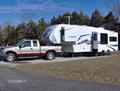
It's happened a couple of times. I'll be towing the RV (total weight 16k#) up a slight grade in 3rd gear. There was a 20-30 mph headwind that day so I couldn't even use OD unless I going down a pretty steep grade. The air temp was about 75. EGT's were between 1000 and 1100. The transmission temp was about 170 (I have a 6.0 trans cooler - best money I ever spent). I'm doing 55 or 60. I don't have a coolant gauge but the factory gauge wasn't higher than normal, for whatever that's worth.
And then I'll hear the fan kick on. It roars like a lion. I can hear it over the radio with the windows open or closed and the AC on high. It will stay engaged until I hit level or a downhill grade and after a few moments the fan disengages. The extra engine load increases the EGTs further, forcing me to back off the throttle even more.
It's very annoying. Is this normal and is there a solution to this? An electric fan conversion maybe? Do I just need a newer or better fan clutch?
It's happened a couple of times. I'll be towing the RV (total weight 16k#) up a slight grade in 3rd gear. There was a 20-30 mph headwind that day so I couldn't even use OD unless I going down a pretty steep grade. The air temp was about 75. EGT's were between 1000 and 1100. The transmission temp was about 170 (I have a 6.0 trans cooler - best money I ever spent). I'm doing 55 or 60. I don't have a coolant gauge but the factory gauge wasn't higher than normal, for whatever that's worth.
And then I'll hear the fan kick on. It roars like a lion. I can hear it over the radio with the windows open or closed and the AC on high. It will stay engaged until I hit level or a downhill grade and after a few moments the fan disengages. The extra engine load increases the EGTs further, forcing me to back off the throttle even more.
It's very annoying. Is this normal and is there a solution to this? An electric fan conversion maybe? Do I just need a newer or better fan clutch?
I disagree with the premise of your statement. An electric fan can most certainly move as much, or more air then a stock mechanical clutch fan. AND, it can likely do it quieter. I would assume that the fields of aerodynamics, fluid dynamics, and mechanical and electrical engineering have advanced considerably since the time that the mechanical fan in our trucks was "engineered". Given your interest in boating, I would assume you are aware of the advances in prop design and efficiency over the years. More thrust with less cavitation, from lower rpm. Props moving water, and fans ( or airplane props) moving air are similar in many ways. There have also been improvements in fan technology an blade geometry ( namely curved blades). There have also been huge improvements in electronic controls, as well as the motors themselves. I'm sure you have a much better understanding of those kinds of technological developments then I do.
Also, you really only want the fan working at low road speeds. At highway speeds, the fan ( mechanical and electric) becomes a restriction, as the don't move as much air as would occur naturally from the vehicle's movement down the road. That is why many aftermarket fans, and even many newer oem have provisions for a relief "flap" somewhere on the fan shroud, so the outside air doesn't "stack up" at highway speed, and add drag and lose cooling efficiency.
If the fan's controller is using the 'push-in' thermostat, correct the reading is coming from the external side of the radiator fins. It is possible to get an thermostat that reads from a housing that is inline with the heater hose that will read actual ECT.
However, for towing, I would not consider an electric fan. When I first looked into electric fans (~ 10 years ago), manufacturer's outright stated that they could not handle combined weight levels above a certain point. Do not recall what the stated limitation was, but seeing as (at that time) I regularly was at the 14K# range and decided to steer-away, the limitation was somewhere around that point. Recent searching (about 2 years ago) did not show that same weight limit disclaimer, but seeing as the parts looked the same I do not know how they could suddenly handle the load when previously they could not...........
However, for towing, I would not consider an electric fan. When I first looked into electric fans (~ 10 years ago), manufacturer's outright stated that they could not handle combined weight levels above a certain point. Do not recall what the stated limitation was, but seeing as (at that time) I regularly was at the 14K# range and decided to steer-away, the limitation was somewhere around that point. Recent searching (about 2 years ago) did not show that same weight limit disclaimer, but seeing as the parts looked the same I do not know how they could suddenly handle the load when previously they could not...........
Mechanical fans are inefficient. They suck HP and hurt MPG. They turn on when not needed or beneficial. On the other hand, you can't make then come on when you might want it, such as when stuck in traffic and your a\c is getting warm. Also, hanging all that weight off the water pump reduces the life of the pump/bearing. The fan can also introduce vibration/harmonics to other belt driven accessories, also reducing there life span. Further, electric fans are typically a thinner profile, leaving a lot more room, when working on the front of your engine. They are typically also a lot easier to remove then the mechanical/clutch fan if needed.
I built a custom fan for my '93 Ranger, and it worked great. I used a scrap stock fan for a Volvo V70, with a broken plastic shroud, and trimmed it down to fit and get fiberglassed into a spare stock fan shroud for the Ranger. It bolts right in/out like a stock shroud ( 2 bolts and lift out). It worked great. When I get the truck back on the road, I will make some updates to the wiring/controller, but that's just because I was in a rush when I built it.
I also used a direct fit Flex-A-Lite fan in my '80 Chevy K20 with a built small block 350, that I used to use to tow my stock car to the track. I would run 80-90mph for 1-2 hours at a time, with a 7-8K trailer/car combo, sometimes up steep hills. I never met a left lane lingerer that I didn't try to pass aggressively and as rapidly as the truck was physically capable of (foot to the floor), all with the a/c blasting. It never once came close to overheating.
Finally, just about every new vehicle comes with electric fans, including most trucks. I think they work just fine.
Anyway, here's a good option. Direct fit for the SuperDuty. Recommended for use on the 7.3L, by the very reputable manufacturer. It moves 6,200cfm. I think that will do. If I had the money, it would be going in in a heartbeat. If you happen to already need a $200 fan clutch anyway, this gets a little easier to swallow:
https://www.flex-a-lite.com/direct-f...uper-duty.html
EDIT: I see they are readily available for $669, from multiple vendors, including JEGS. ( and as low as $628 on Amazon) Several of those vendors indicate a max GVW of 18,000LBS for use of this fan, BUT the manufacturers website makes no such claim or limitation.

FTE Leadership Emeritus


Joined: May 2014
Posts: 27,356
Likes: 5,952
From: Lake Hartwell, GA

Anyway, here's a good option. Direct fit for the SuperDuty. Recommended for use on the 7.3L, by the very reputable manufacturer. It moves 6,200cfm. I think that will do. If I had the money, it would be going in in a heartbeat. If you happen to already need a $200 fan clutch anyway, this gets a little easier to swallow:
https://www.flex-a-lite.com/direct-f...uper-duty.html
EDIT: I see they are readily available for $669, from multiple vendors, including JEGS. ( and as low as $628 on Amazon) Several of those vendors indicate a max GVW of 18,000LBS for use of this fan, BUT the manufacturers website makes no such claim or limitation.
FTE Stories
Ford Trucks for Ford Truck Enthusiasts

Top 6 Best Deals Available on New Fords & Lincolns Right Now
Brett Foote
This Hennessey Takes the Expedition Tremor's Off-Roading Capability to the Next Level
Verdad Gallardo
Top 10 Fords at 2026 Carlisle Ford Nationals
Joe Kucinski
3 Best / 3 Worst Parts of Modern Ford Ownership
Brett Foote
10 Amazing Upgrades That Solve Common Ford Truck Owner Headaches
Pouria Savadkouei
Every 2026 Ford Engine Explained
Brett Foote
10 Ugly Ford Trucks That We Still Kinda Love
Joe Kucinski
10 Things Every Truck Owner NEEDS (2026 Edition)
Michael S. Palmer
Rezvani's Latest Post-Apocalyptic Monster Is a Ford F-150 Raptor Underneath
Verdad Gallardo
More Turbo
Joined: May 2016
Posts: 717
Likes: 9
Having about three different types of cooling fans on as many Trucks. The OEM Viscous fan clutches far exceeds and are hard pressed to be beaten in their ability to cool, bar-none.
True, some expense in HP Loss is cost. But, the engines performance is saved.
JMHO
True, some expense in HP Loss is cost. But, the engines performance is saved.
JMHO

Laughing Gas

Joined: May 2007
Posts: 793
Likes: 29
I disagree with the premise of your statement. An electric fan can most certainly move as much, or more air then a stock mechanical clutch fan. . . . There have also been huge improvements in electronic controls, as well as the motors themselves. . . .
Mechanical fans are inefficient. They suck HP and hurt MPG. They turn on when not needed or beneficial. On the other hand, you can't make then come on when you might want it, such as when stuck in traffic and your a\c is getting warm. . . .
I built a custom fan for my '93 Ranger, and it worked great. I used a scrap stock fan for a Volvo V70, with a broken plastic shroud, and trimmed it down to fit and get fiberglassed into a spare stock fan shroud for the Ranger. . . I also used a direct fit Flex-A-Lite fan in my '80 Chevy K20 with a built small block 350, that I used to use to tow my stock car to the track. I would run 80-90mph for 1-2 hours at a time, with a 7-8K trailer/car combo, sometimes up steep hills. . . .
Finally, just about every new vehicle comes with electric fans, including most trucks. I think they work just fine.
Anyway, here's a good option. Direct fit for the SuperDuty. Recommended for use on the 7.3L, by the very reputable manufacturer. It moves 6,200cfm. . . .
https://www.flex-a-lite.com/direct-f...uper-duty.html
Mechanical fans are inefficient. They suck HP and hurt MPG. They turn on when not needed or beneficial. On the other hand, you can't make then come on when you might want it, such as when stuck in traffic and your a\c is getting warm. . . .
I built a custom fan for my '93 Ranger, and it worked great. I used a scrap stock fan for a Volvo V70, with a broken plastic shroud, and trimmed it down to fit and get fiberglassed into a spare stock fan shroud for the Ranger. . . I also used a direct fit Flex-A-Lite fan in my '80 Chevy K20 with a built small block 350, that I used to use to tow my stock car to the track. I would run 80-90mph for 1-2 hours at a time, with a 7-8K trailer/car combo, sometimes up steep hills. . . .
Finally, just about every new vehicle comes with electric fans, including most trucks. I think they work just fine.
Anyway, here's a good option. Direct fit for the SuperDuty. Recommended for use on the 7.3L, by the very reputable manufacturer. It moves 6,200cfm. . . .
https://www.flex-a-lite.com/direct-f...uper-duty.html
Overall, sharing is caring. Blasting is . . . Just say-in.

Good information and at the same time am seeing it as coming up short in terms of apples to apples.
Platforms noted are gassers with different heat loads. Even the K20 gasser is a completely different animal and has a reputation of a clean cooling stack that can take advantage of slipstream cooling; were this a later year GM *diesel* product, I have significant doubts that it would have survived with electric fans. In terms of the K20's tow duty, if the trailer is open, this is far less of a load on the motor as compared to the OP's observation with a closed trailer.
And good point about the use of the 'flaps' in the shroud as I do not recall seeing them in Flex-A-Lite's eariler product; perhaps this is the secret sauce that allowed them to remove the weight restriction for the 7.3's offering.
In terms of Flex-A-Lite's stated "Up to 6,200 cfm of airflow", I will interpret that as a measurement under ideal conditions (specifically: with *nothing* in front of it or in back of the unit, and at desirable ambient conditions (specific humidity, specific temperature, and no wind)) and look forward to the actual results at different humidity, temperature, restrictions (motor in back, radiator, condenser, and aux cooling), and wind / direction levels / conditions. So without seeing the robust test results, the number is just a number to me and not what I should expect in practical application.
Toward the overall electric fan aspect, I did have products all the way back to the early 80's that used only electric fans (they came OE with them) and they certainly were nice.
Toward fan clutch use in the Super Duty Series, what I am aware of in term of OE:
- 7.3: thermal-viscous
- 6.0: electro-viscous
- 6.4: electro-viscous
- 6.7: electro-viscous
My read is that in the race to squeeze out as much HP/Tq out of the motor as possible, Ford still stuck with the viscous fan clutch. Have not looked into GM or Dodge as that is not an apples to apples comparison.
Yes, electric fans are a good product. Still remain skeptical that they are the correct choice on a 7.3 Super Duty when towing (specifically: a closed trailer). Yes, they should work well if the vehicle sees just daily driver use.
Also, electric fans are not 'tax-free' as they do load the alternator; but generally will do it with less load on the motor than a fully engaged viscous clutch.
Aside, a viscous clutch actually *does* cool the A/C condenser when sitting still and at idle and / or while plugging along in traffic. So far I have sat in traffic, with the A/C blasting cold, and over 100F & ~80% RH outside with the thermal-viscous clutch doing its job. Just say-in
Definitely not looking to stop anybody from checking out the electric fan, and (as noted by others) at the same time am just not seeing it in use by those whom tow. Yes viscous fan clutches are know for lower efficiency than electric fans, but am not seeing where that is part of the OP's observation or concern.
Back to my original comment, were I to go electric, I'd consider an electro-magnetic clutch; also, I'd put a small pusher fan in front for A/C use. But that is just me and everybody is free to go with what lies within their comfort zone


Thread
Thread Starter
Forum
Replies
Last Post
ScaldedDog
1999 - 2003 7.3L Power Stroke Diesel
11
May 27, 2013 11:46 AM
Alwaysfixin
1973 - 1979 F-100 & Larger F-Series Trucks
2
Aug 8, 2002 07:13 PM