





Pyro in downpipe

Thread Starter
|
Cross-Country
Joined: Jun 2009
Posts: 75
Likes: 0
From: West Central Indiana
Pyro in downpipe
My pyro probe is in my downpipe not in a manifold. From what ive gathered, it will read 200*-300* lower than the actual temps. Is this accurate? Ive also heard 1250* is the max you ever want to see, and my pyro has hit 1000* before, so am I pushing it? How long at 1250*+ temps can you be at until parts are compromised?
Hook it, I'll pull it.
Joined: May 2007
Posts: 15,037
Likes: 4
From: Grand Lake, La.

I've heard where you can run 1250 all day and still be good. I don't know if I would like to try this, but.
The thing about EGT is, the probe is only reading the hot exhaust stroke. I wonder if there is an average temp inside the cylinders where the exhaust stroke and the intake stroke is concerned? Half the strokes in the cylinders are cold air and fuel, but the probe is only reading the exhaust out of the 4 cylinders. I need to put a pyro probe in one of the glow plug holes and get a reading in the cylinder. I wonder if it would be lower then the EGT reading?
The thing about EGT is, the probe is only reading the hot exhaust stroke. I wonder if there is an average temp inside the cylinders where the exhaust stroke and the intake stroke is concerned? Half the strokes in the cylinders are cold air and fuel, but the probe is only reading the exhaust out of the 4 cylinders. I need to put a pyro probe in one of the glow plug holes and get a reading in the cylinder. I wonder if it would be lower then the EGT reading?
Thread Starter
|
Cross-Country
Joined: Jun 2009
Posts: 75
Likes: 0
From: West Central Indiana
That's a good point. I believe I read somewhere, and I may be wrong, that some parts can be compromised around 1350*-1400*. I'm guessing stock parts at that. But I guess I've also seen reports of 1500*-1600* readings on built trucks at the strip or on a sled. I was just curious.

Post Fiend
Joined: Jun 2004
Posts: 9,293
Likes: 10
From: Parker, CO
You can be at 1250 or lower for sustained periods of time. Above 1250, and it can only be in short bursts before risking damage to the pistons.

Postmaster
Joined: Jan 2009
Posts: 2,544
Likes: 4
From: Suffolk, VA
My pyro probe is in my downpipe not in a manifold. From what ive gathered, it will read 200*-300* lower than the actual temps. Is this accurate? Ive also heard 1250* is the max you ever want to see, and my pyro has hit 1000* before, so am I pushing it? How long at 1250*+ temps can you be at until parts are compromised?

Postmaster
Joined: Jun 2006
Posts: 2,647
Likes: 0
From: Fulltime RVer

You can find more details here... 113 things to know about a stock 7.3L PSD @ WOT!!! - Ford Truck Enthusiasts Forums ...but for a stock truck operating at a sustained steady-state WOT at a 300 ft altitude the PTGT=Post Turbine Gas Temperature, *F is given in line #106 in this table... http://ernesteugene.com/PSD/Stock_Output2.jpg ...and the pre-turbine EGT is in line #99 ...and the AFCT=Air Fuel Combustion Temperature, *F is in line #96.
The Banks stinger kit includes a fitting in their downpipe for a probe to measure the PTGT ...and Banks recommends not exceeding a 900 to 1000*F at that point ...but it's always safer to measure the pre-turbine EGT directly!
The Banks stinger kit includes a fitting in their downpipe for a probe to measure the PTGT ...and Banks recommends not exceeding a 900 to 1000*F at that point ...but it's always safer to measure the pre-turbine EGT directly!
Trending Topics
Postmaster
Joined: Jun 2006
Posts: 2,647
Likes: 0
From: Fulltime RVer
Here's an equation that relates the PTGT=Post Turbine Gas Temperature *F to the EGT=Exhaust Gas Temperature *F pre-turbine...
EGT=PTGT+{(TSHP)(33,000)}/{(TMGF)(HCG)} *F
...where TSHP=Turbine Shaft HP generated, TMGF=Turbine Mass Gas Flow lbm/min, HCG=Heat Capacity of Gas ft-lbf/lbm-*F exhaust gas, and the constant 33,000 comes from 1 HP=33,000 ft-lbf/min.
For steady-state operation the TSHP=Turbine Shaft HP generated must equal the CSHP=Compressor Shaft HP required to produce a given BP ...so TSHP=CSHP ...and the TMGF=(1+1/AFR)(MAF) ...where AFR=Air Fuel Ratio mass ratio and MAF=Mass Air Flow lbm/min ...because the mass of air flowing into the intake combines with the mass of fuel that's injected during combustion and the total mass of air plus fuel flows out the exhaust. During combustion the fuel releases stored chemical energy and some of that energy is converted into PSHP=Power Stroke HP but there's no change in the overall total mass of air plus fuel.
The CSHP=Compressor Shaft HP required to produce a given BP is equal to...
CSHP={(AFIAT+460)(CPR^0.283-1)(MAF)(HCA)}/{(TCE)(33,000)} hp
...where AFIAT=Air Filter Inlet Air Temperature *F, CPR=Compressor Pressure Ratio which is given by CPR=(AAP+BP+ICPD)/(AAP-AFPD), HCA=Heat Capacity of Air ft-lbf/lbm-*F compressed air, TCE=Turbo Compressor Efficiency, and the constant 0.283 relates to the "gas constant" for compressing air.
If you combine the above equations you see that the MAF cancels and the constant 33,000 cancels and that gives...
EGT=PTGT+{(AFIAT+460)(CPR^0.283-1)(HCA/HCG)}/{(1+1/AFR)(TCE)} *F
...and as you can see above the EGT is determined by the PTGT plus a term that depends on the ratio of heat capacities (HCA/HCG)=0.9 ...but in case anyone's interested in more details the HCA=188.3 ft-lbf/lbm-*F and the HCG=207.9 ft-lbf/lbm-*F ...and this gives the final "simplified equation" as...
EGT=PTGT+{(AFIAT+460)(CPR^0.283-1)(0.9)}/{(1+1/AFR)(TCE)} *F
As everyone knows the EGT depends on the load that's placed on the engine ...and this can be seen from the above equation because for a given PTGT the load on the engine (throttle position) determines the BP which in turn determines the CPR=(AAP+BP+ICPD)/(AAP-AFPD) ...and the load also determines the TCE because the BP determines the MAF and the CPR and MAF combine to determine the operating point on the compressor map which is what determines the TCE ...and the load also determines the AFR because the throttle position determines the VFF=Volume Fuel Flow gal/hr which combines with the BP dependent MAF to determine the AFR.
You can also see from the above equation that if you want to place the highest possible load on the engine without exceeding a given EGT limit then you need to have the lowest possible value for the AFIAT=Air Filter Inlet Air Temperature *F. With a "cold-air intake" the AFIAT is approximately equal to the AAT=Ambient Air Temperature *F independent of engine load ...but with a "hot-air intake" such as with the 6637 mod or with any "open-element" under the hood AF the AFIAT is approximately equal to the temperature under the hood ...and for a sustained engine load such as towing up a long grade during the summer the under the hood temperature along with the AFIAT continues to increase until the radiator fan clutch goes into its full lock-up mode at an under the hood temperature of 205*F!
Here's an example of how to use the EGT equation for a stock engine ...if at the operating point RPM=2600, BP=17 psig, CPR=2.34, AFR=25.3, TCE=0.7, and AFIAT=85*F, a probe in the downpipe reads PTGT=819*F then the EGT equation gives... EGT=PTGT+{(AFIAT+460)(CPR^0.283-1)(0.9)}/{(1+1/AFR)(TCE)}=819*F+{(85+460)(2.34^0.283-1)(0.9)}/{(1+1/25.3)(0.7)}=819*F+{(545)(1.272-1)(0.9)}/{(1.0395)(0.7)}=819*F+(133.4)/(0.723)=819*F+184*F=1003*F.
Here's an example of how to use the EGT equation for a modified engine with a GTP38R that's making 500 hp on the dyno ...if at the operating point RPM=2800, BP=32 psig, CPR=3.42, AFR=18.8, TCE=0.7, and AFIAT=65*F, a probe in the downpipe reads PTGT=979*F then the EGT equation gives... EGT=PTGT+{(AFIAT+460)(CPR^0.283-1)(0.9)}/{(1+1/AFR)(TCE)}=979*F+{(65+460)(3.42^0.283-1)(0.9)}/{(1+1/18.8)(0.7)}=979*F+{(525)(1.416-1)(0.9)}/{(1.053)(0.7)}=979*F+(196.6)/(0.737)=979*F+268*F=1247*F.
This final example is similar to the one above but assume a hot summer day with AAT=100*F, the A/C is on and the A/C condenser is blowing 150*F air into the IC, and that after nearing the end of a long grade the under the hood temperature along with the AFIAT is equal to 180*F because you've got an "open-element" under the hood AF ...if at this operating point RPM=2800, BP=32 psig, CPR=3.42, AFR=16.2, TCE=0.7, and AFIAT=180*F, a probe in the downpipe reads PTGT=1218*F then the EGT equation gives... EGT=PTGT+{(AFIAT+460)(CPR^0.283-1)(0.9)}/{(1+1/AFR)(TCE)}=1218*F+{(180+460)(3.42^0.283-1)(0.9)}/{(1+1/16.2)(0.7)}=1218*F+{(640)(1.416-1)(0.9)}/{(1.0617)(0.7)}=1218*F+(239.6)/(0.743)=1218*F+322*F=1540*F.
EGT=PTGT+{(TSHP)(33,000)}/{(TMGF)(HCG)} *F
...where TSHP=Turbine Shaft HP generated, TMGF=Turbine Mass Gas Flow lbm/min, HCG=Heat Capacity of Gas ft-lbf/lbm-*F exhaust gas, and the constant 33,000 comes from 1 HP=33,000 ft-lbf/min.
For steady-state operation the TSHP=Turbine Shaft HP generated must equal the CSHP=Compressor Shaft HP required to produce a given BP ...so TSHP=CSHP ...and the TMGF=(1+1/AFR)(MAF) ...where AFR=Air Fuel Ratio mass ratio and MAF=Mass Air Flow lbm/min ...because the mass of air flowing into the intake combines with the mass of fuel that's injected during combustion and the total mass of air plus fuel flows out the exhaust. During combustion the fuel releases stored chemical energy and some of that energy is converted into PSHP=Power Stroke HP but there's no change in the overall total mass of air plus fuel.
The CSHP=Compressor Shaft HP required to produce a given BP is equal to...
CSHP={(AFIAT+460)(CPR^0.283-1)(MAF)(HCA)}/{(TCE)(33,000)} hp
...where AFIAT=Air Filter Inlet Air Temperature *F, CPR=Compressor Pressure Ratio which is given by CPR=(AAP+BP+ICPD)/(AAP-AFPD), HCA=Heat Capacity of Air ft-lbf/lbm-*F compressed air, TCE=Turbo Compressor Efficiency, and the constant 0.283 relates to the "gas constant" for compressing air.
If you combine the above equations you see that the MAF cancels and the constant 33,000 cancels and that gives...
EGT=PTGT+{(AFIAT+460)(CPR^0.283-1)(HCA/HCG)}/{(1+1/AFR)(TCE)} *F
...and as you can see above the EGT is determined by the PTGT plus a term that depends on the ratio of heat capacities (HCA/HCG)=0.9 ...but in case anyone's interested in more details the HCA=188.3 ft-lbf/lbm-*F and the HCG=207.9 ft-lbf/lbm-*F ...and this gives the final "simplified equation" as...
EGT=PTGT+{(AFIAT+460)(CPR^0.283-1)(0.9)}/{(1+1/AFR)(TCE)} *F
As everyone knows the EGT depends on the load that's placed on the engine ...and this can be seen from the above equation because for a given PTGT the load on the engine (throttle position) determines the BP which in turn determines the CPR=(AAP+BP+ICPD)/(AAP-AFPD) ...and the load also determines the TCE because the BP determines the MAF and the CPR and MAF combine to determine the operating point on the compressor map which is what determines the TCE ...and the load also determines the AFR because the throttle position determines the VFF=Volume Fuel Flow gal/hr which combines with the BP dependent MAF to determine the AFR.
You can also see from the above equation that if you want to place the highest possible load on the engine without exceeding a given EGT limit then you need to have the lowest possible value for the AFIAT=Air Filter Inlet Air Temperature *F. With a "cold-air intake" the AFIAT is approximately equal to the AAT=Ambient Air Temperature *F independent of engine load ...but with a "hot-air intake" such as with the 6637 mod or with any "open-element" under the hood AF the AFIAT is approximately equal to the temperature under the hood ...and for a sustained engine load such as towing up a long grade during the summer the under the hood temperature along with the AFIAT continues to increase until the radiator fan clutch goes into its full lock-up mode at an under the hood temperature of 205*F!
Here's an example of how to use the EGT equation for a stock engine ...if at the operating point RPM=2600, BP=17 psig, CPR=2.34, AFR=25.3, TCE=0.7, and AFIAT=85*F, a probe in the downpipe reads PTGT=819*F then the EGT equation gives... EGT=PTGT+{(AFIAT+460)(CPR^0.283-1)(0.9)}/{(1+1/AFR)(TCE)}=819*F+{(85+460)(2.34^0.283-1)(0.9)}/{(1+1/25.3)(0.7)}=819*F+{(545)(1.272-1)(0.9)}/{(1.0395)(0.7)}=819*F+(133.4)/(0.723)=819*F+184*F=1003*F.
Here's an example of how to use the EGT equation for a modified engine with a GTP38R that's making 500 hp on the dyno ...if at the operating point RPM=2800, BP=32 psig, CPR=3.42, AFR=18.8, TCE=0.7, and AFIAT=65*F, a probe in the downpipe reads PTGT=979*F then the EGT equation gives... EGT=PTGT+{(AFIAT+460)(CPR^0.283-1)(0.9)}/{(1+1/AFR)(TCE)}=979*F+{(65+460)(3.42^0.283-1)(0.9)}/{(1+1/18.8)(0.7)}=979*F+{(525)(1.416-1)(0.9)}/{(1.053)(0.7)}=979*F+(196.6)/(0.737)=979*F+268*F=1247*F.
This final example is similar to the one above but assume a hot summer day with AAT=100*F, the A/C is on and the A/C condenser is blowing 150*F air into the IC, and that after nearing the end of a long grade the under the hood temperature along with the AFIAT is equal to 180*F because you've got an "open-element" under the hood AF ...if at this operating point RPM=2800, BP=32 psig, CPR=3.42, AFR=16.2, TCE=0.7, and AFIAT=180*F, a probe in the downpipe reads PTGT=1218*F then the EGT equation gives... EGT=PTGT+{(AFIAT+460)(CPR^0.283-1)(0.9)}/{(1+1/AFR)(TCE)}=1218*F+{(180+460)(3.42^0.283-1)(0.9)}/{(1+1/16.2)(0.7)}=1218*F+{(640)(1.416-1)(0.9)}/{(1.0617)(0.7)}=1218*F+(239.6)/(0.743)=1218*F+322*F=1540*F.
FTE Stories
Ford Trucks for Ford Truck Enthusiasts

10 Best Ford Truck Engines We Miss the Most!
Joe Kucinski
2026 Shelby F-150 Off-Road: Better Than a Raptor R?
Brett Foote
2027 Super Duty Carhartt Package First Look: 12 Things You NEED to Know!
Michael S. Palmer
10 Most Surprising 2026 Ford Truck Features!
Joe Kucinski
Top 10 Ford Trucks Coming to Mecum Indy 2026
Brett Foote
5 Best / 5 Worst Ford Truck Wheels of All Time
Joe Kucinski
Ford Super Duty: 5 Things Owners LOVE, 5 Things They LOATHE!
Joe Kucinski
Every 2026 Ford Truck Engine RANKED from WORST to FIRST!
Michael S. Palmer
The Best F-150 Deal of Every Trim Level (XL through Raptor)
Joe Kucinski
Cargo Master

Joined: Mar 2006
Posts: 2,502
Likes: 2
From: Bend Oregon
The thing about EGT is, the probe is only reading the hot exhaust stroke. I wonder if there is an average temp inside the cylinders where the exhaust stroke and the intake stroke is concerned? Half the strokes in the cylinders are cold air and fuel, but the probe is only reading the exhaust out of the 4 cylinders. I need to put a pyro probe in one of the glow plug holes and get a reading in the cylinder. I wonder if it would be lower then the EGT reading?
I would be curious to see what you read through the GP hole, could be interesting.
Hook it, I'll pull it.
Joined: May 2007
Posts: 15,037
Likes: 4
From: Grand Lake, La.
I had never thought of it that way, for sure the pistons are only seeing the temp we are reading on the probe for about 1/2 of their life, IE only at the very end of the compression stroke/higher for the initial part of the power stroke/and temps falling during the entirety of the exhaust stroke followed by an inrush of cool air and fuel.
I would be curious to see what you read through the GP hole, could be interesting.
I would be curious to see what you read through the GP hole, could be interesting.


Postmaster
Joined: Jun 2006
Posts: 2,647
Likes: 0
From: Fulltime RVer
...The thing about EGT is, the probe is only reading the hot exhaust stroke. I wonder if there is an average temp inside the cylinders where the exhaust stroke and the intake stroke is concerned? Half the strokes in the cylinders are cold air and fuel, but the probe is only reading the exhaust out of the 4 cylinders. I need to put a pyro probe in one of the glow plug holes and get a reading in the cylinder. I wonder if it would be lower then the EGT reading?...
I had never thought of it that way, for sure the pistons are only seeing the temp we are reading on the probe for about 1/2 of their life, IE only at the very end of the compression stroke/higher for the initial part of the power stroke/and temps falling during the entirety of the exhaust stroke followed by an inrush of cool air and fuel.
I would be curious to see what you read through the GP hole, could be interesting.
I would be curious to see what you read through the GP hole, could be interesting.
Due to its thermal mass an EGT probe has about a 1-sec a time constant for responding to temperature changes and at 2600 rpm each crankshaft degree occurs in 64.1 usec=6.41x10^-5 sec=0.0000641 sec and a single 180 crankshaft degree exhaust stroke occurs in (180)(0.0000641)=0.0115 sec which is about 100 times faster than the response time of an EGT probe so the probe isn't exactly... "reading the hot exhaust stroke"!
Since 4 cylinders per bank feed each exhaust manifold the accumulated temperature and pressure in the exhaust manifold are fairly stable over time intervals of seconds and their average steady-state values are what is read by an EGT gauge and/or an EBP gauge and the turbine wheel and bearing are subjected to the stress of these average steady-state values.
On the other hand the peak temperature and pressure in the cylinder when intake air is compressed and combusted with fuel only occurs for a few crankshaft degrees near TDC and the piston top has a large thermal mass and is also cooled on its underside by oil squirters and this is why the piston top doesn't melt when it's subjected to the 3040*F AFCT=Air Fuel Combustion Temperature shown in the table below which I pulled together from some pertinent temperature line #'s in the link I gave earlier!
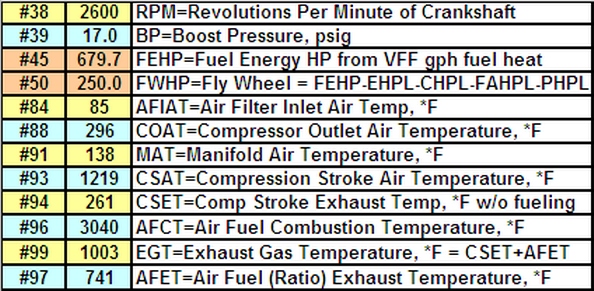
As can be seen in the above table air enters the compressor at a 85*F AFIAT=Air Filter Inlet Air Temperature and exits the compressor at a 296*F COAT=Compressor Outlet Air Temperature and that means a considerable amount of heat energy was added to the incoming airflow and the time rate of heat energy addition that's needed to increase the temperature of the airflow from 85*F to 296*F determines the CSHP=Compressor Shaft HP required to power the compressor so it can produce a BP=17 psig in the intake manifold.
After exiting the IC the airflow enters the engine at a MAT=138*F and at TDC of the compression stroke the air has been heated to a 1219*F CSAT=Compression Stroke Air Temperature and if no fuel is injected then the power stroke consists of just the "air-spring rebound effect" of the compressed air and at BDC of this "no fuel" power stroke the air cools to a 261*F CSET=Compression Stroke Exhaust Temperature w/o fueling and the exhaust stroke then delivers this 261*F airflow to the exhaust manifold.
The temperature increase from MAT=138*F to CSAT=1219*F determines the CSHPA=Compression Stroke HP Absorbed from the crankshaft to compress the airflow and the temperature decrease from CSAT=1219*F to CSET=261*F determines the CSHPR=Compression Stroke HP Returned to the crankshaft and the temperature difference (CSET-MAT)=(261*F-138*F)=123*F determines the CSHPL=Compression Stroke HP Loss=CSHPA-CSHPR.
If 250 FWHP worth of fuel is injected at TDC of the compression stroke where the air is at CSAT=1219*F then the air rapidly heats up an additional amount and some of the combustion heat is lost to the coolant and the difference between the 3040*F AFCT=Air Fuel Combustion Temperature and the 1003*F EGT=Exhaust Gas Temperature determines the total PSHP=Power Stroke HP which is equal to the amount of fuel energy that's converted to PSHP plus the amount of "air-spring rebound effect" energy in the compressed air that's returned to the crankshaft during the power stroke.
The temperature difference (EGT-CSET)=(1003*F-261*F)=741*F (rounding error) gives the 741*F AFET=Air Fuel (Ratio) Exhaust Temperature which is the contribution to EGT that's due to combusting the fuel at a given AFR and accounting for heat loss to the coolant and extracting the PSHP! So the EGT can be thought of as consisting of residual heat from air compression plus residual heat from fuel combustion or in equation form... EGT=CSET+AFET *F.
The EGT equation that relates the PTGT=Post Turbine Gas Temperature *F to the EGT=Exhaust Gas Temperature *F pre-turbine... EGT=PTGT+{(TSHP)(33,000)}/{(TMGF)(HCG)} *F ...can also be written as...
TSHP={(EGT-PTGT)(TMGF)(HCG)}/(33,000) hp
...and this form of the EGT equation makes it clear that the temperature difference (EGT-PTGT) determines the TSHP that powers the compressor so it can produce the BP=17 psig in the intake manifold.

Hotshot
Joined: Jun 2007
Posts: 10,008
Likes: 7
From: Austin, TX
My buddy Cody and I did this test in his truck to answer this very question a good while back. I can't find the pics right now, but they are on this site somewhere. We hooked up a pyro pre turbo in the manifold and another in the downpipe and put both guages right beside each other and went for a drive. Temp differences ranged from 100*-600* differences IIRC. I would put the guage in the manifold after seeing that b/c really there is no good way to know exactly what temp your really seeing @ the downpipe. The differences ranged so much that i could never trust it. I'm still trying to find the pics i took of the guages while driving
EDIT: see this thread for the EGT pics of pre vs post turbo.. https://www.ford-trucks.com/forums/7...s-for-tim.html
EDIT: see this thread for the EGT pics of pre vs post turbo.. https://www.ford-trucks.com/forums/7...s-for-tim.html

Thread
Thread Starter
Forum
Replies
Last Post
tractoman
1994.5 - 1997 7.3L Power Stroke Diesel
3
Aug 27, 2015 12:28 PM
Groundpounder0331
1994.5 - 1997 7.3L Power Stroke Diesel
7
May 15, 2009 02:47 PM
