



Auto choke linkage issue

Thread Starter
|
New User
Joined: Nov 2009
Posts: 5
Likes: 0
Auto choke linkage issue
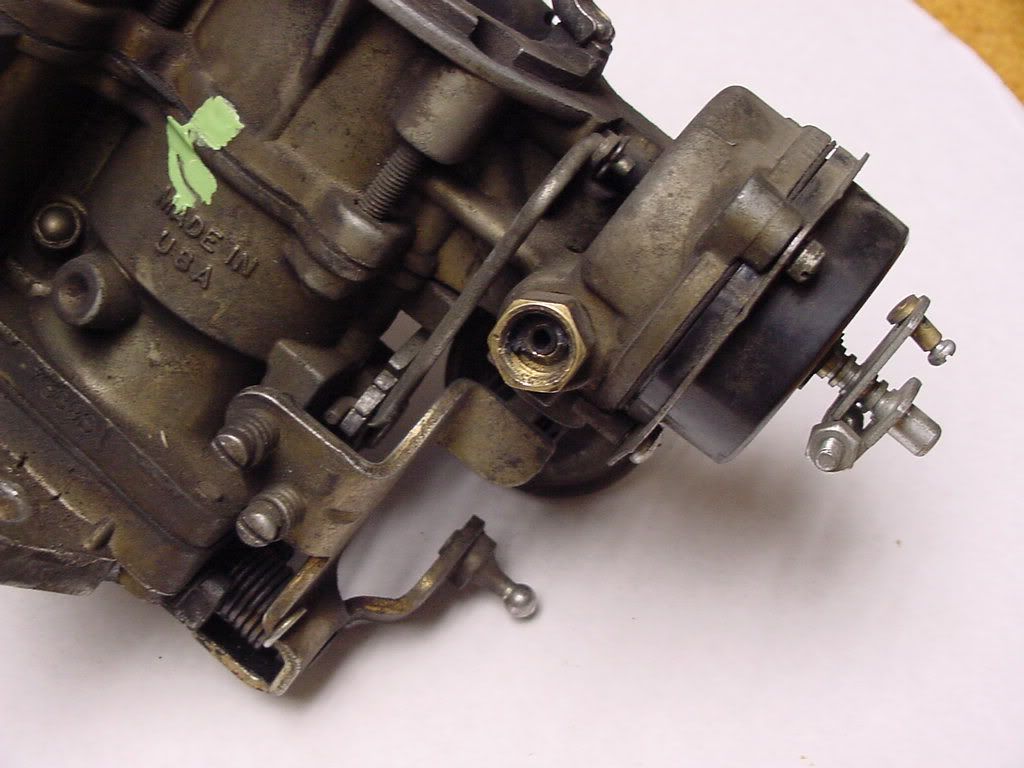
Hope someone has the answer, I have a Haynes manual and it does not show a Carter single barell carb linkage setup. I have searched online and cant find it anywhere. Does anyone have a diagram or link or point me to a manual that has one.
The sticker from engine compartment is gone and need to re-do all the vacuum lines. Thanks in advance....
The sticker from engine compartment is gone and need to re-do all the vacuum lines. Thanks in advance....
Moderator


Joined: Dec 2007
Posts: 7,987
Likes: 104
From: Boise, Idaho

Are you looking for how to hook up the linkage? Or for a vacuum diagram of the engine compartment, or both?
What year vehicle is it? That'll change a lot about how the vacuum lines are hooked up they get more and more complicated as the years go on.
As for the choke linkage, what is it that's wrong with it? Can you take a picture of how it's currently set up? There should just be an arm that comes down from the choke and goes into a slot. If it's not hooked up, you'll need to pull the carb in half (can be done on the vehicle) to get the arm back into the slot. It's set up this way so that it doesn't come undone during normal driving.
What year vehicle is it? That'll change a lot about how the vacuum lines are hooked up they get more and more complicated as the years go on.
As for the choke linkage, what is it that's wrong with it? Can you take a picture of how it's currently set up? There should just be an arm that comes down from the choke and goes into a slot. If it's not hooked up, you'll need to pull the carb in half (can be done on the vehicle) to get the arm back into the slot. It's set up this way so that it doesn't come undone during normal driving.
Moderator
Joined: Dec 2007
Posts: 7,987
Likes: 104
From: Boise, Idaho
Are you looking for how to hook up the linkage? Or for a vacuum diagram of the engine compartment, or both?
What year vehicle is it? That'll change a lot about how the vacuum lines are hooked up as they get more and more complicated as the years go on.
As for the choke linkage, what is it that's wrong with it? Can you take a picture of how it's currently set up? There should just be an arm that comes down from the choke and goes into a slot. If it's not hooked up, you'll need to pull the carb in half (can be done on the vehicle) to get the arm back into the slot. It's set up this way so that it doesn't come undone during normal driving.
What year vehicle is it? That'll change a lot about how the vacuum lines are hooked up as they get more and more complicated as the years go on.
As for the choke linkage, what is it that's wrong with it? Can you take a picture of how it's currently set up? There should just be an arm that comes down from the choke and goes into a slot. If it's not hooked up, you'll need to pull the carb in half (can be done on the vehicle) to get the arm back into the slot. It's set up this way so that it doesn't come undone during normal driving.
Thread Starter
|
New User
Joined: Nov 2009
Posts: 5
Likes: 0
More info
Sorry for not providing enough info. It is a 1983 Ford Bronco, 4.9 litre with what I think is the Carter single barrel carb. On start up the butterfly valve does not move at all, even through the entire accelerator pedal movement the valve does not move and therefore doesnt start without manually closing it. Once the engine in warm, it starts just fine. It seems as if there should be some type of linkage either through spring return or other to close the butterfly valve when cold (choke?).
Manual does not do anything for me and have never added a picture, will take a couple today and try to post.
Also looking for vacuum line diagram as the one from engine compartment is gone.
Manual does not do anything for me and have never added a picture, will take a couple today and try to post.
Also looking for vacuum line diagram as the one from engine compartment is gone.
Last edited by GBronco; Nov 10, 2009 at 12:10 PM. Reason: more info
Moderator
Joined: Dec 2007
Posts: 7,987
Likes: 104
From: Boise, Idaho
If it's all stock, it's the Carter YF one barrel.
When you're talking about the butterfly valve, are you talking about the one right underneath the aircleaner on top? (That's the choke valve).
When working right, it should close on it's own when it's cold and open straight up and down when it's warm. If I understand you right, you're saying that it's fully open when warm, but doesn't close when it cools down? Unless you manually flip it closed?
If that's the case, it's either one of two things (that I can think of). The first is that the spring inside the choke has broken. To find out, remove the three little screws that hold the retaining ring from around the choke housing (big black plastic). Should be able to easily see them in the top left corner in this picture.
http://i.ehow.com/images/GlobalPhoto...-main_Full.jpg
Inspect the spring inside and see if it's broken. If it is, you'll need to replace the entire housing. They're usually around $20 - $50 depending on where you find them.
If the spring is alright, then inspect the linkage on the back of the carb. There should be a thin metal arm (again, visible to the far left in the picture. The thin arm that goes from the choke, down to the throttle plate) is disconnected or something. That arm pulls the choke open and closed under different circumstances. Could just be that it's not hooked up and not pulling your choke plate closed once the engine is cooled off. It'll definitely have a tough time starting cold with it fully open.
When you're talking about the butterfly valve, are you talking about the one right underneath the aircleaner on top? (That's the choke valve).
When working right, it should close on it's own when it's cold and open straight up and down when it's warm. If I understand you right, you're saying that it's fully open when warm, but doesn't close when it cools down? Unless you manually flip it closed?
If that's the case, it's either one of two things (that I can think of). The first is that the spring inside the choke has broken. To find out, remove the three little screws that hold the retaining ring from around the choke housing (big black plastic). Should be able to easily see them in the top left corner in this picture.
http://i.ehow.com/images/GlobalPhoto...-main_Full.jpg
Inspect the spring inside and see if it's broken. If it is, you'll need to replace the entire housing. They're usually around $20 - $50 depending on where you find them.
If the spring is alright, then inspect the linkage on the back of the carb. There should be a thin metal arm (again, visible to the far left in the picture. The thin arm that goes from the choke, down to the throttle plate) is disconnected or something. That arm pulls the choke open and closed under different circumstances. Could just be that it's not hooked up and not pulling your choke plate closed once the engine is cooled off. It'll definitely have a tough time starting cold with it fully open.
Cargo Master


Joined: Mar 2008
Posts: 2,589
Likes: 212
From: Washington
I have been looking for a while for a carb to replace my feedback carb but most of the stuff I see at the junk yard is pretty sad looking, this one might work out as I can still use some parts off another old feedback carb I have in the basement. I would like to keep the auto choke so I will just change the cap/spring.
I have been trying to find a carb with the hot air intake for the choke on the passenger side like I currently have, but everyone I have seen has it on the driver side. I think this might have been a change when the carb switched to a feedback type. I might have to patch something up using parts from both types to get hot air to the choke or just see if it will work with the electric only.
I just failed the emission test last week, it was to rich. The truck did pass the last 2 emissions test with my feedback carb but it was at the max limit. I have now hooked up a push button switch to energize the feedback solenoid. I will use this to adjust (lean out) the mixture based on the voltage output of the O2 sensor to hopefully pass the emission test. If it works I can put off the carb work till it gets warmer outside. It is hard to keep the O2 sensor around .5 volts with the push button switch, it normal has been .7-.8 range with normal around town driving and my gas mileage has still been 15-17 mpg.
The O2 sensor seem to go out of range as the truck speed goes above 55-60 range and then the O2 sensor drops to 0 volts. I have even tried a different sensor, but it still slowly climbs up .7 .8 then .9 ,,, (at freeway speeds) the highest I see is about .95 then it just drops to zero until I let my foot of the gas. I would have expected the voltage to just stay at .9-1.0 volt range. I have been wondering if it going very rich at high speeds due to lifting the metering rod pin out of the main jet. Lifting the metering rod pin it directly connected to throttle position. A very rich mixture would cool the exhaust and the O2 sensor. I have not done any freeway testing with my push button switch and the voltmeter, I will need a co-pilot to work the switch and read the meter if I am going to stay in my own lane on the freeway.
The readouts from the O2 sensor really are an eye opening experience as the truck runs great as is.
Jim
I have been trying to find a carb with the hot air intake for the choke on the passenger side like I currently have, but everyone I have seen has it on the driver side. I think this might have been a change when the carb switched to a feedback type. I might have to patch something up using parts from both types to get hot air to the choke or just see if it will work with the electric only.
I just failed the emission test last week, it was to rich. The truck did pass the last 2 emissions test with my feedback carb but it was at the max limit. I have now hooked up a push button switch to energize the feedback solenoid. I will use this to adjust (lean out) the mixture based on the voltage output of the O2 sensor to hopefully pass the emission test. If it works I can put off the carb work till it gets warmer outside. It is hard to keep the O2 sensor around .5 volts with the push button switch, it normal has been .7-.8 range with normal around town driving and my gas mileage has still been 15-17 mpg.
The O2 sensor seem to go out of range as the truck speed goes above 55-60 range and then the O2 sensor drops to 0 volts. I have even tried a different sensor, but it still slowly climbs up .7 .8 then .9 ,,, (at freeway speeds) the highest I see is about .95 then it just drops to zero until I let my foot of the gas. I would have expected the voltage to just stay at .9-1.0 volt range. I have been wondering if it going very rich at high speeds due to lifting the metering rod pin out of the main jet. Lifting the metering rod pin it directly connected to throttle position. A very rich mixture would cool the exhaust and the O2 sensor. I have not done any freeway testing with my push button switch and the voltmeter, I will need a co-pilot to work the switch and read the meter if I am going to stay in my own lane on the freeway.
The readouts from the O2 sensor really are an eye opening experience as the truck runs great as is.
Jim
Trending Topics
Moderator
Joined: Dec 2007
Posts: 7,987
Likes: 104
From: Boise, Idaho
I hear you on that. I have an O2 sensor hooked up to my '81 and it's amazing how much information it gives you on how your carburetor is tuned and running.
The .7 - .9 is definitely on the rich side, and I'm guessing that when it goes to 0, it's the voltmeter's failsafe number because the signal from the O2 sensor went out of it's readable range. Probably about as rich as you can get at that point. =P And most likely why it failed the emissions test.
If you're curious, another type of O2 sensor you can get is a wideband. They're a little more expensive (about $50 - $70), but you can actually see your exact air/fuel mixture with them. They read from 0 to 5 volts and you just take the voltage * 2 and add 10 and you'll know your mixture. So, 2.35 volts is perfect (2.35 * 2 + 10 = 14.7 a/f) I'm thinking of trying to find one.
The .7 - .9 is definitely on the rich side, and I'm guessing that when it goes to 0, it's the voltmeter's failsafe number because the signal from the O2 sensor went out of it's readable range. Probably about as rich as you can get at that point. =P And most likely why it failed the emissions test.
If you're curious, another type of O2 sensor you can get is a wideband. They're a little more expensive (about $50 - $70), but you can actually see your exact air/fuel mixture with them. They read from 0 to 5 volts and you just take the voltage * 2 and add 10 and you'll know your mixture. So, 2.35 volts is perfect (2.35 * 2 + 10 = 14.7 a/f) I'm thinking of trying to find one.
FTE Stories
Ford Trucks for Ford Truck Enthusiasts

Top 6 Best Deals Available on New Fords & Lincolns Right Now
Brett Foote
This Hennessey Takes the Expedition Tremor's Off-Roading Capability to the Next Level
Verdad Gallardo
Top 10 Fords at 2026 Carlisle Ford Nationals
Joe Kucinski
3 Best / 3 Worst Parts of Modern Ford Ownership
Brett Foote
10 Amazing Upgrades That Solve Common Ford Truck Owner Headaches
Pouria Savadkouei
Every 2026 Ford Engine Explained
Brett Foote
10 Ugly Ford Trucks That We Still Kinda Love
Joe Kucinski
10 Things Every Truck Owner NEEDS (2026 Edition)
Michael S. Palmer
Rezvani's Latest Post-Apocalyptic Monster Is a Ford F-150 Raptor Underneath
Verdad Gallardo
Cargo Master
Joined: Mar 2008
Posts: 2,589
Likes: 212
From: Washington
Oxygen Sensors, Types of
Be sure to read the links at the bottom of the page. Might be hard to read the sensor output as the current changes direction as it goes rich/lean.
I had 2 high dollar Fluke meters reading the output of the O2 sensor at the same time, both meters where set to auto range, I think the first scale range was 0-3 VDC. As soon as you let your foot of the gas they had a reading again. Both O2 sensors did the same thing… I gave up trying to figure it out as it was a moot point seeing how I know it was running to rich anyway.
Jim
Be sure to read the links at the bottom of the page. Might be hard to read the sensor output as the current changes direction as it goes rich/lean.
I had 2 high dollar Fluke meters reading the output of the O2 sensor at the same time, both meters where set to auto range, I think the first scale range was 0-3 VDC. As soon as you let your foot of the gas they had a reading again. Both O2 sensors did the same thing… I gave up trying to figure it out as it was a moot point seeing how I know it was running to rich anyway.
Jim
Moderator
Joined: Dec 2007
Posts: 7,987
Likes: 104
From: Boise, Idaho
I usually have mine set at 2000m, it seems to work very well. There's no decimal places, and the reading ranges from 0 to 2000, so if it goes over 1 volt, there's still a signal. That, and the numbers are like 015, 400, 850, etc. Easy to read, I like it.
Makes sense on the wideband. If that's the case, I'll probably forgo that idea. Good reading, since I almost just bought one. Looks like they need an EFIE for it to translate the voltages into something readable, and they look kinda expensive.
Makes sense on the wideband. If that's the case, I'll probably forgo that idea. Good reading, since I almost just bought one. Looks like they need an EFIE for it to translate the voltages into something readable, and they look kinda expensive.

Thread
Thread Starter
Forum
Replies
Last Post
51f1truck
1948 - 1956 F1, F100 & Larger F-Series Trucks
11
Nov 9, 2020 08:47 AM
chaseon
1961 - 1966 F-100 & Larger F-Series Trucks
12
Dec 14, 2013 04:14 PM
chaseon
1973 - 1979 F-100 & Larger F-Series Trucks
4
Dec 11, 2013 08:25 PM
