When you click on links to various merchants on this site and make a purchase, this can result in this site earning a commission. Affiliate programs and affiliations include, but are not limited to, the eBay Partner Network.
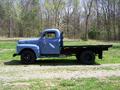
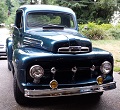
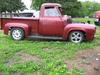
As I try to put my 49 F6 back on the road, I am letting go of the ideation I've been holding onto for a while of dropping in an electric motor/battery system... but thought I'd check around and see if anyone else has thought through any of this?
I expect my 2011 Chevy Volt (on it's 2nd traction battery) with 200,000 miles to eventually deserve replacement and have considered that the EV parts (including the spare, though lame battery) might bolt in nicely in place of the non-stock V8 in my F6... It wouldn't have much range (the Volt only has about 30 miles EV range and is lighter, smoother roller) or much speed, but for the on-property uses I put it to, it would be fine I think. There is *plenty* of room under the hood for the motor and electronics and the 500lb 16kWh traction battery wouldn't even deflect the springs!
Seems like a good solution for any classic vehicle only used for parades and low-speed/range cruising?
The larger trucks have been converted to EV. Several years back, a local guy put a motor in a mid 50s F5 or F6, I don't remember which. He used old EV technology with a bed full of lead-acid batteries. He had the motor in front of the stock four speed transmission. He had a post about it on this forum. I'll see if I can find it. I don't think he had much range.
If your volt, which was designed to have the electric motor and battery combination gets 30 miles I'd bet you might get five miles, at most, since your F-6 has to weight at least 5-6 times more. I don't see any advantage, only problems and disappointment. Unless you're made of money and have a lot to through at this project I don't see any advantage at all.
Ray -
Thanks for the reference, I hope the project *does* show up. I'd find it interestng to see how it worked out for someone with more 'round 'tuits than I apparently have.
Hotshot -
I don't disagree with either point... the range will be significantly reduced with the higher rolling friction (and to a lesser extent weight) for sure. The only reason I'd do such a thing myself would be *because* I had the time/energy and sometimes money to keep fiddling with it. The beauty of these old trucks for such a converstoin is that they can carry the extra weight with no problem and there is plenty of room to fit the gear under the hood, weld/bolt in mounts, etc. And the expectations on this type of vehicle (especially if used *only* for the simplest of utility work on-property or a 1 mile run in a parade) are much more reasonable than for a daily driver.
I've got a *lot* of use out of this old beast already, with minimal expense/effort. I should have put in the effort when she sprung the fuel leak to get her back on the road (she deserved a full fuel-pump-through-carb upgrade) and kept her going by using her. Now she is going to need more than a minimal amount of work to get back to roadworthy. The advice I already got here on other threads is a great start, even if I just pass it on to a new potential owner.
I think electrics will find a place at some point. I think they will be perfect for the soccer Mom type driving kids back and forth to school. Since children now seem incapable of walking anywhere. Enough rant. I've wondered about using a small vehicle electric motor attached to the rear axle just for making it easier to move projects around. Then I think naw, hook it up to the garden tractor and get the wife to help. If you do the volt conversion let us know how it works out.
Agree with Bob Jones. Those electric vehicles are designed start to finish to be electric vehicles. So different than Old Henry where the engine was not really related to the brakes for example. Electrocuting old iron is going to be almost as much a frontier effort as Brother Elon proving electric cars to be viable. First practical electric car was 1870's. I'm sure someone will come up with some conversion as a start, and then more sophistication later. First efforts are likely to be less than parade worthy, I would guess.
Last edited by electricmaniac; Oct 17, 2022 at 12:58 AM.
Reason: picture garlbled
Saw this one in 2009 at one of the Port calls in Alaska. Was on display at the Potlatch Totem Pole Park. With the limited battery capacity, I'm sure it didn't go far but it seems pretty clean install. Not for me, but.....
Is this going to be an engineering experiment or does your gas engine really use that much around the farm? My 52 f1 6 cyl was a farm truck only with a trip to town once in a while and has original 82k on it now.The farmer had used it mainly for small hay hauling.
That one shouldn't have to much problem in Ketchikan I thing the road is only 22 miles long on that island. Been a few year since I was there, but electric vehicles would work great there since you can't go far.
Jeep has recently started a new ad campaign for their electric vehicles. One or two scenes show people inserting and pulling out charging plug but most of the time they are showing Jeep vehicles going up and down mountains and over rugged terrain in very isolated areas. They don't make a connection between there new electric vehicles and the activities they are showing their vehicles partaking in. Kind of false advertising if I were asked for my opinion. No way I'd take an electric vehicle of any type up into the isolated mountains, over rugged terrain. Well, not unless I had two extra completely charged battery packs strapped to the top of the vehicle and then again, added weight to drain the batteries faster.
If you are really serious about doing a conversion the technology band kits are already out there.
Ford is selling their Mach E electric motor as a crate motor for $3,900. Batteries and other stuff extra but supposedly about $10k all in which is less than a high performance gas crate motor these days.