When you click on links to various merchants on this site and make a purchase, this can result in this site earning a commission. Affiliate programs and affiliations include, but are not limited to, the eBay Partner Network.
Thanks for all the help you guys! I just got off the phone with Clay and he said it’s nothing more than a part number that supersedes the old one. Does that mean it’s now Chinese instead of other I don’t know for sure but I’m going to run them and not look back. He said they switched over to the A earlier this year so most places have been just depleting their old stock if you did get one that’s a FL-1995 recently. Good to know
Fwiw the oring is different but it’s the same now as most aftermarket filters (flat vs. beveled) which should be a non issue I think.
Again thanks for the help everyone. I wanted to make sure I didn’t get the wrong one on there
The new-label FL-1995-A does not fit in my 01 7.3. I can't get it onto the stud, apparently due to a clearance issue with the oil pan. I tried two of em from 2 different stores before giving up and hunting all over for a FL-1995
I see 2 obvious differences between the 1995-As that are currently available and the FL-1995, which is suddenly hard to find.
The new FL-1995-A is slightly longer ... maybe 3/8". This is what's causing my clearance issue.
The new FL-1995-A has a different gasket. It's totally flat on top (like most other oil filters), whereas the 1995 gasket is usually oriented so there's an angled ridge on top.
I'd love to hear if anyone else is having problems with the new-label 1995-A in their application. I know some have reported no issues with interchangeability.
I installed the FL 1995-A on my '01 with no issues.
So far I'm not hearing of anyone having the same problem I'm having.
I'm wondering if previous owner put in a different oil pan on mine or something? My problem is the extra 1/4" in length on the 1995A makes it just a tiny bit too long to get it onto the stud, because the bottom is hitting the oil pan and just the wrong place. I would need to take a hammer to the pan, lol.
I'm curious, did your filter even touch the oil pan as you threaded it on there?
How about some pics to show your pan, and to illustrate the interference point between filter and pan, and to demonstrate the length difference you are reporting between the FL-1995 and the FL-1995A, with the filters compared side by side to each other?
All the evidence I can present easily follows. They are not even close to the same. In my case, I have no choice but to switch due to my fitment problem.
Even if they did fit, I'd be looking for a new brand. Evidence suggests (obviously doesn't prove) there's been a change in manufacturing process. I have zero reason to expect that change was for the consumer's benefit.
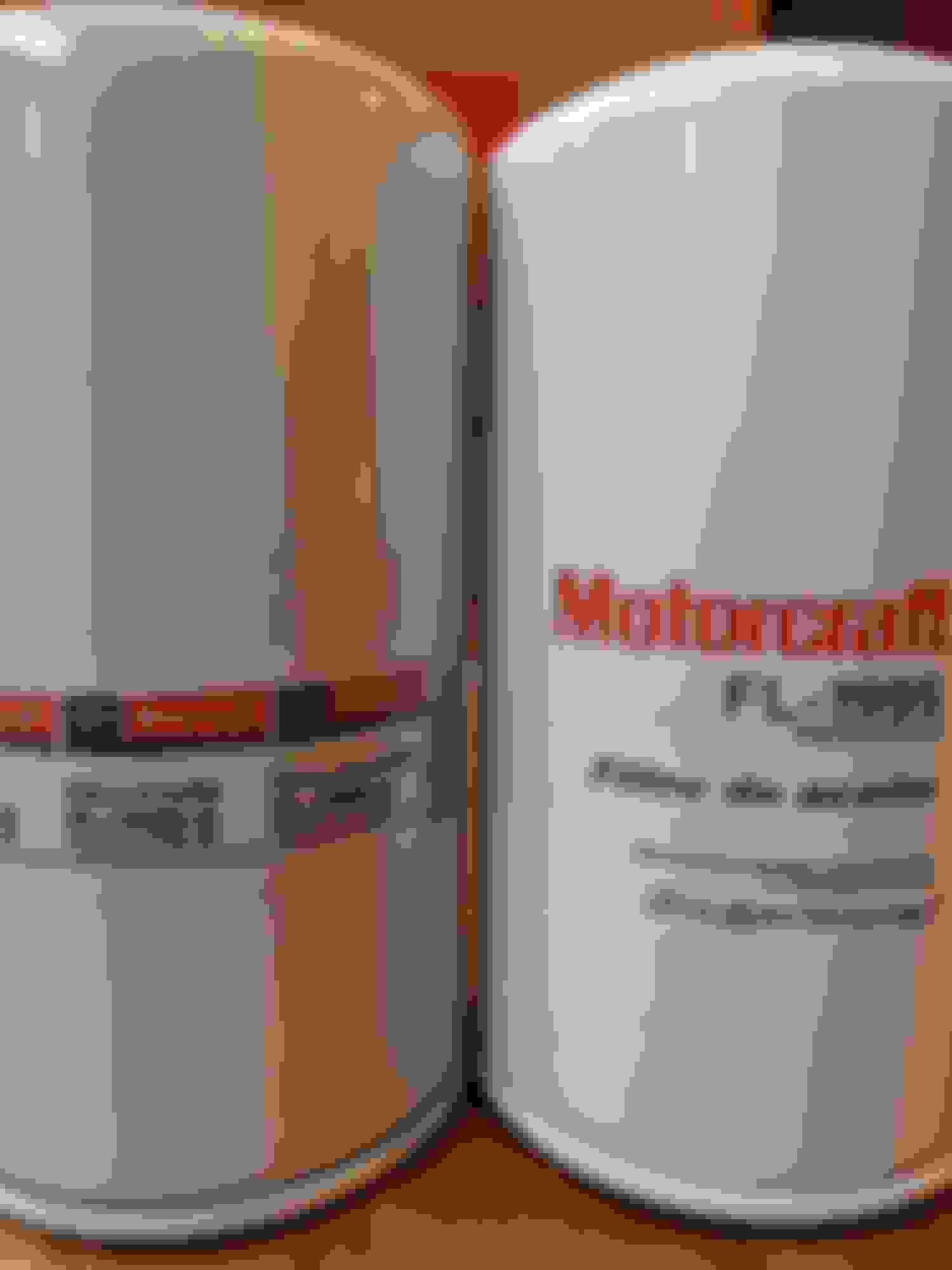
Dome shape is totally different. Way more clearance at the edge of the FL-1995. See how different the domes are? (FL-1995 on right) Stand them up this way, and they're not really that close in terms of length. Not to mention, totally different gasket. Anyone else wonder if there was a REASON the old 1995 gaskets were the way they were?
@Bad Angus , well done on documenting the filter differences. We have seen the Donaldson blue oil filter rub the oil pan before. I believe it was @Brandonpdx that experienced this issue and provided pictures.
Some have no clearance problems at all, but some apparently do.
I have been using K&N white oil filters with the 1" nut on the end of them. I use this style on all 4 of my vehicles as I like consistency and uniformity. They are pricey, but I wait for sales/deals at the part store or Amazon and buy a few at a time for a hood price.
Just putting that out there as an alternative for your consideration going forward.
Thank you so much for posting the photos of the two oil filters side by side.
The details you highlighted, such as the differences between bevel cut and square cut gaskets, are interesting.
Can you now let us have a look at your oil pan?
What year is your 7.3L? What vehicle is it in? (Truck, van, etc)
Some members have been able to successfully fit significantly longer Donaldson oil filters (more than 3" longer, not just 3/8" longer) on 1999-2003 7.3L engines in Super Duty pickups...
...filters so long in fact that they later found the bottoms of these filters to be dented by the anti sway bar behind their front axle....
So while the length difference that you have now illustrated is readily apparent, there remains this puzzle about how such a slight difference can have an affect on your installation, while having no effect on several other members who have reported their experience recently in this thread.
I can't get under the truck for a while (it's my comp BBQ trailer puller, and it lives in a hanger 60 miles away all winter), but your pix explain pretty well why the length doesn't matter to most folks.
I'm third owner of my 2001 7.3, XLT, Extended Cab. So I can't say what all happened to it before me. I was told it has an "ambulance package engine setup," for whatever that's worth.
On mine, the oil filter housing MUST be more angled than is typical. And unfortunately it's angled right toward the oil pan. Even with the FL-1995, there's just BARELY enough room to get it onto the stud.
Now my question is, why the heck would that be? Something to do with an ambulance package?
The ambulance package has zero effect on oil pan, oil filter head, or oil cooler that connects to it.
The ambulance package does give you two alternators, instead of one, so if you ever run out of propane or brickets during a BBQ competition, you can cook with an inverter.
Let's get back to your assertion that the FL1995-A looks like a POS to you, based on your visual assessment of the guts, when compared side by side with the FL-1995.
I really appreciate your taking the time to take those photos, because I know how much time and effort it takes. In fact, your doing so inspired me to do the same, comparing 4 genres of FL-1995 filters, without the "A" appended. Considering how long it took me to do that this afternoon, I once again appreciate when anyone takes the time to post photos, to help everyone interested gain more perspective.
The various samples of FL-1995 filters I have do differ from each other, in graphics on the packaging, in printing on the can, and in the interior screen and top plate, both of which were changed, without a change in part number.
The filters are all labeled FL-1995, except for the Purolator. Premium Plus L44872.
"Purolator invented The Oil Filter. In 1923, Ernest Sweetland and George H. Greenhalgh patented the first automotive oil filtration system. They called their invention "Purolator", short for the words "pure oil later", and they began a story of quality and innovation that continues to this day."
Purolator was also the OEM supplier that manufactured the Motorcraft FL-1995 filter for Ford when these trucks and engines were new. I do not know who manufactures the Motorcraft oil filters for this application today.
All of the Motorcraft filters below were purchased in person, at a Ford dealer, so it seems reasonable to assume that none of the Motorcraft filters below are "fakes", despite the vast differences in packaging, which is simply explained by the number of years I've stored the filters. The Purolator filter was purchased at a Sears Roebuck Automotive Center about 20 years ago, back when Sears was Sears. I have never purchased an oil filter from eBay, nor Amazon. Some of these filters were bought before Amazon sold anything other than books.
A sample of each genre that I have on hand is presented below:
I don't have an actual filter for the earliest Motorcraft box shown above, which is the white top version, adjacent to the Purolator. So that leaves us with four actual filters to compare.:
All of the filters shown were Made In USA, and except for the Purolator PremiumPLUS L44872, which is identical to the earliest FL-1995, all filters are FL-1995, without an A appended.
Differences in the mounting plate hump and number of perimeter entry holes can be seen between the two earlier filters on the left, and the two later filters on the right.
The filters above are arranged in date order, with the most recent filter on the right, which is the latest and last FL-1995 produced before the switch to FL-1995-A, which I have none of.
Below, listed in the same sequential order, from Purolator first, working across to last FL-1995, are photos of the interior screen.
I do not know enough about oil filter construction or internal flow dynamics to make a judgment about which filter is built better, or which filter is a POS, based on these photos. Nor can I make a determination having the benefit of holding each filter in my hands, side by side.
All of the filters shown in this post do have a bevel cut gasket. I think I have a couple of dozen FL-1995 filters in stock, and all of them have the bevel cut gasket. I found the change of gasket profile to be the most interesting observable difference.
Perhaps the most concerning difference would be the micron rating of the filter media itself. We can't see the pleats too well through the various hole patterns that Motorcraft filters have used over the years, but even if we could count the number of pleats, we cannot "see" the micron rating of the media, or "see" the thermal stability of the media, or the permeability, or any other quality that might make one filter "better" than another.
The original FL-1995 was famous for having a very high quality media... which made the relatively low price for the filter all the more the puzzle. But given the ridiculously frequent (by today's standards) oil change intervals recommended by Ford (every 3,000 miles), and given the high volume of engines made (well over 2 million) and how long they remained burning fuel (half a million miles), the sheer volume of manufacturing FL-1995 filters likely played a part in how affordable they were, compared to filters of the same size and quantity of materials for other engines.
It would certainly be interesting to learn whether or not the FL-1995-A is a cheaper made version of the FL-1995, but this post is intended to demonstrate that the construction of the FL-1995 has changed in the past, despite the name not changing.
Man, I'm so glad I landed here. Good people and great info.
If I had posted this on Facebook ... there'd be 500 responses about how I shoulda bought a {whatever other truck} instead.
Really cool to see the generations. Interesting notes about the new one:
- Why a part number change, now?
- What's up with the rubber thing in the bottom? None of the prior gens had that it seems.
This Hennessey Takes the Expedition Tremor's Off-Roading Capability to the Next Level
Slideshow: The VelociRaptor Expedition gains a lift, upgraded suspension, Brembo brakes, and trail-ready equipment while retaining the stock 440-horsepower EcoBoost V6.