When you click on links to various merchants on this site and make a purchase, this can result in this site earning a commission. Affiliate programs and affiliations include, but are not limited to, the eBay Partner Network.
Close to max here, mostly for higher mpg, lower sidewall heat, and.....
If you inflate only for 2150# cause you only have 2125# per tire, verified by a CAT scale..... What do think happens to that poor tire when you get on some rolling roads that bounce your trailer up and down repetitively? Do you think it still sees 2125# per tire, or do you consider the physics of the downward momentum increasing the weight on the tires during the downward stroke? Watch your mirrors next time you get on a stretch like that to see that not only does your trailer's suspension not absorb all the bound and rebound keeping the tires rock steady and perfectly circular, but your tires sidewalls are flexing a lot as they look nearly flat at the bottom of a downward stroke and normal and round again at the top of the upward stroke
At least that was my experience when the load range C tires were on our last 5th wheel back when we got it, and according to all the numbers the tires were within 20#s of their max weight at max psi on that trailer. Upgrading to D range tires made a huge difference in ride quality just by going up another 10psi that the D tires would easily handle compared to max on the C load range. The D tires with 10 more psi did not squish down on the downward strokes anything like the C range tires. Granted yeah there was an extra ply or 2 in different tire construction, but the higher psi handled the extra weight seen on them on downward bounces.
Just like your knees are fine walking down the stairs, but if you should jump down the last 3 steps over the stairs to the bottom you feel a lot more weight on your knees even though you weigh the same
I’d like to think the tire’s weight rating includes peaks for dynamic loading.
On a truck, we want to avoid higher than needed load rating because it changes ride quality. This is what has kept me from running 19.5 tires on my dually (plus, this wheel/tire combo is MUCH heavier).
This ride quality is basically irrelevant on trailers. I see no disadvantage in a stiffer sidewall and harder tread compound for trailers.
Forensic tire engineer Roger Marble used to recommend using the load and inflation tables and adding 10% for uneven loading but he recently changed his recommendation for trailers with more than 1 axle. For trailers with more than 1 axle he now recommends full sidewall pressure due to failures from interply shear which happens when turning with 2 and 3 axle trailers due to the sideways dragging of the trailing axles. For the vast majority of trailers tread wear is not a concern as they will generally age out long before they wear out.
I posted this same tire post over on an RV site I sometimes hang out at. Little did I know but this is the equivalent to “what oil should I run” here. Good discussions though!
I posted this same tire post over on an RV site I sometimes hang out at. Little did I know but this is the equivalent to “what oil should I run” here. Good discussions though!
I’m with Wes and SSJ. Typically run max on the trailer and base truck off of load. I do run a bit extra in the truck when towing beyond what would be best for wear because it handles the trailer better. Worth wearing a bit quicker in my opinion.
My trailer tires age out... but don’t usually get changed until 1 has an issue. 😳
I have had 2 blowouts. One was likely due to age and sun wear (in the evening sun) while the other may have been insufficient pressure. I prefer the extra pressure to reduce side wall temps. My new parking spot no longer has mid day or evening sun.
Oh and I run T6 5w-40 changed at 5000 mile intervals with a WIX filter.
I posted this same tire post over on an RV site I sometimes hang out at. Little did I know but this is the equivalent to “what oil should I run” here. Good discussions though!
I posted this same tire post over on an RV site I sometimes hang out at. Little did I know but this is the equivalent to “what oil should I run” here. Good discussions though!
People can be silly at times...
Based on some of the advice above and other publications, do what gives you the most peace. I will continue to run my tires at 70 PSI cold as it is easy for me to remember that because that is what I set the truck rear tires to.
As you mentioned on the phone, you do have the shock suspension kit, so that may come into play a bit when you are figuring out what is right for you.
Originally Posted by RacinJasonWV
I run T6 5w-40 changed at 5000 mile intervals with a WIX filter.
Wise ***... Come on now brah, don't you know TSC oil and SuperTech filters are the best...
If you have a complaint leave it at the front desk..
I was referring to the RV forum members and we know they can have some very strong opinionated members. Go ask about towing a small 5th wheel with an F-150 and they will loose their mind, unless it is a Scamp.
Also, I thought I did leave my complaint at the front desk. Short, direct and minimal words that fit on a 1.5 x 1.5 yellow sticky post it note that will likely be filed in the trash.
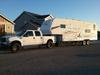
Built some shelving in the V nose and put of some poly on the decks to protect them and a slot for the table to sit, soon time to get the bikes ready for race season on the east coast. Looking forward to not be screaming at 4k rpm up hills like the Yukon has done for the last few years.
Has anybody ever experienced trailer tires like this? They were probably only 1 year old Carlisles. It was after our last camping trip of the year last year. I went to go dump the tanks the next day following our trip, and I looked down and noticed this. It was on at least two of the tires. Really shocked me. Tire store warrantied them and gave me 4 new Goodyear Endurance tires as replacements. They said it was probably just bad tires, but I was wondering if something else was causing it. I'm typically running 70-80 psi. I don't have any trips on the new Goodyear tires yet since they were replaced at the end of the trailer season last year. Just a little paranoid after this.
Has anybody ever experienced trailer tires like this? They were probably only 1 year old Carlisles. It was after our last camping trip of the year last year. I went to go dump the tanks the next day following our trip, and I looked down and noticed this. It was on at least two of the tires. Really shocked me. Tire store warrantied them and gave me 4 new Goodyear Endurance tires as replacements. They said it was probably just bad tires, but I was wondering if something else was causing it. I'm typically running 70-80 psi. I don't have any trips on the new Goodyear tires yet since they were replaced at the end of the trailer season last year. Just a little paranoid after this.
(most?) ST tires suck.
Inspect tires constantly to try and avoid catastrophic failures. Look for bubbles like this and for separation (bulging tread in center).
Never move after being parked without checking air pressure.
I keep IR thermometer in the door of truck and check all tires and brakes at literally every stop. It’s very fast and easy to spot an issue.
Jason is right, most ST tires are subpar and are about the profit margins more than quality or durability.
For the past few years, Sailun S637 and Goodyear Endurance have been the top two choices for quality before getting into commercial rated tires. Even then, Goodyear was manufacturing crap with the Marathon and G614 prior to the Endurance.
They took some time and went back to the drawing board before releasing the Endurance. I have put these on 2 out of my 3 RV trailers and have been very happy with them.
I want to say I remember Carlisle having a bad run of tires for a while a few years ago, but am not 100% on that. Also, I don't know when your pictures are from or what the date on your tires are.
That is not a common failure, but in the world if junk ST tires, it happens more than it should.
Has anybody ever experienced trailer tires like this? They were probably only 1 year old Carlisles.
Count me in as one who has experienced this tire bubbling on new Carlisle's. I had just put these on the boat trailer for a heavy '79 Searay SRV240. Within a week, the bubble/separation showed up. I just exchanged the one tire, and sold the boat soon after, so not sure how they performed.
I've had good luck with lighter duty Carlisle's on a 3500lb cargo trailer.
On the 30ft travel trailer, went from D to load range E Tow Master's. 2 years on them - so far so good. I had been running them at 65psi based on load tables, but from the info in this thread, need to consider going to max sidewall pressure (80psi).
I wasn't going to stick my nose in this conversation cause anytime I stick my toe into Sous's pond, I end up with an empty wallet. But I can't resist the subject.....31 ft Crossroads 5'vr, 11k at the Tires, and I had 2 out of 4 China Bombs Detonate, 1 on each side on Cabbage Hill, I 84 thru Oregon to Boise ID. Needless to say, it was a Come to Jesus Moment . I don't care what anyone says, I put G code Bridgestones all the way around and never looked back. I'm never gonna cheap out on my family's safety again. They weren't cheap, but Costco had them for around 300$ apiece. Those sidewalls might as well be stone. They don't move.....at all.
This Hennessey Takes the Expedition Tremor's Off-Roading Capability to the Next Level
Slideshow: The VelociRaptor Expedition gains a lift, upgraded suspension, Brembo brakes, and trail-ready equipment while retaining the stock 440-horsepower EcoBoost V6.
Rezvani's Latest Post-Apocalyptic Monster Is a Ford F-150 Raptor Underneath
Slideshow: Called the Fortress, the 850-horsepower pickup combines Raptor underpinnings with military-inspired features, survival equipment, and a starting price of $285,000.