When you click on links to various merchants on this site and make a purchase, this can result in this site earning a commission. Affiliate programs and affiliations include, but are not limited to, the eBay Partner Network.
Boost - otherwise known as the testostometer. This is likely the most famous and favorite PID for anybody with a right foot. However... before we can get all misty or teary about what the Boost PID reads, we must be sure the readings from the sensors are accurate. Manifold Absolute (more on that later) Pressure or MAP sensors are pretty reliable, but the MAP sensor has a black sheep cousin - the Exhaust Back Pressure (EBP) sensor. EBP sensors are way the hell over on the "not" side of the reliability meter. In case your curious, I'll explain the disparity:
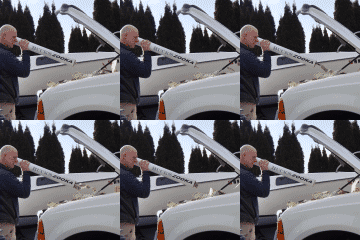
The EBP sensor is reading pressures with such high temperatures that Ford had to put the sensor on the end of a tube far from the exhaust manifold. With no flow through the tube, the crazy temperatures don't reach the sensor, but that doesn't keep the soot completely away. So... a day in the life of an EBP sensor is to wear a tube on your face and have a fire-breathing dragon belch into the other side of the tube. The MAP sensor gets turbocharged air after the intake filter and the intercooler - that may as well be a damsel blowing kisses. Which sensor are you going to focus on come maintenance time?
A little something about the MAP and EBP sensors - they read zero volts in a vacuum. You know... like in the garage at the International Space Station. Here on the surface of this third rock, we have air pressure - and the EBP and MAP sensors show this in a voltage. We in the US read this voltage as Pounds per Square Inch of pressure, so a truck parked at the beach in Miami will read about 14.7 PSI - where a truck parked at the Denver airport will show about 12 PSI on the MAP. This is called "absolute" pressure - meaning the pressure above a perfect vacuum (0 PSI). Commit that to memory, because absolute pressure is not interchangeable with "gauge" pressure. Gauge pressure is the way we think - pressure above zero to us. Absolute pressure is pressure above absolute zero (vacuum)... which is zero to a computer, a scientist, or somebody with an OCD trophy on the mantle.
Just to sprinkle this story with pixie dust, there is another sensor in the truck - the BARO (short for BAROmetric pressure) sensor. This BARO sensor isn't attached to any tubes, it just bathes in the atmosphere - allegedly reading the exact same absolute pressure as the MAP and EBP while parked with the Key On Engine Off (waay more on that later).
"You say we have 3 sensors that read my altitude? But Tugly... why should I care what altitude I'm at... in triplicate?" In one word - reference. Our engines will perform much differently at one mile up than they do at sea level, and the PCM needs to know how much air there is to dial the tune. Once the fuel has been applied, the MAP sensor needs to know how much you are boosting above barometric pressure, as does the EBP sensor with the exhaust side of the engine. If you are to get the pressure above atmosphere on both the intake exhaust sides of the engine, you'll need three sensors - one for reference (BARO) and the other two on the intake/exhaust.
I can hear it already - "But Tugly, I can see the Boost PID, but my OBDII gauge shows EBP in absolute pressure, not gauge pressure." Yeah... but the PCM has the BARO to work out the math and control the engine accordingly. While we have the option of reading Manifold Absolute Pressure (MAP) or Boost (intake pressure above barometric pressure) on a gauge, Ford didn't add the "exhaust boost" if you will. That doesn't mean the calculation isn't being made and used - it just means Ford in 1996 never envisioned people wanting to see that PID with $20 worth of hardware/apps in 2016. For those of us with apps with programmable PIDs (or virtual PIDs) like one can with Torque Pro, I can set an "Exhaust Boost" - or even a "Turbo Pressure Delta" (exhaust pressure minus the boost). That TPD shows the efficiency of the turbo, or makes for very interesting reading with engine braking or an Exhaust Back Pressure Valve warm-up on a cold truck.
Now... getting to the meat of this thread - the KOEO test one should perform when you first install your OBDII adapter and app: EBP, MAP, and BARO on the screen all at the same time. The OBDII adapter doesn't link to the app with the ignition key off on many versions of OBDII adapters, so it's usually a given the key will be on when you are reading OBDII gauges. The biggest and most common mistake many people make is turning that key to "Start" when trying to do a KOEO reading of the EBP, MAP, and BARO. Key On Engine Off - chisel that into the backside of your eyeballs alongside "absolute" pressure. Some apps show the BARO in volts, and some show it in pressure - so the conversion from volts to pressure is volts times 3.1957. If the BARO, MAP, and EBP sensors all say you are at the same altitude, you can likely trust your pressure readings. However... EBP sensors usually read high after 16 years of getting the ol' face treated like a dragon's puffer.
If the EBP sensor reads about 0.5 to 1.0 PSI higher than the MAP and BARO, then your finances dictate how **** you can afford to be. If the EBP sensor reads significantly higher, it's easier to justify the expense of a new sensor, because your fuel economy and/or power is likely not where you want it.
Here is an AutoEnginuity screenshot of a truck in Denver with KOEO, then KOER (Key On Engine Running):
Rezvani's Latest Post-Apocalyptic Monster Is a Ford F-150 Raptor Underneath
Slideshow: Called the Fortress, the 850-horsepower pickup combines Raptor underpinnings with military-inspired features, survival equipment, and a starting price of $285,000.