



question about grounds
Thread Starter
|
Junior User
Joined: Jan 2014
Posts: 62
Likes: 0
question about grounds
'78 F250
300
Sorry if this is in a "sticky", but I checked and didn't find it.
I am really, really new to auto mechanics. One thing I don't understand is "ground."
What I don't get is how to find one. If I have a wire that the instructions says is the ground wire, what am I attaching it to? Is it just any metal piece of my truck (that doesn't have paint on it)?
For example, I bought a circuit tester recently. I use the clamp that goes to ground on any thing metal (like instructions say). Is it that easy? What if I'm grounding a wire? How do I know where to ground a wire so that I don't burn up my truck?
Sorry if you're rolling your eyes...you guys seem to really know what you're doing. I don't. I bought this truck to learn.
Thanks!
Jon
300
Sorry if this is in a "sticky", but I checked and didn't find it.
I am really, really new to auto mechanics. One thing I don't understand is "ground."
What I don't get is how to find one. If I have a wire that the instructions says is the ground wire, what am I attaching it to? Is it just any metal piece of my truck (that doesn't have paint on it)?
For example, I bought a circuit tester recently. I use the clamp that goes to ground on any thing metal (like instructions say). Is it that easy? What if I'm grounding a wire? How do I know where to ground a wire so that I don't burn up my truck?
Sorry if you're rolling your eyes...you guys seem to really know what you're doing. I don't. I bought this truck to learn.
Thanks!
Jon

MSEE
Joined: Apr 2004
Posts: 10,386
Likes: 35
From: Austin, TX

No rolling of eyes at all. These are great questions. You're learning the right way.
All electrical loads essentially have two "terminals." One terminal to accept current from the source (battery in this case), and one to return current to the source. If both "terminals" had to be wired back to the battery, it would be a lot of wiring, considering all the bulbs and accessories throughout the truck.
Instead, the entire structural metal of the truck, from bumper to bumper, is the "return." The structural metal of the truck is electrically connected to the negative terminal of the battery, so we set a "rule" to say that all of the structural metal on the truck is this return terminal, called "ground." That's where the term "negative ground" comes from. Doing it this way cuts the amount of wiring required in half, because now only the power wires have to be connected. The structural metal acts as the other "wire" - one big one!
The negative terminal of the battery always connects to the engine block through a large cable - so we say that the engine block is the true master ground. Things like the frame, firewall, support brackets behind the dash, etc. ultimately make it back to this point. Typically, the engine block makes a connection to a paint-free point on the firewall through a ground strap, which is a thick, strong, braided length of wire. Now the cab is grounded, and all the electrical loads in the cab can have a return path to the battery by simply tying to some metal in the cab.
The frame itself is grounded by another ground strap to the firewall, and the bed grounds by bolting to the frame. As such, the ground points of all the rear lighting simply screw to the bed sheetmetal. Engine mounts and body bushings are not ground paths. As you mention, when finding a ground connection, it needs to be absent of paint. If you are wiring something up and you mean to connect it to ground, you want to verify that there is a proper electrical connection with a multimeter. However, from a safety perspective, assume any metal is grounded. This is important if you're installing something with an exposed power terminal near a bracket, etc. Don't assume something won't conduct because it has paint. This is why good workmanship is important when wiring a vehicle - proper use of grommets, securing runs of wire, preventing melted or pinched insulation, etc.
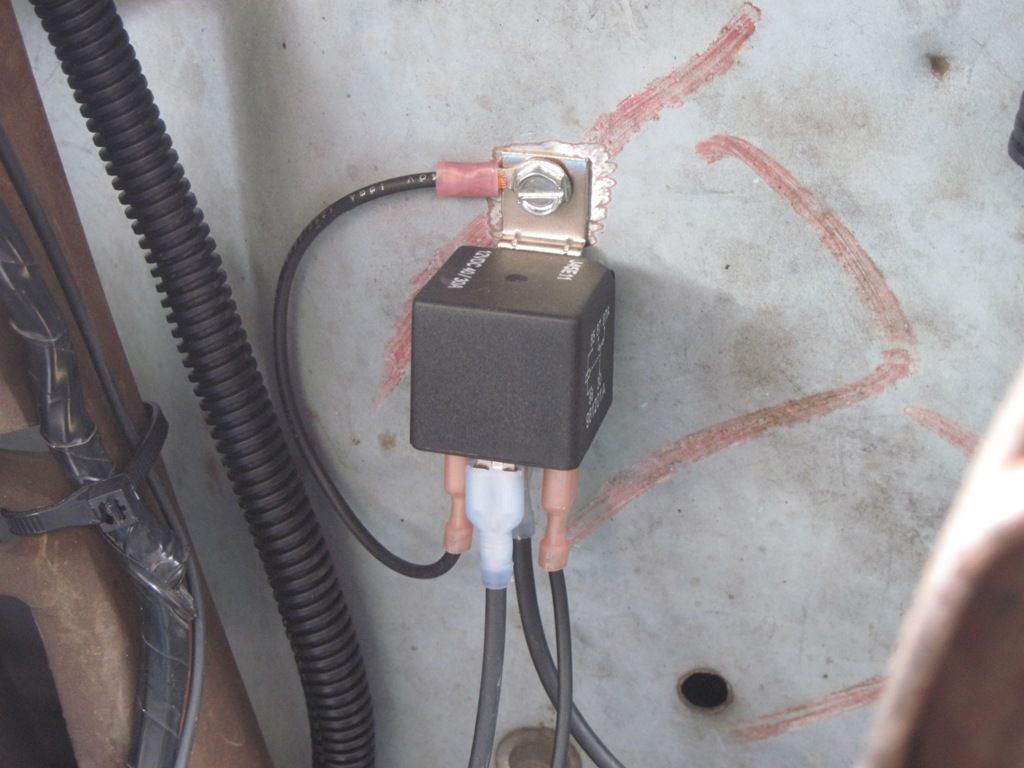
Here's a good example: I had to ground a terminal of a relay when I installed an electric fuel pump. The relay happened to be mounted to the firewall. So, I simply ran a small length of wire from the terminal that needed to be grounded, to the mounting screw of the relay. As you can see, I buffed off some paint to create a guaranteed electrical connection.
All electrical loads essentially have two "terminals." One terminal to accept current from the source (battery in this case), and one to return current to the source. If both "terminals" had to be wired back to the battery, it would be a lot of wiring, considering all the bulbs and accessories throughout the truck.
Instead, the entire structural metal of the truck, from bumper to bumper, is the "return." The structural metal of the truck is electrically connected to the negative terminal of the battery, so we set a "rule" to say that all of the structural metal on the truck is this return terminal, called "ground." That's where the term "negative ground" comes from. Doing it this way cuts the amount of wiring required in half, because now only the power wires have to be connected. The structural metal acts as the other "wire" - one big one!
The negative terminal of the battery always connects to the engine block through a large cable - so we say that the engine block is the true master ground. Things like the frame, firewall, support brackets behind the dash, etc. ultimately make it back to this point. Typically, the engine block makes a connection to a paint-free point on the firewall through a ground strap, which is a thick, strong, braided length of wire. Now the cab is grounded, and all the electrical loads in the cab can have a return path to the battery by simply tying to some metal in the cab.
The frame itself is grounded by another ground strap to the firewall, and the bed grounds by bolting to the frame. As such, the ground points of all the rear lighting simply screw to the bed sheetmetal. Engine mounts and body bushings are not ground paths. As you mention, when finding a ground connection, it needs to be absent of paint. If you are wiring something up and you mean to connect it to ground, you want to verify that there is a proper electrical connection with a multimeter. However, from a safety perspective, assume any metal is grounded. This is important if you're installing something with an exposed power terminal near a bracket, etc. Don't assume something won't conduct because it has paint. This is why good workmanship is important when wiring a vehicle - proper use of grommets, securing runs of wire, preventing melted or pinched insulation, etc.
Here's a good example: I had to ground a terminal of a relay when I installed an electric fuel pump. The relay happened to be mounted to the firewall. So, I simply ran a small length of wire from the terminal that needed to be grounded, to the mounting screw of the relay. As you can see, I buffed off some paint to create a guaranteed electrical connection.

Junior User

Joined: Jan 2001
Posts: 81
Likes: 0
From: Snohomish
As FMC400 has stated you are learning the right way and welcome to the world of auto mechanics. To add a little; what I do is cap seal the ground once the wire is secure to the attaching point with some sealant to prevent the metal from oxidizing and degrading the ground.
Hotshot


Joined: Apr 2009
Posts: 14,333
Likes: 247
From: Stanley, VA
YouTube can be helpful....or not. I've seen a lot of good videos and a lot that I just walk away thinking "geeze, what a moron".

Post Fiend
Joined: Apr 2008
Posts: 8,261
Likes: 15
From: Big Sky Country
Ground, ground, ground...can never have too many grounds!....battery to engine, engine to frame, frame to cab, cab to frame.....etc. etc. this eliminates almost 90% of all most electrical issues......

New User
Joined: Apr 2011
Posts: 14
Likes: 0
From: Alberta, Canada
Ground
That's a great tip. I've just started doing that myself recently.
Trending Topics

Post Fiend
Joined: Apr 2002
Posts: 19,311
Likes: 97
From: Waterloo, Iowa
Good plan! It definitely pays to go over ground points and terminals, SAE connectors &c because they are subject to pollution and road salt. My favorite is NO-OX-ID "special", a thick conductive grease long used in outdoor telecom apps, buss bars, and other critical connections. Great for battery terminals, cable ends, starter cable connections, grounding straps. Cheap too. Worked so good on the 64 have taken to pre-empting any troubles on the 09
FTE Stories
Ford Trucks for Ford Truck Enthusiasts

3 Best / 3 Worst Parts of Modern Ford Ownership
Brett Foote
10 Amazing Upgrades That Solve Common Ford Truck Owner Headaches
Pouria Savadkouei
Every 2026 Ford Engine Explained
Brett Foote
10 Ugly Ford Trucks That We Still Kinda Love
Joe Kucinski
10 Things Every Truck Owner NEEDS (2026 Edition)
Michael S. Palmer
Rezvani's Latest Post-Apocalyptic Monster Is a Ford F-150 Raptor Underneath
Verdad Gallardo
Top 10 Most Expensive Ford Trucks Ever Sold on Bring a Trailer
Joe Kucinski
2027 Ford Super Duty Buyer's Guide (Every Model, Engine, & Package)
Brett Foote
Top 10 Ford Truck Tragedies
Joe Kucinski


Thread
Thread Starter
Forum
Replies
Last Post
dalberti
Pre-Power Stroke Diesel (7.3L IDI & 6.9L)
16
Mar 22, 2019 12:13 PM
jesse_h97
1980 - 1986 Bullnose F100, F150 & Larger F-Series Trucks
3
Jun 13, 2010 12:11 PM
james G. phillips
1948 - 1956 F1, F100 & Larger F-Series Trucks
5
Jul 17, 2008 05:16 PM