


LMC headlight harness
Hotshot


Joined: Sep 2001
Posts: 11,958
Likes: 228
Something else to top off the relays, I like GE Nighthawk (not sport), Sylvania Xtravision (easily found at most stores), Phillips Xtreme Power or Vision Plus. These are all clear bulbs with different filiments and gas mixture. They are a little brighter. They are a tad brighter than regular bulbs. Just don't buy any blue coated bulbs, this includes Silverstar and all that stuff called hyper white etc. Those actually reduce the amount of usable light slightly, since the more yellow light is filtered out.

pedant
Joined: Jan 2008
Posts: 23,576
Likes: 38
From: EXTREME southwest CT

85 & 86 are the pulldown, 30 is power, 87A is normally closed, and 87 is the one that becomes fed when the pulldown is energized.
Here, let me Google up a couple of diagrams for you...

Here are the pinouts:
Regular SPDT relay
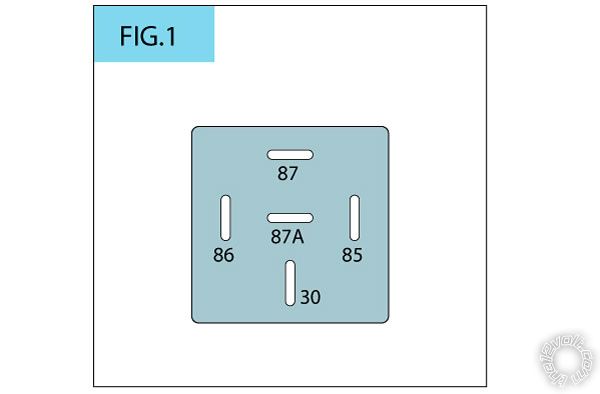
This is what you need to make it work.
One with 2 #87 terminals. SPST
Notice the other 87 is not in the center between the 85 & 86 terminals.

pedant
Joined: Jan 2008
Posts: 23,576
Likes: 38
From: EXTREME southwest CT
No, it is the difference between a Single Pole Single Throw relay with dual output, and a Single Pole Double Throw relay.
The terminals are labeled by convention.
It is Bosch who started with these pinout numbers way back when...
The terminals are labeled by convention.
It is Bosch who started with these pinout numbers way back when...
pedant
Joined: Jan 2008
Posts: 23,576
Likes: 38
From: EXTREME southwest CT
No, but that is the most common relay available.
I was pointing that out...
The pinouts are similar, but NOT the same.
I was pointing that out...
Originally Posted by ArdWrknTrk
I see in that writeup he mentions two #87 terminals.
Don't make the mistake of confusing 87 & 87A (which is NC, and open when the relay is energized)
Don't make the mistake of confusing 87 & 87A (which is NC, and open when the relay is energized)
Tuned
Joined: Apr 2011
Posts: 464
Likes: 5
From: Redmond, WA USA
Something else to top off the relays, I like GE Nighthawk (not sport), Sylvania Xtravision (easily found at most stores), Phillips Xtreme Power or Vision Plus. These are all clear bulbs with different filiments and gas mixture. They are a little brighter. They are a tad brighter than regular bulbs. Just don't buy any blue coated bulbs, this includes Silverstar and all that stuff called hyper white etc. Those actually reduce the amount of usable light slightly, since the more yellow light is filtered out.
If you go online and research all of these type of "performance" bulbs, you will find that there is one universal complaint: bulb life. In some cases it can be 75% lower than standard halogen bulbs (ie 200 hour bulb life vs. 800-1000).
It's an individual decision whether the additional brightness (and significantly higher cost) is worth the tradeoff of the much shorter life.
Hotshot
Joined: Sep 2001
Posts: 11,958
Likes: 228
I have just "burned" through a set of the Nighthawks ($40/<acronym title="Page Ranking">pr</acronym> retail, ouch) in 13 months, and both bulbs burnt out within a week of each other.
If you go online and research all of these type of "performance" bulbs, you will find that there is one universal complaint: bulb life. In some cases it can be 75% lower than standard halogen bulbs (ie 200 hour bulb life vs. 800-1000).
It's an individual decision whether the additional brightness (and significantly higher cost) is worth the tradeoff of the much shorter life.
If you go online and research all of these type of "performance" bulbs, you will find that there is one universal complaint: bulb life. In some cases it can be 75% lower than standard halogen bulbs (ie 200 hour bulb life vs. 800-1000).
It's an individual decision whether the additional brightness (and significantly higher cost) is worth the tradeoff of the much shorter life.
I don't know what the rated hours is on the Xtravision or regular Nighthawk. The XV's are cheap though, so its not a big deal.
The blue coated bulbs really do have much shorter life spans. The coating absorbs heat.
FTE Stories
Ford Trucks for Ford Truck Enthusiasts

2027 Ford Super Duty Buyer's Guide (Every Model, Engine, & Package)
Brett Foote
Top 10 Ford Truck Tragedies
Joe Kucinski
AEV FXL Super Duty - the Super Duty Raptor Ford Doesn't Make
Brett Foote
Lobo Vs Lobo: Proof the F-150 Lobo Should Be Even Lower!
Michael S. Palmer
Ford's 2001 Explorer Sportsman Concept Looks For a New Home
Verdad Gallardo
10 Best Ford Truck Engines We Miss the Most!
Joe Kucinski
2026 Shelby F-150 Off-Road: Better Than a Raptor R?
Brett Foote
2027 Super Duty Carhartt Package First Look: 12 Things You NEED to Know!
Michael S. Palmer
10 Most Surprising 2026 Ford Truck Features!
Joe Kucinski
Thread
Thread Starter
Forum
Replies
Last Post
AJHEATING
1973 - 1979 F-100 & Larger F-Series Trucks
11
Jan 22, 2012 02:41 PM
