
Ford Truck History Part 7: 1992-1996
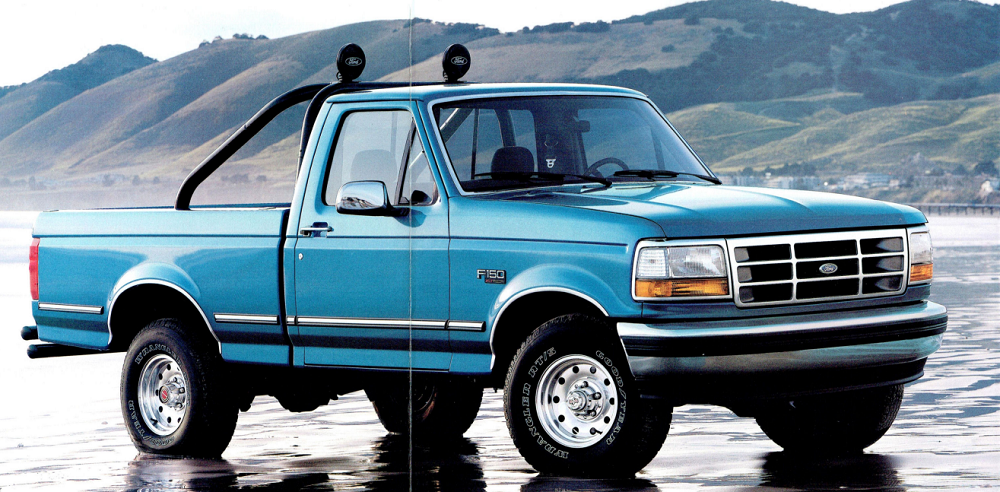
In 1992, Ford released the zenith of 20th-century truck design: the 9th-generation F-series, alongside the Explorer, Ranger, and E-series.
Welcome to is Part 7 of our Ford truck history series. Here’s where we’ve been so far:
Part 1: F Series Origins
Part 2: 1953-1960
Part 3: 1961-1972
Part 4: 1973-1979
Part 5: 1980-1986
Part 6: 1987-1991
The end of the 20th century marked a high point in automotive development across a great swath of the industry. You had everything from inexpensive, dependable cars freed from the shackles of primitive 1980s vacuum hose tech, to 200+mph exotics. In particular, the domestics really upped their game. Legendary models like the C5 Corvette, Viper, 5th-gen Mustang, Panther-body, Cherokee, Explorer, the list continues. And Ford trucks were certainly no exception. Modern post-Malaise focus groups demanded a return to the days when you got a truck with good power, reliability, and refinement.
Most of these groups comprised individuals who grew up with trucks from the early 1970s. By the early 90s, Ford’s lineup hauled cargo for over 40 years, and there’s something to be said about that sense of familiarity and ruggedness. So when it came time to replace the 8th-gen, Ford devised a plan. These focus groups proved invaluable with the upcoming 10th-gen F-series, codenamed “PN-96.” But while that truck neared completion, Ford’s 1980-platform isn’t going down without a fight. After a decade of refinement, Ford in fact created a truly venerable product, outselling both Dodge and GM trucks combined by 1996.
Young at Heart
The 9th-gen was still, of course, powered by that ludicrously durable Truck Six. By now, the humble little straight-six produced 145 horsepower and 265 lb/ft – similar to the 351M of 1980-82 vintage. Naturally Ford accompanied this with its equally venerable V8s, in 5.0L and 5.8L flavors. Base models with the six were equipped with the M5OD 5-speed, though various other transmissions were available based on model year and engine.

In 1996, power figures stood at: 150 hp/260 lb/ft for the Six, 205 hp/275 lb/ft for the 5.0, and 210 hp / 325 lb/ft for the 5.8.
The trucks very much took the “If it ain’t broke, don’t fix it” mindset to heart. Again, Ford simply chose refinement over replacement, retaining long-running designs such as the Twin I-Beam suspension and squared profile. But they did adopt various alterations in favor of a younger, sportier demographic. Most notably, the Flareside bed makes its return after a generation-long hiatus. Ford also carried over the Nite package for one-year only and added additional trim levels to appeal to the off-roaders. Even their advertisements feature photography from desert racing, doubling-down on advertising this as a model that’s both practical and fun to drive.

The Bronco, much like the Explorer, received an Eddie Bauer trim package for the 1992-6 model years.
But, as they say, that’s not all. Ford later introduced the Lightning for the 1993 model year, the second true “Muscle Truck” in recent memory. This supercharged beast followed the likes of the GMC Syclone and Chevy 454SS. We have a whole article detailing the history of the Lightning package alone, which you can read here.

Jackie Stewart weighed in his thoughts during handling testing of the Lightning to help refine it. The end-goal was a truck that handled like a car.
They Grow Up So Fast
In 1992, the Ranger earned its place at the big kids’ table as well. For the 1993 model year, Ford revised the truck with a brand spankin’ new body design from the ground up. Essentially, the body lines evoked more of a “car” feel to the little pickup. 1992 and 1993 shared no external body panels, a characteristic which further separated the Explorer as well. Now the two models were distinctly separate from one another. The Explorer itself received its first generational revision for the 1995 model year, garnering a more luxurious but practical mid-size SUV vibe. But traditionally Ford marketed these models as smaller, sportier versions of the big stuff. So what changed?

The more rounded front-end preceded the upcoming 10th-generation F-Series’ grille design by almost 3 years.
Well, to answer that question, we look again to competitors at Chrysler. Jeep Cherokee sales ate into the car market so much that Chrysler released the ZJ Grand Cherokee in 1993. This truck marked the launch of the domestic luxury SUV for the modern age. And again, the Jeeps outperformed their competitors, offering high-tech, luxurious, but usable and reliable platforms for mid-range price brackets. Ford, meanwhile, played catch-up yet again. It took a full 2 years of refinement, but their answer to Jeep was simple, yet complicated. Divide the Ranger and Explorer models into two distinct lines, both visually and in feel. The 1995 Explorer, therefore, competed directly against the Grand Cherokee and new Land Rover Discovery, while the Ranger handled the 1994 Chevy S-10.
At War
Mind you, this isn’t the first time the Big Three riffed off each other’s ideas. Ford knows this all too well, being the progenitor of the American pickup, after all. Such trends shaped the 90s light truck market from a no-nonsense work truck to a sporty, luxury vehicle. For Ford, this meant emphasizing their trucks’ domestic utility more than ever before. Dealers ordered trucks equipped with options like dual airbags, big disc brakes, automatic transmissions, and leather interiors. This new wave proved immensely successful – not to mention profitable – for everyone involved. And Ford never stopped innovating throughout this trend. For example, in 1997 the Ranger earned the pedigree of being the first domestic vehicle with a 5-speed automatic. This generation also saw Mazda’s B-Series return, a badge-engineered Ranger to promote Mazda’s growing popularity.

The Base-model B-series was solt at just $9,460 MSRP.
The same applied to full-size trucks as well. In 1986 Ford’s 8th-gen F-series was a refined, comfortable ride, undoubtedly the top of its food chain. In response, Dodge totally revamped its underdog Ram truck, releasing the 2nd-gen Ram for the 1994 model year. This truck marked the beginning of the end for basic, no-frills full-size pickups. Chevy further steered this trend along with their performance-package Silverados.

The Ranger was the last truck to use the Mazda M5OD manual transmission, used from 1987 to 2011.
Throughout the 90s, the list of features – and price tags – expanded dramatically across all three brands. For Ford, they held essentially the final original design out of all of them, therefore arguably also the most refined. This brand-image of a luxury pickup took time to stick. And in the meantime, some people craved the familiarity of older stuff. It’s why Chrysler built the SJ Wagoneer and Chevy the square-body C/K until 1991. Ford, meanwhile, didn’t have that issue. Ford’s design, while exterior-wise resembled the older trucks, still absolutely received the full modernization treatment. In effect, Ford had its cake and ate it, too. And sales figures reflected this: the truck yet again outsold all competitors by a landslide.
New Faces
1994-96 marked one busy time period for the light truck industry, especially for Ford. In 1994, Ford introduced the Mazda B-series mentioned earlier and substantially updated no fewer than four models: the light and medium-duty F-series, Explorer, and Ranger. Starting with the simplest: following the luxury truck trend, the F-series received most of its revisions in the form of optional extras. For 1994, Ford loaded the trucks with everything available under the sun. You could get your F-series with electrochromic rearview, keyless entry, knitted vinyl bench, CD player, power seats, power mirrors, single or dual fuel tanks… the list is ridiculously long. So long, in fact, that the scan of the options page produced a font too small to decipher without zooming in.

By 1995, even a fully-equipped Bronco’s interior doesn’t look out-of-place at a modern showroom.
Meanwhile, the Explorer and Ranger, as stated before, drifted into two separate models almost entirely. And while we talked about the Explorer, the Ranger filled a different market segment. For that truck, Ford took the route of a more basic but still well-equipped job-site truck. Of course, you could option it as a Styleside with a big V6 and 5-speed auto or manual for the enthusiast crowd. But a massive market share of this truck was the commercial industry. Even today, small trucks like the Ranger, Chevy S-10, Dodge Dakota, and their derivatives are common sights in various workplaces. With a mid-cycle facelift as well, the 3rd-gen Ranger proved a basic but dependable platform for traveling handymen and light job-site work alike.
Putting Bread on the Table
Speaking of the commercial market, Ford continued producing the heavier variants with yet another facelift. In 1994, its medium-duty F-series trucks received their first facelift since 1980, gaining a standard forward-tilting hood while retaining the original cab. By now, this truck remained in production for 14 years. Ultimately, the design was so well-received that another update wouldn’t occur until 1999.

A large share of B-Series sales went to school bus production as well. Original author.
But for the smaller cargo vans, the E-series, Ford really went all-out. In 1992, alongside the F-series, these humble work and passenger vans received their final substantial update as of 2022. The vans, still called Econoline at this point, retain a bunch of features from the companion F-series. You got the same Twin I-Beam suspension, engines, automatic transmissions, and so on. It also retained the separate body and cab, a critical feature which ensured its relevance to this day (more on that in later articles). However, the entire interior was redesigned to better accommodate the chunky engines. To this end, Ford reworked the dash, engine cover, and passenger compartments, optimizing for better space-saving.

Ford continued offering the van in a full-size passenger configuration as well. And it was reasonably popular in this venture, but nowhere near its commercial-oriented cargo spec. In this basic configuration, the humble work van essentially grew so obscenely popular that it became a household name. Whenever you ask someone these days who isn’t a car-person to think of a white work van, their minds tend to jump right to the mid to late-90s Ford E-series. If that isn’t a sign of success, I don’t know what is.
The End of an Era
Ford certainly closed the 20th century with a bang. Its final generation entirely encapsulated in this timeframe was easily the pinnacle of its day. The F-series combined the luxury features of modern 1990s tech with the strong-chinned appearance of its predecessors. The Ranger grew from a light pickup with a big heart to a universal inexpensive work truck. The Explorer rode the wave of luxury SUVs, offering competitive alternatives to the Grand Cherokee and Blazer. And the E-Series work vans basically became the quintessential van of the modern age. All in all, things were looking pretty good for Ford.
Meanwhile, under the hood, the company experimented with a new design to usurp both the Ram and the Chevy. This new generation has some mighty big shoes to fill, seeing as its predecessor somehow managed to remain in a position of utter dominance in this wave of innovation. The 10th-gen Ford, as discussed previously, began its life as the PN-96 in 1989. And with Dodge’s Ram and Chevy’s Silverado gaining traction, this entirely ground-up redesign needs to be something special: Ford’s first postmodern truck. Next time, we’ll talk about how Ford designed this new truck and its subsequent runaway success as Ford’s first all-new platform since 1980.
Additional images from Wikimedia Commons.
Brochures used: 1992-97 Ford F-series, 1995 Ford Trucks, 1999 Ford E-Series, 1995 Ford Bronco, 1994-96 Ford Ranger, 1995 Ford Explorer, 1993 Jeep Grand Cherokee, 1994 Mazda Trucks, 1994 GM Trucks.
Join the Ford Truck Enthusiasts forums now!


You must be logged in to post a comment.