




Possible causes for Carburetor Fire?

Thread Starter
|
Freshman User
Joined: Feb 2013
Posts: 27
Likes: 0
Possible causes for Carburetor Fire?
Hello all,
Yesterday while trying to start my truck (warm start), I turned the key and eased on the gas. The starter motor started to get stuck. I laid on the gas without thinking and continued trying to start. Before you know it, I saw flames coming out from under the hood and the carburetor was on fire.
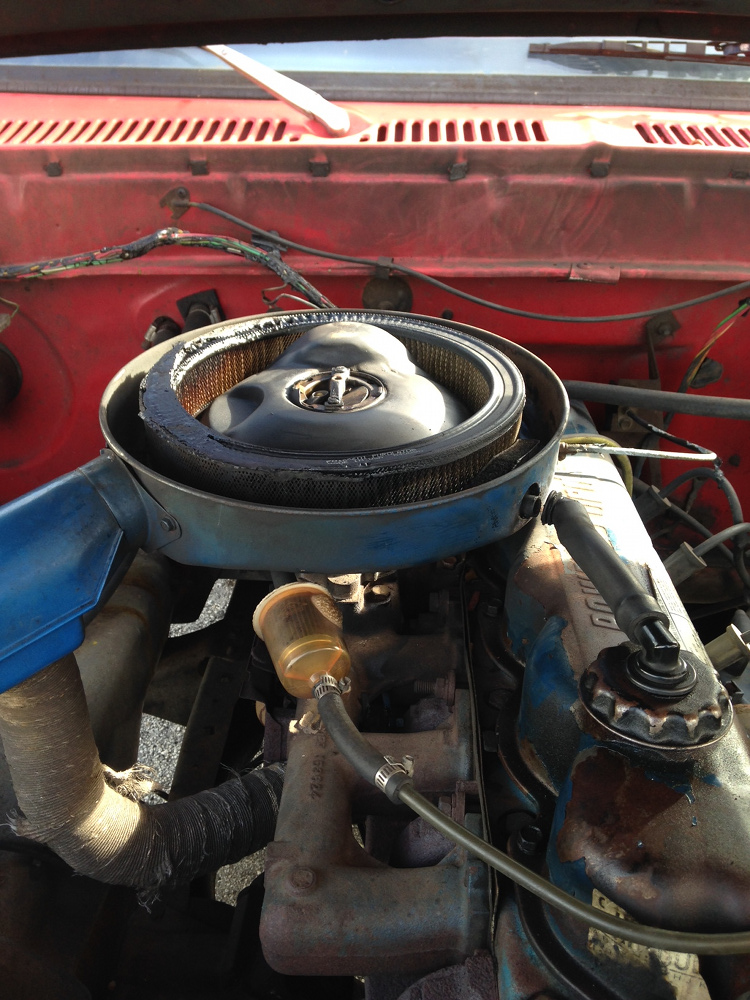
We put it out with some wet beach towels we had handy nearby. After surveying the damage, we saw that the air filter was gone, a hose had come loose and the fuel filter suffered some deformation/slight burns from the flames but still looks functional. I've attached a pic for reference...
I have two questions, the first one being what could have caused this? After reading a bit I understand it could be a lot of things (timing could be off) but I think it's safe to narrow it down on account of some previous observations in the past, the first being: I've seen the fuel filter full with gas and leaking droplets of gasoline before and in fact I just now remember I've seen it catch fire before on a very small scale (I was messing with starter solenoid and some sparks had flew and ignited a spot of gasoline that was still wet after falling from fuel filter). Another thing I noticed was that I probably shouldn't have pressed the pedal as much as I did while trying to start and I might have saturated the air filter with gas, making it very flammable at that moment. But what exactly could have happened to cause that fire to start up? It was coming out from inside the carburetor ...
My other question is, why did that hose come loose? It looks like an important hose (I don't know the name of it if anyone can help), and I don't think the fire could have shaken it loose?
I appreciate the help,
bttf
Yesterday while trying to start my truck (warm start), I turned the key and eased on the gas. The starter motor started to get stuck. I laid on the gas without thinking and continued trying to start. Before you know it, I saw flames coming out from under the hood and the carburetor was on fire.
We put it out with some wet beach towels we had handy nearby. After surveying the damage, we saw that the air filter was gone, a hose had come loose and the fuel filter suffered some deformation/slight burns from the flames but still looks functional. I've attached a pic for reference...
I have two questions, the first one being what could have caused this? After reading a bit I understand it could be a lot of things (timing could be off) but I think it's safe to narrow it down on account of some previous observations in the past, the first being: I've seen the fuel filter full with gas and leaking droplets of gasoline before and in fact I just now remember I've seen it catch fire before on a very small scale (I was messing with starter solenoid and some sparks had flew and ignited a spot of gasoline that was still wet after falling from fuel filter). Another thing I noticed was that I probably shouldn't have pressed the pedal as much as I did while trying to start and I might have saturated the air filter with gas, making it very flammable at that moment. But what exactly could have happened to cause that fire to start up? It was coming out from inside the carburetor ...
My other question is, why did that hose come loose? It looks like an important hose (I don't know the name of it if anyone can help), and I don't think the fire could have shaken it loose?
I appreciate the help,
bttf
Last edited by bttf; Oct 7, 2013 at 08:37 PM. Reason: fixed broken img

Laughing Gas


Joined: Aug 2000
Posts: 1,005
Likes: 63
From: Eastern, Idaho
Backfire or bad wire arcing near the fuel source is my guess. Kinda hard to saturate the air filter with gas but they do burn easily. 3 things have to be in place for fire to occur... oxygen, fuel and heat. Fix fuel leaks and inspect all wiring and connections around the engine, then make sure the timing is setup correctly.

Fleet Owner
Joined: Dec 2009
Posts: 20,678
Likes: 82
From: NorCal
Yer pic doesn't work and we have no idea what hose you're referring to.
Cause... well, it sounds like the rig has two of the three ingredients for a fire - air and fuel. Add a spark and, Voila! Fuego!
The excess fuel fumes prolly ignited (from cranking and bad timing) in the intake manifold chamber, resulting in an overpressure and a flame front which, in turn, blew off the hose, and ignited the fuel which was leaking. A backfire isn't necessary to be set alight.
Some hoses are slip (compression) fit, some hoses are secured with a spring clamp, and some are held on with a band clamp. ...Be a detective.
Cause... well, it sounds like the rig has two of the three ingredients for a fire - air and fuel. Add a spark and, Voila! Fuego!
The excess fuel fumes prolly ignited (from cranking and bad timing) in the intake manifold chamber, resulting in an overpressure and a flame front which, in turn, blew off the hose, and ignited the fuel which was leaking. A backfire isn't necessary to be set alight.
Some hoses are slip (compression) fit, some hoses are secured with a spring clamp, and some are held on with a band clamp. ...Be a detective.
Thread Starter
|
Freshman User
Joined: Feb 2013
Posts: 27
Likes: 0
Fixed the image.
Interesting theory HIO Silver; I think that seems most plausible.
I think my next steps include fixing that fuel line so it doesn't leak anymore and replacing the air filter. Is it common to have the excess fuel fumes ignite when starting up? It seems like something that happens without noticing when the engine starts up as normal...
Interesting theory HIO Silver; I think that seems most plausible.
I think my next steps include fixing that fuel line so it doesn't leak anymore and replacing the air filter. Is it common to have the excess fuel fumes ignite when starting up? It seems like something that happens without noticing when the engine starts up as normal...
Thread Starter
|
Freshman User
Joined: Feb 2013
Posts: 27
Likes: 0
The PCV breather hose if I'm not mistaken is on the back end of the engine. You can't see it on the picture but I'm almost sure; I posted a thread a couple months ago just asking what it was, and I was told it was the PCV...
Trending Topics

Senior User
Joined: Jun 2013
Posts: 130
Likes: 1
From: Eastern Washington
You are correct. There is a pcv hose coming out of the back of the engine. The hose I pointed out is also for pcv. The back hose goes to the base of your carburetor. Manifold vacuum pulls blow by vapor out of the crankcase through it. The hose shown in your picture connects to the air cleaner. It prevents the crankcase from having negative pressure by pulling clean air into the crankcase through the air cleaner.
FTE Stories
Ford Trucks for Ford Truck Enthusiasts

10 Best Ford Truck Engines We Miss the Most!
Joe Kucinski
2026 Shelby F-150 Off-Road: Better Than a Raptor R?
Brett Foote
2027 Super Duty Carhartt Package First Look: 12 Things You NEED to Know!
Michael S. Palmer
10 Most Surprising 2026 Ford Truck Features!
Joe Kucinski
Top 10 Ford Trucks Coming to Mecum Indy 2026
Brett Foote
5 Best / 5 Worst Ford Truck Wheels of All Time
Joe Kucinski
Ford Super Duty: 5 Things Owners LOVE, 5 Things They LOATHE!
Joe Kucinski
Every 2026 Ford Truck Engine RANKED from WORST to FIRST!
Michael S. Palmer
The Best F-150 Deal of Every Trim Level (XL through Raptor)
Joe Kucinski
Thread Starter
|
Freshman User
Joined: Feb 2013
Posts: 27
Likes: 0
You are correct. There is a pcv hose coming out of the back of the engine. The hose I pointed out is also for pcv. The back hose goes to the base of your carburetor. Manifold vacuum pulls blow by vapor out of the crankcase through it. The hose shown in your picture connects to the air cleaner. It prevents the crankcase from having negative pressure by pulling clean air into the crankcase through the air cleaner.
Anyhow, this morning I went to the car and inspected for damage. Other than some scoring on nearby wires, everything seemed in good condition. I replaced the air filter and gave it a start. She started up fine. Then I noticed some dripping. The fuel line was dripping near the fuel filter, right onto the engine block. Then I noticed that when I hit the gas the leak would spit out fuel towards the windshield; some droplets landed on my windshield since the hood was up. This I think may be the cause of the somewhat large fire I saw the other day.

Cranky Old Guy
Joined: Mar 2008
Posts: 3,562
Likes: 6
From: Raphine, Virginia
The main cause of the fire is you didn't fix the fuel leak. And still haven't. Gas dripping down on the exhaust manifold is not good. A greasy, oily air filter catches fire quickly. I'm sorry, but you seem determined to burn your truck to the ground.

Posting Guru
Joined: Oct 2007
Posts: 1,144
Likes: 0
From: Sedro-Woolley, WA
From the symptoms you described, HIO Silver's conclusion is the most probable cause. In fact I am convinced that is what happened. A timing set to far advanced will cause the starter motor to stall when trying to turn it over because peak cylinder pressure is achieved before top dead center of the piston stroke. This over pressurizes the cylinder and can allow hot or burning gasses back into the intake and causing a carb fire.
Check under the distributor cap for rust, grease, gunk and anything else that can cause your mechanical or vacuum advance to hang up and not return to it's starting position. Also check your initial timing.
Check under the distributor cap for rust, grease, gunk and anything else that can cause your mechanical or vacuum advance to hang up and not return to it's starting position. Also check your initial timing.
Thread Starter
|
Freshman User
Joined: Feb 2013
Posts: 27
Likes: 0
From the symptoms you described, HIO Silver's conclusion is the most probable cause. In fact I am convinced that is what happened. A timing set to far advanced will cause the starter motor to stall when trying to turn it over because peak cylinder pressure is achieved before top dead center of the piston stroke. This over pressurizes the cylinder and can allow hot or burning gasses back into the intake and causing a carb fire.
Check under the distributor cap for rust, grease, gunk and anything else that can cause your mechanical or vacuum advance to hang up and not return to it's starting position. Also check your initial timing.
Check under the distributor cap for rust, grease, gunk and anything else that can cause your mechanical or vacuum advance to hang up and not return to it's starting position. Also check your initial timing.

Thread
Thread Starter
Forum
Replies
Last Post
StanleyZ
6.7L Power Stroke Diesel
15
Jun 11, 2019 10:44 AM
cwtex
1980 - 1986 Bullnose F100, F150 & Larger F-Series Trucks
11
Dec 19, 2003 02:46 PM