



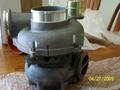
 With the stock Air Intake Heater element removed

boost gauge hook up?
Fleet Mechanic
Joined: Feb 2005
Posts: 1,797
Likes: 1
From: Northern Colorado
Clay at RiffRaff Diesel Performance has a great little fitting to eliminate the Air Intake Heater and at the same time, gives you a 1/8" NPT opening to hook the boost gauge to. It is a much better place to sense boost than simply splicing into the MAP sensor line.

Hotshot


Joined: Feb 2007
Posts: 10,499
Likes: 10
From: Sterling Heights,Mi
Sorry, no pictures, but running from the passenger side of your truck there is a red hose, it is a the MAP sensor line, this is what you need to tap into. Mean while, I will look for a link.
Hotshot
Joined: Feb 2007
Posts: 10,499
Likes: 10
From: Sterling Heights,Mi
Gauge Installations at DieselManor- 1999-2003 7.3L Powerstroke
Sorry it took so long.
Bob, I have read, and re read, I believe, everything on this I can.. It doesnt seem to make a difference if you remove the AIH, or does it?
Sorry it took so long.
Bob, I have read, and re read, I believe, everything on this I can.. It doesnt seem to make a difference if you remove the AIH, or does it?

Thread Starter
|
Freshman User
Joined: Sep 2009
Posts: 25
Likes: 0
Trending Topics
Fleet Mechanic
Joined: Feb 2005
Posts: 1,797
Likes: 1
From: Northern Colorado
What does make a difference is where the boost gauge is sensing true boost. The closer that you can get to the intake plenum, the better. The AIH hole is just a handy place to do it without pulling the spider and tapping it and most that have eliminated the AIH have found that it is a pretty useless item on the truck.
FTE Stories
Ford Trucks for Ford Truck Enthusiasts

Top 10 Fords at 2026 Carlisle Ford Nationals
Joe Kucinski
3 Best / 3 Worst Parts of Modern Ford Ownership
Brett Foote
10 Amazing Upgrades That Solve Common Ford Truck Owner Headaches
Pouria Savadkouei
Every 2026 Ford Engine Explained
Brett Foote
10 Ugly Ford Trucks That We Still Kinda Love
Joe Kucinski
10 Things Every Truck Owner NEEDS (2026 Edition)
Michael S. Palmer
Rezvani's Latest Post-Apocalyptic Monster Is a Ford F-150 Raptor Underneath
Verdad Gallardo
Top 10 Most Expensive Ford Trucks Ever Sold on Bring a Trailer
Joe Kucinski
2027 Ford Super Duty Buyer's Guide (Every Model, Engine, & Package)
Brett Foote

PREMIUM SPONSOR


Joined: Feb 2009
Posts: 6,039
Likes: 74



Postmaster
Joined: Jun 2006
Posts: 2,647
Likes: 0
From: Fulltime RVer

Here is one for you Gene. AIH delete.
Now I don't even know if you can even make a call on this one without extensive measurements on the AIH itself or air flow data. It may take some assumptions which is probably most difficult if not impossible with your background. Myself....assumptions are all I have to go on.
Just for grins and giggles, it would be interesting to see what kind of feedback you received if you are able to make any kind of educated call on this one without posting all of the supporting documentation on your reasoning..... but you would probably get chastised for the lack of that too.....interesting nevertheless.
Now I don't even know if you can even make a call on this one without extensive measurements on the AIH itself or air flow data. It may take some assumptions which is probably most difficult if not impossible with your background. Myself....assumptions are all I have to go on.
Just for grins and giggles, it would be interesting to see what kind of feedback you received if you are able to make any kind of educated call on this one without posting all of the supporting documentation on your reasoning..... but you would probably get chastised for the lack of that too.....interesting nevertheless.
The R Inches H2O restriction of this path depends on the VAF=Volume Air Flow (CFM) flow going through the spider and into the cylinders and for a 444 in^3 engine with a VE=Volumetric Efficiency of 80% when operating at 2,900 rpm this is a... VAF={(0.1285)(VE)(RPM)}={(0.1285)(0.8)(2,900)}=300 cfm.
In the graph below if you look across from 300 CFM until you come to the blue curve (3.0" dia) and then down to the black AFV=Air Flow Velocity curve you see a AFV=70 mph and then look down to also see a R=0.5" H2O and if you look across from 300 CFM until you come to the red curve (2.5" dia) and then down to the black AFV curve you see a AFV=100 mph and then look down to also see a R=1" H2O ...and this bounds the spider's flow restriction without the AIH element installed as being between R=0.5" H2O with a 70 mph AFV and R=1" H2O with a 100 mph AFV.

Now here's where someone needs to measure the actual AIH element and post the result but for now I'll assume the element has a 0.25" dia and is 2" long and this gives an Ap=Projected Frontal Area of... Ap=(0.25)(2)=0.5 in^2=0.0035 ft^2 ...and I'll also assume... Cd=0.75 ...where Cd=Drag Coefficient which is a dimensionless ratio that takes into account the objects shape.
This equation gives the ADHP=Aerodynamic Drag HP of the AIH element... ADHP={(Ap)(Cd)(MAP)(MPH^3)}/{(MAT+460)(4,150)} hp ...and I'm assuming a BP=28 psig which gives a MAP=14.7+28=42.7 psia and that MAT=140*F due to a long duration steady state flow like you encounter when climbing a long grade.
Here's the ADHP calculation for the worst case of R=1" H2O with a 100 mph AFV... ADHP={(Ap)(Cd)(MAP)(MPH^3)}/{(MAT+460)(4,150)}={(0.0035)(0.75)(42.7)(100^3)}/{(140+460)(4,150)}=0.045 hp ...and you can relate a given ADHP to a "drag restriction" Rd from this equation... Rd={(ADHP)(6,343)}/(VAF) Inches H2O ...so the Rd for a ADHP=0.045 hp is ...Rd={(ADHP)(6,343)}/(VAF)={(0.045)(6,343)}/(300)=1" H2O.
So the addition of the AIH element causes an additional "drag restriction" of Rd=1" H2O and without the AIH element installed the restriction was R=1" H2O so with the element installed the total restriction is Rt=2" H2O and the restriction doubles!
For the case of R=0.5" H2O with a 70 mph AFV you get... Rd={(0.015)(6,343)}/(300)=0.3" H2O ...and without the AIH element installed the restriction was R=0.5" H2O so with the element installed the total restriction is Rt=0.8" H2O and the restriction increases by a factor of (0.8)/(0.5)=1.6!
So having the AIH element installed causes a large "percentage" increase in "spider restriction" ranging from a 60% to a 100% increase but so what!!! For the stated conditions the gauge pressure at the turbo outlet is 30 psig and comparing that with a BP=28 psig in the spider means the intercooler restriction is 2 psi=55" H2O ...and what really counts is the gauge pressure inside the cylinder at BDC of the intake strokes which is only 80% of the spider pressure or 22.4 psig so you can view the intake valve as having a 5.6 psi=155" H2O restriction ...so when you consider the total 7.6 psi=210" H2O restriction from the turbo outlet to inside the cylinders it really doesn't make much "bottom-line" difference if you have an additional 1" H2O restriction which is only a 0.5% increase due to the AIH element!
Please ask some questions ...especially if you don't understand why the CFM flow going through the spider and into the cylinders doesn't depend on boost and is only 300 cfm and not a number like the 600 cfm that everyone talks about when discussing air filters!
Fleet Mechanic
Joined: Feb 2005
Posts: 1,797
Likes: 1
From: Northern Colorado
GENE! You forgot to leave out all of your supporting documentation!!!!!!!!!!!! (I know, you couldn't help yourself) 
So what I get out of that is that is does create a restriction but it is so little, it does not make a difference, especially with the SOTP gauge.
The only assumption that may be off, since I don't have an AIH here to measure, but from what I remember, the AIH is about 3/4" in diameter and 2 1/2 to 2 3/4" in length.
So what I get out of that is that is does create a restriction but it is so little, it does not make a difference, especially with the SOTP gauge.
The only assumption that may be off, since I don't have an AIH here to measure, but from what I remember, the AIH is about 3/4" in diameter and 2 1/2 to 2 3/4" in length.
Postmaster
Joined: Jun 2006
Posts: 2,647
Likes: 0
From: Fulltime RVer
...First I'll calculate the spider's flow restriction without the AIH element installed and here I'm just considering the path from where the spider receives its "cool air" input from the CAC tube to the "output hoses" leading to the plenums. I modeled this path as having a flow restriction that's comparable to that of a 3-ft length of straight pipe where the pipe diameter is somewhere between 2.5" to 3.0"...
The "physical" flow path through the spider isn't 1.2 ft in length but the actual path isn't straight and even the slightest bend plus the "Y" divider increases the restriction so I think an "equivalent" 1.2 ft length of straight pipe is a pretty good model for the actual spider restriction!
However the real reason I'm using a 1.2 ft length of straight pipe is that I already had a graph for a 3-ft length pipe flowing atmospheric density air that was done a long time ago for an unrelated effort and as the old saying goes ...if your only "tool" is a "hammer" then every problem looks like a "nail" ...so I used that previous graph as convenient a "tool" for this new problem!
Check out my post #26 here... https://www.ford-trucks.com/forums/8...w-8k-lb-2.html ...where I wrote...
...Well here's yet another "penalty hp equation" to consider and this "penalty hp" results from running "excessive BP" and this "penalty hp" also places additional stress on the rods and reduces your MPG. I'll call this the CSHP*=Compression Stroke HP* penalty where the * denotes that it's a "penalty hp" associated with running an actual BP that's higher than the BP* which is the "smoke free BP" needed to combust the actual fuel flow being used to produce the actual FWHP.
CSHP*={(VE)(CID)(RPM)(BP-BP*)}/(173,000) hp
I'm very familiar with this "penalty hp" because it's a "designed in feature" on my C7 which has a maximum FWHP=300 at an RPM=2,200 and this FWHP could easily be produced without any smoke at all by using an actual BP=22 psig but in order to meet the 2003 NOx emissions without using EGR CAT runs the wastegate so that the turbo produces a BP=28 psig! This gives a... CSHP*={(VE)(CID)(RPM)(BP-BP*)}/(173,000)={(0.8)(442)(2,200)(28-22)}(173,000)=27 hp!
In addition to placing additional stress on the rods this 27 hp "emissions penalty" also increases the fuel consumption by 1 MPG compared to the older 3126 which runs at a lower BP for the same 300 FWHP! Of course if CAT had used EGR to meet emissions there'd also be a 27 hp "emissions penalty" and I'd rather have the extra fresh air going into the cylinders instead of exhaust gas! ...
CSHP*={(VE)(CID)(RPM)(BP-BP*)}/(173,000) hp
I'm very familiar with this "penalty hp" because it's a "designed in feature" on my C7 which has a maximum FWHP=300 at an RPM=2,200 and this FWHP could easily be produced without any smoke at all by using an actual BP=22 psig but in order to meet the 2003 NOx emissions without using EGR CAT runs the wastegate so that the turbo produces a BP=28 psig! This gives a... CSHP*={(VE)(CID)(RPM)(BP-BP*)}/(173,000)={(0.8)(442)(2,200)(28-22)}(173,000)=27 hp!
In addition to placing additional stress on the rods this 27 hp "emissions penalty" also increases the fuel consumption by 1 MPG compared to the older 3126 which runs at a lower BP for the same 300 FWHP! Of course if CAT had used EGR to meet emissions there'd also be a 27 hp "emissions penalty" and I'd rather have the extra fresh air going into the cylinders instead of exhaust gas! ...
https://www.ford-trucks.com/forums/8...gine-need.html
https://www.ford-trucks.com/forums/8...ing-smoke.html
...and I just noticed that this last thread has a long reply that I never got around to answering!

Thread
Thread Starter
Forum
Replies
Last Post
TheTowingCowboy
1994.5 - 1997 7.3L Power Stroke Diesel
30
Jun 27, 2017 12:37 PM
mattwoodsd
1987 - 1996 F150 & Larger F-Series Trucks
1
Sep 14, 2016 05:50 PM
