


Better Cold Running 521


Thread Starter
|
Post Fiend
Joined: Jan 2006
Posts: 5,037
Likes: 9
From: Kasson, Minnesota
Better Cold Running 521
My 77 F250 has a 521 with a 750 CFM E85 Quickfuel Carb with electrick choke, Edelbrock performer intake, DUI distributor, trickflow aluminum heads, mild cam, 10.5:1 compression. I'm running 3/8 fuel line and using a manual fuel pump. This summer was the first time I've been able to drive the truck. Motor is brand new with only about 400 miles on it. Trouble I'm having is at the start when it has set awhile. The motor starts kinda hard and runs rough for a bit than smoothes out, but will only hold an idle if I have my foot on the gas. Once the motor runs a bit and warms up, it seems to run fine, starts fine, idles fine. The timing is right on and I have been messing with the float levels and mixture screws, but can't seem to find out why it's doing what it is. I've messed with the electric choke a bit too. I'm looking for ideas on what I can do to get it to run fine when cold. I gotta believe it's just a fuel issue and I just don't have the carb dialed in right. Thanks.
Elder User
Joined: Apr 2003
Posts: 673
Likes: 0
From: Maryland
Wow, nice '77! What are you running for an air-cleaner? I'm guessing the answer is in your choke/fast idle settings and maybe adding an intake air warmer setup off the headers. Is the exhaust cross-over in the intake functional? E85 is not known for cold start performance and presents a set of challenges in carbruated vehicles. You may have to come up with a fresh air setup that has factory-like air heating for winter? Keep us posted...
Post Fiend
Joined: Jul 2006
Posts: 6,948
Likes: 44
How much cam do you have? Have any idea on how much vacuum that engine is making? My 557 is similar to this, but settle into a fine idle after a moment or two. Now keep in mind that I do not have a choke at all, but this is probably splitting hairs really.
There is little doubt in my mind that you have a very common problem and this also deals with a slightly rich running engine too. Seems that most engines with a slightly larger cam and lower vacuum all have a cold idle problem, and this stems from the throttle blades being too far open revealing the transfer slott too much. That being said you are probably running with both the main circuit and the idle curcuit and during cold sarts, the thing is just too fat. Try popping the carb off and check the throttle blade position relative to the transfer slot opening. Not sure of the exact measure ment that yours should be at but .020" seems to keep things happy. If you have a rich condition still, then there are other things to consider, and a reasonably easy fix, but lets start you off there Buck. We can see of that can work for you.
I can almost guarantee that it will. It may seem to idle too low, but you can bet that once the transfer slot is exposed they way it shoud be, you can adjust the idle mixture screws and they will make a big difference with only a small adjustment. I can bet that they have little affect on anything now.
You may also bump the secondary blades slightly more open, if they are flat shut right now. These are more tempermental and cant be moved much especially if the carb has a vacuum secondary.
Tell me more about the carb. Does it have 4 corner idling? Just sounds a bit too fat and when it is cold and the choke is shut, you have to compensate by giving it more air by opening the throttle blades.
Slight tuning to be done, but you are close.
There is little doubt in my mind that you have a very common problem and this also deals with a slightly rich running engine too. Seems that most engines with a slightly larger cam and lower vacuum all have a cold idle problem, and this stems from the throttle blades being too far open revealing the transfer slott too much. That being said you are probably running with both the main circuit and the idle curcuit and during cold sarts, the thing is just too fat. Try popping the carb off and check the throttle blade position relative to the transfer slot opening. Not sure of the exact measure ment that yours should be at but .020" seems to keep things happy. If you have a rich condition still, then there are other things to consider, and a reasonably easy fix, but lets start you off there Buck. We can see of that can work for you.
I can almost guarantee that it will. It may seem to idle too low, but you can bet that once the transfer slot is exposed they way it shoud be, you can adjust the idle mixture screws and they will make a big difference with only a small adjustment. I can bet that they have little affect on anything now.
You may also bump the secondary blades slightly more open, if they are flat shut right now. These are more tempermental and cant be moved much especially if the carb has a vacuum secondary.
Tell me more about the carb. Does it have 4 corner idling? Just sounds a bit too fat and when it is cold and the choke is shut, you have to compensate by giving it more air by opening the throttle blades.
Slight tuning to be done, but you are close.
Thread Starter
|
Post Fiend
Joined: Jan 2006
Posts: 5,037
Likes: 9
From: Kasson, Minnesota
Instead of typing my cam specs, I'll just show a pic of the box.
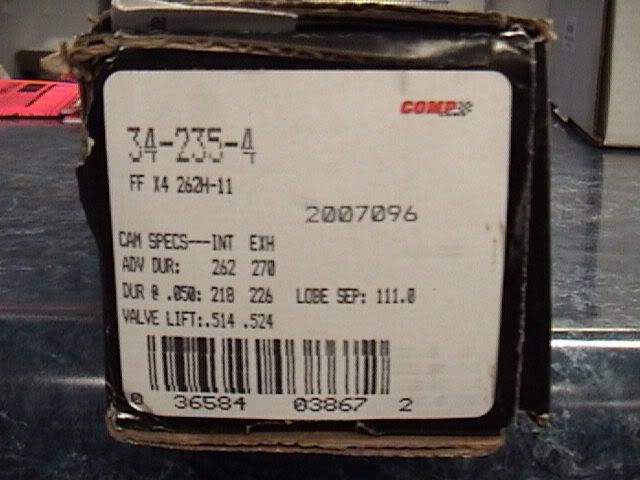
I'm not sure how much Vac the engine is making. I haven't taken the carb off yet to check the throttle plates. I did set the fast idle a bit today and adjusted the choke again. It still runs a bit rough at the start, but doesn't take too long before it starts to idle OK, but still takes a little time until the engine warms up a bit until I can put the truck in gear and run fine. I do have an RPM drop of about 300-400 from park to reverse/drive and seems like it's just to hard of a drop for the motor to keep running until it warms up a bit. I have the idle set right now at around 10-1100 RPMs so I have an "in gear idle" of around 700. Does that seem about right for some of these motors? I don't mind waiting a bit for the motor to warm up, but I really want to be able to just jump in and go. Before I started messing with the choke and fast idle screw, I was messing with mainly the 4 corner mixture screws and they seemed to not do anything for me. So then I was messing with the floats (which are set so the level is just under half on the site glass) and mixture screws and still not much of a difference. So, right now I can at least start the truck up and it will idle without me having to keep my foot on the gas just after few seconds, but still have the engine quitting when I put into gear until I have the engine warmed up a bit. How do I adjust the throttle blades if they are open to far?
I'm not sure how much Vac the engine is making. I haven't taken the carb off yet to check the throttle plates. I did set the fast idle a bit today and adjusted the choke again. It still runs a bit rough at the start, but doesn't take too long before it starts to idle OK, but still takes a little time until the engine warms up a bit until I can put the truck in gear and run fine. I do have an RPM drop of about 300-400 from park to reverse/drive and seems like it's just to hard of a drop for the motor to keep running until it warms up a bit. I have the idle set right now at around 10-1100 RPMs so I have an "in gear idle" of around 700. Does that seem about right for some of these motors? I don't mind waiting a bit for the motor to warm up, but I really want to be able to just jump in and go. Before I started messing with the choke and fast idle screw, I was messing with mainly the 4 corner mixture screws and they seemed to not do anything for me. So then I was messing with the floats (which are set so the level is just under half on the site glass) and mixture screws and still not much of a difference. So, right now I can at least start the truck up and it will idle without me having to keep my foot on the gas just after few seconds, but still have the engine quitting when I put into gear until I have the engine warmed up a bit. How do I adjust the throttle blades if they are open to far?
Post Fiend
Joined: Jul 2006
Posts: 6,948
Likes: 44
Fairly conservative on the cam huh? Thats a little feeller. Did your engine builder help you select that? Ran the exact cam on a mild almost stock 460, and it just left me wanting more. Stepped it up and was a little more pleased. Just hoping that this cam does not leave you feeling short changed with a large displacement engine.
Regardless it should make great off idle power, and should be responsive as can be.
Lets talk about the carb. Throttle blades or throttle position is just that. I feel that they are open too far. This simulates or at least re-creates a giant vacuum leak. This might explain the fact that the idle is so high.
Now, does it idle at over 1000 rpm all of the time or just when it is cold?
How does it rev once it has reached temp? Often times any engine requires a little temp to start reaching the proper tolerances and so forth. I mean even the engine has to have some temp in it.
Since you have mentioned that the idle screws have little affect on the engines performance, I feel that you have to use a vacuum gauge to see if this is true or not.
Since you notice very little change then it would appear that the transfer slot is exposed and you are not running on enough of the idle curcuit to feel or even see the effects that the idle screws have.
Do verify that you have zero, I mean zero vacuum leaks, and once again a good vacuum gauge will show you if you have a probelm.
Once you have one hooked up and you know without a doubt that you dont have any vacuum leaks,I believe that you will be able to lower the idle, by backing out the idle set screw, (not adjustments in the metering blocks) and lowering the idle. I believe that you should only realize a small, I mean minute drop in rpm when you engage the trans.
Once you can lower the idle by backing out the set screw, try adjusting the metering block idle adjustment screws for the front. You should see a change and if the throttle blade is closed enough, the engine will die if you seat the adjustement needle.
On any of my Demons, I usually run them out two turns, and verify that my throttle blade is only open so that I can measure .020" of the transfer slot. really, I dont adjust the idle with the throttle blade. Once in a while I may raise it by just touchng the rear blades ever so slightly and the engine will gain a hundred or two rpm. Your carb has an adjustable secondary shaft as well. You can try to close the front down and raise the rear slightly. Only a small bump on the set screw, this will make a big difference.
Last but not least, make sure that your K&N filter does not have too much oil. For some reason, this plays games with cold calibrations. I believe that you are close, and you should be able to tinker this thing into submission.
Regardless it should make great off idle power, and should be responsive as can be.
Lets talk about the carb. Throttle blades or throttle position is just that. I feel that they are open too far. This simulates or at least re-creates a giant vacuum leak. This might explain the fact that the idle is so high.
Now, does it idle at over 1000 rpm all of the time or just when it is cold?
How does it rev once it has reached temp? Often times any engine requires a little temp to start reaching the proper tolerances and so forth. I mean even the engine has to have some temp in it.
Since you have mentioned that the idle screws have little affect on the engines performance, I feel that you have to use a vacuum gauge to see if this is true or not.
Since you notice very little change then it would appear that the transfer slot is exposed and you are not running on enough of the idle curcuit to feel or even see the effects that the idle screws have.
Do verify that you have zero, I mean zero vacuum leaks, and once again a good vacuum gauge will show you if you have a probelm.
Once you have one hooked up and you know without a doubt that you dont have any vacuum leaks,I believe that you will be able to lower the idle, by backing out the idle set screw, (not adjustments in the metering blocks) and lowering the idle. I believe that you should only realize a small, I mean minute drop in rpm when you engage the trans.
Once you can lower the idle by backing out the set screw, try adjusting the metering block idle adjustment screws for the front. You should see a change and if the throttle blade is closed enough, the engine will die if you seat the adjustement needle.
On any of my Demons, I usually run them out two turns, and verify that my throttle blade is only open so that I can measure .020" of the transfer slot. really, I dont adjust the idle with the throttle blade. Once in a while I may raise it by just touchng the rear blades ever so slightly and the engine will gain a hundred or two rpm. Your carb has an adjustable secondary shaft as well. You can try to close the front down and raise the rear slightly. Only a small bump on the set screw, this will make a big difference.
Last but not least, make sure that your K&N filter does not have too much oil. For some reason, this plays games with cold calibrations. I believe that you are close, and you should be able to tinker this thing into submission.
Thread Starter
|
Post Fiend
Joined: Jan 2006
Posts: 5,037
Likes: 9
From: Kasson, Minnesota
My brother who built the engine with me helped me select the cam. We thought that this cam would be more responsive "off the line" than a larger one and figured we could always change it out to a larger one later if needed.
I'll have to get a good vacuum gauge. And as far as I know, I don't have any vac leaks, but I'll double and triple check.
Before I set the fast idle screw, the motor would only idle at around 6-700 RPMs, but I would have to keep it idled to around 1000 with my foot until it warmed up enough to hold it's own idle and after a few minutes of warming up, the motor starts to idle a bit higher until it reaches around 1000 where I have the idle screw set and that's where it sits at an idle when in park/neutral. It drops to 600-700 when in gear. I could have the idle set a bit lower, but the damn York A/C compressor pulls down a bit so I have to account for that too. But, when I get some time, I'll pull the carb off and see where I'm at with the blades and if I'm at that .020 mark.
Would the torque converter cause such a drop in my RPM from park to in gear if that doesn't have anything to do with my carb?
I'll have to get a good vacuum gauge. And as far as I know, I don't have any vac leaks, but I'll double and triple check.
Before I set the fast idle screw, the motor would only idle at around 6-700 RPMs, but I would have to keep it idled to around 1000 with my foot until it warmed up enough to hold it's own idle and after a few minutes of warming up, the motor starts to idle a bit higher until it reaches around 1000 where I have the idle screw set and that's where it sits at an idle when in park/neutral. It drops to 600-700 when in gear. I could have the idle set a bit lower, but the damn York A/C compressor pulls down a bit so I have to account for that too. But, when I get some time, I'll pull the carb off and see where I'm at with the blades and if I'm at that .020 mark.
Would the torque converter cause such a drop in my RPM from park to in gear if that doesn't have anything to do with my carb?
Thread Starter
|
Post Fiend
Joined: Jan 2006
Posts: 5,037
Likes: 9
From: Kasson, Minnesota
Well, did some more adjusting. I think your advice helped quite a bit Ed. The transfer slot looked to be open much more than .020. So, I adjusted that a bit. I also adjusted the float levels again and gave it a bit more in the site glass to about 1/2 way up. Then I started all over with the mixture screws and idle. Right now when cold, the engine starts pretty good and runs a bit rough for only a matter of 20 or 30 seconds and I can at least put it into gear and drive. I still have to keep the RPM up to around 1000 with my foot on the pedal while I shift and have to double foot the brake and gas pedal for a little longer, but much better. Before, I couldn't even shift into gear when cold without the dang thing dying. I also still have a slight hesitation when I step down on the pedal or when I'm throttling under the hood. I keep forgetting to get a Vacuum Gauge to check that out.
Trending Topics
Post Fiend
Joined: Jul 2006
Posts: 6,948
Likes: 44
Ahhh, I wrote a ton of stuff, but ofrgot that you have a quick fuel carb, and not a Demon. The Demon has some adjustments that the quick fuel does not.
Ok thats alright, we can move forward. It is common to see the blades open a little too far, and this exposed the transfer slot and makes tuning difficult. Larger cams make this a real problem, but it sounds as though you have a handle on it and we are seeing some improvement.
You can try to open the throttle blades ever so slightly on the secondary side. This will permit a little more air to pass and not contribute to transfer problems. ou should pick up about a hundred RPM and will (hopefully) get rid of that silght hesitation. This wil also help throttle response since you will actually have a slightly lean mixture at idle.
You may just be on the lean side anyway, but this is probably not the case. Symptoms for both are identical, but lets assume rich is the condition currently. Over 90% of the time that is the case.
Once the secondary throttle blades are open a tiny amount, I would expect that rough idle when cold to start going away. ABout the same improvement from the last little tweek can be expected again after you open the secondary side. DOnt go too far, or you will notice some problems with response and you will get a real fat condition.
AFter this, put the vacuum gauge on and see if the 4 corner idle screws are close.
Of course verifying that the fuel pressure is low enough, or at least not too high is also a very critical element in tuning a carb. I like to see around 6 to 7 psi. No more than that or the thing will freak out. Carbs like volume and not pressure so much.
If you have too much pressure you will create a problem and chase your tail.
If each of these are fine, the idle should be just about right and you should have response even while cold. Not as great as operating temps, but you should not have to double foot anything.
If after all of this results in a stumble, we can approach a larger shot of gas to compensate for the huge amount of air that the larger cam and bigger carb is now serving up, but this is probably last on the list.
Sounds as though the power valve(s) are right so some simple tweeks and small adjustments should get you right where you wanna be.
You are close. I can tell that you have some excitement going on. Keep it up, you are in the range of perfection. Its not far away.
Ok thats alright, we can move forward. It is common to see the blades open a little too far, and this exposed the transfer slot and makes tuning difficult. Larger cams make this a real problem, but it sounds as though you have a handle on it and we are seeing some improvement.
You can try to open the throttle blades ever so slightly on the secondary side. This will permit a little more air to pass and not contribute to transfer problems. ou should pick up about a hundred RPM and will (hopefully) get rid of that silght hesitation. This wil also help throttle response since you will actually have a slightly lean mixture at idle.
You may just be on the lean side anyway, but this is probably not the case. Symptoms for both are identical, but lets assume rich is the condition currently. Over 90% of the time that is the case.
Once the secondary throttle blades are open a tiny amount, I would expect that rough idle when cold to start going away. ABout the same improvement from the last little tweek can be expected again after you open the secondary side. DOnt go too far, or you will notice some problems with response and you will get a real fat condition.
AFter this, put the vacuum gauge on and see if the 4 corner idle screws are close.
Of course verifying that the fuel pressure is low enough, or at least not too high is also a very critical element in tuning a carb. I like to see around 6 to 7 psi. No more than that or the thing will freak out. Carbs like volume and not pressure so much.
If you have too much pressure you will create a problem and chase your tail.
If each of these are fine, the idle should be just about right and you should have response even while cold. Not as great as operating temps, but you should not have to double foot anything.
If after all of this results in a stumble, we can approach a larger shot of gas to compensate for the huge amount of air that the larger cam and bigger carb is now serving up, but this is probably last on the list.
Sounds as though the power valve(s) are right so some simple tweeks and small adjustments should get you right where you wanna be.
You are close. I can tell that you have some excitement going on. Keep it up, you are in the range of perfection. Its not far away.
Thread Starter
|
Post Fiend
Joined: Jan 2006
Posts: 5,037
Likes: 9
From: Kasson, Minnesota
More good advice!! Thanks. This is the first time I've ever messed with an Ethanol Carb. Ethanol seems like it's not as forgiving as gasoline so it can take some time to adjust and of course I'm not the most mechanically inclined when it comes to engine tuning. The other thing that makes this so frustrating is that when the motor warms up, it really runs pretty good so than I have to wait until it cools down again to see if any of my adjustments work. Very time consuming, but I think I'm at least on the right track.
Most of my other stuff I always had help from Bros, but I don't have that benefit anymore, so this is a learning game for me. Good thing we have these forums or I'd be screwed. Again, thanks for all your help.
Most of my other stuff I always had help from Bros, but I don't have that benefit anymore, so this is a learning game for me. Good thing we have these forums or I'd be screwed. Again, thanks for all your help.
Post Fiend
Joined: Jul 2006
Posts: 6,948
Likes: 44
Corn power huh? Even though the Ethanol is not quite the same as methanol, the tuning is similar, and every alky carb I have ever tuned with this has always had a volume problem.
Verify that the floats are not too high and the pressure is low enough to provide adequate volume. Pressure is not volume, and if the pressure is too high, the needles wont permit enough flow. This is true for loaded and unloaded conditions.
Improper fuel pressures here may require a slightly higher float level and will create a mixture problem (think this is where we are now) and can require most tuners to try to change jets to cure, and the snowball effect makes top end power suffer.
Lets get fuel pressure verified and see what happens.
Verify that the floats are not too high and the pressure is low enough to provide adequate volume. Pressure is not volume, and if the pressure is too high, the needles wont permit enough flow. This is true for loaded and unloaded conditions.
Improper fuel pressures here may require a slightly higher float level and will create a mixture problem (think this is where we are now) and can require most tuners to try to change jets to cure, and the snowball effect makes top end power suffer.
Lets get fuel pressure verified and see what happens.

Thread
Thread Starter
Forum
Replies
Last Post
KsCop
1980 - 1986 Bullnose F100, F150 & Larger F-Series Trucks
3
Dec 14, 2013 09:44 AM
brooklyn
1973 - 1979 F-100 & Larger F-Series Trucks
13
Jan 26, 2010 08:39 PM
toms86ford
1980 - 1986 Bullnose F100, F150 & Larger F-Series Trucks
13
Apr 22, 2007 03:42 PM
tgore3
1980 - 1986 Bullnose F100, F150 & Larger F-Series Trucks
8
Jul 30, 2006 09:14 PM
