


my 347 stroker thread
Thread Starter
|
Posting Guru
Joined: Dec 2008
Posts: 1,074
Likes: 1
From: Mass.
well, deck height is the distance from the top of the piston to the top of the shortblock correct? i dont know what the compression distance of the piston actually means, im assuming it has something to do with the height of the piston itself?
FTE Legend


Joined: Jun 2006
Posts: 31,930
Likes: 1,499
From: Ottawa, Ontario
I did my best to figure out what it should be and I come up with 10.4:1 CR with 60cc heads.. which seems to be similar to the other numbers you have posted. To me this is still a bit high for a motor that will have to push a 4000lb car around on pump gas so maybe you should consider the 64cc heads, that still produces a 9.95:1 CR.
In any event I get a motor that produces 417ft/lbs at 4000rpm and 380hp at 5500rpm.. which is more like what I think a 342 should do. That uses the actual AFR flow data and the E303 cam, the only thing I haven't plugged in is the intake airflow but I'm allowing for 800-1000cfm which is more than enough for the motor. Any carb intake produces more peak HP in the software but the low rpm TQ drops right off to 302 levels. Overall I think this is a more realistic gustimate of what it will actually do, particularly given the kit 73FOMO just posted, it's using more cam and better flowing heads and it still doesn't quite reach the numbers posted earlier for your 342.
In any event I get a motor that produces 417ft/lbs at 4000rpm and 380hp at 5500rpm.. which is more like what I think a 342 should do. That uses the actual AFR flow data and the E303 cam, the only thing I haven't plugged in is the intake airflow but I'm allowing for 800-1000cfm which is more than enough for the motor. Any carb intake produces more peak HP in the software but the low rpm TQ drops right off to 302 levels. Overall I think this is a more realistic gustimate of what it will actually do, particularly given the kit 73FOMO just posted, it's using more cam and better flowing heads and it still doesn't quite reach the numbers posted earlier for your 342.
Thread Starter
|
Posting Guru
Joined: Dec 2008
Posts: 1,074
Likes: 1
From: Mass.
I did my best to figure out what it should be and I come up with 10.4:1 CR with 60cc heads.. which seems to be similar to the other numbers you have posted. To me this is still a bit high for a motor that will have to push a 4000lb car around on pump gas so maybe you should consider the 64cc heads, that still produces a 9.95:1 CR.
i dont see a 64cc afr 185 head listed but there might be one available.
FTE Legend
Joined: Jun 2006
Posts: 31,930
Likes: 1,499
From: Ottawa, Ontario
It's simple, a heavier vehicle is a bigger load for the motor to push, so it won't rev as fast which means the combustion gases stay in the cylinder longer and more heat gets transferred to the heads and piston crown instead of pushed out the exhaust... which makes the motor more detonation prone.
Thread Starter
|
Posting Guru
Joined: Dec 2008
Posts: 1,074
Likes: 1
From: Mass.
hmm, ok i can see the reason behind that. afr only makes a 58,60,68cc head though. what thickness head gasket were you using to calculate? since in using this compression calculator when i change to a .041 gasket thickness with a 60cc head it come out to about 10.1:1 compression ratio
FTE Stories
Ford Trucks for Ford Truck Enthusiasts

Top 10 Fords at 2026 Carlisle Ford Nationals
Joe Kucinski
3 Best / 3 Worst Parts of Modern Ford Ownership
Brett Foote
10 Amazing Upgrades That Solve Common Ford Truck Owner Headaches
Pouria Savadkouei
Every 2026 Ford Engine Explained
Brett Foote
10 Ugly Ford Trucks That We Still Kinda Love
Joe Kucinski
10 Things Every Truck Owner NEEDS (2026 Edition)
Michael S. Palmer
Rezvani's Latest Post-Apocalyptic Monster Is a Ford F-150 Raptor Underneath
Verdad Gallardo
Top 10 Most Expensive Ford Trucks Ever Sold on Bring a Trailer
Joe Kucinski
2027 Ford Super Duty Buyer's Guide (Every Model, Engine, & Package)
Brett Foote
Postmaster
Joined: Jan 2009
Posts: 4,558
Likes: 2
You actually add +5cc or +11cc when calculating the compression ratio with fly cuts as you now have more volume in the combustion chamber. If you have dome tops it would be - cc's as you are taking away compression space. Hey check with the guys at T&L Engines in Charlotte N.C.. I used coated Speed Pro Hypers and they did custom flycuts on mine in their machine shop. I also got the whole stroker package from them and they did the balance work and everything. VERY reasonable. They also have a dyno and build full turn key engines to sell and for Nascar teams. Check 'em out on the web.
Lew....the GT40's have 64cc chambers. I had Manley ProFlo 1.94/1.60 valves installed and I did all of the port work. I have never had them flowed so I am using conservative numbers, but check out these numbers on a set flowed with the same valves. I'm sure my port work is probably not quite as good, but I made most of the same cuts. If I am flowing anywhere close to these numbers I am actually closer to 400h.p. I have not started my motor yet...I have RCI aluminum fuel cell left to install and plumbing for that. I have to install a flexible lower radiator hose, and put on my serpentine belt. Then the moment of truth. Oh, and I am also installing a Air Inlet Systems Dual 4" Ram Air Intake (try to get the most part of it done tomorrow). Here are the flow numbers that I spoke about and some pics of my motor and rebuilt c4 when I was sitting it the frame rails. I am pretty sure I am at least 360 on the low side and 400 on the high side.
Bottom numbers is ported with the Manley RaceFlo/ProFlo Valves
CFM flow chart
---------+--------+--------+--------+--------+--------+--------+--------
Valve | | | | | | |
Lift | .100" | .200" | .300" | .400" | .500" | .600" |
---------+--------+--------+--------+--------+--------+--------+--------
stock | | | | | | |
intake | | 111 | 159 | 183 | 185 | 190 |
---------+--------+--------+--------+--------+--------+--------+--------
#1 prting| | | | | | |
intake | | 115 | 166 | 193 | 208 | 210 |
---------+--------+--------+--------+--------+--------+--------+--------
1.94 prtd| | | | | | |
intake | 98 | 156 | 207 | 225 | 237 | 242 |
CFM flow chart
---------+--------+--------+--------+--------+--------+--------+--------
Valve | | | | | | |
Lift | .100" | .200" | .300" | .400" | .500" | .600" |
---------+--------+--------+--------+--------+--------+--------+--------
Stock | | | | | | |
exhaust | | 28.5 | 125 | 129 | 129 | |
---------+--------+--------+--------+--------+--------+--------+--------
#1 Prting| | | | | | |
Exhaust | | 101 | 142 | 172 | 174 | 173 |
---------+--------+--------+--------+--------+--------+--------+--------
1.6 prtd | | | | | | |
Exhaust | 127 | 155 | 178 | 195 | 203 | 203 |
(The comments below reflect the mods made with the 1.94/1.60" valve install)
* The final porting of the GT40 iron head in which 1.94/1.60 Manley
Race flow valves were used resulted in truly great flow numbers.
The large Manley valves appeared to aid both the intake and exhaust
significantly, with the exhaust gaining the most as predicted
due to an inferior small 1.54 valve for the port size and bowl
area after porting the 2nd time around. The Short-side radius
turn on the exhaust also was laid back perfectly this time
with a slightly decreasing radius from the valve job to the exit.
The exhaust port floor was untouched and the roof extensively
modified esp around the critical guide and thermactor hole locations.
The combustion chamber was lightly worked around it's outer edge to
eliminate any rough edges and lips that might hurt low lift flow.
* The Intake port on the 2nd porting with the 1.94" valve installed
was simply a bowl widening on the short turn port "wall" (not the
floor) and smoothing of the radius. After that operation, the bowl
was opened up and blended with a bottom cut for the larger valve.
The bottom cut left a rough edge and also made the narrowest point
in the intake port valve throat area. The 242cfm # was with this
rough spot still on the casting. It was later removed and the
bowl hand-blended (opened another .030" in radius), but it was
never reflowed. Thus it is surmised that the GT40 iron will go to
over 242cfm (maybe 250-260cfm).
* No special cuts were used on the intake valve which was a bone
stock Manley Race flow valve.
* Note the extremely high low lift exhaust flow #s. This is excellent
or ideal for a forced induction motor and even the killer low lift
intake flow is outpaced by the incredible exhaust flow from
.100" to .300". Also note the high intake to exhaust ratios throughout
the entire lift range.
* The extremely high low lift flow #s on both the intake and exhaust
and the high intake to exhaust ratios may require a revised camshaft
profile to take into account that the overlap period may have
substantially higher scavenging or reversion effects given the
increased low-lift flow over the unported heads.

Lew....the GT40's have 64cc chambers. I had Manley ProFlo 1.94/1.60 valves installed and I did all of the port work. I have never had them flowed so I am using conservative numbers, but check out these numbers on a set flowed with the same valves. I'm sure my port work is probably not quite as good, but I made most of the same cuts. If I am flowing anywhere close to these numbers I am actually closer to 400h.p. I have not started my motor yet...I have RCI aluminum fuel cell left to install and plumbing for that. I have to install a flexible lower radiator hose, and put on my serpentine belt. Then the moment of truth. Oh, and I am also installing a Air Inlet Systems Dual 4" Ram Air Intake (try to get the most part of it done tomorrow). Here are the flow numbers that I spoke about and some pics of my motor and rebuilt c4 when I was sitting it the frame rails. I am pretty sure I am at least 360 on the low side and 400 on the high side.
Bottom numbers is ported with the Manley RaceFlo/ProFlo Valves
CFM flow chart
---------+--------+--------+--------+--------+--------+--------+--------
Valve | | | | | | |
Lift | .100" | .200" | .300" | .400" | .500" | .600" |
---------+--------+--------+--------+--------+--------+--------+--------
stock | | | | | | |
intake | | 111 | 159 | 183 | 185 | 190 |
---------+--------+--------+--------+--------+--------+--------+--------
#1 prting| | | | | | |
intake | | 115 | 166 | 193 | 208 | 210 |
---------+--------+--------+--------+--------+--------+--------+--------
1.94 prtd| | | | | | |
intake | 98 | 156 | 207 | 225 | 237 | 242 |
CFM flow chart
---------+--------+--------+--------+--------+--------+--------+--------
Valve | | | | | | |
Lift | .100" | .200" | .300" | .400" | .500" | .600" |
---------+--------+--------+--------+--------+--------+--------+--------
Stock | | | | | | |
exhaust | | 28.5 | 125 | 129 | 129 | |
---------+--------+--------+--------+--------+--------+--------+--------
#1 Prting| | | | | | |
Exhaust | | 101 | 142 | 172 | 174 | 173 |
---------+--------+--------+--------+--------+--------+--------+--------
1.6 prtd | | | | | | |
Exhaust | 127 | 155 | 178 | 195 | 203 | 203 |
(The comments below reflect the mods made with the 1.94/1.60" valve install)
* The final porting of the GT40 iron head in which 1.94/1.60 Manley
Race flow valves were used resulted in truly great flow numbers.
The large Manley valves appeared to aid both the intake and exhaust
significantly, with the exhaust gaining the most as predicted
due to an inferior small 1.54 valve for the port size and bowl
area after porting the 2nd time around. The Short-side radius
turn on the exhaust also was laid back perfectly this time
with a slightly decreasing radius from the valve job to the exit.
The exhaust port floor was untouched and the roof extensively
modified esp around the critical guide and thermactor hole locations.
The combustion chamber was lightly worked around it's outer edge to
eliminate any rough edges and lips that might hurt low lift flow.
* The Intake port on the 2nd porting with the 1.94" valve installed
was simply a bowl widening on the short turn port "wall" (not the
floor) and smoothing of the radius. After that operation, the bowl
was opened up and blended with a bottom cut for the larger valve.
The bottom cut left a rough edge and also made the narrowest point
in the intake port valve throat area. The 242cfm # was with this
rough spot still on the casting. It was later removed and the
bowl hand-blended (opened another .030" in radius), but it was
never reflowed. Thus it is surmised that the GT40 iron will go to
over 242cfm (maybe 250-260cfm).
* No special cuts were used on the intake valve which was a bone
stock Manley Race flow valve.
* Note the extremely high low lift exhaust flow #s. This is excellent
or ideal for a forced induction motor and even the killer low lift
intake flow is outpaced by the incredible exhaust flow from
.100" to .300". Also note the high intake to exhaust ratios throughout
the entire lift range.
* The extremely high low lift flow #s on both the intake and exhaust
and the high intake to exhaust ratios may require a revised camshaft
profile to take into account that the overlap period may have
substantially higher scavenging or reversion effects given the
increased low-lift flow over the unported heads.

Fleet Mechanic
Joined: Aug 2005
Posts: 1,462
Likes: 74
From: Hartford, AL
Paul....can you run the carcraft build on your DD and see what you come up with? The freshened 302 with AFR heads and 1.7 rockers....I think they used 165's, but use the flow #'s that Torino gave us. I am curious as to why my DD is coming up with a different number than my DD. Also I ran on Virtual Dyno and got about the same torque and even more h.p....but I tend to lean towards the DD numbers. I only used 700 cfm for airflow and my compression was about a 1/2 point higher. Your numbers seem low. It's got more cam and 185's compared to the little Carcraft motor that cranked out 402 hp and 380 torque. I think the graph I showed of Torino's and Carcraft's 302 is accurate based on the build's. I still confident (+ or - 20) 425hp and I am saying around 450 (+ or - 20) on torque with a flat torque curve coming on early.....I believe it would match up similarly with the motor I posted....but I think that's a good buy at $4k. Throw on a 670 carb and your good to go.
Fleet Mechanic
Joined: Aug 2005
Posts: 1,462
Likes: 74
From: Hartford, AL
I found this dyno run on a stang forum.....
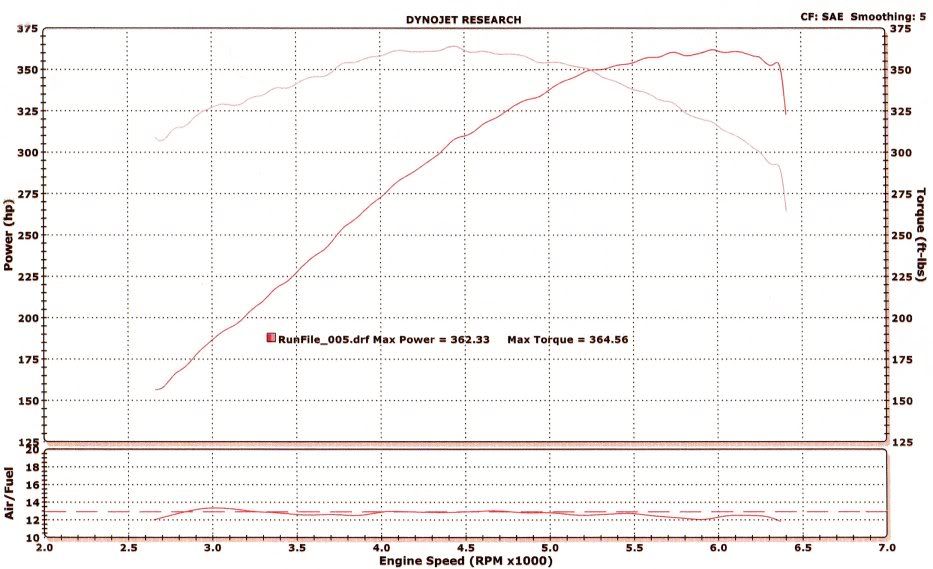
Ported/polished '69 C90E 351W, 1.94/1.60 valves (say that 3 times fast).
The engine is a 347, about 9.25:1 compression, AFM N-91 cam, Stealth intake, Holley 650dp, plus all the other typical bolt-ons.
This is rear wheel hp....if you take into account 15% higher numbers for flywheel hp 416hp/418tq.
The owner was obviously stoked about these numbers.
Ported/polished '69 C90E 351W, 1.94/1.60 valves (say that 3 times fast).
The engine is a 347, about 9.25:1 compression, AFM N-91 cam, Stealth intake, Holley 650dp, plus all the other typical bolt-ons.
This is rear wheel hp....if you take into account 15% higher numbers for flywheel hp 416hp/418tq.
The owner was obviously stoked about these numbers.
FTE Legend
Joined: Jun 2006
Posts: 31,930
Likes: 1,499
From: Ottawa, Ontario
What type induction did you use for your simulation? I used tuned port injection which is supposed to mimic GM TPI, and that's essentially the same as the Ford style EFI intakes. I really don't see a little 342 producing 450 ft lbs TQ at low rpms, that's strictly 408 stroker and 460 territory. It can certainly produce big HP with the right cam and induction but it'll be at high rpms.
Thread Starter
|
Posting Guru
Joined: Dec 2008
Posts: 1,074
Likes: 1
From: Mass.
perhaps a 351W block with stock bore and stroke with the same head/intake setup would? im kind of curious how a 351 with the same mods would compare, although id probably use a different cam for a 351
FTE Legend
Joined: Jun 2006
Posts: 31,930
Likes: 1,499
From: Ottawa, Ontario
Well the E-cam is hardly optimal for this motor and application, it'll do a lot better in the TQ department with others like the Comp 35-320-8. With that I get 425+ ft lbs from 2000rpm up peaking at 440 at 4000rpm. Peak HP is still 395 at 5500rpm.