



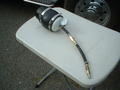


exhaust brake mod

Posting Guru
Joined: Nov 2006
Posts: 1,059
Likes: 0
From: Herndon KY
Originally Posted by c00nhunterjoe
i hooked the ngs up to the truck today to moniter backpressure. at idle with the brake on it goes to 25-26 psi. at 2500 rpm with the converter locked it goes to 50 psi! i didnt go higher then 2500 due to the 50 psi number, thats too high for my comfort zone. even 2000 was at 45-48 psi with no load on the truck.

Post Fiend
Joined: Apr 2004
Posts: 12,835
Likes: 3
From: Silver Lake Dunes, MI

Originally Posted by bkcowboss
I am not sure what a NGS is but are you sure you were not monitoring Absolute pressure instead of differential pressure? If you were recieving absolute pressure you can subtract 14-15 psi from all of those numbers, still seems a little high but not as far off as what I or neal have seen. I suppose the best way to tell is read the NGS reading with the KOEO
FTE Stories
Ford Trucks for Ford Truck Enthusiasts

10 Things Every Truck Owner NEEDS (2026 Edition)
Michael S. Palmer
Rezvani's Latest Post-Apocalyptic Monster Is a Ford F-150 Raptor Underneath
Verdad Gallardo
Top 10 Most Expensive Ford Trucks Ever Sold on Bring a Trailer
Joe Kucinski
2027 Ford Super Duty Buyer's Guide (Every Model, Engine, & Package)
Brett Foote
Top 10 Ford Truck Tragedies
Joe Kucinski
AEV FXL Super Duty - the Super Duty Raptor Ford Doesn't Make
Brett Foote
Lobo Vs Lobo: Proof the F-150 Lobo Should Be Even Lower!
Michael S. Palmer
Ford's 2001 Explorer Sportsman Concept Looks For a New Home
Verdad Gallardo
10 Best Ford Truck Engines We Miss the Most!
Joe Kucinski
Thread Starter
|
Lead Driver

Joined: May 2007
Posts: 8,608
Likes: 13
From: Belair md
ngs is the ford scan tool, i moniter ebp which is the exhaust backpressure sensor. a properly operating sensor reading stmospheric pressure at koeo or 14.7 in my case, map baro and ebp should all be within .5 psi of each other koeo so in response to the question yes my reading of 50 psi you can subract 14.7 from it for an actual pressure reading on the exhaust itself giving me 35 psi which is why i said i am on the high side of "tolerable" since the consensous on other posts is that head gaskets are good for 40 psi boost. but also as madvan said the motor has 236k on it, granted she runs good but i want to keep it that way.......

Senior User
Joined: Jun 2007
Posts: 369
Likes: 0
Homemade exhaust brake
<!-- / icon and title --><!-- message -->
The Engine Exhaust Back Pressure Valve (EBPV) is a butterfly type valve located on the outlet of the turbocharger, between the turbine and the down pipe. It is controlled by the Power train Control Module (PCM), and activated by engine oil pressure. Its purpose is to decrease engine warm up time in cold weather by restricting exhaust flow out of the engine. It can be very easily and very inexpensively converted into an engine exhaust brake by adding some simple wiring and a switch.
The valve is very practical for assisting braking. When used correctly its braking effect can be compared to the restriction gained by downshifting one gear while descending a hill. The valve is most valuable to braking when engine speed is between 2500 and 3000 RPM. Unfortunately, it will lose the engine braking abilities when engine speed drops below 2000 RPM.
The following method outlines the manner in which the EBPV can be converted to a braking device. The following will cover any vehicle equipped with a manual transmission. Vehicles equipped with automatic transmissions will require an additional circuit to be added in order to maintain torque converter lockup while the exhaust brake is activated. That circuit will be addressed at the end of this article, however the majority of this article is applicable for both transmission types.
In order to control the function of the EBPV, I recommend using a 3-position switch. This type of switch will control the Valve in the following manner:
Switch in the OFF Position (center position): The EBPV will function normally, as it would for a stock vehicle. This means that the valve will only actuate in order to warm up the engine.
Switch in the "A" ON Position: the EBPV closes and remains closed until the switch is turned OFF.
Switch in the “B” ON Position: the EBPV will close whenever the brake pedal is pressed, and will open when the pedal is released. There will be a 2-3 second lag for the exhaust valve to close upon stepping on the brake. Thus, it is important to understand that when using it in the "B" ON position to push the pedal and hold it down with steady pressure. The reason for keeping pedal pressure is that the EBPV actuator is receiving power from the brake light circuit when the switch is in this position. Thus, pumping the brakes or releasing the pedal will cause the valve to deactivate or open. Furthermore, once the brake is applied again it will take another two seconds for the EBPV to activate again. Unfortunately, pumping the brake pedal will result in the exhaust valve remaining in a constant open position. This will provide ZERO engine braking force. To prevent this less than desirable phenomenon from happening, it is important the operator keep his foot on the brake lightly enough that the brake light switch is continually activated. I prefer touching and holding my pedal just hard enough for the brake lights to come on; then, when I hear the EBPV close (it makes a distinct hissing), I begin applying additional pressure to the brake pedal. Reducing brake pedal pressure can be done without losing exhaust-braking force, as long as there is enough pedal pressure maintained to keep the brake lights on.
Materials:
•
(1) ON-OFF-ON type Heavy Duty Double-Pole Double-Throw (DPDT) toggle switch. It will have connections for 6 wires on the back, and the switch will have 3 positions UP=ON, CENTER=OFF, DOWN=ON. RS (Radio Shack)# 275-1533A $2.49 or 275-710 $2.99 • 25'-30' of 18 gauge wire. 5'-7' each of 4 different colors is best. • (10-12) Ring or Spade terminals for wire connections. 18-22 gauge are red. RS# 64-3032A or 64-3033A $1.49 (4-6) Butt connectors for wires. 18-22 gauge are red. RS# 64-3037A $1.49 • (2) Rectifier Diodes. A diode is the equivalent on an electrical check valve, allowing current to flow in only one direction. RS# 276-1114 • (2) Optional Mini Indicator lamps. RS# 276-085A (red) 276-084A (green) $1.99 each. (By using the switch indicator lights, the operator immediately knows how the EBPV is activated or not.) • 10' Split loom for protecting wires. RS# 278-1264 $3.99 • (10) Wire ties. • (1) Inline fuse holder. RS# 270-1213 $1.99 • Electrical tape. I recommend Liquid Electrical Tape as being better for almost everything. • Tape and Marker (In order to label wires.)
Tools:
•
Wire cutters/strippers • Screw Drivers • Drill w/ bits up to 7/16" • Volt/Ohm Meter, or at least a test light. • Soldering Iron is recommended but not essential. • Torx bits &/or 1/4" drive metric sockets to remove dashboard trim to install switch.
Procedure:
Decide on a place in the dash to install the switch. I installed mine in the black panel just to the right of the "Wait to Start" light. There is room for 2-3 switches there.
Remove the necessary trim and molding around the steering column / instrument panel to access the reverse side of where you want the switch. Drill a 1/2" hole, and install the switch. Re-install the molding to make sure it fits into place when the switch is installed. Then, remove the switch and the molding again for ease of access while wiring.
Wire #1: Decide what you will use for a positive power source. Insure that this source is one that is "ON" only when the ignition is in the “ON” position. I recommend the 8 gauge, gray/yellow wire in the bundle under the steering column. You can also tap a fuse in the fuse panel. Run wire [#1] from the source to the switch, connecting it to terminal A2. I numbered the terminals as viewed from the back of the switch Install the inline fuse holder on this line. Make sure to leave 6"-12" or more of slack on all the wires. You can always bundle them up later.
Wire #2: Decide placement of a negative power point or ground, and run a wire from this to the switch, connecting it to terminal C1.
Connect one light to terminals A1 and C2; this is light A. Connect the other light to terminals B1 and C2; this is light B. Drill holes for the lights just above and below the switch. Install the lights with B in the top hole, and A in the bottom. I recommend this because when the switch is down, contact is made between A+C; when the switch is up, contact is between B+C. For simplicity, the diagram does not show the lights "crossed" like this.
Remove the black-hinged cover from over the fuel filter area in the engine compartment.
Wires#3 & #4: Run two wires from the switch through the firewall into the engine compartment. Connect one [#3] to terminal C2 and run it to the front of the engine. Connect the other [#4] to terminal B2 and run it to the brake master cylinder. If you have a horizontal diamond shaped plate about 2.5" wide just to the passenger's side of the clutch cylinder, remove the screws and run the wires through it. Otherwise, you may need to drill a hole. I always find that running the wires is the hardest part of any wiring project.
There should be a green wire by the driver's side of the master cylinder in the group of 4 marked "Center High Mount Stop Lamp Feed." This wire most likely will not be connected to anything. This wire is only energized when the brake lights come on. Connect wire [#4] to this one. If this wire is not present, use a voltmeter or test light to find a wire that is hot only when the brake lights are on and connect to that wire instead.
Locate the wires that travel from the PCM to the EBPV. There should be a 2-wire plug just under the turbo compressor. It is located towards the front of the engine between the turbocharger and the fuel pump on the intake side of the turbocharger. The plug is attached to the turbo pedestal. Disconnect this plug, and remove the loom (protective plastic shielding) on the plug side moving away from the turbo, to expose the wires inside. Slide off the loom until it reaches the intersection of the larger wire bundle. This will expose both wires; one wire is black w/gray, the other gray w/red.
The Two Rectifier Diodes that are required will each have a silver band around one end. Twist the wires from the "silver" ends together making a "Y.” The "black" ends will be at the top and the silver ends at the bottom of the "Y.” Cut the gray w/red wire 2"-3" before the plug, strip the insulation back 1/2" or so, and solder the black end on one diode to the end of the cut wire that does NOT go into the plug. Solder the black end on the other diode to wire [#3]; solder the two silver ends to the gray w/red wire that goes into the plug. The diodes are necessary to prevent the brake lights from coming on when the PCM operates the EBPV, and to prevent the PCM from receiving a 12v signal from wire [#1]. If you don't have a soldering iron, you can use crimp connectors.
Coat all the wire connections with several coats of Liquid Electrical Tape, then wrap them with regular electrical tape, and replace the loom. Also, cover wires [#3 & #4] with loom, all the way to the switch. Bundle up any excess wire with wire ties, and secure them all to prevent chafing. Install the switch in its hole, and replace the dash trim.
Automatic Transmission Circuit:
If the intention is to use the EBPV as a brake with an Automatic Transmission equipped vehicle, then an additional circuit is required in order to reap the most engine braking benefit from this application. This circuit will keep the torque converter locked up while the valve is in an activated state. In effect, it maintains engine RPM in relation to ground speed and prevents transmission disconnection, which would result in loss of engine speed, ultimately reducing the effectiveness of the exhaust valve as an engine brake.
Auto Trans Circuit Procedure: Run a wire from [#3] to connect to the TC lockup circuit. Install a diode on that wire with the silver end towards the transmission.
Must say i got this write up off powerstorke.org.
<!-- / icon and title --><!-- message -->
The Engine Exhaust Back Pressure Valve (EBPV) is a butterfly type valve located on the outlet of the turbocharger, between the turbine and the down pipe. It is controlled by the Power train Control Module (PCM), and activated by engine oil pressure. Its purpose is to decrease engine warm up time in cold weather by restricting exhaust flow out of the engine. It can be very easily and very inexpensively converted into an engine exhaust brake by adding some simple wiring and a switch.
The valve is very practical for assisting braking. When used correctly its braking effect can be compared to the restriction gained by downshifting one gear while descending a hill. The valve is most valuable to braking when engine speed is between 2500 and 3000 RPM. Unfortunately, it will lose the engine braking abilities when engine speed drops below 2000 RPM.
The following method outlines the manner in which the EBPV can be converted to a braking device. The following will cover any vehicle equipped with a manual transmission. Vehicles equipped with automatic transmissions will require an additional circuit to be added in order to maintain torque converter lockup while the exhaust brake is activated. That circuit will be addressed at the end of this article, however the majority of this article is applicable for both transmission types.
In order to control the function of the EBPV, I recommend using a 3-position switch. This type of switch will control the Valve in the following manner:
Switch in the OFF Position (center position): The EBPV will function normally, as it would for a stock vehicle. This means that the valve will only actuate in order to warm up the engine.
Switch in the "A" ON Position: the EBPV closes and remains closed until the switch is turned OFF.
Switch in the “B” ON Position: the EBPV will close whenever the brake pedal is pressed, and will open when the pedal is released. There will be a 2-3 second lag for the exhaust valve to close upon stepping on the brake. Thus, it is important to understand that when using it in the "B" ON position to push the pedal and hold it down with steady pressure. The reason for keeping pedal pressure is that the EBPV actuator is receiving power from the brake light circuit when the switch is in this position. Thus, pumping the brakes or releasing the pedal will cause the valve to deactivate or open. Furthermore, once the brake is applied again it will take another two seconds for the EBPV to activate again. Unfortunately, pumping the brake pedal will result in the exhaust valve remaining in a constant open position. This will provide ZERO engine braking force. To prevent this less than desirable phenomenon from happening, it is important the operator keep his foot on the brake lightly enough that the brake light switch is continually activated. I prefer touching and holding my pedal just hard enough for the brake lights to come on; then, when I hear the EBPV close (it makes a distinct hissing), I begin applying additional pressure to the brake pedal. Reducing brake pedal pressure can be done without losing exhaust-braking force, as long as there is enough pedal pressure maintained to keep the brake lights on.
Materials:
•
(1) ON-OFF-ON type Heavy Duty Double-Pole Double-Throw (DPDT) toggle switch. It will have connections for 6 wires on the back, and the switch will have 3 positions UP=ON, CENTER=OFF, DOWN=ON. RS (Radio Shack)# 275-1533A $2.49 or 275-710 $2.99 • 25'-30' of 18 gauge wire. 5'-7' each of 4 different colors is best. • (10-12) Ring or Spade terminals for wire connections. 18-22 gauge are red. RS# 64-3032A or 64-3033A $1.49 (4-6) Butt connectors for wires. 18-22 gauge are red. RS# 64-3037A $1.49 • (2) Rectifier Diodes. A diode is the equivalent on an electrical check valve, allowing current to flow in only one direction. RS# 276-1114 • (2) Optional Mini Indicator lamps. RS# 276-085A (red) 276-084A (green) $1.99 each. (By using the switch indicator lights, the operator immediately knows how the EBPV is activated or not.) • 10' Split loom for protecting wires. RS# 278-1264 $3.99 • (10) Wire ties. • (1) Inline fuse holder. RS# 270-1213 $1.99 • Electrical tape. I recommend Liquid Electrical Tape as being better for almost everything. • Tape and Marker (In order to label wires.)
Tools:
•
Wire cutters/strippers • Screw Drivers • Drill w/ bits up to 7/16" • Volt/Ohm Meter, or at least a test light. • Soldering Iron is recommended but not essential. • Torx bits &/or 1/4" drive metric sockets to remove dashboard trim to install switch.
Procedure:
Decide on a place in the dash to install the switch. I installed mine in the black panel just to the right of the "Wait to Start" light. There is room for 2-3 switches there.
Remove the necessary trim and molding around the steering column / instrument panel to access the reverse side of where you want the switch. Drill a 1/2" hole, and install the switch. Re-install the molding to make sure it fits into place when the switch is installed. Then, remove the switch and the molding again for ease of access while wiring.
Wire #1: Decide what you will use for a positive power source. Insure that this source is one that is "ON" only when the ignition is in the “ON” position. I recommend the 8 gauge, gray/yellow wire in the bundle under the steering column. You can also tap a fuse in the fuse panel. Run wire [#1] from the source to the switch, connecting it to terminal A2. I numbered the terminals as viewed from the back of the switch Install the inline fuse holder on this line. Make sure to leave 6"-12" or more of slack on all the wires. You can always bundle them up later.
Wire #2: Decide placement of a negative power point or ground, and run a wire from this to the switch, connecting it to terminal C1.
Connect one light to terminals A1 and C2; this is light A. Connect the other light to terminals B1 and C2; this is light B. Drill holes for the lights just above and below the switch. Install the lights with B in the top hole, and A in the bottom. I recommend this because when the switch is down, contact is made between A+C; when the switch is up, contact is between B+C. For simplicity, the diagram does not show the lights "crossed" like this.
Remove the black-hinged cover from over the fuel filter area in the engine compartment.
Wires#3 & #4: Run two wires from the switch through the firewall into the engine compartment. Connect one [#3] to terminal C2 and run it to the front of the engine. Connect the other [#4] to terminal B2 and run it to the brake master cylinder. If you have a horizontal diamond shaped plate about 2.5" wide just to the passenger's side of the clutch cylinder, remove the screws and run the wires through it. Otherwise, you may need to drill a hole. I always find that running the wires is the hardest part of any wiring project.
There should be a green wire by the driver's side of the master cylinder in the group of 4 marked "Center High Mount Stop Lamp Feed." This wire most likely will not be connected to anything. This wire is only energized when the brake lights come on. Connect wire [#4] to this one. If this wire is not present, use a voltmeter or test light to find a wire that is hot only when the brake lights are on and connect to that wire instead.
Locate the wires that travel from the PCM to the EBPV. There should be a 2-wire plug just under the turbo compressor. It is located towards the front of the engine between the turbocharger and the fuel pump on the intake side of the turbocharger. The plug is attached to the turbo pedestal. Disconnect this plug, and remove the loom (protective plastic shielding) on the plug side moving away from the turbo, to expose the wires inside. Slide off the loom until it reaches the intersection of the larger wire bundle. This will expose both wires; one wire is black w/gray, the other gray w/red.
The Two Rectifier Diodes that are required will each have a silver band around one end. Twist the wires from the "silver" ends together making a "Y.” The "black" ends will be at the top and the silver ends at the bottom of the "Y.” Cut the gray w/red wire 2"-3" before the plug, strip the insulation back 1/2" or so, and solder the black end on one diode to the end of the cut wire that does NOT go into the plug. Solder the black end on the other diode to wire [#3]; solder the two silver ends to the gray w/red wire that goes into the plug. The diodes are necessary to prevent the brake lights from coming on when the PCM operates the EBPV, and to prevent the PCM from receiving a 12v signal from wire [#1]. If you don't have a soldering iron, you can use crimp connectors.
Coat all the wire connections with several coats of Liquid Electrical Tape, then wrap them with regular electrical tape, and replace the loom. Also, cover wires [#3 & #4] with loom, all the way to the switch. Bundle up any excess wire with wire ties, and secure them all to prevent chafing. Install the switch in its hole, and replace the dash trim.
Automatic Transmission Circuit:
If the intention is to use the EBPV as a brake with an Automatic Transmission equipped vehicle, then an additional circuit is required in order to reap the most engine braking benefit from this application. This circuit will keep the torque converter locked up while the valve is in an activated state. In effect, it maintains engine RPM in relation to ground speed and prevents transmission disconnection, which would result in loss of engine speed, ultimately reducing the effectiveness of the exhaust valve as an engine brake.
Auto Trans Circuit Procedure: Run a wire from [#3] to connect to the TC lockup circuit. Install a diode on that wire with the silver end towards the transmission.
Must say i got this write up off powerstorke.org.

Thread
Thread Starter
Forum
Replies
Last Post
tjmike
1999 - 2003 7.3L Power Stroke Diesel
9
Feb 2, 2015 09:24 PM