




Backfiring/Popping Timing issue?

Thread Starter
|
Mountain Pass

Joined: Oct 2019
Posts: 120
Likes: 0
Backfiring/Popping Timing issue?
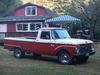
I have a 1964 F350 with a 292 engine, The carb has been set up, the plugs and wires are all new, and headers and new exhaust system was just installed. I have noticed that when the I decelerate by downshifting, braking or take my foot of the gas going down I get a popping sound coming from the exhaust. Last summer I noticed the same thing, I took it to the mechanic and he said it was normal, then I got on the highway and bang a muffler split, that's why the exhaust system has been replaced. I figures it was caused as the exhaust manifold had no gasket and were leaking, I am surprised that with a new exhaust system I am still hearing a popping sound. I had the shop that installed the exhaust have a listen and they too said it was normal.
I am thinking it may be timing, but not sure. The only other symptom is when I tramp down on the pedal she stumbles before it takes off.
I have never had to advance or retard the timing, I found a write up that makes it seem fairly simple, that being said any advise or guidance will be appreciated. I do not have a timing light, vacuum gauge, or any special tool for timing.
Thanks
I am thinking it may be timing, but not sure. The only other symptom is when I tramp down on the pedal she stumbles before it takes off.
I have never had to advance or retard the timing, I found a write up that makes it seem fairly simple, that being said any advise or guidance will be appreciated. I do not have a timing light, vacuum gauge, or any special tool for timing.
Thanks
Logistics Pro


Joined: Jun 2018
Posts: 3,551
Likes: 442
The back firing and blown muffler is the product of raw fuel in the exhaust igniting. So somewhere someway that fuel is not being ignited in the cylinder and just being passed off. I still say something is wrong with the firing order.

Logistics Pro


Joined: May 2015
Posts: 4,467
Likes: 961
From: Tri Cities, TN

You are experiencing classic symptoms of the distributor advance mechanisms not working properly. When you decelerate you have a very lean mixture. In order to keep the fire lit and not put raw fuel in the exhaust it takes a lot of advance 30 degrees +. If your mechanic has a dial back timing light and a hand held vacuum pump he can trouble shoot your distributor in 10 minutes. But don't take it to the one who told you that popping out the exhaust was normal.
I don't have the specific specs for your truck but these are for a 292 and should be in the ballpark.
This is crankshaft degrees.
Centrifugal advance start, 4 degrees @ 1600 rpm, max. 24 degrees @ 4000rpm
Vacuum advance, start @ 7 inches of vacuum, max. 24 degrees @ 20 inches.
I don't have the specific specs for your truck but these are for a 292 and should be in the ballpark.
This is crankshaft degrees.
Centrifugal advance start, 4 degrees @ 1600 rpm, max. 24 degrees @ 4000rpm
Vacuum advance, start @ 7 inches of vacuum, max. 24 degrees @ 20 inches.
Thread Starter
|
Mountain Pass
Joined: Oct 2019
Posts: 120
Likes: 0
I think the timing marks may be gone on, I cant find a pointer. Anyone have a pic of what I'm looking for. They were easy to find on my 68 Mustang but I can not see anything on the 292 Y block.
Trending Topics
Logistics Pro
Joined: Jun 2018
Posts: 3,551
Likes: 442
FTE Stories
Ford Trucks for Ford Truck Enthusiasts

2027 Ford Super Duty Buyer's Guide (Every Model, Engine, & Package)
Brett Foote
Top 10 Ford Truck Tragedies
Joe Kucinski
AEV FXL Super Duty - the Super Duty Raptor Ford Doesn't Make
Brett Foote
Lobo Vs Lobo: Proof the F-150 Lobo Should Be Even Lower!
Michael S. Palmer
Ford's 2001 Explorer Sportsman Concept Looks For a New Home
Verdad Gallardo
10 Best Ford Truck Engines We Miss the Most!
Joe Kucinski
2026 Shelby F-150 Off-Road: Better Than a Raptor R?
Brett Foote
2027 Super Duty Carhartt Package First Look: 12 Things You NEED to Know!
Michael S. Palmer
10 Most Surprising 2026 Ford Truck Features!
Joe Kucinski
Thread Starter
|
Mountain Pass
Joined: Oct 2019
Posts: 120
Likes: 0
I planed on trying a wire brush or sand paper on the balancer when I get a few minutes, however there doesn't seem to be a pointer anywhere I can see.

Cross-Country
Joined: Dec 2019
Posts: 79
Likes: 2
From: Durham
Pulley should have a notch in it for TDC. You can also just try turning your distributor a little each way youself until you notice an improvement. Just loosen the one bolt holding the distributor down to the engine block.

Logistics Pro
Joined: May 2015
Posts: 4,467
Likes: 961
From: Tri Cities, TN
292 timing
If the timing pointer is missing. You need to figure out which one you need and put one on it. You don't know if your mechanical and vacuum advance is working or not. If you start cranking around on that distributor without the benefit of a timing light or even knowing where TDC is. You could end up with an engine that won't run or you could burn a hole in a piston in which case you end up with an engine that won't run.


Fleet Mechanic


Joined: Sep 2016
Posts: 1,459
Likes: 70
From: Southern Maryland
The first thing you need to do is find top dead center. Use a piston stop and rotate the engine in both directions until it hits the stop. Halfway between those points is TDC. Fabricate a pointer that points to that spot. Eventually you can look for the factory pointer that corresponds to that location.
Then follow Crop Dusters directions for checking your distributor curves. If they aren't very close, you need to pull it and have it re-curved. I suspect Crop Duster is right, your distributor is not advancing properly. Moving initial timing back and forth could do serious damage. Take the time to find and fix what's wrong, don't just start making changes hoping something works.
Then follow Crop Dusters directions for checking your distributor curves. If they aren't very close, you need to pull it and have it re-curved. I suspect Crop Duster is right, your distributor is not advancing properly. Moving initial timing back and forth could do serious damage. Take the time to find and fix what's wrong, don't just start making changes hoping something works.
Cross-Country
Joined: Dec 2019
Posts: 79
Likes: 2
From: Durham
Keep in mind old Studebakers had a lever inside the cab that the operator could use to advance or retard the timing. Similar to a choke, the lever connected the operator to the distributor via a cable. Your senses can go a long way to timing your engine and curing any of its aches and pains.

Thread
Thread Starter
Forum
Replies
Last Post
jurban
1973 - 1979 F-100 & Larger F-Series Trucks
20
Nov 15, 2009 12:24 PM
PetesPonies
FE & FT Big Block V8 (332, 352, 360, 390, 406, 410, 427, 428)
3
Jun 6, 2001 06:11 PM