When you click on links to various merchants on this site and make a purchase, this can result in this site earning a commission. Affiliate programs and affiliations include, but are not limited to, the eBay Partner Network.
Close the vanes as far as they go to begin with and open them up from there if needed. The instructions they give to adjust them are backwards. I run mine as tight as it will go, the factory adjustment is nowhere near where you want it to be.
Are you running a drive pressure gauge as well?
Thinking about getting a combo boost/ebp gauge for my truck but it is parked for the winter so it doesn’t really matter.
Yes I’m running a boost gauge and exhaust back pressure gauge. I notice the 364.5/73/.91 is more than 1:1 down low (ex: 10 lbs of boost 8-9 lbs of back pressure) and at 2500 rpm plus getting on it, it’s about 1:1. I assume that’s why it’s lazy downlow
It is here!!!! my HX4O flange is on its way and should be here saturday. I will get that welded up to the downpipe so the turbonator accepts the downpipe.
I noticed the T4 flange on the turbonator is open. and the irate T4 kit is a divided flange. Does that matter? Do I have to cut out the divider on the exhaust flange?
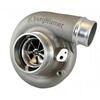
While this isnt mandatory, I figured I would get the ball rolling if I do in fact want to change out my compressor wheel. I reached out to Mamba, it appears they already make a wheel for a 364.5 but in a factory form of 7+7. I asked if they could make an 11+0. Thankfully @brokestroke has done the research and noticed modern VGT turbos use 10 or 11 blade wheels and when he had a surging issue off throttle going to an 11+0 on his S363 made it better and even helped low end spool even more. They seem to be onboard with making new wheels since their site says reach out if you don't see an application you need.
That thing looks like it gained 50 more horses just sitting there, without the turbo.
When did you get the uppies done? I don't recall seeing any installation photos from you showing the flames of hades that singe the hair off of forearms in the endeavor, due to the difficulty.
Just post a link to your write up if I over looked it. I tend to gloss over engine stuff and focus on chassis stuff when I read. I figure if the engine starts and runs, we're good. However, your approach to all of the challenges you have faced since you acquired this unusual vehicle of yours has never failed to intrigue, and obviously you must have committed to a different turbo when you did the up pipes. Don't know how I missed it.
@Y2KW57 I did them in 2020. The truck was in such rough shape it essentially needed a turbo, injectors and a transmission within months.
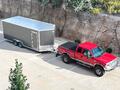
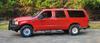
Seeing you are into chassis stuff and the truck has a unique frame stretch, I figured I would share. I would love to know the exact history on this truck. Here is what I know. I believe it was owned by the state of CA, I remember the previous owner saying it but don't have it in writing. I am almost sure of it though. I do know it was professionally stretched immediately. the door sticker shows a manufacturer completion tag from carter industries in redwood city, CA in December of 1999. The first owner (State of CA?) sold it to the guy I bought it from in 2019. He had it for a year then the trucks were banned in CA and sold it to me. The bed was transferred from another truck or it sat unbought for a few years because the bed was manufactured in 1996. The truck is a 2000. When peeling off stickers I found it was registered by the fleet/company/state (whoever it was) at 30k lbs in the 2000s. The hitch pin hole was pretty wallowed out when I got it. I do not think the previous owner hauled much. He was using it to help people move. He didn't appear to have any trailers or anything. I have put about 22k miles on it and it has always grossed 20-30k lbs. I think the 400k miles it has lived have been a very rough and hard 400k miles, especially seeing the hitch pin hole.
The "30K" registration sticker on the fender is not just for the truck... it is for the weight of the truck plus the load on the truck AND the trailer plus the load on the trailer, all combined.
That type of registration was the result of the Commercial Vehicle Registration Act (CVRA) that began in 2001, which removed weight registration fees from trailers, and transferred the assessment of those fees to the trucks that pull trailers, and created Permanent Trailer Identification tags (PTI) for trailers, that were weight fee neutral, and had 5 year expiration periods, instead of every year, like trucks that have their own motive power.
So don't interpret the "30K" sticker as indicative of the weight that was borne by the truck itself, which either had a 17,500 GVWR or a 19,000 GVWR as originally built by Ford, and as determinable by the Federal Certification Label at the bottom of the B pillar between doors. I forget if you have a crew cab or a regular cab. That will make a difference in terms of available GVWR ratings, as Ford offered the higher GVWR in the regular cab, and a thicker L shaped frame reinforcement for longer native cab to axle distances available in Regular cabs.
Carter Industries went out of business more than a dozen years ago. They moved from high rent Redwood City (Silicon Valley) across the bay to industrial Union City during the dot com boom, and then faltered in the aftermath of the Recession at the beginning of the teens. I last visited their facility in or around 2010, give or take a couple of years, and it was clear then that they wouldn't make it. Their competition in the greater area (North Bay Body, Daily Body, Union City Body) all shut down as well.
A pre-existing bed, that perhaps came from an OBS F-SuperDuty, could explain why the frame of your 2000 was stretched, because stretching the frame of an F-Series Super Duty is neither routine nor recommended by Ford. Stretching an E-Series, yes. Stretching an F-53 yes. But not stretching a 1999 up F-Series. This is in part due to the frame reinforcement design of the 1999 up F-Series. There is a defined procedure to deal with the reinforcement, but the better solution is to select the right wheelbase and cab to axle in the first place, and conform the body to fit the chassis.
However, crew cab F-550's were only offered in short CA distances... 60" and 84"... and that is it. Regular cabs were offered in those CA's as well, but additionally, regular cabs were also available in 108" and 120" CAs. So if your truck is a crewcab (apologies for my forgetfulness), that would explain why your frame had to be stretched to accommodate a body that was originally mounted to an OBS F-SuperDuty (in our hypothetical scenario), which was only available in a Regular Cab.
Another type of chassis cab that the State of California CALTRANS commonly used was a GM 3500HD, with gasoline engines that burned a gallon of gas just sitting parked overnight. A body transfer could have been made for an improvement in fuel economy.
Yet another scenario could be that your truck originally had a traffic cone body, with seated man tubs on either side (hence the need for a longer CA) where guys would sit in the man tub as the truck tooled along the highway, and place traffic cones (or retrieve the same). This was a twice per day activity leading up to what was once a 3 bore tunnel in California, where the 3rd bore was alternated between east bound and west bound traffic, depending on morning or evening commute hour. All the cone work used to be done by hand by CALTRANS workers in these special traffic cone beds with mantubs, until the state installed retractable traffic cones that sprung from beneath the road surface, and were sucked back down into the road again when the traffic direction for the common bore was changed based on time of day. Eventually the state (with the help of the federal government) drilled a 4th bore, and ended the entire musical traffic lane game altogether.
Sorry, I wandered off track there for a bit. Anyway, picture a specialized bed on your truck. Now, picture the state knowing that they have to get rid of your truck, due to state regulations. Now, picture the state removing their specialized bed from your truck, and auctioning off the bare cab chassis. Now picture a buyer winning the auction, and finding another body to fit that cab chassis, which happened to come from an older truck. That is a possible scenario, if there is any evidence that the body presently on your truck isn't the body that was originally fitted to your truck, as indicated by the secondary certification label on the door jamb placed by the original upfitter.
As for the wallowed out hitch hole... most hitches are made from mild steel, and 1/4" wall mild steel is not resistant to deformation from a hitch pin. If the trailer had a lunette eye, and was pulled with a pintle hitch, then the percussive shock loading of every acceleration and braking event could exacerbate wallowing more than a ball coupler set up.
Tack welding two MCX extra thick hardened washers to either side of the hitch, sized one size down from the hitch pin (if 5/8" hitch pin, then select 9/16" diameter MCX Extra Thick washers), aligned with a 5/8" rod passed through in common with both walls of the receiver tube prior to welding at 3 o'clock and 9 o'clock, while avoiding 6 o'clock and 12 o'clock, can effectively reduce hitch slop. Now that receiver hitches are common in 2.5" and 3" sizes, longer locking hitch pins are readily available that can easily accommodate the extra thickness of the washers added outboard of the receiver tube.
@Y2KW57 I should have indicated that I knew 30k gross weight rating being total weight. Especially with the wallowed out hitch pin holes I imagine it was at the higher weight rating between the weight of the truck and trailer.
From what I know, the guy bought the truck as is with the bed on it. I can ask him, I still have his #.
I can’t imagine the truck being registered for 30k to just have guys moving cones around which also makes me think it was on there the entire time.
The truck is a crew cab, I believe it was a 201in wheelbase truck but the wheelbase is now 238in.
Here is the upfitter tag. I made it black and white to see the lettering better. It appears they wrote in their own GVWR.
@Y2KW57 I should have indicated that I knew 30k gross weight rating being total weight. Especially with the wallowed out hitch pin holes I imagine it was at the higher weight rating between the weight of the truck and trailer.
From what I know, the guy bought the truck as is with the bed on it. I can ask him, I still have his #.
I can’t imagine the truck being registered for 30k to just have guys moving cones around which also makes me think it was on there the entire time.
The truck is a crew cab, I believe it was a 201in wheelbase truck but the wheelbase is now 238in.
Here is the upfitter tag. I made it black and white to see the lettering better. It appears they wrote in their own GVWR.
It is standard operating procedure for a supplemental certification label applied by the final stage manufacturer to be a pre-printed form, that has all values blank, with the relevant data entered in hand writing, so that costs can be saved by printing only one label form that is compliant with federal standards, which can apply to any and all vehicles upfitted, regardless of brand, GVWR, GAWR, etc. Extremely common.
It is also very common for upfitters to enter the exact values as shown on Ford's (in your case) Incomplete Vehicle Federal Certification Label. From GVWR, to each GAWR, to each tire inflation pressure and tire size, all the same as what the Incomplete Vehicle label already states.
Thank you for making an effort to make your label more legible, but I still can't quite make it out. If it says "18,500" lbs GVWR, then in that case, your supplemental label is an unusual departure from what your Incomplete Vehicle Federal Certification Label states. You didn't post it, but based on the September 1999 build month of the second stage manufacturer, it appears that your chassis GVWR is only 17,500 lbs. And it appears that your original wheelbase was only 176", with a 60" CA.
Ford did not yet offer an 84" CA crew cab F-550 in 4WD. In fact, Ford didn't offer a 200" wheelbase in (84" CA crew cab) in 2 wheel drive either. The 2000 model year information may indicate a crew cab 84" F-550, but there was a caveat with that information: "Late Availability." It wasn't until calendar year 2000 that Ford began producing the 200" WB crew cabs, and the 188.8" regular cabs (w/108" CA). And neither the 60" CA (what your's started life as), nor the 84" CA (what later became available), were ever offered in a 19,000 GVWR rating with a crew cab during that year, nor the year following (2001). All were 17,500 lbs GVWR, just like my 2000 F-550.
Of interest though, and related to the 30K GCWR that your truck was previously registered for, the maximum GCWR for all F-550s of this era, whether regular cab or crew cab, was only 26,000 GCWR. However, another "Late Availability" package that was announced toward the end of 1999 was an upgrade package to obtain a 30,000 lbs GCWR rating from Ford (nothing to do with the Federal Certification Label).
The 30K GCWR upgrade package (High Capacity Towing Package 535) consisted of 2 things:
1. Full synthetic gear lubricant in the Dana S135 rear axle
2. An oil to water transmission cooler (that at that time was not included in production Super Duties)
The 30K GCWR rating REQUIRED an automatic transmission, an was not available with the manual transmission.
The traffic cone bed idea was only one of several hypothetical scenarios postulated in absence of all the facts, but do know that those trucks often towed crash attenuation trailers.
Not the specific trailer above, which was only just now yanked from the internet to illustrate what I meant by crash attenuation. The CalTrans crash cushioning systems were much larger, more elaborate, had traffic director arrows, and eventually were truck mounted on heavier Class 6 dump trucks that followed a few hundred feet behind the cone trucks (which still had their own crash attenuator).
Rezvani's Latest Post-Apocalyptic Monster Is a Ford F-150 Raptor Underneath
Slideshow: Called the Fortress, the 850-horsepower pickup combines Raptor underpinnings with military-inspired features, survival equipment, and a starting price of $285,000.