When you click on links to various merchants on this site and make a purchase, this can result in this site earning a commission. Affiliate programs and affiliations include, but are not limited to, the eBay Partner Network.
That is correct for 99-16. However, these style steps are for 17-21 and the brackets are different. You still need to match up the truck configuration but You also have to use the older bracket with the new running board. They didn’t make the long wheel-wheel running board with the bed step until 17 unfortunately but it looks sharp when you retro fit it. I had ones off a 10 on my 02 prior but want the bed step on the new ones now
Anything can be made to fit as long as you can fab the mounting points. I don’t care for the nerf bar style side steps. I don’t mind the regular running boards that butt up against the lower rocker. They seem to keep the snow and road crap off better. I’ve slipped off my tube style running boards on my F250. Hate those infernal things. I woild gladly trade them for a set of the regular running boards.
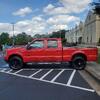
BWGuardian: Where did you get the latest running boards from and how much. I have a 2002 F 250 CCLB 4WD in silver and we have almost the same truck although yours is a 350. Are they Ford OEM or aftermarket? They look good and that's something I would want to install on mine.
PJ
BWGuardian: Where did you get the latest running boards from and how much. I have a 2002 F 250 CCLB 4WD in silver and we have almost the same truck although yours is a 350. Are they Ford OEM or aftermarket? They look good and that's something I would want to install on mine.
PJ
Mine is an 02 f250 ccsb. The ones I got were OEM take offs from a 21 f250 ccsb. I found them on offer up for $125 so figure I couldn’t go wrong modifying the mounting some to work. I ll post pics when I get them mounted up on what had to be done
I dig this look and i am doing the same myself! How did you mount the brackets to the boards? It appears the holes don’t line up, I’m thinking of drilling and using nut insert rivets…. Do you think there is a need to reinforce the back portion sense the back support bracket won’t work?
I first mounted the brackets to the truck, then placed the boards on the brackets where I wanted them. Once everything measured and looked good, I then took self tapping screws and secured the boards to the brackets. I wish these boards would have come with the back brace as I would have figured out a way to mount them, but it really isn't necessary and haven't had an issue yet. When you look at the extension and see how it's attached you'll see what I'm talking about.
BWGuardian: Where did you get the latest running boards from and how much. I have a 2002 F 250 CCLB 4WD in silver and we have almost the same truck although yours is a 350. Are they Ford OEM or aftermarket? They look good and that's something I would want to install on mine.
PJ
They are from a 2020 Superduty, so oem Ford and not aftermarket. I paid $200 for the boards and brackets and another $25+- for the attaching hardware. If you're thinking about getting some I would start looking and these were only produced from 2018-2020, so not a whole lot of them out there.
In the second of the two additional threads you linked, we talked about the bracket supporting the tail extension of the 2017+ extended running boards, to support the extension that enhances access to the pickup bed.
A photo of the support bracket is below: (For those unfamiliar with these alumiduty boards, look in the lower left hand corner of this photo)
After some time in use, do you still find that "it's fine" without the extension support bracket?
Is it not deflecting downward when stepping on it without that support bracket?
In the second of the two additional threads you linked, we talked about the bracket supporting the tail extension of the 2017+ extended running boards, to support the extension that enhances access to the pickup bed.
A photo of the support bracket is below: (For those unfamiliar with these alumiduty boards, look in the lower left hand corner of this photo)
After some time in use, do you still find that "it's fine" without the extension support bracket?
Is it not deflecting downward when stepping on it without that support bracket?
First off, these steps became available in 2018, not 2017, and were only offered for a couple years when they were discontinued because everyone seemed to want the automatic style steps. As previously mentioned mine have been absolutely fine with no apparent deformation. If you look at how that extended part is made and/or extended into the rest of the board...it's 2 separate pieces...you will see how strong it's built. The original design also only has 2 supports up front where mine, like all the earlier models, has 3 brackets. I also don't like the way that last support you speak of holds the end as it doesn't appear to be very sturdy.
First off, these steps became available in 2018, not 2017, and were only offered for a couple years when they were discontinued because everyone seemed to want the automatic style steps.
Not sure how either late availability or supposed discontinuance of the extended length cab steps relates to how well the step extension performs without the support bracket for it, but in case others are interested in these useful extended cab steps, here is what Ford shows online today regarding the extended cab steps model year applicability and current availability:
FORD PARTS: HC3Z-16450-BB
FORD "BUILD YOUR OWN" ORDER GUIDE FOR CURRENT 2022 MODEL YEAR:
What matters in this thread, and on this 1999-2016 sub forum, is that you have demonstrated a retrofit of 2017+ Super Duty running boards, to the 1999-2016 cab body, by using the body brackets of the previous steel body generation, on the cab steps that were not released until the new aluminum body generation.... which uses different mounting brackets. It makes no difference when the extended boards were released, or whether or not they are discontinued. The main event here is that you made it happen by combining different generations of parts... older brackets, to newer steps.
Originally Posted by bwguardian
The original design also only has 2 supports up front where mine, like all the earlier models, has 3 brackets.
Likewise, it doesn't matter much whether there are 2 brackets, 3 brackets, or 5 brackets supporting the step directly beneath the cab. The question I had was about the cab step extension behind the cab, that cantilevers away from the aft most bracket beneath the cab. There are actually 5 pre-drilled places for step brackets on the 1999-2016 steel body. I have 5 brackets in place, per side, on my 2000. Yet it is only the last bracket that matters the most, in terms of proximity to support 220 lbs of body weight applied to the tail end of the cantilevered extension.
The 2017-2022 body has a provision to mount the support arm bracket that Ford saw fit to engineer into the support of the cab step extension, whereas the 1999-2016 body does not.
That is why I asked you about it when you first reported installing these cab steps, because you are the only FTE member I've read of who has retrofitted these useful extended cab steps to an earlier body style. After the topic resurfaced again a few months later, I thought to ask you again for an update, to see if time and experience using the extension without the support for the cantilevered tail had changed your assessment after a few more months of usage.
Originally Posted by bwguardian
I also don't like the way that last support you speak of holds the end as it doesn't appear to be very sturdy.
Any support at the end of a cantilever probably contributes more to limiting the bending beyond the last cab support than meets the eye.... but they say beauty is in the eye of the beholder, and to my eye, the design of the support arm bracket for the extension looks ugly. In fact, it is the absence of that support arm bracket that makes your install look better than factory.
Yet if the support arm looks like it is either ugly or flimsy to us, it surely must also appear that way to the sharp young Ford truck designers, who have done a pretty good job designing the exterior appearance of the 17+ Super Duty. So it seemed as if the support arm was a necessary functional evil if they permitted it to pass their visual aesthetic.
I wanted to get a better real world sense of how the extension performs without it.... over time.
Y2KW57, when I researched this almost exactly a year ago Ford parts showed them discontinued. It also showed production from 2018-2020. So not sure if they decided to start producing them again or maybe even under a different part number...but you're right it's kind of irrelevant.
It does matter how many support brackets something has structurally as it's just stronger..to a certain extent. Again, that last support bracket doesn't appear to be all that supportive given the angles needed to get it attached to the truck. I'm 200 lbs. and typically have something in hand trying to get into or out of the bed and have not had any issues.
Have you looked at a set of these steps closely to see how they're put together? If so, you will see as aforementioned that extension is a second piece that inserts into the main longer board. This means that the material thickness is twice as thick there and extends up to that last bracket.
If ever I feel like another support needs to be installed at the end, I would install another support bracket like the ones on the front and fab up some support straight up to tie into something on the truck...but I really don't see the need...
@bwguardian Thanks for the follow up video, which illustrates your point, albeit excruciatingly slow, even at 2x speed, making the video unbearable to finish. That isn't your fault.
But I did see enough to see the parallelism between the youtuber's point and your point, that being: The entire running board is so flexible, that standing down on the aft extension end induces a wave effect in the thin channel that bows the unrestrained middle in-between the fore and aft bracket upward.
By putting in the middle bracket, as you and the youtuber have done, the upward rise in the middle of the board under the cab is restrained, thus the entire board feels more stable under foot, instead of like standing on a wet noodle where the extension dips down and the unrestrained middle bows up.
I get it.
In fact I got it earlier.
But my suspicion is that Ford allowed the middle to flex so as to reduce the bending stress concentration to the rear of the aft bracket, so that the bending stress is more distributed throughout the entire running board, which would forestall fatigue failure that would otherwise be concentrated just behind the aft bracket.
But just as likely is Ford was being cheap, and thrifted out a bracket.
Or, the middle bracket in the 17 up looks goofy, as it is offset and not dead center in between the fore and aft bracket.
I don't claim to know what Ford was thinking. But I'm thinking that the extension part will not hold up to the way I would want to use it, if left cantilevered without additional support.
One idea that comes to mind is to add additional aluminum channel or box tubing underneath the transition between the last bracket and the extension, that would not be visible, but would distribute the stress.
Thanks again for follow up, and for illustrating the wave effect. I'm not sure that is a bad thing as far as longevity of the metal, but I am sure that yours feels more solid, with your middle bracket installed, than oem installations without. Yet it is possible that OEM installations might, by design, increase or broaden the arc of the bend radius, rather than concentrate it. That might make a difference in longevity of the metal. Or, it might not add up to a hill of beans.
Y2KW57, as aforementioned twice, the extended part is inserted into the forward board. This doubles the thickness of the material and makes the extended part stronger. The only thing I didn't like about what I saw was that it's secured in place with pop rivets from what I remember. I thought about cutting those out and installing mechanical fasteners, but they seem to still be holding up. If the need arises I will add another support like the other forward units and fab up something back to the frame.
For all others, the running boards are very strong and sturdy once you add the third support on each side like the 2016 down units. I use the extended part to help get into the toolbox and/or something into or out of the adjacent bed. If I'm getting up in the bed I still utilize the rear tire or bumper as the extended part is still just too low even though I'm long legged. My wife and kiddos can actually get in and out of the truck safely and I don't have to worry about slipping on the round stainless nerf tube bars anymore. What's really cool is the new side rear mirrors puck led lights that shine down onto the running boards at night to make it easier to see where you're stepping.
I did a search and nothing really pulled up. I'm looking at what years factory running boards or side steps will be a direct bolt up for a 2000 F250/F350. I've read anything from 2007 to 2011 to 2016. I'm not afraid of modifying them if need be so also interested if a newer style, like a 2020, may even fit with some modifications.
Where did you find those new style running boards?
Where did you find those new style running boards?
People buying the newer trucks will pull those off and get the aftermarket units...either the fixed ones or more than likely the AMP Research type electric folding ones...so I bought a very new set that way. Just put the 04 18" wheels with 35's on it yesterday...
This Hennessey Takes the Expedition Tremor's Off-Roading Capability to the Next Level
Slideshow: The VelociRaptor Expedition gains a lift, upgraded suspension, Brembo brakes, and trail-ready equipment while retaining the stock 440-horsepower EcoBoost V6.
Rezvani's Latest Post-Apocalyptic Monster Is a Ford F-150 Raptor Underneath
Slideshow: Called the Fortress, the 850-horsepower pickup combines Raptor underpinnings with military-inspired features, survival equipment, and a starting price of $285,000.