


Quick Phenolic Carb Spacer Question

Thread Starter
|
Mountain Pass
Joined: Oct 2020
Posts: 214
Likes: 8
Quick Phenolic Carb Spacer Question
So I will be installing this tomorrow to see if it alleviates the fuel boil issue I've been witnessing, and I have a quick question about the plumbing of the fuel inlet pipe. As the line is rigid from the pump to the carb, and the carb is now being raised an additional inch, how does the rigid fuel line how reach the carb's inlet port?
Just trying to plan ahead...
Geoff
Just trying to plan ahead...
Geoff

Post Fiend
Joined: Apr 2002
Posts: 19,311
Likes: 97
From: Waterloo, Iowa
Welcome to FTE
That might be a problem anytime the geometry is changed. Steel fuel line is easily made up though, NAPA and others sell straight sticks of flared brake like with fittings pre-installed that answer for this.
That might be a problem anytime the geometry is changed. Steel fuel line is easily made up though, NAPA and others sell straight sticks of flared brake like with fittings pre-installed that answer for this.

Lead Driver
Joined: Jul 2011
Posts: 8,679
Likes: 191
From: On the Edge of the Desert
There should be enough slack in the line that you just bend it and stretch it up a little bit.
If not, i usually cut the hard line off down in front of the carburetor and use rubber the last several inches.
Improvise, adapt, overcome
If not, i usually cut the hard line off down in front of the carburetor and use rubber the last several inches.
Improvise, adapt, overcome
Mountain Pass


Joined: Apr 2011
Posts: 247
Likes: 18
From: Central Ohio
I can't remember who said it or find the post but he said...when the boil-over problem occurs...to just turn the key and not touch the pedal.
I've tried it and it works almost every time for me.
I've tried it and it works almost every time for me.
Thread Starter
|
Mountain Pass
Joined: Oct 2020
Posts: 214
Likes: 8
Thanks for your replies, fellas. Will try manipulating the line and see what I get.
WJ - my issue is that that technique almost never works for me - especially the deeper I get into the boil. Early on - just as the boil begins, the no pedal method works, but 10 mins into it, the throttle needs to be wide open to dump enough air to clear all the fuel that has flooded the throat.
I'll let you know how I make out.
Geoff
WJ - my issue is that that technique almost never works for me - especially the deeper I get into the boil. Early on - just as the boil begins, the no pedal method works, but 10 mins into it, the throttle needs to be wide open to dump enough air to clear all the fuel that has flooded the throat.
I'll let you know how I make out.
Geoff
Thread Starter
|
Mountain Pass
Joined: Oct 2020
Posts: 214
Likes: 8
It was possible to massage the rigid fuel line into its new location. Everything fuel-wise should work out. Looking at the linkage now: I'm taking this opportunity to eliminate the trapeze and install a single rod link, so I think that part is under control, but the issue I am having is with the kickdown rod. It's new higher location makes it want to kick back and stay back (towards the firewall) - a significant amount of force is needed to bring it forward again. What the go-to method for dealing with this? "Reprofile" (bend) the lever up? Or put the mother of all springs to get it to return forward?
Geoff
Geoff
Trending Topics
Logistics Pro
Joined: Aug 2015
Posts: 4,093
Likes: 14
From: Lind, WA- Eastern WA
This is from a reply from JEFFFAFA:
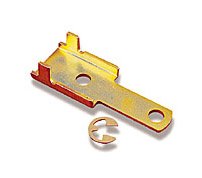
The passing gear link (tube) is basically a "L". Short side of it to the carb. Now if you recently put an extra spacer under the carb that kick down tube will be short that amount. Or if you recently replaced a factory 2V carb with a 4V carb and intake it may require a kick down rod extension. Holley part number 20-41. Different intakes set the center pivot of the carb in a different spot.
The passing gear link (tube) is basically a "L". Short side of it to the carb. Now if you recently put an extra spacer under the carb that kick down tube will be short that amount. Or if you recently replaced a factory 2V carb with a 4V carb and intake it may require a kick down rod extension. Holley part number 20-41. Different intakes set the center pivot of the carb in a different spot.
#energyEfficiency .a-icon-popover {display: none; }
Holley 20-41 Transmission Kickdown Lever Extension
Price:$11.99 & FREE Shipping on orders over $49.- Made of steel with gold irridite finish
- Accepts transmission kickdown cables
- Converts 2-barrel carburetors to 4-barrel carburetors
- Extends transmission kickdown lever
- Carburetor base bracket mounting style
FTE Stories
Ford Trucks for Ford Truck Enthusiasts

3 Best / 3 Worst Parts of Modern Ford Ownership
Brett Foote
10 Amazing Upgrades That Solve Common Ford Truck Owner Headaches
Pouria Savadkouei
Every 2026 Ford Engine Explained
Brett Foote
10 Ugly Ford Trucks That We Still Kinda Love
Joe Kucinski
10 Things Every Truck Owner NEEDS (2026 Edition)
Michael S. Palmer
Rezvani's Latest Post-Apocalyptic Monster Is a Ford F-150 Raptor Underneath
Verdad Gallardo
Top 10 Most Expensive Ford Trucks Ever Sold on Bring a Trailer
Joe Kucinski
2027 Ford Super Duty Buyer's Guide (Every Model, Engine, & Package)
Brett Foote
Top 10 Ford Truck Tragedies
Joe Kucinski
Thread Starter
|
Mountain Pass
Joined: Oct 2020
Posts: 214
Likes: 8
Thanks for that. I think I'll get 2 of them and here's why...
...I think trapeze contraption somehow prevented contact between the kickdown rod and the the pedal linkage. Now that I've done away with the trapeze, there is definitely contact between the new carb linkage rod and the kickdown rod where it begins to sweep down. If I can get the kickdown downturn to start a little further back by using one of your extensions at the carb end, then that should avoid contact there. Then I'll have to use an extension at the tranny end to to make up for the vertical leg height because of the spacer. Might work...might not. But worth a try!
Geoff
...I think trapeze contraption somehow prevented contact between the kickdown rod and the the pedal linkage. Now that I've done away with the trapeze, there is definitely contact between the new carb linkage rod and the kickdown rod where it begins to sweep down. If I can get the kickdown downturn to start a little further back by using one of your extensions at the carb end, then that should avoid contact there. Then I'll have to use an extension at the tranny end to to make up for the vertical leg height because of the spacer. Might work...might not. But worth a try!
Geoff
Thread Starter
|
Mountain Pass
Joined: Oct 2020
Posts: 214
Likes: 8
Gary - that's awesome that you found this and awesome that there is someone out there doing this. I have reached out to that person this morning for the purpose of having a custom rod made for me. I'll let you know how this one turns out.
Thanks and Regards,
Geoff
Thanks and Regards,
Geoff
Thread Starter
|
Mountain Pass
Joined: Oct 2020
Posts: 214
Likes: 8
The 1" phenolic pacer is in. Straight accelerator linked it at the same time as well as putting in a 3G alternator. Some squeal at start up, but that has been improving and only lasts a few seconds. Otherwise starts and idles great. What I wanted to ask was: does having a spacer and running it without an air cleaner make a louder-than-normal hissing or sucking sound (like a vacuum leak)? I initially forgot the crankcase vent hose off the carb baseplate and that made a horrendous hissing sound. Connected that up and 80% of the hiss went away but some of it still remains and it's definitely coming from the carb. Is this now the new normal or is something wrong?
Geoff
Geoff

Hotshot
Joined: Mar 2013
Posts: 14,255
Likes: 199
From: Phoenix, Az.
Different carbs hiss more than others at idle. The hiss is the air and gas the engine is sucking in past the throttle plates at idle. When those throttle plates are just barely open. If you still hear a hiss while above idle, then you have a vacuum leak.
Thread Starter
|
Mountain Pass
Joined: Oct 2020
Posts: 214
Likes: 8
Thanks Jefffafa. I ended up going the vacuum leak route as you suggested and started to shoot spurts of brake cleaner. Idle rose behind the carb especially in the region of the vacuum hose. Turns out, how I had the old spacer stacked on top of the phenolic spacer, there was a small gap caused by the protrusion of the vacuum pipe and how it attaches to the baseplate - a gap of about a 1/16th" wide and less than 1" long. I didn't have the proper gasket to seal this off, So I used a smear of gasket maker to seal in, and now the engine has no more hiss.
Thanks for your help!
Thanks for your help!

Thread
Thread Starter
Forum
Replies
Last Post
FordsOnlyGarage
1961 - 1966 F-100 & Larger F-Series Trucks
0
Nov 17, 2018 08:43 AM
Bobtailfan
Fuel Injection, Carburetion & Fuel System
2
Nov 21, 2005 05:22 PM