


Mpg improving mods

Tuned


Joined: Dec 2017
Posts: 387
Likes: 105
Wow that's amazing!!!
https://www.consumerreports.org/cro/...nomy/index.htm
Aerodynamic drag increases 86% when driving 75 vs 55. https://www.grc.nasa.gov/www/k-12/airplane/drageq.html
https://www.consumerreports.org/cro/...nomy/index.htm
Aerodynamic drag increases 86% when driving 75 vs 55. https://www.grc.nasa.gov/www/k-12/airplane/drageq.html

Elder User
Joined: Mar 2017
Posts: 764
Likes: 30
I can only presume you're claim is that you're applying all other things being a constant (the same)?
I find that mpg claim hard to believe, given that both the rpm would be higher and the drag (as mentioned above) significantly more. Drag essentially is squared by doubling the speed; it would take 4x more effort to overcome drag at 40mph than 20mph, as an example.
I find that mpg claim hard to believe, given that both the rpm would be higher and the drag (as mentioned above) significantly more. Drag essentially is squared by doubling the speed; it would take 4x more effort to overcome drag at 40mph than 20mph, as an example.

i ain't rite
Joined: Mar 2005
Posts: 65,569
Likes: 5,606
From: Marlboro Mental Hospital.

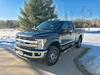
well, fill up and get on the freeway 1/4 mile away, set cruise at 55 and do a 50 mile run. truck will get 14.7 - 14.9 mpg.
turn around fill up and get back on set cruise at 75 and truck will get 15.2 - 15.4 mpg.
this was done three times when i was trying to set readiness for emissions inspection.
conditions were the same each time. sunny, around 55 degrees, and no wind.
truck has stock Michelin tires on 18 inch rims and 3.73 gears.
turn around fill up and get back on set cruise at 75 and truck will get 15.2 - 15.4 mpg.
this was done three times when i was trying to set readiness for emissions inspection.
conditions were the same each time. sunny, around 55 degrees, and no wind.
truck has stock Michelin tires on 18 inch rims and 3.73 gears.
Cargo Master

Joined: Jan 2004
Posts: 2,429
Likes: 701
From: Minnesota
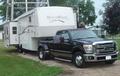
Other factors can come into play however. My gasser holds 6th gear better at 70 mph than 60 mph (towing a fifth wheel) because of the torque curve on my 6.2. But, this is at the cost of fuel mileage for sure.

Tuned


Joined: Jan 2020
Posts: 417
Likes: 144
From: Kerrville, Texas
i ain't rite
Joined: Mar 2005
Posts: 65,569
Likes: 5,606
From: Marlboro Mental Hospital.
basically flat ground, fill up at wawa both sides.
FTE Stories
Ford Trucks for Ford Truck Enthusiasts

Top 10 Fords at 2026 Carlisle Ford Nationals
Joe Kucinski
3 Best / 3 Worst Parts of Modern Ford Ownership
Brett Foote
10 Amazing Upgrades That Solve Common Ford Truck Owner Headaches
Pouria Savadkouei
Every 2026 Ford Engine Explained
Brett Foote
10 Ugly Ford Trucks That We Still Kinda Love
Joe Kucinski
10 Things Every Truck Owner NEEDS (2026 Edition)
Michael S. Palmer
Rezvani's Latest Post-Apocalyptic Monster Is a Ford F-150 Raptor Underneath
Verdad Gallardo
Top 10 Most Expensive Ford Trucks Ever Sold on Bring a Trailer
Joe Kucinski
2027 Ford Super Duty Buyer's Guide (Every Model, Engine, & Package)
Brett Foote
Elder User
Joined: Mar 2017
Posts: 764
Likes: 30
At 50 mph the engine may be lugging so low as it's not in an efficient part of the combustion process. And so you may actually get better mpg at 70 mph than 50 mph, even if the engine is holding the same tranny gear.
Some would ask why this is so, and it's a simple answer ... emissions. Ford wants the engine to run as low as possible in rpms, because engine emissions and engine rpm efficiency do not always go hand-in-hand; there's not always a direct linear relationship. Whereas our heavy trucks do not have to make a specific mpg for CAFE, they DO have to meet emissions standards. When the rpms are really low (say running 50mph in 6th gear), the output of emissions is lower than at 70mph in that same gear. I don't know at what vehicle speed they are required to test at (probably a few different speeds), but the lower the rpm can be held under light load, the less emissions are pushed out the tailpipe. So it behooves Ford to program the vehicle computers to manage the rpm as low as possible under light loads. Many of us have noticed the 6.2L (generally a rev-happy engine) seems to lug way more than desired in most any light-load condition and it won't downshift until you nudge the pedal firmly; at times my 6.2L will lug in the higher gears all the way down to 1300 rpm before downshifting). That's not an accident; it was done on purpose to meet emissions criteria.
However, the engine may be more efficient (defined as fuel consumed for each mile traveled) at a slightly higher rpm (say around 2000 rpm). So it's very possible that the engine is more efficient running 70 mph in 6th than 55 mph in 6th. There are times when it might be advantageous to actually lock out 6th gear (under very light loads) and you might eek out a fractionally higher mpg experience running in 5th rather than 6th, but this is only true at lower road speeds of course. If you were running 50 mph down a long US route and it's flat enough to carry 6th gear, try tapping down a gear with the CC locked on 50 mph; you might actually see the mpg raise a bit.
Boils down to this; very low rpms makes for the lowest emissions output even if it's not the most desirable in terms of fuel efficiency. As long as the truck can maintain the desired speed, under light loads it's going to up-shift as much as it can to reduce CO and other GHG output.
Some would ask why this is so, and it's a simple answer ... emissions. Ford wants the engine to run as low as possible in rpms, because engine emissions and engine rpm efficiency do not always go hand-in-hand; there's not always a direct linear relationship. Whereas our heavy trucks do not have to make a specific mpg for CAFE, they DO have to meet emissions standards. When the rpms are really low (say running 50mph in 6th gear), the output of emissions is lower than at 70mph in that same gear. I don't know at what vehicle speed they are required to test at (probably a few different speeds), but the lower the rpm can be held under light load, the less emissions are pushed out the tailpipe. So it behooves Ford to program the vehicle computers to manage the rpm as low as possible under light loads. Many of us have noticed the 6.2L (generally a rev-happy engine) seems to lug way more than desired in most any light-load condition and it won't downshift until you nudge the pedal firmly; at times my 6.2L will lug in the higher gears all the way down to 1300 rpm before downshifting). That's not an accident; it was done on purpose to meet emissions criteria.
However, the engine may be more efficient (defined as fuel consumed for each mile traveled) at a slightly higher rpm (say around 2000 rpm). So it's very possible that the engine is more efficient running 70 mph in 6th than 55 mph in 6th. There are times when it might be advantageous to actually lock out 6th gear (under very light loads) and you might eek out a fractionally higher mpg experience running in 5th rather than 6th, but this is only true at lower road speeds of course. If you were running 50 mph down a long US route and it's flat enough to carry 6th gear, try tapping down a gear with the CC locked on 50 mph; you might actually see the mpg raise a bit.
Boils down to this; very low rpms makes for the lowest emissions output even if it's not the most desirable in terms of fuel efficiency. As long as the truck can maintain the desired speed, under light loads it's going to up-shift as much as it can to reduce CO and other GHG output.

Tuned
Joined: Dec 2017
Posts: 387
Likes: 105
I encourage y'all, if you are interested, to learn about BSFC curves (brake specific fuel consumption), BMEP, and also throttling losses in otto (spark ignition) engines. Typically being in the tallest gear you can be in, with really deep throttle settings to maintain the speed desired, generates the best fuel economy in gas engines. Particularly if the engine is in the 1700 to 2200 RPM range for our truck type engines. I'm headed out on vacation but I'll check in next week

Fleet Mechanic

Joined: Nov 2015
Posts: 1,674
Likes: 676
From: DeMotte, IN
 .
. 
Mountain Pass

Joined: Jan 2020
Posts: 232
Likes: 99
I will disagree with this point. I used to believe this, but watching the instantaneous mpg on various vehicles, even accelerating easy, its poor. Then when you get up to speed and begin cruising it gets better. So what is better, poor mpg accelerating easy for XX seconds to get up to speed then get good mpg, or get really poor mpg accelerating harder for X seconds then get good mileage? Someone with more time and curiosity on this topic than I have can get more data and let us all know. .
.
Moderator

Joined: May 2004
Posts: 6,526
Likes: 926
From: Home Base Nebraska
I will disagree with this point. I used to believe this, but watching the instantaneous mpg on various vehicles, even accelerating easy, its poor. Then when you get up to speed and begin cruising it gets better. So what is better, poor mpg accelerating easy for XX seconds to get up to speed then get good mpg, or get really poor mpg accelerating harder for X seconds then get good mileage? Someone with more time and curiosity on this topic than I have can get more data and let us all know. .
.Denny

4wd Low
Joined: Jul 2015
Posts: 12
Likes: 2
From: nebraska
I find that I get my best mpg at 70 mph. I always accelerate to highway speed as quick as I can. Mpg varies from 13.5 to 16. I get my best on level highways. In the hills I get 13.5. Love the truck. I didn't buy it for the mpg. It's a farm truck.

Thread
Thread Starter
Forum
Replies
Last Post