When you click on links to various merchants on this site and make a purchase, this can result in this site earning a commission. Affiliate programs and affiliations include, but are not limited to, the eBay Partner Network.
I contacted Reese customer service about a week ago and they told me the older fifth wheel hitchs Will work with the newer puck system but the pins need to be modified. You probably should call the hitch manufacture.
While the quote above is somewhat related to the general subject matter per the thread title, it is unrelated to the specific op's question in the thread itself.
The spacing between pucks on center remains the same, old or new, at 13" on center front to back, and 30" on center side to side.
What the Reese customer service was most likely referring as far as "older fifth wheel hitches" and the newer puck system was related to Reese hitches and the two iterations of Reese towing system utilizing pucks. Those two systems are:
1. Reese Signature Series (older, the original puck system, now discontinued and no longer manufactured)
2. Reese Elite Series (newer... but still 14 years old now... still manufactured, coincided with Ford's introduction of the puck system as an OEM hitch system)
The difference between the Signature Series and the Elite series is very little, and boils down to mostly one thing: The height of the pucks relative to the underbed rails... and thus relative to the deck surface of the bed.
The original Signature Series puck lands were higher above the surface of the bed than the newer Elite Series and the Ford OEM equivalent. To the extent that I remember correctly, when Ford decided to incorporate the Reese puck system as OEM equipment, Ford wanted the puck tops to sit more even with the top surface of the bed... which inspired the slight redesign of puck heights.
The "pins" that were referenced by the Reese customer service rep are the four engagement pins underneath the removable 5th wheel apparatus itself that engage and lock into the fixed pucks. Back when Ford introduced the OEM puck system (simultaneous with Reese's introduction of the Elite system) there were still a lot of Signature Series hitches (and aftermarket underbed rail kits) on the market. These Signature Series hitches would ostensibly fit the Ford and Elite system puck pattern (13" x 30"), but would not engage successfully with the Elite and Ford OEM pucks due to the difference in puck height relative to the bed deck, due to the engagement pin length.
The Elite series and Ford Accessory hitch apparatus were already built with the proper pins to engage with the Elite series puck heights, but the Signature Series hitches were not, so Reese came out with a kit to change the pins of the older Signature series hitches, so that a customer's investment in their Signature Series hitch (at the time Reese's top of the line) would not be wasted, and could in fact be utilized in a new Ford truck.
Again, this has nothing to do with puck pattern or distance on center... the difference in pins only related to the ability to lock down an older REESE hitch into the pucks without the lower part of the hitch crashing against the bed first.
As is apparent by now, this has little to do with fitting a B&W hitch, because by the time B&W built a hitch that engaged in Ford pucks, B&W based their height clearance over the bed relative to the surface height of the pucks on the Ford OEM standard, which by definition is the same as the Reese Elite series standard... hence there is no "old" and "new" when it comes to B&W hitches and Ford puck systems, nor is there any above the bed difference in any of Ford truck puck systems. The various generations of Ford trucks that had OEM puck hitch systems have all been the same above the bed. As has already been pointed out, the differences in the OEM puck systems have only to do with frame engagement for the different designed truck frames.
While the quote above is somewhat related to the general subject matter per the thread title, it is unrelated to the specific op's question in the thread itself.
The spacing between pucks on center remains the same, old or new, at 13" on center front to back, and 30" on center side to side.
What the Reese customer service was most likely referring as far as "older fifth wheel hitches" and the newer puck system was related to Reese hitches and the two iterations of Reese towing system utilizing pucks. Those two systems are:
1. Reese Signature Series (older, the original puck system, now discontinued and no longer manufactured)
2. Reese Elite Series (newer... but still 14 years old now... still manufactured, coincided with Ford's introduction of the puck system as an OEM hitch system)
The difference between the Signature Series and the Elite series is very little, and boils down to mostly one thing: The height of the pucks relative to the underbed rails... and thus relative to the deck surface of the bed.
The original Signature Series puck lands were higher above the surface of the bed than the newer Elite Series and the Ford OEM equivalent. To the extent that I remember correctly, when Ford decided to incorporate the Reese puck system as OEM equipment, Ford wanted the puck tops to sit more even with the top surface of the bed... which inspired the slight redesign of puck heights.
The "pins" that were referenced by the Reese customer service rep are the four engagement pins underneath the removable 5th wheel apparatus itself that engage and lock into the fixed pucks. Back when Ford introduced the OEM puck system (simultaneous with Reese's introduction of the Elite system) there were still a lot of Signature Series hitches (and aftermarket underbed rail kits) on the market. These Signature Series hitches would ostensibly fit the Ford and Elite system puck pattern (13" x 30"), but would not engage successfully with the Elite and Ford OEM pucks due to the difference in puck height relative to the bed deck, due to the engagement pin length.
The Elite series and Ford Accessory hitch apparatus were already built with the proper pins to engage with the Elite series puck heights, but the Signature Series hitches were not, so Reese came out with a kit to change the pins of the older Signature series hitches, so that a customer's investment in their Signature Series hitch (at the time Reese's top of the line) would not be wasted, and could in fact be utilized in a new Ford truck.
Again, this has nothing to do with puck pattern or distance on center... the difference in pins only related to the ability to lock down an older REESE hitch into the pucks without the lower part of the hitch crashing against the bed first.
As is apparent by now, this has little to do with fitting a B&W hitch, because by the time B&W built a hitch that engaged in Ford pucks, B&W based their height clearance over the bed relative to the surface height of the pucks on the Ford OEM standard, which by definition is the same as the Reese Elite series standard... hence there is no "old" and "new" when it comes to B&W hitches and Ford puck systems, nor is there any above the bed difference in any of Ford truck puck systems. The various generations of Ford trucks that had OEM puck hitch systems have all been the same above the bed. As has already been pointed out, the differences in the OEM puck systems have only to do with frame engagement for the different designed truck frames.
100% Correct!!
Originally Posted by PghFamilyMan
That is correct, I bought the hitch (B&W Companion) that was in a 2013 Ford with the factory puck system and it dropped right into my 2018.
I've spent a lot of design time making narrow frame chassis cab and low profile service body integration adaptations to incorporate the Reese Signature / Elite / Ford OEM underbed hitch attachment system for the perimeter pucks, combined with the B&W gooseneck attachment system as the central "puck" in order to have the advantage of the central square receiver and all of the various attachments and implements that B&W has created over the past two decades.
So... I've spent a lot of time slaying Puck the magic dragon.
I've spent a lot of design time making narrow frame chassis cab and low profile service body integration adaptations to incorporate the Reese Signature / Elite / Ford OEM underbed hitch attachment system for the perimeter pucks, combined with the B&W gooseneck attachment system as the central "puck" in order to have the advantage of the central square receiver and all of the various attachments and implements that B&W has created over the past two decades.
So... I've spent a lot of time slaying Puck the magic dragon.
I'm going to put you down as an "Authoritative Source" on this topic.
Impressive, I have a design idea similar to the bent plate gooseneck adapters that connect to a rail system, bur make one to fit into the oem pucks that has an offset gooseball, maybe with different offsets. This would solve my dilemma of ordering the prep pkg or not and getting the B&W that has the offset, but only a 4" offset.
Impressive, I have a design idea similar to the bent plate gooseneck adapters that connect to a rail system, bur make one to fit into the oem pucks that has an offset gooseball, maybe with different offsets. This would solve my dilemma of ordering the prep pkg or not and getting the B&W that has the offset, but only a 4" offset.
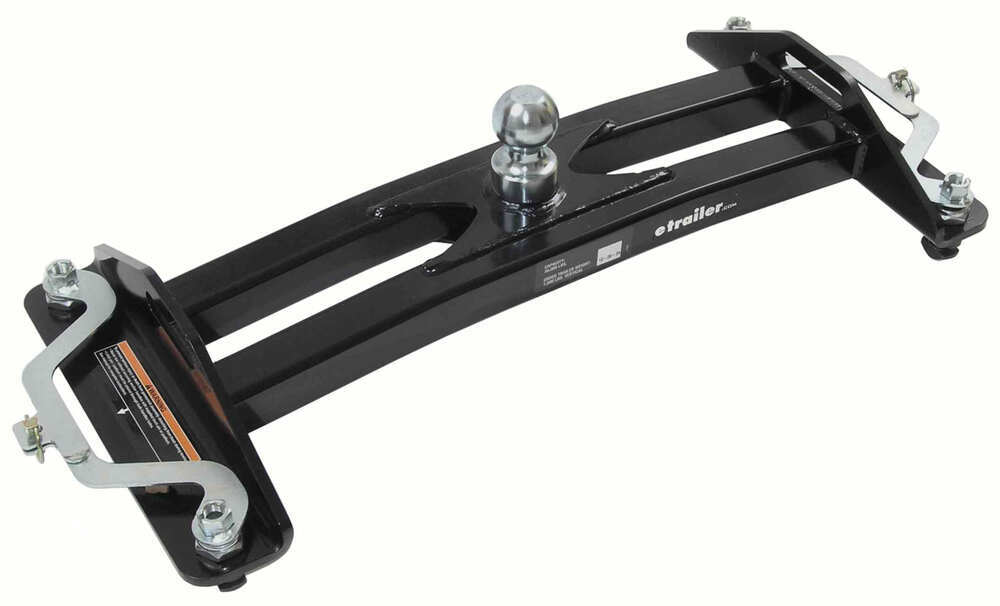
When you say "bent plate gooseneck adapters that connect into a rail system", are you referring to a traditional hat channel above bed rail system, and a bent plate gooseneck adapter that looks like what is depicted immediately below?
What do you mean by "offset"?
Offset in the fore and aft direction?
Are you wanting 4" ahead of rear axle center line?
Why? For pin weight distribution toward tow vehicle steer axle?
Or are you wanting 4" behind axle center line?
Why? For more cab to trailer nose clearance on turns, where trailer is light enough or truck is heavy enough to forgive an aft axle pin location? (Sometimes seen in Class 7 MDTs, but rare and usually discouraged in light trucks)
Are you seeking a forward gooseneck offset that is ~4" ahead of the rear axle center line, plus perimeter pucks?
Yes, what they call bent plate, but it would have four 1/4 turn lock pins that fit the oem puck system with the ball rearward to gain turning clearance. I think even though the ball is offset, the weight would be distributed to the four pucks which is centered a few inches forward of the axle on oem hitch. I thought about the B&W that has the square gooseball hole in the hitch and they offer a 4" offset gooseball that can't rotate, but then the four pucks are not included.
FWIW, you may want to double check, bc they are not the same part # from ford. When I bought the OEM system for my 13, I never installed it. When I got this 19, I called local ford parts house, he told me to return the 1 I had, pick up this newer one. I have no idea what is different, I just know they are different part #s, and dealer told me the old 1 will not work.
2013 model shows: BC3Z-5F057-A
2019 model shows: HC3Z-5F057-B
If a pickup, is the under bed puck system there already?
If you don't have the pickup yet, but intend on ordering one, I strongly recommend getting the Ford factory production underbed puck system.
The key benefit to the Ford production under-bed puck system is in the frame attachment engineering. And that it is already done.
To mount a gooseneck ball support apparatus into the four pucks, where the gooseneck ball support structure is entirely above the bed, introduces a new problem to solve... coupler height.
Take a look...
And now look at the structure under the plastic cover...
All of this structure to support the ball and keep the ball from tilting backwards on launch or rocking forward on brake dives sits above the deck height, adding another 6+" to top of ball height, all of which consumes the adjustability of the gooseneck trailer coupler post.
Another issue is that traditional above bed hat channel 5th wheel hitch rails are 22" apart from each other (on center, slot to slot) which affords some latitude in offsetting what is placed between those rails.
However, with the Reese and Ford puck system, the underbed rails are only 13" apart from each other (on center, puck to puck) which doesn't leave a lot of latitude for offsetting fore and aft between pucks.
(The greater fore and aft puck distance in the Ram offers improved mechanical advantage, as well as latitude for offset, with the increased on center distance longitudinally between pucks)
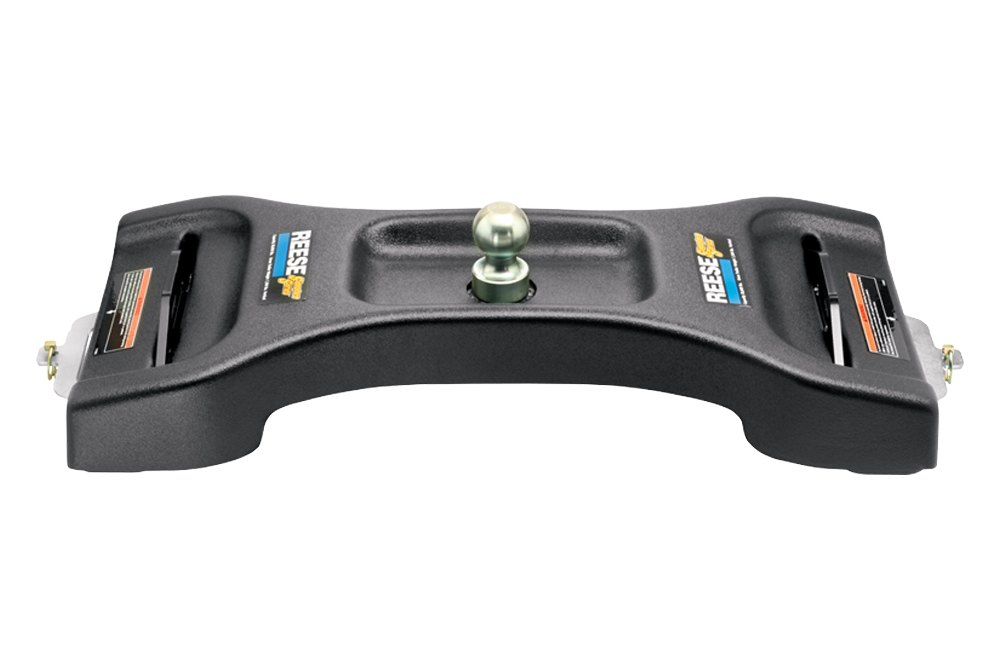
On the Reese above bed gooseneck ball hitch shown above that fits into the Ford and Reese underbed puck systems that are only 13" apart, notice that their really isn't much room to deviate structurally between the pre-cambered cross tubes and the fish plated gusset. That piece was derated from 30K to 25K coinciding with when manufacturing moved from Canada to China, and Signature Series was dropped and renamed to Elite Series.
When designing an above bed puck mounted offset gooseneck ball holder, how will you test it for dynamic capacities?
Have you considered replacement couplers to mount in your gooseneck trailer instead?
Or considered an air shocker hitch that has a small offset incorporated?
Rezvani's Latest Post-Apocalyptic Monster Is a Ford F-150 Raptor Underneath
Slideshow: Called the Fortress, the 850-horsepower pickup combines Raptor underpinnings with military-inspired features, survival equipment, and a starting price of $285,000.