When you click on links to various merchants on this site and make a purchase, this can result in this site earning a commission. Affiliate programs and affiliations include, but are not limited to, the eBay Partner Network.
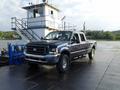
Due to a tire failure I ended up putting 6 new tires on my 2002 F350 Friday. The owner of the tire shop told me that if I keep following Fords recommendations on tire pressure that I could expect to repeat the same problem. He said that the sticker is low is way to low for that Diesel motor sitting over the axle. Tires were less than a year old and 4 of six had seen service on the front axel and you could pick them out of the pile.
not only were the edges both inside and out wore more the overall profile of the tire off the rim and on it was different. The tires that were in front looked to have 1 1/2” thinner with a radius tread like a motorcycle tire the two that had not been up front looked wider and flat. This I could see for sure and know that it was the two that had not been on front that looked good.
To get to the point he said that I should be running 80 psi up front all the time and that running the lower recommended pressure was softening the side wall/ face of the tire as well as warring the tread unnecessary. Told me that it would ride a little more harshly but tires would last much longer.
sounds like good advice and makes sense to me but this is my first diesel and first SD.
shawn
I have never wore out tires because of tread wear (200,000 on clock). You may have other issues.
Driving around at 80psi is like driving a beer wagon or a block of wood (very rough)
I drive with 70psi when unloaded.... only when loaded or pulling something big will I go to 80psi
I’m getting it lined up as soon as I can but don’t think that’s the problem inside and outside of tires were almost the same an left and right were looking the same before the left gave out. Tire guy didn’t think it was allinment problem he even went over a way to use chalk to get the tires to right pressure.
shawn
The diesel puts about 10% more weight on the axle than a v10, doesn't seem like enough to warrant much of a difference in air pressure between the two. I've seen trucks wear tires like you're describing with one brand and not another, but I don't know exactly why. Some vehicles & tires need rotation more than others to keep them even. What pressure were you running and are they stock size and rated tires?
I normally go 5 pounds below the maximum rated pressure on the sidewall, loaded, unloaded year round. I like the way it rides, improves fuel mileage and wear evenly. Another added benefit is the power steering doesn't work as hard in parking lots.
When I pull my camper, I have "Tire Minders" on my truck..... starting out at 80psi, the psi will increase around 5-8 psi due to heat ( this is natural) . So each tire will have 'around' 85-88 or more (depends how hot it is) in each tire, front and back. So, if you 'start out' at close to 70psi..... the psi will increase to 75-78 psi. Very Very close to the '80psi that the tire guy 'suggests'...
Me thinks something else is going on with your tires/front end and it is not the psi 'per se' '.
Grab a piece of sidewalk chalk. On dry pavement, draw a perpendicular line at. 9-12 & 3 o’clock on each tire then Drive straight down the street for 100’, Check the wear pattern. Then another 100’ check again.... this will show you the amount of the tire that’s contacting the street.
I run 75 psi in the front and currently 65# in the rears but that’s getting lowered this week to 60 psi. I’m wearing the chalk in the middle but not the edges of the rears.
Here’s the weights on each axle on my truck with me in it.
I can't answer this with a number for anybody. 17 years ago, that door sticker was the recommended tire pressure for the stock tires - things have changed a bit since then. One of the things that has changed is wear on the front of the vehicle, and I had a lot of difficulty finding anybody who knew how to do a proper alignment on my truck. The front needs a hardware upgrade to accommodate things going out of whack over the years, and you need somebody who knows what they're doing to get it all done.
Once the front is sound, the proper tire pressure is a matter of the recommendation from the tire manufacturer, not the vehicle it's riding under. The trick is to find the chart for your tire, here are some examples:
The alignment seems to be a little tricky called a few shops and so far when I say CC LB DRW they say sorry we can’t do that. One shop gave me a name of a place that could do it but said that he would not use them if it were him. I knew of that place years ago it was the gold standard for medium to heavy truck suspension and steering then owner retired and whoever took over has run the business into the ground.
I have a couple leads now I have to check into.
shawn
so much misinformation in this thread it is mind boggeling.
tire pressures required to support a given load is based on physis not voodoo.
correct tire pressure for a tires volume and construction type to support a given load are listed in the manufactures Load and inflation tables. all the manufactures use the same code since it is based on physis.
as a Rule set your tire pressure to the Gross Axle weight Rating published by any of the manufactures. ( you can typically lower the rear 5 psi when not carrying a payload)
here is Toyo's https://www.toyotires.com/media/2125...s_20170203.pdf
modern radial tires show little wear due to slight inflation variances, your tire wear is almost certainly due to alignment and when it comes to alignment ford gives such a wide varance in specs that few shops have the skilled personal to actually tune your alignment, they operate on the "set the toe, collect the dough" moto. problem is the specs allow for tow out to toe in, these solid axles trucks can be made to handle horrible with even worse tire wear even when "in spec" by using the wrong combonation of toe, caster and camber.
your best bet is to find a independant shop who will tune your alignment, not a big box franchaise with some 20 year old on the computer who doesnt have a clue bessides what the Green light on the screen allows.
for all you inflate to max sidewall psi guys, remember to inform people you are trying to convinne to overinflate their tires that your breaking distances are vastly increased since you have considerably reduced the tires traction.