


Battery CCA Vs PCA

Thread Starter
|
FTE Legend


Joined: Jan 2009
Posts: 80,542
Likes: 97
From: Norlina NC
Battery CCA Vs PCA
Can someone explain why all of a sudden that the battery companies are going from CCA to PCA in their listings lately?? What their differences are? and what the differences mean for choosing a battery?
When i tried looking up the meanings everyone had the same definitions which really told me very little... I know with CCA is that its the measurement of cranking amps available in the battery at 0*F over the time of 30seconds of cranking... but PCA i couldnt find a definition that included a temp rating and seems to only measure for a 3 second crank....
@TooManyToys. you seem to know a bit on electrical stuff.. maybe you can explain this best??? Anyone else can answer in too if they know... trying to look at new batteries for the truck and seeing it pop up all over the place.... use to looking at CA and CCA...
When i tried looking up the meanings everyone had the same definitions which really told me very little... I know with CCA is that its the measurement of cranking amps available in the battery at 0*F over the time of 30seconds of cranking... but PCA i couldnt find a definition that included a temp rating and seems to only measure for a 3 second crank....
@TooManyToys. you seem to know a bit on electrical stuff.. maybe you can explain this best??? Anyone else can answer in too if they know... trying to look at new batteries for the truck and seeing it pop up all over the place.... use to looking at CA and CCA...

Fleet Owner


Joined: Jan 2004
Posts: 26,007
Likes: 575
From: Brentwood,CA

Its to make their batteries look stronger than they are. PCA is pulse cranking amps, short duration 3 seconds and tells you nothing about the battery. Reminds me years ago when manufacturers were claiming 6hp on lawn mowers and they were at best 3hp. It's all marketing.

Super Moderator


Joined: Dec 2011
Posts: 13,340
Likes: 6,123
Pulse Cranking Amps is actually a useful metric when comparing batteries that are built as "dual purpose" SLI and Deep Cycle.
An SLI battery (Starting, Lighting, Ignition/Instrumentation) is generally built with thinner plates, and more of them, to make more current more immediately available, at the cost of a shorter sustained duration.
A Deep Cycle battery is generally built with thicker plates, and fewer of them due to space constraints within the BCI group size form factor. The thicker plates can be discharged for a longer duration, but with fewer plates, less current is immediately available for short term bursts like starting.
Newer battery electrolyte and cell construction technologies enabled the high availability of short term current in SLI batteries to be combined with the deeper discharge (before unrecoverable damage) and longer cycle life of Deep Cyle batteries.
However, different execution of these battery innovations over the last 30 years produce different results. As a way to measure and distinguish the differences in the starting functionality of dual purpose batteries, the Pulse Cranking Amp metric is utilized.
An SLI battery (Starting, Lighting, Ignition/Instrumentation) is generally built with thinner plates, and more of them, to make more current more immediately available, at the cost of a shorter sustained duration.
A Deep Cycle battery is generally built with thicker plates, and fewer of them due to space constraints within the BCI group size form factor. The thicker plates can be discharged for a longer duration, but with fewer plates, less current is immediately available for short term bursts like starting.
Newer battery electrolyte and cell construction technologies enabled the high availability of short term current in SLI batteries to be combined with the deeper discharge (before unrecoverable damage) and longer cycle life of Deep Cyle batteries.
However, different execution of these battery innovations over the last 30 years produce different results. As a way to measure and distinguish the differences in the starting functionality of dual purpose batteries, the Pulse Cranking Amp metric is utilized.

Fleet Mechanic
Joined: Mar 2009
Posts: 1,856
Likes: 52
From: Sacramento Delta, CA
Y2KW57: What is your favorite "dual purpose" battery. I am over using deep cycle batteries for the house side of my van, and plan on just sticking a couple Optima BlueTop or maybe even RedTop or YellowTops in the deep cycles' place.
Because, they are compatible with the charge profile of our stock alternators and recharge quickly.
And my particular usage is only over a short period in the morning and a short period in the evening (except for intermittent thermostatically controlled diesel furnace) such that they discharge quickly.
And I think I mentioned here once before, that I got over 10 years on a BlueTop as the starting battery in my Bronco (kept on a BatteryMinder charger/desulfator when not driven).
Any suggestions?
Because, they are compatible with the charge profile of our stock alternators and recharge quickly.
And my particular usage is only over a short period in the morning and a short period in the evening (except for intermittent thermostatically controlled diesel furnace) such that they discharge quickly.
And I think I mentioned here once before, that I got over 10 years on a BlueTop as the starting battery in my Bronco (kept on a BatteryMinder charger/desulfator when not driven).
Any suggestions?
Super Moderator
Joined: Dec 2011
Posts: 13,340
Likes: 6,123
Tim, I'm so sorry. I spent about an hour this morning typing out a detailed, reasoned, 8 bullet point response to your request for suggestions, specifically targeted to your planned intentions as described in this and the other thread... but the with a splint on my finger sewn back together from an injury, I hit keys inadvertently, and in so doing, somehow found the short cut that obliterates all text previously typed in the window... and backspace doesn't work when the post hasn't been sent yet. So all that thought and work was lost, and I don't think I can muster it back. Today's schedule didn't permit a revisit until now.
Cut to the chase, the short answer is: Odyssey Extreme.
There was a lot of considered reasoning behind this answer, but at the end of the day, the actionable result is still the same.
Cut to the chase, the short answer is: Odyssey Extreme.
There was a lot of considered reasoning behind this answer, but at the end of the day, the actionable result is still the same.

Fleet Owner
Joined: Aug 2010
Posts: 21,255
Likes: 1,657
From: Reynoldsburg, Ohio
Y2KW57 a suggestion if you'll permit me---when I know I'll be writing a lengthy forum reply I'll do it in MS Word or similar, saving every few minutes or so. Once complete I copy>paste it into the reply box.
I know the anguish of losing so much information or a reply that takes so long to create.
I know the anguish of losing so much information or a reply that takes so long to create.
Fleet Mechanic
Joined: Mar 2009
Posts: 1,856
Likes: 52
From: Sacramento Delta, CA
Y2KW57 Your contributions here are legendary. Thank you for both your intended lengthy reply and your actual concise answer.
https://www.batterymart.com/p-odysse...0-battery.html
"[W]ith simple constant voltage charging (alternator or independent charger), there is no limitation on the inrush current, so the user is assured of a fast charge."
Our alternators are certainly not constant voltage output, correct?
Is the charging profile for the Odyssey agm battery just plug and play with our stock alternators or must something be done to our charging system to make sure that the batteries are not damaged by charging?
Please don't type if it hurts or is frustrating.
https://www.batterymart.com/p-odysse...0-battery.html
"[W]ith simple constant voltage charging (alternator or independent charger), there is no limitation on the inrush current, so the user is assured of a fast charge."
Our alternators are certainly not constant voltage output, correct?
Is the charging profile for the Odyssey agm battery just plug and play with our stock alternators or must something be done to our charging system to make sure that the batteries are not damaged by charging?
Please don't type if it hurts or is frustrating.
Trending Topics

Fleet Owner

Joined: Apr 2008
Posts: 24,323
Likes: 5,133
From: 0,0,1
It just one of manufacture's news tricks to confuse and fool you into buying less while paying more.
FTE Stories
Ford Trucks for Ford Truck Enthusiasts

Top 6 Best Deals Available on New Fords & Lincolns Right Now
Brett Foote
This Hennessey Takes the Expedition Tremor's Off-Roading Capability to the Next Level
Verdad Gallardo
Top 10 Fords at 2026 Carlisle Ford Nationals
Joe Kucinski
3 Best / 3 Worst Parts of Modern Ford Ownership
Brett Foote
10 Amazing Upgrades That Solve Common Ford Truck Owner Headaches
Pouria Savadkouei
Every 2026 Ford Engine Explained
Brett Foote
10 Ugly Ford Trucks That We Still Kinda Love
Joe Kucinski
10 Things Every Truck Owner NEEDS (2026 Edition)
Michael S. Palmer
Rezvani's Latest Post-Apocalyptic Monster Is a Ford F-150 Raptor Underneath
Verdad Gallardo
Super Moderator
Joined: Dec 2011
Posts: 13,340
Likes: 6,123
Y2KW57 Your contributions here are legendary. Thank you for both your intended lengthy reply and your actual concise answer.
https://www.batterymart.com/p-odysse...0-battery.html
"[W]ith simple constant voltage charging (alternator or independent charger), there is no limitation on the inrush current, so the user is assured of a fast charge."
Our alternators are certainly not constant voltage output, correct?
Is the charging profile for the Odyssey agm battery just plug and play with our stock alternators or must something be done to our charging system to make sure that the batteries are not damaged by charging?
Please don't type if it hurts or is frustrating.
https://www.batterymart.com/p-odysse...0-battery.html
"[W]ith simple constant voltage charging (alternator or independent charger), there is no limitation on the inrush current, so the user is assured of a fast charge."
Our alternators are certainly not constant voltage output, correct?
Is the charging profile for the Odyssey agm battery just plug and play with our stock alternators or must something be done to our charging system to make sure that the batteries are not damaged by charging?
Please don't type if it hurts or is frustrating.
Our alternators ARE voltage regulated. They have voltage regulators built inside. The typical F600 voltage regulator our alternators use have a set point of 14.4 volts, which is well beneath the maximum 15 volt threshold that Enersys recommends not be exceeded by a charger of any type.
Constant current chargers that commit to supplying a given amount of current regardless of the voltage needed to overcome the internal resistance of a battery are not recommended, but our alternators are regulated by a voltage sense reading that varies the current produced based on the electrical load determined by the dip in voltage sensed from supplying the load, up to the limit of the alternators ability to produce current based on the rpm the alternator is spinning at.
While the voltage can and does vary a little bit within a narrow range ...such as when temperature sensors in the regulator chip might scale back the voltage to 13.9... or such as when glow plug demand combined with battery replenishment following engine start combined with low rpm from idling waiting for the engine to warm up can result in laggy voltage for the first couple of minutes... by and large the voltage regulator sees to it that the voltage output is relatively constant in an alternator, hovering around 14 volts, give or take a couple of tenths. This is well within the wheel house of what the Odyssey batteries can tolerate, as that is the operating environment that they were designed for.
Fleet Mechanic
Joined: Mar 2009
Posts: 1,856
Likes: 52
From: Sacramento Delta, CA
Y2KW57: Perfect! Lithium-Ion batteries are all the rage at the Sportsmobile.com forum and even in the 25-30 year old 2-cycle standup jet skis that my wife and I ride. I read the charging profile for the Lithium-Ion batteries and was concerned that they would be destroyed by a regular automotive charging system or a crude but regulated 2-cycle engine stator charging system. Many people don't understand that the charging system must be matched with the battery's required charging profile, or the battery will be prematurely destroyed or at the very least won't ever reach its full recharge state.
I get it now that the batteries you recommended are lead acid batteries which are approporiate for our automotive charging systems but are just AGM. So constant current is NOT what is needed to charge them. So, I now understand that you and I are actually on the same page. You have just selected a more robust AGM battery than the Optima BlueTops that I was thinking of using. Thank you. I selected Optima BlueTops because although they are AGM, they are specifically made for automotive applications and thus compatible with automotive charging systems. For those interested in the topic here is a great discussion although not automotive:
There are three common methods of charging a battery; constant voltage, constant current and a combination of constant voltage/constant current with or without a smart charging circuit.
Constant voltage allows the full current of the charger to flow into the battery until the power supply reaches its pre-set voltage. The current will then taper down to a minimum value once that voltage level is reached. The battery can be left connected to the charger until ready for use and will remain at that “float voltage”, trickle charging to compensate for normal battery self-discharge. A typical example would a low cost auto battery charger for home use or basic back up power systems. This method enables fast charging rates and is suitable for lead acid types, but not for Nickel Metal Hydride (Ni-MH) or Lithium-Ion (Li-ion) types.
Constant current is a simple form of charging batteries, with the current level set at approximately 10% of the maximum battery rating. Charge times are relatively long with the disadvantage that the battery may overheat if it is over-charged, leading to premature battery replacement. This method is suitable for Ni-MH type of batteries. The battery must be disconnected or a timer function used once charged.
Constant voltage / constant current (CVCC) is a combination of the above two methods. The charger limits the amount of current to a pre-set level until the battery reaches a pre-set voltage level. The current then reduces as the battery becomes fully charged. This system allows fast charging without the risk of over-charging and is suitable for Li-ion and other battery types.
Smart charging involves the use of a micro-controller to compensate for temperature rise and adjust the charge current and charge time accordingly to the battery specifications. This extends battery life and is used with Li-ion battery types. This battery management circuit or unit can be fitted externally to the charger. A number of the power semiconductor manufacturers offer control circuits to perform this function."
From:
https://power-topics.blogspot.com/20...t-current.htmlOr for a deeper dive:https://mpoweruk.com/chargers.htmI like that it says this at the top of the page:
More batteries are damaged by bad charging techniques than all other causes combined.And this is food for thought for anyone considering a Tesla:"Note that for automotive batteries the charging time may be limited by the available power rather than the battery characteristics. Domestic 13 Amp ring main circuits can only deliver 3KW. Thus, assuming no efficiency loss in the charger, a ten hour charge will at maximum put 30 KWh of energy into the battery. Enough for about 100 miles. Compare this with filling a car with petrol.
It takes about 3 minutes to put enough chemical energy into the tank to provide 90 KWh of mechanical energy, sufficient to take the car 300 miles. To put 90 KWh of electrical energy into a battery in 3 minutes would be equivalent to a charging rate of 1.8 MegaWatts!!"
I get it now that the batteries you recommended are lead acid batteries which are approporiate for our automotive charging systems but are just AGM. So constant current is NOT what is needed to charge them. So, I now understand that you and I are actually on the same page. You have just selected a more robust AGM battery than the Optima BlueTops that I was thinking of using. Thank you. I selected Optima BlueTops because although they are AGM, they are specifically made for automotive applications and thus compatible with automotive charging systems. For those interested in the topic here is a great discussion although not automotive:
"Constant Voltage, Constant Current Battery Charging
There are three common methods of charging a battery; constant voltage, constant current and a combination of constant voltage/constant current with or without a smart charging circuit.
Constant voltage allows the full current of the charger to flow into the battery until the power supply reaches its pre-set voltage. The current will then taper down to a minimum value once that voltage level is reached. The battery can be left connected to the charger until ready for use and will remain at that “float voltage”, trickle charging to compensate for normal battery self-discharge. A typical example would a low cost auto battery charger for home use or basic back up power systems. This method enables fast charging rates and is suitable for lead acid types, but not for Nickel Metal Hydride (Ni-MH) or Lithium-Ion (Li-ion) types.
Constant current is a simple form of charging batteries, with the current level set at approximately 10% of the maximum battery rating. Charge times are relatively long with the disadvantage that the battery may overheat if it is over-charged, leading to premature battery replacement. This method is suitable for Ni-MH type of batteries. The battery must be disconnected or a timer function used once charged.
Constant voltage / constant current (CVCC) is a combination of the above two methods. The charger limits the amount of current to a pre-set level until the battery reaches a pre-set voltage level. The current then reduces as the battery becomes fully charged. This system allows fast charging without the risk of over-charging and is suitable for Li-ion and other battery types.
Smart charging involves the use of a micro-controller to compensate for temperature rise and adjust the charge current and charge time accordingly to the battery specifications. This extends battery life and is used with Li-ion battery types. This battery management circuit or unit can be fitted externally to the charger. A number of the power semiconductor manufacturers offer control circuits to perform this function."
From:
https://power-topics.blogspot.com/20...t-current.htmlOr for a deeper dive:https://mpoweruk.com/chargers.htmI like that it says this at the top of the page:
More batteries are damaged by bad charging techniques than all other causes combined.And this is food for thought for anyone considering a Tesla:"Note that for automotive batteries the charging time may be limited by the available power rather than the battery characteristics. Domestic 13 Amp ring main circuits can only deliver 3KW. Thus, assuming no efficiency loss in the charger, a ten hour charge will at maximum put 30 KWh of energy into the battery. Enough for about 100 miles. Compare this with filling a car with petrol.
It takes about 3 minutes to put enough chemical energy into the tank to provide 90 KWh of mechanical energy, sufficient to take the car 300 miles. To put 90 KWh of electrical energy into a battery in 3 minutes would be equivalent to a charging rate of 1.8 MegaWatts!!"
Thread Starter
|
FTE Legend
Joined: Jan 2009
Posts: 80,542
Likes: 97
From: Norlina NC
You have just selected a more robust AGM battery than the Optima BlueTops that I was thinking of using. Thank you. I selected Optima BlueTops because although they are AGM, they are specifically made for automotive applications and thus compatible with automotive charging systems.
actually the Blue tops are their Marine & RV Battery line.... The Red and Yellow tops are their automotive line... Red tops are more their "standard" line where the yellow are meant for vehicles with like aftermarket stereos, winches and things like that..
Super Moderator
Joined: Dec 2011
Posts: 13,340
Likes: 6,123
Red top yellow top blue top drop top it doesn't matter.
Optima batteries are but a mere shadow of what they used to be back in the early 80's when their reputation was originally earned once they were introduced to the military and automotive after market.
But something happened along the way of this formerly Colorado based specialty battery company's journey to success.
They got bought.
By Johnson Controls.
Within a year, the Optima battery manufacturing was changed from formerly using pure lead to usingrecycled lead. Note: recent Optima marketing materials state that Optima is using 99.9% pure lead.
Within another year, a manufacturing plant was opened in Mexico, and about half the US workforce was let go. The other half openly complained (online even... check the WayBack) about cost cutting and quality degradation of a once celebrated product they used to take personal pride in.
Within another year or two or three, the US operation in Colorado was shut down completely, with all manufacturing now taking place in Mexico, with some components sourced from China.
You will find stories about Optima's fall from grace in every truck, RV, 4WD, racing, collector, military, and enthusiast forum that has existed over the last 20 years.
Optimas are not what they used to be... but they still are a heck of a lot better than flooded wet cell and silica gel cell batteries (for various reasons in Tim's application, not necessarily related to electrical performance)
One thing that attracts people to Optima batteries is there unique "Spiracell technology". Let's pause for a moment and put all that spiral cell "technology" into some historical perspective...
See this?
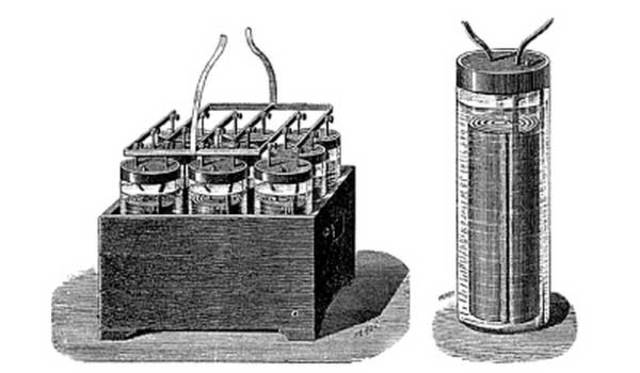
That is a rendering of Plante's battery. It is a rendering, not a photograph, because photography had barely been invented 160 years ago, when French physicist Gaston Plante invented the first viable rechargeable battery, using spiral wrapped lead pastes, as depicted in the rendering above. So Optima's "spiracell" shape is nothing new. It has been outdated for more than a century.
The fact is, spiral wraps are spatially inefficent in an automotive battery that conforms to the universally standardized sizes defined by the Battery Council International, better known as the BCI Group size. Ford trucks and vans use BCI Group 65, so let's take a look at Odyssey's comparison of how Optima's spirals work out within the rectangular cubes specified by the BCI...

Ok, not trying to pimp for Odyssey, but I'm not going to draw a diagram myself to illustrate the space efficiency argument that the professional illustration above so aptly makes.
The problem withJohnson Controls switching the Optima battery to recycled lead is that the impurities in recycled lead* make the lead grid plate weaker, and more apt to break apart when charging breaks apart sulfation crystals that adhere to the plate grid like barnacles. The plates are gridded to increase surface area for more electron transfer. That's also why, in a starting battery especially (like a Red to) the plates are made thinner, so that more plates can be stuffed into the same size cell, because the more plates, the more surface area, the more surface area, the more electron flow, the more electron flow, the more cold cranking amps. *Note: recent Optima marketing materials state that Optima is using 99.9% pure lead.
However, the thinner the plates, the less tolerant the plates are of deep discharge. Hence we have deep cycle batteries (like a Yellow top), which use thicker plates, that won't break apart as easily from sulfation that follows deeper discharges or longer durations between recharges... but that with less surface area, are less able to move a whole bunch of electrons immediately between the cathode and anode plates, and hence have less instantly available cranking power. Tim Hodgson made the right choice with Blue Tops, because, as a marine battery, they have been designed to strike a compromise between Red starting batteries and Yellow deep cycle batteries. The only reason that yellow deep cycle batteries were put in cars initially was to power booming stereo systems that young people play with. To the extent that yellow top batteries continue to be used in cars is likely due to the loss of fact and the formation of fiction that follows from a lack of understanding of the original purpose.
But sadly, with Optima batteries, it really doesn't matter what color they are, because due to the inefficiency of the cell form factor, anddue to the degradation of the substantive materials from which they are made*, the difference in electrical energy storage and delivery between any of the three Optima colors is minimal, such that it doesn't much matter which color you choose, there are far more effective batteries out there that deliver on the dual purpose needs of a camper van that must do everything a huge motor home does within the footprint of an automobile. I would argue that Tim chose the right Optima color (Blue), but perhaps not the optimal battery brand (sorry). *Note: recent Optima marketing materials state that Optima is using 99.9% pure lead.
Optima batteries are but a mere shadow of what they used to be back in the early 80's when their reputation was originally earned once they were introduced to the military and automotive after market.
But something happened along the way of this formerly Colorado based specialty battery company's journey to success.
They got bought.
By Johnson Controls.
Within a year, the Optima battery manufacturing was changed from formerly using pure lead to using
Within another year, a manufacturing plant was opened in Mexico, and about half the US workforce was let go. The other half openly complained (online even... check the WayBack) about cost cutting and quality degradation of a once celebrated product they used to take personal pride in.
Within another year or two or three, the US operation in Colorado was shut down completely, with all manufacturing now taking place in Mexico, with some components sourced from China.
You will find stories about Optima's fall from grace in every truck, RV, 4WD, racing, collector, military, and enthusiast forum that has existed over the last 20 years.
Optimas are not what they used to be... but they still are a heck of a lot better than flooded wet cell and silica gel cell batteries (for various reasons in Tim's application, not necessarily related to electrical performance)
One thing that attracts people to Optima batteries is there unique "Spiracell technology". Let's pause for a moment and put all that spiral cell "technology" into some historical perspective...
See this?
That is a rendering of Plante's battery. It is a rendering, not a photograph, because photography had barely been invented 160 years ago, when French physicist Gaston Plante invented the first viable rechargeable battery, using spiral wrapped lead pastes, as depicted in the rendering above. So Optima's "spiracell" shape is nothing new. It has been outdated for more than a century.
The fact is, spiral wraps are spatially inefficent in an automotive battery that conforms to the universally standardized sizes defined by the Battery Council International, better known as the BCI Group size. Ford trucks and vans use BCI Group 65, so let's take a look at Odyssey's comparison of how Optima's spirals work out within the rectangular cubes specified by the BCI...
Ok, not trying to pimp for Odyssey, but I'm not going to draw a diagram myself to illustrate the space efficiency argument that the professional illustration above so aptly makes.
The problem with
However, the thinner the plates, the less tolerant the plates are of deep discharge. Hence we have deep cycle batteries (like a Yellow top), which use thicker plates, that won't break apart as easily from sulfation that follows deeper discharges or longer durations between recharges... but that with less surface area, are less able to move a whole bunch of electrons immediately between the cathode and anode plates, and hence have less instantly available cranking power. Tim Hodgson made the right choice with Blue Tops, because, as a marine battery, they have been designed to strike a compromise between Red starting batteries and Yellow deep cycle batteries. The only reason that yellow deep cycle batteries were put in cars initially was to power booming stereo systems that young people play with. To the extent that yellow top batteries continue to be used in cars is likely due to the loss of fact and the formation of fiction that follows from a lack of understanding of the original purpose.
But sadly, with Optima batteries, it really doesn't matter what color they are, because due to the inefficiency of the cell form factor, and
Last edited by Y2KW57; Jun 1, 2019 at 09:31 AM. Reason: Note: recent Optima marketing materials state that Optima is using 99.9% pure lead.


Thread Starter
|
FTE Legend
Joined: Jan 2009
Posts: 80,542
Likes: 97
From: Norlina NC
i dunno about their downfall... ive had one in the mustang for the last 6 years after the factory battery wouldnt hold a charge from day to day when it got to being 9 years old... and the one in dads truck is a year older than mine and still going strong... My truck however went through 2 sets of motorcraft Max batts ntm the napa golds that were in the truck when i bought it.. dunno how old the golds were but they died and wouldnt take a charge after a year of my getting the truck... the first set of MCM's lasted a month before the 2 year warranty ran out so they got replaced under warranty... the second set got just outside the warranty..
Right now i have a set of Odyssey Extremes in my truck.. They just went in this year so will see how long they last..
Right now i have a set of Odyssey Extremes in my truck.. They just went in this year so will see how long they last..
Super Moderator
Joined: Dec 2011
Posts: 13,340
Likes: 6,123
Thread update: Recent Optima marketing materials state that Optima is using 99.9% pure lead. I've edited my post above to make this important notation. I do not know when the return to pure lead was made. I have very strong memories of former Optima employees stating that lower cost lead began being used during a period of time (about 12 -13 years ago), and those reports coincided with user reports of degradation in Optima performance. I do not know when Johnson Controls returned to using pure lead in Optimas, but since Optima currently advertises that they do, that should be considered in any decision on AGM batteries.

Thread
Thread Starter
Forum
Replies
Last Post